YEA Lesson Library
Two Goats
About This Lesson
This lesson teaches the importance of observing the Day of Atonement, complete with fasting, to acknowledge that Jesus paid the penalty for our sins.
Scriptures
Leviticus 16:21-22, 29-30
Leviticus 23:26-32
Leviticus 23:27-28
Psalm 103:10-12
Ecclesiastes 3:1
Romans 3:23-26
2 Corinthians 5:17-19
I John 2:1-2
I John 4:9-10
Words to Know
ATONEMENT - being reconciled to God through Christ
SCAPEGOAT - a person or animal made to bear the blame for another
The Lesson
What makes most of the Holy Days really neat is that you get out of school and you have some really good things to eat. Maybe your church has a potluck. You go through the line and pile your plate high. Or maybe your family goes to a nice restaurant, or you stay home and prepare a very special meal. The festivals of God are very special times. We all like to eat, and no one likes to go hungry. God wants you to feast six days out of the year. He wants you to cel- ebrate and have a great time!
Every Holy Day pictures something very special that you must celebrate. The Holy Days are God’s appointed times. They help us to understand Him better. They also help us to understand what He wants to do for us.
You’ve had a lesson where you learned about God rescuing the Israelites from Egyptian slavery. He brought them out of Egypt with a “high hand.” They came out so quickly that they didn’t even have time to let their bread rise. When they reached Mount Sinai, God called Moses up and gave him the most righteous Law ever known to man. The mountain quaked, there was thunder and lightning. This was an awesome event!
Then we learned that the Holy Days have a greater meaning than just being Jewish. We’ve learned that Christ is the center of every Holy Day. The trumpet is blown on the first day of the seventh month – the Feast of Trumpets. Christ will return at the sound of the seventh trumpet. He’s coming back to rescue us. If Christ doesn’t return, the earth will be completely destroyed. We’ve also learned that every- thing God does is good for us.
As much as we would like for life to be all fun and games – all feasting on special foods, it’s not always that way. In King Solomon’s great wisdom he said, “There is a time for everything, and a season for every activity under heaven” Ecclesiastes 3:1 (NIV). There is a time to eat and there is a time not to eat. The Day of Atonement is a day when God says that we should “afflict ourselves.” It is generally understood that we should not eat food or drink water on that day.
The children of Israel had completely lost God’s Law. They had never kept the Day of Atonement in Egypt. But now that they were free, God wanted them to know and follow His law because it was for their good. He said to Moses, “The tenth day of this seventh month is the Day of Atonement. Hold a sacred assembly and deny yourselves, and present an offering made to the LORD by fire. Do no work on that day, because it is the Day of Atonement, when atonement is made for you before the LORD your God. Anyone who does not deny himself on that day must be cut off from his people. I will destroy from among his people anyone who does any work on that day. This is to be a lasting ordinance for the generations to come, wherever you live. It is a sabbath of rest for you, and you must deny yourselves. From the evening of the ninth day of the month until the following evening you are to observe your sabbath” (Leviticus 23:26-32 NIV).
Is the Day of Atonement just for the Jews and not for Christians? Didn’t Christ make an atonement for us on Passover when He was crucified? Absolutely! Then why should Christians keep the Day of Atonement? What is different about the atonement made on this day and the Passover? Jesus Christ died to save us individually. Only you can repent of your sins and have the blood of Christ pay for them. The Day of Atonement is a communal forgiveness.
God required a ceremony to take place in the Temple on the Day of Atonement. It was like a play that was being acted out on a stage with two goats. Aaron, the High Priest, was required to make an
offering as an atonement for himself and his family. Then he had to slaughter a goat and take its blood behind the curtain in the Holy of Holies and make an atonement for the sins of the people. The one goat that represented Christ was killed.
After that, the High Priest laid his hands on the head of the second goat, the “scapegoat,” and confessed all the sins and wickedness of all the Israelites and put them on the goat’s head. . . “The goat will carry on itself all their sins to a solitary place; and the man shall release it in the desert” (Leviticus 16:21-22). Only Jesus can bear our sins and carry them away from us (John 1:29; 1 Peter 2:24; 2 Corinthians 5:21; Isaiah 53:4, 11-12) so that we can be reconciled to the Father.
Who is to keep the Day of Atonement and for how long is this law binding? “This is to be a lasting ordinance for you: on the tenth day of the seventh month you must deny your- selves and not do any work – whether native-born (an Israelite) or an alien living among you – because on this day atonement will be made for you to cleanse you.” (Leviticus 16:29-30 NIV).
God wants us to celebrate, but He also wants us to humble ourselves and repent of our sins because He wants to cleanse us. The Day of Atonement may seem like an eternity, but it only lasts for 24 hours. It’s worth keeping it because it will please God - the One to whom we owe so much!
Student Prayer
Almighty God,
You are so wonderful to provide a way that we can be forgiven of our sins individually and as a community. Thank you for the Day of Atonement. It’s not my favorite Holy Day, but help me to understand you better and love you more on this day.
It’s in Jesus’ name that I pray.
Amen.
Daily Devotions
Sunday - Leviticus 23:26-32
Monday - Ecclesiastes 3:1
Tuesday - Psalm 103:10-12
Wednesday - Romans 3:23-26
Thursday - I John 2:1-2
Friday - I John 4:9-10
Saturday - 2 Corinthians 5:17-19
Objectives
At the end of this lesson, students will be able to:
1. Explain how Passover differs from the Day of Atonement.
2. Discuss the reasons why we fast.
3. State that Christ is pictured in the first goat that was sacrificed.
4. Review the other festivals that have been covered so far in this book.
5. Repeat their memory verse
Topics & Themes
Day of Atonement
Fasting
Forgiveness
Goats
High Priest
Holy Days, Atonement
Humility
Repentance
Materials Needed
Bible, YEA Students’ and Teacher’s books, attendance and memory verse charts, songbook, two large stuffed animals – preferably goats, a curtain
How to Teach This Lesson
Before class, set up your room with chairs in a semicircle. Write out the Scriptures on separate pieces of paper. As the students enter the classroom, hand out one or more (depending on the size of the class) slips of paper with Scriptures on them.
Begin the class by asking: Which is your favorite Holy Day? Allow each student to tell which one they enjoy most and why. The Feast of Tabernacles will probably be the answer you get from virtually every student. We all learn from repetition. Do a review of all of the other festivals that have been covered so far by asking the following questions:
What one thing stands out in your mind about the first Passover Israel ever kept?
Why did the children of Israel eat unleavened bread when they left Egypt? Why do we eat it today?
What do you think was the most profound thing that happened when the children of Israel arrived at Mt. Sinai? Why? What three names does that Feast have?
How would you summarize what the Feast of Trumpets shows us What important lesson can you learn from it?
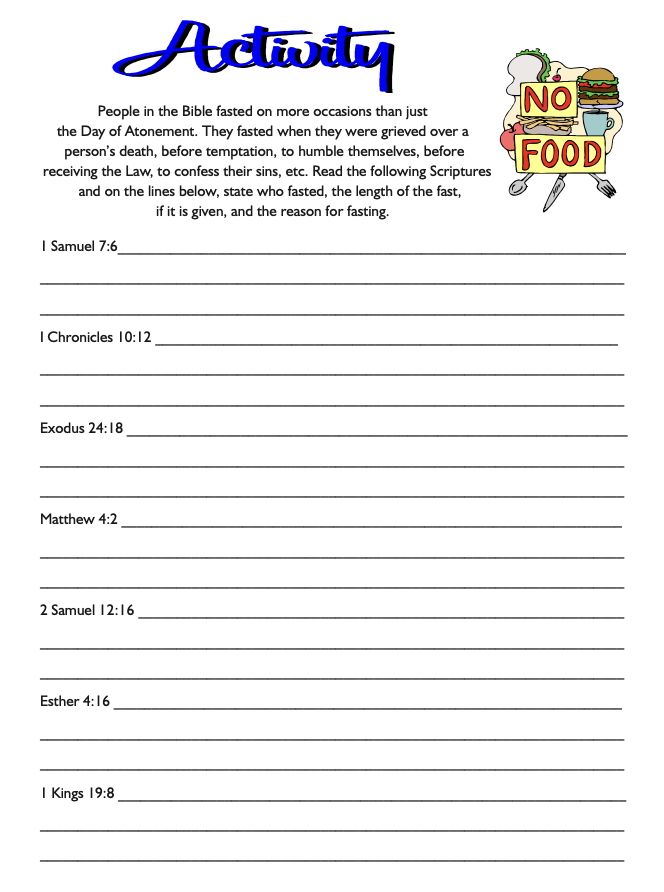
Why do we fast on the Day of Atonement? Because God said to, to humble ourselves and ask forgiveness of our sins. Now go around the room and have each student read their Scripture, tell who fasted, and explain why they fasted.
Teacher-Directed Activity
Have students plan the play that the High Priest acted out “on the stage” in the Temple. Give them six or eight minutes to brainstorm, read the biblical account and their lesson in the Students’ book. Have them put up the curtain for the Holy of Holies. Give them the two stuffed animals. Allow them to decide who acts out each part in the play. Debrief after the play is finished by asking the following questions:
• Who did the first goat represent? Christ.
• What does the second goat do? Carries away the all the sins of all of the people. Who does that?
• How is the Passover different from Atonement? The Passover is forgiveness for individual sins and Atonement is communal or national forgiveness.
• What benefit do we receive from the play that the High Priest acted out in the Temple? Ask one of the students to read Psalm 103:12. What does it mean to you to know that your sins are removed as far as the east is from the west?
REACH Activity
Memory Verse Spotlight
Look up the word “deny” in Leviticus 23:27. Write down the Hebrew word and its meaning. Although this word doesn’t specifically mean “to fast,” fasting is an effective way to humble yourself before God. Fasting is used in the Old Testament to humble oneself before God. Find three other Scriptures where this word is used. Write what you have found in your Bible notebook.
Where in the World?
Do you know what the tabernacle layout was? Where was the lampstand and table of showbread? Where was the altar of incense and the ark of the covenant? Using a Bible resource, find a depiction of the tabernacle. Photocopy it and add it to your Bible notebook. Add a note about how often the high priest could enter the Holy of Holies.
They Did What Back Then?
Leviticus 16 details the ceremony on the Day of Atonement. Read the whole chapter carefully. Write down the significant steps and what they were for in your Bible notebook.
Making It Mine
Have you ever had such a big fight with a friend that you were no longer on speaking terms? Were you ever able to resolve the disagreement? If yes, how did that happen? If no, do you wish you could be reconciled to your friend?
Our sin separates us from God. It is only through the blood of Jesus Christ (His sacrifice, His crucifixion and death) that we can be reconciled to God the Father. We have access to God and are able to come before Him with our prayers and requests because of what Jesus has done. So when God commands we afflict our souls for 24 hours, we fast in obedience, love, and gratitude for what He has done for us.
Fasting is not easy or fun. But there is a purpose - for our good. Write your thoughts about this topic in your Bible notebook.
Worldview Collisions
Secular worldviews say that good is good enough. A Biblical worldview says that our goal is perfection. However, perfection is not attainable through our human efforts; it depends on the working of the Holy Spirit in our lives to change us and form us into the image of Christ. This requires submission of our will to the will of the Father in all things. The Day of Atonement is one holy day that God uses to help humble us so He can shape us. Molding and shaping, pushing and pulling, growing and stretching can be uncomfortable and downright painful at times. But God has our best interest at heart. Write your thoughts about this in your Bible notebook. Be sure to include at least three scriptures which support the Biblical worldview.
Questions
As you’re working through the YEA lesson, Daily Devotionals, doing the activity, or reading the Bible, be sure to write down any questions you have. That way you’ll remember to ask someone. Also remember to share the really interesting things you’re learning with family and friends.
Song
“I Will Sing Unto the Lord” is on page 54 of The Group Songbook.
Closing Prayer
Have the students form a circle and hold hands. Ask for a volunteer to lead in prayer thanking God that he has provided a way that we can individually and collectively be forgiven of our sins.
Printable Pages