YEA Lesson Library
What Is It?
About This Lesson
This lesson answers the question -“What is the meaning of life?” - using God’s provision of manna and His admonition to remember God’s blessings in spite of trouble and/or peer pressure to grumble.
Scriptures
Exodus 16:32-36
Numbers 11:4-9
Deuteronomy 4:9
Deuteronomy 8:1-5
Deuteronomy 8:3
Joshua 5:10-12
Psalm 78:1-25
Hebrews 9:4
Words to Know
MANNA - what is it?
The Lesson
Mr. Allen assigned his high school freshman class five paragraphs to write on the meaning of life. "What does Mr. Allen expect?" Staci wondered. She was absolutely clueless as she sat with pencil in hand and a blank paper before her.
Staci stretched her arms above her head and looked around her room. “My room is so me,” she thought. CDs and pictures of her European trip littered her floor. The posters on her wall told stories of so many good times and places she had been. Then her eyes focused on a photograph of her as a cheerleader. She froze for a minute.
Memories now rolled through her mind and flooded her brain. The pencil began to move across the paper. Staci remembered the long, loud bus rides; water fights, trips to fast food eateries after the races, the stinging words of many arguments; the tinkling giggles of laughter gone by. As her pencil lead scraped the blank white paper, she began to realize that the meaning of her life was in these memories.
Doubtless, the Israelites didn’t consider it to be a picnic making their way through the dusty dry desert. But they were making memories every day. They were learning more and more about the meaning of life with every trial and experience.
When the disobedient people went out on the Sabbath to gather manna, God said to Moses, “How long are you going to disobey my commands and not follow my instructions? Don't you see that GOD has given you the Sabbath? On the sixth day he gives you bread for two days. So, each of you, stay home. Don't leave home on the seventh day.
"So the people quit working on the seventh day.
“The Israelites named it manna (what is it)? It looked like coriander seed, whitish. And it tasted like a cracker with honey" (The Message).
God wanted the Israelites to always remember that He gave them manna. So he commanded them to keep two jars of it, an omer, which was about two quarts. Now God would see to it that this manna would not breed maggots and stink. God wanted it kept for future generations to see the bread with which He fed the Israelites in the wilderness after He brought them out of Egypt.
Moses instructed Aaron to fill the jar with an omer of manna and place it before God, keeping it safe for future generations. Aaron did exactly as Moses instructed.
The Israelites ate manna for 40 years until they arrived at the border into Canaan, the Promised Land.
As you can see, manna was a very important part of the lives of those finding their way through the desert without any other food. But they wouldn't have had this if God had not supplied it. This was certainly something the Israelites and future generations should remember.
But did the Israelites really appreciate God giving them manna? How long did this appreciation last?
"But the Egyptians who had come with them began to long for the good things of Egypt. This added to the discontent of the people of Israel and they wept, 'Oh, for a few bites of meat! Oh, that we had some of the delicious fish we enjoyed so much in Egypt, and the wonderful cucumbers and melons, leeks, onions, and garlic! But now our strength is gone, and day after day we have to face this manna!'
"The manna was about the size of coriander seed, and looked like droplets of gum from the bark of a tree. The people gathered it from the ground and crushed it into flour or pounded it in mortars, boiled it, and then made pancakes from it - they tasted like pancakes fried in vegetable oil. The manna fell with the dew during the night" (Numbers 11: 4-9).
God thinks bigger than we do. Even though the Israelites and the Egyptians who left Egypt with them grew weary of manna, it was a miracle from Him and He wanted them to remember it.
So God instructed them to keep the omer of manna in a sacred place from generation to generation. When the first Tabernacle and Ark of the Covenant were built, this manna was kept in it. When Solomon built the Temple, manna was kept in a gold urn in the Ark of the Covenant, along with Aaron's rod that budded, and the Ten Commandments tablets (Hebrews 9:4).
Why was this so important to God? God wanted the Israelites to remember every road that God led them down for 40 years. He wanted them to remember that He pushed them to their limits and tested them. But what lessons did He want them to learn from going hungry? Your memory verse has the answer, "That he might make you know that man doth not live by bread only, but by every word that proceedeth out of the mouth of the LORD doth man live" (Deuteronomy 8:3b). Think about it, the meaning of our life is in that bread kept in a gold urn in the Ark of the Covenant.
Student Prayer
Great God and Father,
Thank you for miraculously feeding the children of Israel with manna from heaven. Help me understand that our faith is strengthened by knowing that you love us and care for us. May I ever be grateful to you and never doubt your love.
In Jesus' name I pray.
Amen.
Daily Devotions
Sunday - Exodus 16:32-36
Monday - Numbers 11:4-9
Tuesday - Deuteronomy 8:1-5
Wednesday - Psalm 78:1-8
Thursday - Joshua 5:10-12
Friday - Deuteronomy 4:9
Saturday - Psalm 78:9-25
Objectives
At the end of this lesson, students will be able to:
1. Tell the story of this section of the Bible.
2. Tell what influence the Egyptians' complaining had on the Israelites and how it relates to peer pressure.
3. Realize the importance of daily Bible study.
4. Explain that God gave the Israelites instructions to gather twice as much manna on the sixth day and none on the Sabbath to show which day the Sabbath is.
Topics & Themes
Bible Study
Bread of Life
God’s Provision
Gratitude
Grumbling
Manna
Peer Pressure
Remember
Sabbath
Materials Needed
Bible, YEA Students’ and Teacher's books, attendance and memory verse charts, songbook, butcher paper, markers, prize, map of the exodus
How to Teach This Lesson
Greet the students warmly calling each one by name as you look them in the eyes. Open the class with prayer. Explain that students will again teach this lesson by drawing out the scenes in it. Encourage students to be creative and draw the details. Appoint a leader and give each leader approximately the same number of students to help with their drawing. Let each leader select one of the papers you prepared before class. Tell them the team that gets the most votes for being the best will get the prize. Give the students a marker and tell them they will have about 25 to 30 minutes to draw the scene that is on the paper that their leader picks. When time is up, have the students return to their seats in a semicircle. Vote on the best drawing and give the prize.
Debrief - Ask: How did you feel about what you learned from drawing this mural today? How did you feel about the actions of the people in this drawing? What do you think they should have done that they didn't do? Why? What do you think they shouldn't have done that they did? Why?
Peer Pressure - How did you feel about the Egyptians, who came out of Egypt with the Israelites, complaining about not having meat, cucumbers, melons, leeks, and garlic? After the Egyptians started their pity party, do you remember what the Israelites did? How would you compare this with what happens to teens when their peers began to complain about the status quo? (The Egyptians had the same influence on the Israelites that our peers have on us today. The Israelites yielded to pressure). How much has human nature changed over the years? What should the Israelites have done when the Egyptians started complaining? How could they have been examples to the Gentiles among them? How can you be an example to the "Gentiles" among you each day?
The Purpose of Manna - Why did God give the Israelites manna? What scripture can you think of that tells you that? (Their memory verse - have the class recite it.) What lesson do you see in God not giving them a 40-year supply all at once, but giving it daily? How would you compare this with daily Bible study? Why is it important that you read your Daily Devotionals every day? Ask a student to read Genesis 41:51 from an Oxford wide-margin Bible. Notice in the margin that Manasseh means "forgetting." Ask: If you should happen to be a descendent of Manasseh, do you think you might have inherited some forgetfulness? Ask a student to read Deuteronomy 4:9 and another to read Deuteronomy 6:12. With these warnings, how important do you think it is that we study our Bibles every day just like God gave the Israelites manna every day? What are you going to do about it?
Teacher-Directed Activity
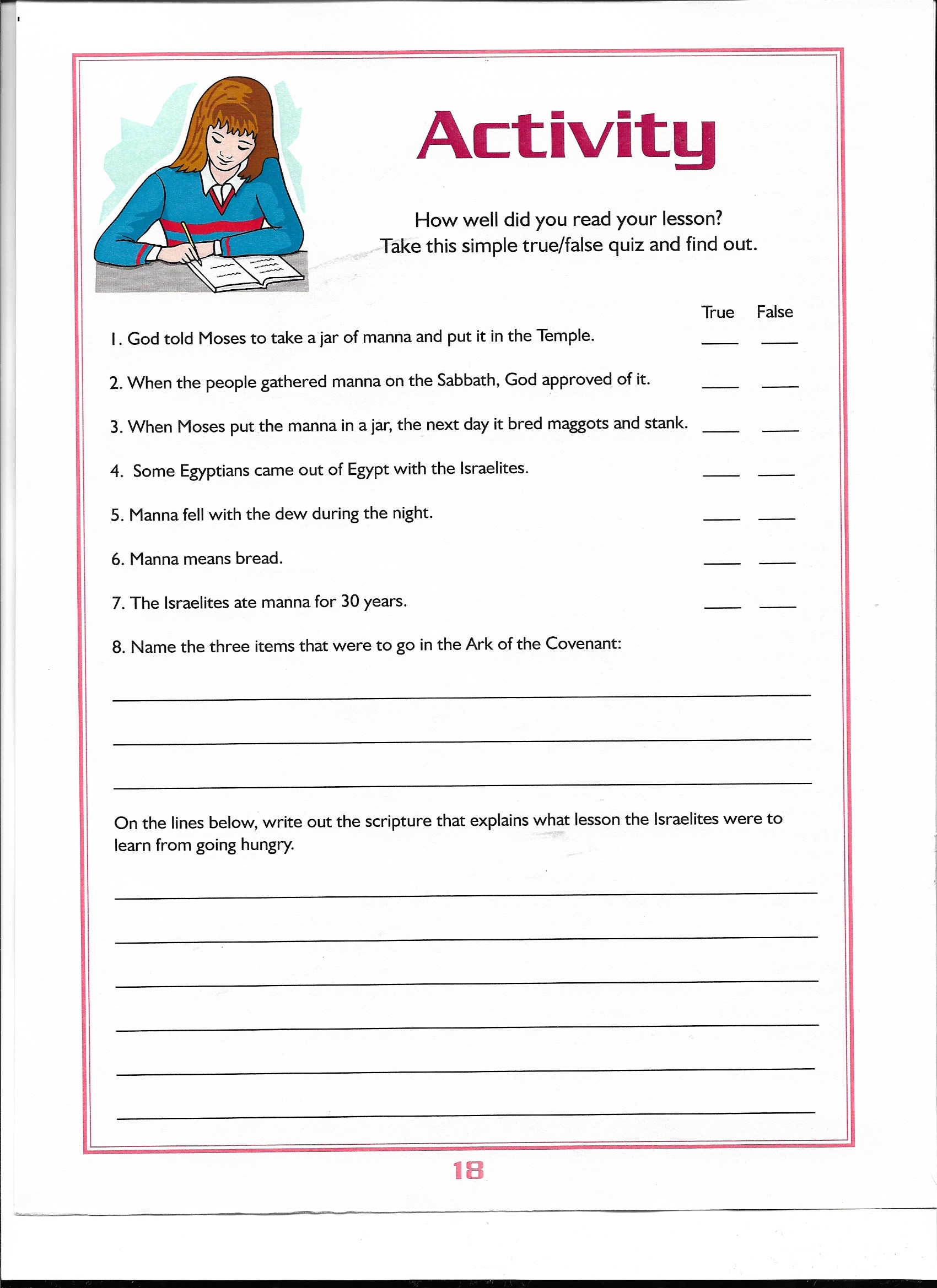
Go over the Activity in the Students' book with the class.
REACH Activity
Memory Verse Spotlight: Deuteronomy 8:3
Look up the word “proceedeth.” Write down the Hebrew word and its meaning. Then find three other Scriptures where this word is used.
Do you find it amazing that God spoke the world into existence? He spoke and everything was! But when he was working with mankind, God did not force people to obey Him. God will draw them, but people still have to embrace what God is telling them and make it part of who they are.
Where in the World? Hebrews 9:4
According to Hebrews 9:4, what was in the Ark of the Covenant? Using a Bible reference, draw a diagram of the Temple (or Tabernacle). What was where in the Tabernacle? How big was the Most Holy Place in comparison to the rest of the Tabernacle? Where was the lampstand, the table for showbread, the altar of incense? Make any notes that you find interesting for each of these furnishings. Place all of your research in your Bible notebook.
They Did What Back Then? Diet in Egypt
Using the Bible and any other historical reference resources, find out what kind of diet the people would have had in Egypt. What do the people of Egypt eat today? How is it the same? How is it different? Be sure to make notes of what you find, along with reference citations. Put this all in your Bible notebook.
Making It Mine: Scroll of Remembrance
How do you remember things? Sometimes you have a celebration on the anniversary of an event; think birthday, anniversary, D-Day, Passover, etc. Sometimes you write a song like “The Wreck of the Edmund Fitzgerald” or the song Moses and the people sang to God (Exodus 15:1-18). Sometimes you write down what you want to remember (Malachi 3:16). What is written in this book of remembrance? Where is the book? Who are the people involved? What did they do? And what will happen to them?
Do you have a scroll of remembrance? If you did, what would you write in it? Where would you keep it? I have a book of remembrance. I write down the times when God answered a prayer, provided protection, or resolved a difficult situation. Sometimes you think you will never forget the things that God has done for you. But time has a way of making the details less sharp. Make it a habit to write down what you want to remember so you can go back and refresh your memory.
Worldview Collisions: Change
“The only constant in life is change.” - Heraclitus
Heraclitus was an ancient Greek philosopher who lived in Ephesus around 500 BC when it was part of the Persian Empire. This would have been around the timing of the book of Esther. This idea has been around, therefore, for a very long time.
Most Christians would agree with this philosophy with one exception: God does not change. Hebrews 13:8 says that Jesus Christ is the same yesterday and today and forever. Because God’s law are an expression of the character of God, God’s laws also do not change. Someone might ask you, then, if you sacrifice animals. Your answer is no. The animal sacrificial system pointed to the sacrifice of Jesus Christ on our behalf, and since Jesus is worth more than all of Creation, his sacrifice once is more than enough to satisfy the debt required by the law when sin has been committed.
If this is confusing, talk about it with your parents. Talk about the laws of God. Are any of them “done away.” Think about this and write your thoughts in your Bible notebook.
Questions
As you’re working through the YEA lesson, Daily Devotionals, doing the activity, or reading the Bible, be sure to write down any questions you have. That way you’ll remember to ask someone. Also remember to share the really interesting things you’re learning with family and friends.
Song
Thy Word" is on page 30 of The Group Songbook.
Closing Prayer
Ask the students to form a circle and join hands. Start with yourself and give one reason why it's important that you study your Bible daily. Then have a volunteer lead in prayer thanking God for His Word that is a lamp unto our paths each day.
Printable Pages