YEA Lesson Library
How You Handle It
About This Lesson
Using the Israelites’ response to troubles and difficulties as an example of what not to do, this lesson teaches the student to trust and obey God when things are going well and when there are difficulties.
Scriptures
Exodus 16:1-31
Isaiah 55:6-9
Isaiah 55:9
Matthew 12:9-12
John 6:31-49
Philippians 2:3-6
Hebrews 9:4
Words to Know
MANNA - What is it?
PREDATOR - one that preys, destroys, or devours
The Lesson
“It all happened so fast, Dad hardly had time to think. He looked down and there was a little brown cottontail - utterly spent - crowded up against his boots. The little thing was trembling all over, but it just sat there and didn’t budge.
“Now this was really strange. Wild rabbits are frightened of people, and it’s not that often you’d ever actually see one - let alone have one come and sit at your feet.
“While Dad was puzzling over this, another player entered the scene. Down the road - maybe twenty yards away - a weasel burst out of the brush. When it saw my dad - and its intended prey sitting at his feet - the predator froze in its tracks, its mouth panting, its eyes glowing red.
"It was then that Dad understood he had stepped into a little life-and-death drama of the forest. The cottontail, exhausted by the chase, was only moments from death. Dad was its last hope of refuge. Forgetting its natural fear and caution, the little animal instinctively crowded up against him for protection from the sharp teeth of its relentless enemy" (Stories For The Heart).
Trials and disappointments come in all shapes and sizes. For this cottontail, it was a weasel seeking to have him for dinner. But trials for us humans can be our parents divorcing, a broken friendship, an unfulfilled romance, an untimely death, a failing grade, not getting a cell phone with all the bells and whistles, or not getting to go to summer camp. Everyone experiences disappointments and trials. The Israelites did as well. But as painful as the trial may be, the most important thing is How You Handle It.
The Israelites continued their journey towards the Promised Land. They left Elim and went on into the Sin wilderness. This is between Elim and Mt. Sinai. They arrived there on the 15th day of the second month.
The Israelites were not happy campers. They were hungry and thirsty, because there was no food or water. So they began griping, grumbling, and complaining about Moses and Aaron. “Why didn’t GOD let us die in the comfort in Egypt where we had lamb stew and all the bread we could eat? You've brought us out into the wilderness to starve us to death, the whole company of Israel!" Wow! Do you realize what you just read? When the Israelites faced a trial, they didn't look to God for help as the cottontail sought protection from his predator. They accused God!
About one million people - all of the Israelites - turned on Moses and Aaron and began accusing them and God of trying to kill them with starvation. What a pity party of moaners and complainers! Think about it. It had just been exactly one month since God miraculously delivered these ungrateful gripers from hard and brutal slavery. They had seen how God had specifically saved them with miracle after miracle. A little physical discomfort came and they completely forgot all the things God had done for them - after only one month had passed.
Think about all they had seen. Why didn't they trust God to see them to the Promised Land? Why didn't they get on their knees and humbly ask God to provide them with daily bread? Why didn't they have faith in God to do this? Why didn't they have the vision to see that God had focused His full attention on them and had mercifully freed them from slavery? They were His chosen people and He wasn't about to give up on them that easily. Philippians 1:6 reassures us that God doesn't start something and not finish it. "Being confident of this very thing, that he which hath begun a good work in you will perform it until the day of Jesus Christ.”
The Israelites didn't put their trust in God as the cottontail did with Dad to gain protection. They made the mistake of looking at God as having the same weaknesses that man has. But God is so much more awesome. Isaiah 55:9 says "For as the heavens are higher than the earth, So are My ways higher than your ways, And My thoughts than your thoughts."
The Israelites had forgotten God's love for them and all the miracles He had done to free them. However, God mercifully heard their complaints and miraculously fed them. But with this food would come a test. This test was to "prove them, whether they will walk in my law, or not" (Exodus 16:4).
God told Moses and Aaron to meet with the Israelites and explain that "This evening you will realize that it was the Lord who brought you out of Egypt. In the morning you will see more of his glory, for he has heard your complaints against him." In the evening God would cast vast numbers of quail to cover the camp. In the morning He sent tiny flakes of something as small as hoarfrost on the ground - manna. Moses told them this was food God has given them to eat. He explained that every day they were to gather enough for their family, but not any more. If they did it would become maggot infested and stink. But there was one exception to this. On Friday, they were to gather twice as much and prepare it, because there wouldn't be any manna or quail on the Sabbath. The Sabbath would be a day of rest.
"But some of the people went out anyway to gather food, even though it was the Sabbath, but there wasn't any" (Exodus 16:27 TLB). Think about it. Time and again God took care of the children of Israel. He gave them this test to see if they would keep His Sabbath or not. And some failed the test. Are you going to believe and obey God's instructions, or will you fail the test?
Student Prayer
Great God who delivered Israel,
Thank you for loving them so much that you miraculously provided for them time and again. No one gets through this life without trials and disappointments. Help me to remember this story and look to you to take care of me rather than griping and complaining and disobeying you.
In Jesus' name I pray.
Amen.
Daily Devotions
Sunday - Isaiah 55:6-9
Monday - Philippians 1:2-6
Tuesday - Exodus 16:4-5
Wednesday- Exodus 16:23-27
Thursday - Matthew 12:9-12
Friday - Hebrews 9:4
Saturday - John 6:31-49
Objectives
At the end of this lesson, students will be able to:
1. Tell the story in Exodus 16.
2. Explain that the Sabbath day is not just one day in seven, but the seventh day.
3. Discuss ways that they can prepare for the Sabbath.
4. Explain that they should go to God first when they have trials or problems.
Topics & Themes
Adversity
Faith
Grumbling
Manna
Miracles
Obedience
Sabbath
Trouble
Trusting God
Materials Needed
Bible, YEA Students' and Teacher's books, attendance and memory verse charts, songbook, map of the Exodus, butcher's paper, markers, prize
How to Teach This Lesson
Greet the students warmly as they arrive. Open the class with prayer. Appoint five leaders for the breakout groups to pick the lesson assignment. Have the leader select one of the five pieces of paper you made up before class. Divide the class into five
groups and tell them who their leader will be. If the class is small, have the leaders pick more than one piece of paper. You may want to help with drawing the lesson if your class is very small.
Explain that the group is to go to their section of the butcher paper and draw what is on their paper. They should use their Bibles and YEA books. Be as detailed as possible. They will have 25 to 30 minutes to complete their drawings. When time is up, bring students back to sit in a semicircle. Vote on the best drawing and give the prize.
Debrief - How did you feel about drawing your section of the lesson? How will this help you to learn and remember this portion of the Bible? What did you find most difficult about drawing your section? What lessons did you learn from drawing the story of Israel wandering in the wilderness?
Israelites complain - How did you feel about the Israelites complaining that they were brought into the wilderness to starve to death? Who do you think they were really blaming? Ask a student to read Exodus 16:7. How do you feel about the Israelites blaming God? What are some reasons they blamed God that you think were really small of them? What do you think was the first thing they should have done when they were caught without food and water? (They should have humbly gone to God and asked Him in prayer.) What did the cottontail do when he needed protection? Did God give us as much brain as He gave the rabbit? Where will you go when you are being tried, tested, or in trouble? Will God be the first place you go?
God feeds Israel - How do you feel about God feeding the Israelites even after they accused Him of taking them out into the wilderness to starve to death? (He is a very merciful and forgiving God.) What lessons does this teach us about the Sabbath? (1. God showed the Sabbath wasn't just one day in seven by having the Israelites gather twice as much manna on the sixth day and not sending any on the seventh. 2. It teaches the principle of preparing for the Sabbath so we can rest and spend time with God on that day.) What things can you do on Friday that will give you more time on the Sabbath to rest and spend with God?
Application - What things should the Israelites have remembered that would have helped them to know that God would take care of them? How will this lesson improve your faith and trust in God? How will you handle it the next time you are tried or tested?
Background - If you have a very good reader, ask him/her to read the first five paragraphs under Background. If not, read it yourself. If time permits, discuss it. Specifically, ask the students if they agree with the author’s idea that you have to be uncomfortable before you will change.
Teacher-Directed Activity
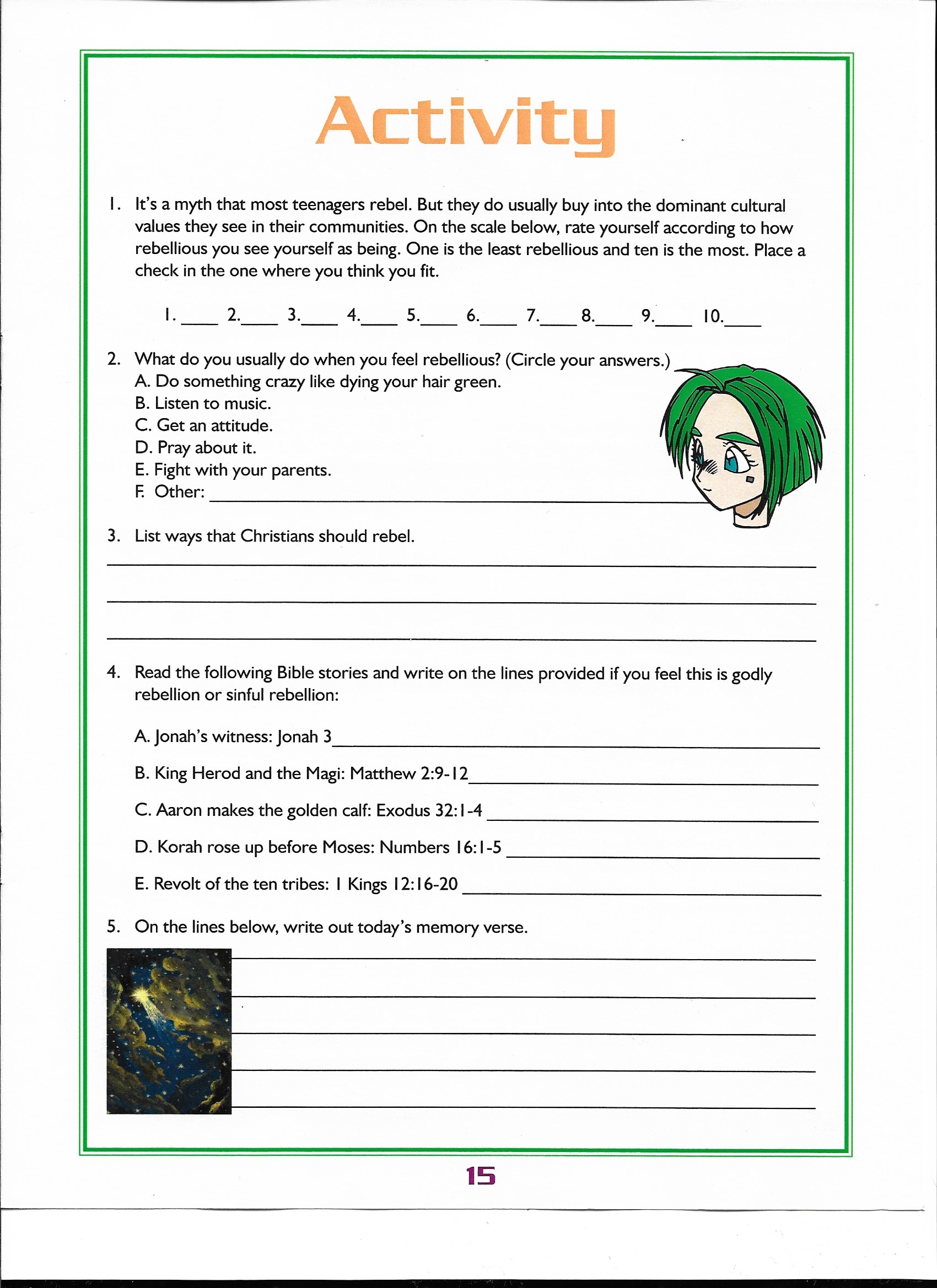
Go over the Activity in the Students' Book with the class.
REACH Activity
Memory Verse Spotlight: Isaiah 55:9
Look up the word “higher.” Write down the Hebrew word and its meaning. Then find three other Scriptures where this word is used.
As you look up Hebrew words, you will discover that the meaning can vary depending on the context. Why is that? Hebrew has relatively few words, compared to other languages. So the same word can have multiple shades of meaning. It’s important to thoroughly understand the context so that you will understand the word.
Where in the World? Gathering Manna
Using the Bible, find a description of manna and where it would be found every day. How did they prepare it to eat? What did it taste like? What happened if you tried to save any of it over until the next day (except on Friday)? In your Bible notebook, write a cookbook entry for manna. Provide preparation, cooking, and storage instructions.
They Did What Back Then? Manna
Your lesson says that with the manna came a test (Exodus 16:4), to show whether they would obey God or not. Have you wondered why the Sabbath is called the test commandment? Here it is. They were to gather manna every day except the Sabbath. They would gather twice as much on Friday and rest on the Sabbath. Were they obedient? God was providing the food. He told them the instructions. Why would you mess with that?! Read all of Exodus 16.
Write about this in your Bible notebook.
Making It Mine: Rebellious
Using the activity from your lesson, expand on the third point: how should a Christian rebel? Why should they rebel? Who are Christians rebelling against? Come up with five instances, at least. Then write a paragraph to explain the need to rebel, if you are truly a Christian. File this in your Bible notebook.
Worldview Collisions: Rebellious
A secular worldview says that all teenagers go through a rebellious phase because they are learning to become independent and are distancing themselves from their parents in preparation to becoming adults.
A Biblical worldview says that you should always honor your father and your mother. Read this passage in Deuteronomy 21:18-21. Does this sound like we’re talking about a small child or even a teenager? A glutton and a drunkard? So let’s take this apart: If you have parents who are God-fearing and try to live a God-honoring life, you don’t want to rebel against them. That could be considered rebelling against God. But if your parents are not living in a way that honors God, you are still required by God to honor them. They are still your parents. However, you answer to God first. You have to follow God’s ways first, even if that means rebelling against your parents.
Here’s an example: When my mom first came to believe in keeping the Sabbath and the holy days, she could hardly wait to share what she had learned with her parents. My grandparents were not happy. They had always had a big family celebration on Christmas and now Mom was telling them that we wouldn’t be part of that anymore. Mom was rebelling against her parents - because she was following God. Nevertheless, Mom was still respectful and honored her parents even while she was adamant she wasn’t going to worship God the way they did.
Write about this in your Bible notebook.
Questions
As you’re working through the YEA lesson, Daily Devotionals, doing the activity, or reading the Bible, be sure to write down any questions you have. That way you’ll remember to ask someone. Also remember to share the really interesting things you’re learning with family and friends.
Song
"On Eagles' Wings" is on page 68 of The Group Songbook.
Closing Prayer
Ask the students to form a circle and join hands. Go around the circle and have each student give one reason (perhaps a miracle) that gave the Israelites a reason why they should have trusted God and not blamed and accused Him. Ask for a volunteer to lead in prayer asking God to help us to always go to Him first with our problems, rather than blaming Him.
Printable Pages