YEA Lesson Library
The Chase Was On!
About This Lesson
Using the story of God’s protection of the Israelites when Pharaoh chased them out of Egypt, the student is taught to ask God for help, to believe in Him, and to trust Him.
Scriptures
Exodus 13:17-20
Exodus 14:1-18
Joshua 24:31-33
Isaiah 45:15-17
Isaiah 55:8-9
Romans 8:33-36
Words to Know
ABSCONDED - to steal off and secrete oneself
FUGITIVE - itinerant o r vagabond
CARAVAN - a company of travelers on a journey through a desert or hostile regions
INFINITE - without limits of any kind
OMNIPOTENCE - Unlimited in power, ability, or authority
The Lesson
Has your team ever lost a sporting event when you really expected to win? What was it like when the team loaded on the bus? Was everyone depressed? Was going home almost as sad as a funeral? Think about what it must have been like in Pharaoh’s palace after he was so badly defeated in the fight to hang on to the Israelites.
Pharaoh's slave workforce was gone. His nation had been ravaged with plagues. But even worse, he'd lost his firstborn son, the heir apparent to the throne. He lost big time! His tenacious stubbornness and defiance of the Living God didn't work. He was a loser.
At last, the Israelites were free. They were on their way to the Promised Land in military formation. Moses took the bones of Joseph with him, fulfilling a promise the Israelites had made to Joseph. Later they would bury them in Shechem (Joshua 24:32).
God led the Israelites with a pillar of cloud during the day, and a pillar of fire gave them light at night. This allowed them to travel day or night.
God told Moses to tell the people to turn toward Pihahiroth, between Migdol and the sea, and to camp there. "For Pharaoh will think, 'Those Israelites are trapped now, between the desert and the sea!' And once again I will harden Pharaoh's heart and he will chase after you. I have planned this to gain great honor and glory over Pharaoh and all his armies, and the Egyptians shall know that I am the Lord."
Think about it. There were no cell phones. No, there weren't any line phones either. There were no newspapers or television sets or radios. Yet somehow, the word reached Pharaoh that the Israelites were not planning to return to Egypt after three days, but they would keep on going. Well, maybe some Israelite let the cat out of the bag before leaving Egypt, and it took awhile before anyone was willing to tell Pharaoh.
But when he learned this news, to say the least, he wasn't a happy camper. His anger must have surpassed his mourning for his son who had died the night the Destroyer passed over. Pharaoh became his usual bold and arrogant self, asking, "What is this we have done, letting al these slaves get away?"
Pharaoh picked 600 chariots from his corps and instructed his officers to get aboard them. Come what may, he was determined to chase down those Israelites. The Israelites had absconded with most of the nation's wealth.These people were his workforce. They made his economy work. Now that they were gone, who would do all of the hard labor? So, The Chase Was On!
Pharaoh was determined. His entire cavalry - horses, 600 chariots in all, and charioteers were in this chase. You can almost hear the "William Tell Overture" as Pharaoh's cavalry raced towards God's people camped beside the shore near Pihahiroth, across from Baalzephon. Doubtless, the noise preceded them.
Then Israel saw Pharaoh's army far in the distance racing after them, and they didn't like what they saw. They cried out to God to help them. But that wasn't all. They turned against Moses and started whining, "Have you brought us out here to die in the desert because there were not enough graves for us in Egypt? Isn't this what we told you, while we were slaves, to leave us alone? We said it would be better to be slaves to the Egyptians than dead in the wilderness."
How do you think Moses must have felt? He never wanted this job. Yet he rose to the occasion and repeatedly went to Pharaoh and asked for the freedom of his people. But even more, how do you think God felt? He saw how hard their lives were in Egyptian slavery. He called Moses from the burning bush to free them. Time and again, God sent Moses and Aaron to Pharaoh. He backed up His message with ten awesome plagues - all for
this whining people.
Moses, being the leader that he was, reassured the people and told them not to be afraid. "Just stand where you are and watch, and you will see the wonderful way the Lord will rescue you today. The Egyptians you are looking at - you will never see them again. The Lord will fight for you, and you won't need to lift a finger!" Do you think some of the Israelites may have worked for some of the Egyptians they saw that day?
God left nothing to chance. "The Angel of God, who was leading the people of Israel, moved the cloud around behind them, and it stood between the people of Israel and the Egyptians. And that night, as it changed to a pillar of fire, it gave darkness to the Egyptians but light to the people of Israel! So the Egyptians couldn't find the Israelites!" How slick!
How often do you underestimate what God can do for you? Do you have trouble trusting God and believing His promises? Think deeply about what you are reading. Remember the mighty miracles God performed for the Israelites when you have doubts. He's just as powerful today and can work miracles for you as well. But you must believe him.
Student Prayer
Great God who freed the Israelites,
Thank you for this story. Help me to always remember it when I need your help or lack faith in you.
In Jesus' name I pray.
Amen.
Daily Devotions
Sunday - Romans 8:33-36
Monday- Isaiah 45:15-17
Tuesday - Joshua 24:31-33
Wednesday - Exodus 13:17-20
Thursday - Exodus 14:1-4
Friday- Exodus 14:5-9
Saturday - Exodus 14:10-18
Objectives
At the end of this lesson, students will be able to:
1. Tell the story of this portion of the Bible.
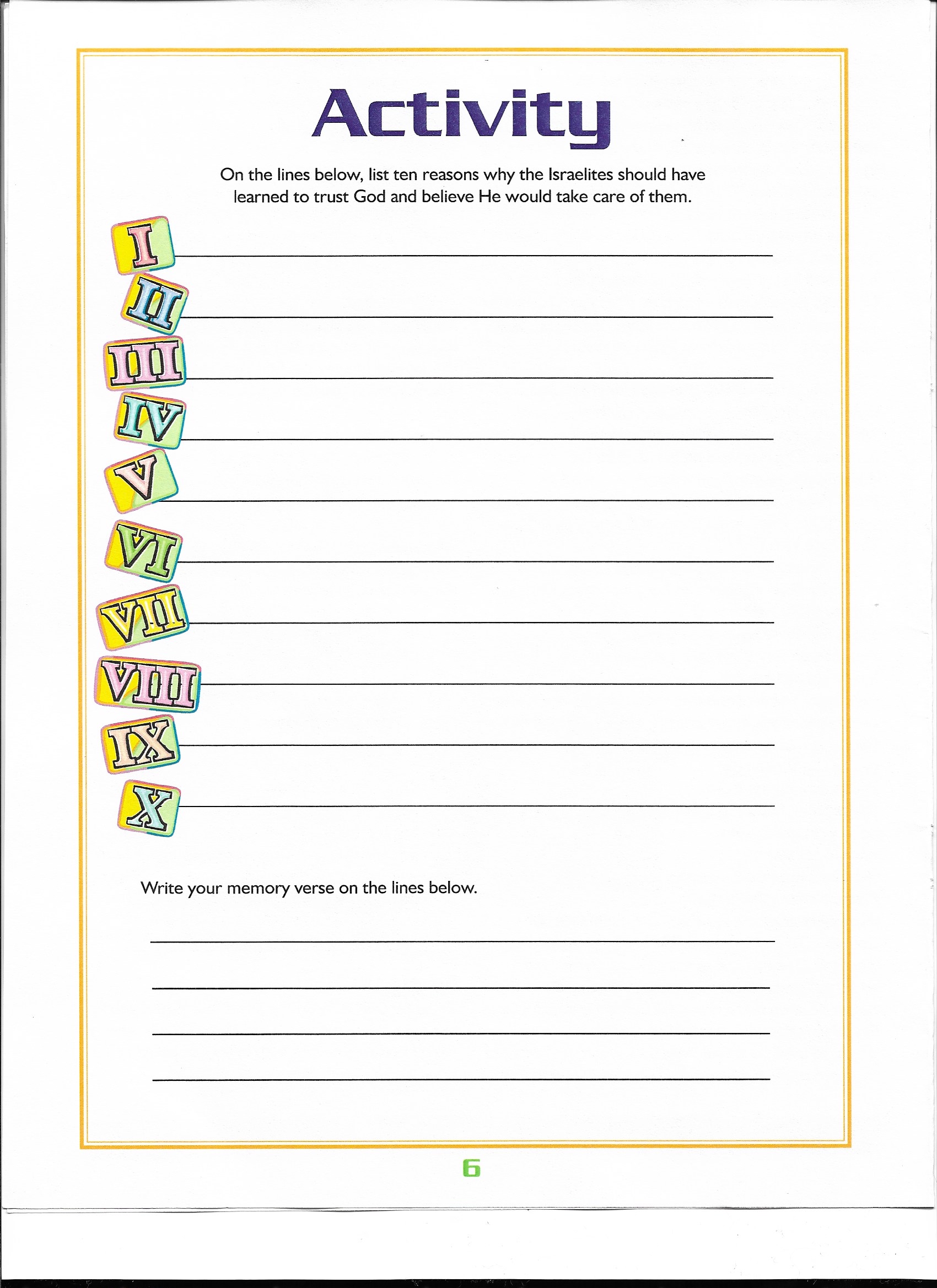
2. Outline reasons the Israelites had for trusting God.
Topics & Themes
Chariots
Egypt, Coming Out
Faith
God’s Omnipotence
Grumbling
Miracles
Pharaoh
Pillar of Fire/Cloud
Prayer
Red Sea
Trusting God
Materials Needed
Bible, YEA Students' and Teacher's Books, attendance and memory verse charts, songbook, butcher's paper, marker pens, map of Egypt and the exodus route, prize
How to Teach This Lesson
After opening the class with prayer, explain to the class that they will be doing a mural of today's lesson. Students can group themselves as they would like and select a frame of today's lesson to draw. Using their YEA books and Bibles, add as many details as time and space permit. Try to make the story as real and complete as possible. A vote will be taken and a prize given for the best mural. Give the students about 25 to 30 minutes to complete their murals. When time is up, call them back to sit in the seats in a semicircle. Take a vote on the best mural and give the prize to the winner.
Debrief - How did you feel about this activity as a means to help you better understand this section of the Bible? How do you think this will help you understand it better? How will it help you remember it longer? What did you learn from this activity that is like or unlike other things in your life? How often do you think the Israelites under-estimated what God could do for them? How do you know they did? When they saw Pharaoh’s army coming at a distance, they complained against Moses and whined.
Application - How often do you underestimate what God can do for you? What kind of things make you complain and whine? Who do you complain about? How often do you really blame God for your problems? Do you have trouble trusting God and believing His promises? What can you do when you doubt that God hears your prayers and is going to help you in a time of need? Think deeply about what you are reading. When you have doubts, remember the mighty miracles God performed for the Israelites. He's just as powerful today and can work miracles for you as well. But you must believe him. When you're inclined to doubt God, how can you reassure yourself that God knows best? Ask the students to recite their memory verse at this point: Isaiah 55:8-10, "For my thoughts are not your thoughts, neither are your ways my ways,' declares the Lord. ‘As the heavens are higher than the earth, so are my ways higher than your ways and my thoughts than your thoughts.'"
Teacher-Directed Activity
Go over the Students’ Activity with the class.
Ten-Week Challenge - Give the students a choice of memorizing ten verses which give encouragement when facing difficulties or of displaying those verses in a power-point presentation, a mural, a picture book, or some other way.
REACH Activity
Memory Verse Spotlight: Isaiah 55:8-9
Look up the word “ways.” Write down the Hebrew word and its meaning. Then find three other Scriptures where this word is used.
Proverbs 14:12 says there’s a way that seems right to a man. What happens if a person follows that way? What way are you following? How do you know?
Where in the World? Pihahiroth and Migdol
Using a Bible map resource, find where scholars think these places were. Copy the map and add it to your Bible notebook. Plan to add places to this map as you do subsequent lessons.
They Did What Back Then? Pharaoh Went After Them
What in the world!?! Pharaoh had just seen the complete destruction the of Egyptian economy. There were so many dead that had to be buried. And now Pharaoh is watching the Israelites seemingly wandering aimlessly in the wilderness. So he decides he wants to bring them back? Ten plagues weren’t enough? What in the world was he thinking? Apply Isaiah 55:8-9 to the story in your lesson. Write about this in your Bible notebook.
Making It Mine: Inventor
Let’s say you are the inventor of a new machine. You are the one who designed it. You built it. You tested it. You know how it works best. So you write the operation manual. You start selling your machine to people. One day you get a phone call from someone who can’t figure out why the machine won’t work correctly. So you start asking them questions about how they’re using it. Come to find out, they haven’t read the operation manual. They have taken parts off that they didn’t think were important. They are using it upside down. And now they have the nerve to call you up and complain that your machine doesn’t work right.
This is a hypothetical explanation of Isaiah 55:8-9. Can you think of something happening in our world today that would be a good illustration? Talk about it with your family. Then write your thoughts in your Bible notebook.
Worldview Collisions: Wants and Desires
One secular worldview says that since there is no god, you are the most important thing in your universe. You are free to pursue whatever you want.
A Biblical worldview says that God sets the standards for right and wrong. Your wants and desires can lead you into coveting, stealing, murdering - all kinds of sins to get what you want. See Genesis 4:7. Cain’s desire didn’t lead to doing what was pleasing to God. Write these two opposing worldviews in your Bible notebook. Then write your thoughts about them. Is it always wrong to follow your desires?
Questions
As you’re working through the YEA lesson, Daily Devotionals, doing the activity, or reading the Bible, be sure to write down any questions you have. That way you’ll remember to ask someone. Also remember to share the really interesting things you’re learning with family and friends.
Song
"Hear, Oh Israel" is on page 100 of The Group Songbook.
Closing Prayer
Have the students form a circle and hold hands. Ask each student to tell one lesson they have learned from today's story. Thank God for all of His promises.
Printable Pages