YEA Lesson Library
The Trek Began
About This Lesson
This lesson focuses on the freedom that God gave the Israelites in bringing them out of Egypt.
Scriptures
Exodus 12:14-51
Exodus 13:1-22
Psalm 105:1-43
Psalm 105:37
Words to Know
KNEADING TROUGH - a wooden, earthenware, or bronze bowl where bread was made and left to rise.
The Lesson
The Israelites did as Moses and Aaron commanded. At midnight, Jehovah killed all the firstborn sons in Egypt. Pharaoh and his officials and all the people of Egypt got up in the night. There wasn't a single house where someone didn't die. Can you imagine the bitter crying that was heard throughout the land?
The Israelites “took with them their bread dough without yeast, and bound their kneading troughs into their spare clothes, and carried them on their shoulders. And the people of Israel did as Moses said and asked the Egyptians for silver and gold jewelry, and for clothing. And the Lord gave the Israelis favor with the Egyptians, so that they gave them whatever they wanted. And the Egyptians were practically stripped of everything they owned!
"That night the people of Israel left Rameses and started for Succoth; there were six hundred thousand of them, besides all the women and children, going on foot" (Exodus 12:34-37 TLB). In other words, there were likely over a million people walking out of Egypt with numerous kinds of carts loaded down with their earthly goods. Maybe even small children and the elderly rode on the carts as well. But notice in your memory verse this remarkable statement: "There was not one feeble person among their tribes." Now that was a group of healthy individuals. What an awesome sight this must have been under a big full moon.
Did you realize that some of the people who left Rameses in Egypt that night were not Israelites? People of various sorts went with them. The same law applied to these people as to the Israelites (v. 49). Then there was the vast number of animals - flocks, herds, and cattle.
God instructed Moses to "Dedicate to me all of the firstborn sons of Israel, and every firstborn male animal: they are mine!” (Exodus 13:1)
As you celebrate the Night to Be Much Observed this spring. go outside and look up at that same full moon. Think about what happened several thousand years ago as you celebrate this night. More than one million people of all ages and sorts, with children, animals and their household possessions, walked out of Egypt. Some were newly born. Some were old. Some were tired. But they had their freedom after 430 years and they knew they must put one foot in front of another going towards the Promised Land.
They stopped to prepare a meal for their families. They baked unleavened bread from the yeastless dough they brought along in their kneading troughs. No, there was no pizza, nor a quick hamburger this night. The Israelites were pushed out of Egypt and didn't even have time for their bread to rise. So whether they liked it or not, everyone had unleavened bread, as God commanded.
"Then Moses said to the people, ‘This is a day to remember forever - the day of leaving Egypt and your slavery; for the Lord has brought you out with mighty miracles. Now remember, during the annual celebration of this event you are to use no yeast: don't even have any in your homes. . . For seven days you shall eat only bread without yeast, and there must be no yeast in your homes, or anywhere within the borders of your land! Then, on the seventh day, a great feast to the Lord shall be held.
"During those celebration days each year you must explain to your children why you are celebrating - it is a celebration of what the Lord did for you when you left Egypt. This annual memorial week will brand you as his own unique people, just as though he had branded his mark of ownership upon your hands or your forehead’" (Exodus 13:3-9 TLB).
At last, Pharaoh didn't renege on his word and he let God’s people go. God led them through the land of the Philistines even though this wasn't the most direct route to the Promised Land. What God had in mind by taking them through the Red Sea wilderness was to prevent discouragement that might cause the people to turn around and go back to Egypt. If they took the most direct route to the Promised Land, they might have to fight their way through. However, they had left Egypt armed.
Do you remember that Joseph made the sons of Israel vow that when they left Egypt they wouldn't leave his bones there? Moses remembered that and took Joseph's bones with them as they left Egyptian slavery.
The first place they camped after leaving Succoth was in Etham at the edge of the wilderness. God guided them by a pillar of cloud during the daytime and by a pillar of fire at night. This made it possible for them to travel at night or during the daytime.
What a happy occasion! What a time to celebrate! After being slaves for 430 and being brutally treated, they were free at last, and The Trek Began to the Promised Land. How grateful do you think the Israelites were? How long do you think they would remember God's miracles to deliver them? If this had been you, how long would you have remembered God's miraculous deliverance and continued to obey God? Read the next YEA lesson and find out.
Student Prayer
God of Abraham, Isaac, and Jacob,
What an awesome God you are to remember your people and deliver them from slavery after 430years. We can always count on you. Help us to be the kind of people that you can count on.
In Jesus' name I pray.
Amen.
Daily Devotions
Sunday - Exodus 12:14-39
Monday - Exodus 12:40-47
Tuesday - Exodus 12:48-51
Wednesday - Exodus 13:1-7
Thursday - Exodus 13:8-13
Friday - Psalm 105:1-22
Saturday - Psalm 105:23-43
Objectives
At the end of this lesson, students will be able to:
1. Recall details of things that happened on the night Israel gained their freedom.
2. Relate to the story by putting a face on the people who left Egypt.
Topics & Themes
Egypt, Coming Out
Freedom
Israel
Pharaoh
Materials Needed
Bible, YEA Students' and Teacher's Books, attendance and memory verse charts, songbook, poster paper, markers, timer
How to Teach This Lesson
Open the class with prayer. Divide the class into four sections. Explain that group number one gets the Pharaoh poster. Group number two has the poster with "Israel" on it. Group number three is to take the poster that has "Israel's Teens" on it. And the fourth group is to take the poster with “Today's Teens" on it. Give each person a marker. Explain that today's lesson is about freedom. Ask: How many of you are anxious for the day you gain your freedom? Say: Well, you certainly have something in common with theIsraelites of old. Tell them that each group is to go to their poster and make a list of freedoms each group had or has. Hint: Pharaoh had the freedom to decide not to do what Moses told him to do. Another Hint: Today's Teens have the freedom to select their own clothing. Give them about five to eight minutes to complete their list of freedoms each group has/had.
Debrief - How did you feel about this activity as a way to compare the freedoms different people have at different times in history? What did this activity do to make you wish you had grown up being an Israelite enslaved by the Egyptians? Who do you think had the most freedom, Pharaoh or today's teenager? Why? How do you think you would have felt if you had been a teenager during the time Israel was in slavery? What kinds of things do you think you would have done to try to make things better? Do you think that you would have prayed more than you do today?
Pharaoh's harsh treatment - How would you have felt if you had been an Israelite slave who had to see your baby drowned in the Nile River? How would you have felt when God started making a difference between the Egyptians and the Israelites and spared the Israelites of the plague?
Time to go - How responsible do you think you would have been in doing everything Moses and Aaron told you to do to be prepared for leaving Egypt and gaining your freedom? What would you have said to your Egyptian master when you were told to ask for gold and silver jewelry and fine clothing? Who would like to describe how things must have been the night Israel left Egypt?
Put faces on the exodus - How many tiny babies do you think left Egypt that night with their parents? How many people over 70 do you think left Egypt that night? How many teenagers do you think left Egypt that night? How do you think the teenagers were acting that night as they walked out of Rameses? Would you have been dancing and singing had you been in that crowd? How many people do you think were complaining that night when they left Egypt? How many feeble people left Egypt that night? Have the students recite their memory verse. Who can tell us about how many people left Egypt that night? Ask a student to read Exodus 12:37. What kind of bread did the Israelites eat as they left Egypt? What did they carry their bread in? What did God use to guide theIsraelites with during the day? What did God use to guide the Israelites with at night? Are you willing to follow God's light today and let Him guide you?
Teacher-Directed Activity
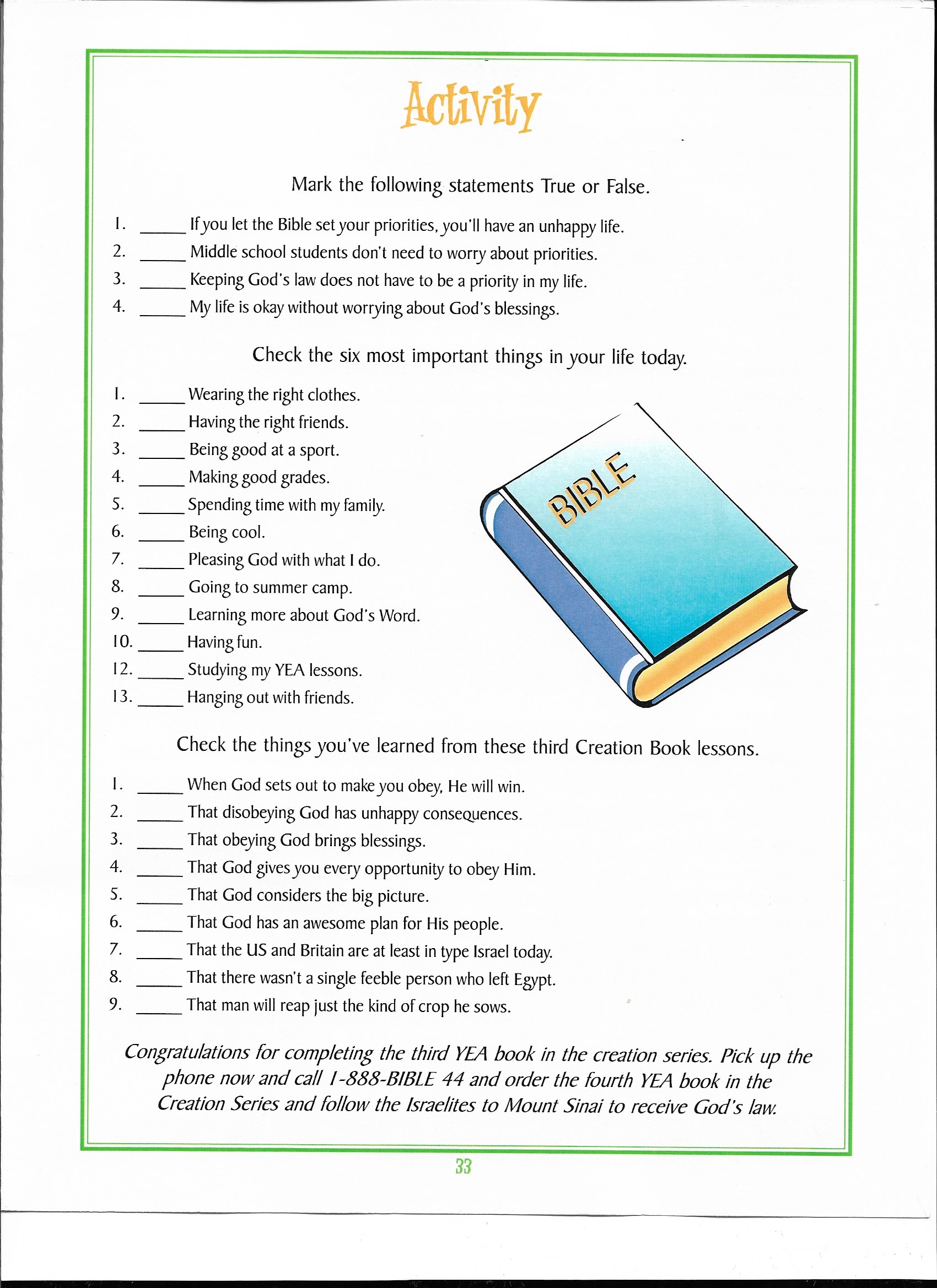
Go over the Activity in the students' book with the class.
Give the students an opportunity to recite the ten plagues in order (10-week Memory Challenge).
REACH Activity
Memory Verse Spotlight: Psalm 105:37
Look up the word “feeble.” Write down the Hebrew word and its meaning. Then find three other Scriptures where this word is used. Isn’t this interesting! Out of the more than 2 million people estimated to have come out of Egypt by scholars - not one of them was feeble? What do you think of that? Write about this in your Bible notebook.
Where in the World? Succoth, Rameses, Etham
Find a map of Egypt circa the timing of the Exodus. Where do scholars believe that Succoth, Etham, and Rameses were? Where do scholars think Moses and the Israelites crossed the Red Sea? Why is there debate about the crossing? Start to do some research. Take notes, with reference citations, and file it in your Bible notebook.
They Did What Back Then? Yeast
Have you ever tried to make homemade bread? Have you ever allowed the bread to become leavened by the yeast in the air? How long does it take? Do some research online to see how the Hebrews anciently would have leavened their bread. When did it change? When did yeast become something you could buy in the stores? What leavens most bread in the store today? Are you surprised at what you have discovered?
Making It Mine: A Pillar of Cloud or Fire
Have you ever thought about what it would have been like for children who grew up wandering in the wilderness under Moses? They would never have known a time when God’s presence wasn’t with them. They could see the pillar of cloud by day and the pillar of fire by night. They knew God was protecting them, standing between them and their enemies. They knew God was guiding them in their wanderings. They had a visible reassurance that God was right there.
What about you? Do you know that God is protecting and guiding you? Do you know that He is with you? If you have accepted that Jesus is your Savior and you have determined to obey God’s laws out of love for Him, then you know God is your God. He’s in control of your life and will never leave you. That doesn’t mean that your life will be without pain and trouble. Jesus said that in this life we will have trouble. It does mean that God is with you through all of it.
Write about this in your Bible notebook. Talk about it with your family.
Worldview Collisions: Whose God?
A secular worldview wants to categorize gods with the peoples who worship them. Allah is the Muslim god. Thor is the Scandinavian god. Zeus is the chief Greek god. Jupiter is the Roman god. Then there are Baal and Molech and Diana and Mercury and on and on. But whose God is our God? A secular worldview would say that He is the God of the Christians or the God of the Jews.
A Biblical worldview says that our God is the God of the Universe. He is the Creator of all. He is God over all. Now, granted, many people don’t recognize Him as God, but someday every knee will bow and every tongue confess that God is ruler of all (Philippians 2:10-11). Someday all people will recognize that our God is the Only True God.
Write this worldview collision in your Bible notebook. Does thinking about these divergent ideas help solidify what you believe? Why or why not?
Questions
As you’re working through the YEA lesson, Daily Devotionals, doing the activity, or reading the Bible, be sure to write down any questions you have. That way you’ll remember to ask someone. Also remember to share the really interesting things you’re learning with family and friends.
Song
"I Will Celebrate" is on page 49 of The Group Songbook.
Closing Prayer
Have the students form a circle and join hands. Ask for a volunteer to lead in prayer thanking God for our freedom and that He freed Israel from Egyptian slavery.
Printable Pages