YEA Lesson Library
Pharaoh Won’t Renege
About This Lesson
Using the example of Pharaoh, the lesson emphasizes that you reap what you sow. The student is led to apply the lessons of Passover to himself, to make a plan to avoid sowing evil, and to follow God’s ways.
Scriptures
Exodus 11:1-10
Exodus 12:1-32
Deuteronomy 32:39
Nehemiah 9:9-10
Galatians 6:7-8
Words to Know
RENEGE - to go back on a promise or commitment
The Lesson
Pharaoh had sown stubborn seeds to please his own desires. He had forgotten that it was because the True God helped Joseph with a plan that his nation was saved from famine. He had forgotten that because Joseph's brothers and father settled in Egypt, they provided offspring as a workforce to build the cities and his nation. He took God's blessing for granted and abused the Israelites - one of Egypt's greatest blessings.
Pharaoh felt threatened by the Israelites having such large families. He feared their numbers would become so large that they would soon take over his country. He looked upon God's people as being a source of cheap and plentiful labor. He wanted to keep them that way. He thought the way to do it meant control! Yes, even controlling the number of children they had. So he first commanded midwives to kill newborn babies at birth. That didn't work, so he commanded that all boy babies be thrown into the Nile River to die.
There wasn't a humble bone in Pharaoh's body. He was King of Egypt and planned to stay that way, regardless of what it took. But God had other plans.
Pharaoh never gave a thought to God sitting at the controls of the universe. In his arrogance he thought of himself as all-powerful. Deuteronomy 32:39 says,”Don't you see that I alone am God? I kill and make live. I wound and heal - No one delivers from my power" (TLB).
Pharaoh was a hard nut to crack. but God set out systematically to bring him down. The plagues that God had already brought on Egypt, because he wouldn't allow the Israelites to go into the wilderness for three days and worship Him, virtually destroyed that nation. And yet, God wasn't through.
"God said to Moses: ‘I'm going to hit Pharaoh and Egypt one final time, and then he'll let you go.’” Hurray! Pharaoh Won't Renege. So what do you think God did to get Pharaoh's attention and to keep him from changing his mind? Read on.
“Now Moses announced to Pharaoh, 'Jehovah says, About midnight I will pass through Egypt. And all the oldest sons shall die in every family in Egypt, from the oldest child of Pharaoh, heir to his throne, to the oldest child of his lowliest slave; and even the firstborn of the animals’” (Exodus 11:4,5 TLB). Do you think that God ever forgot the order Pharaoh gave the midwives to kill all Hebrew boys as soon as they were born?
The Apostle Paul warns us in Galatians 6:7-8. “Don't be misled; remember that you can't ignore God and get away with it; a man will always reap just the kind of crop he sows! If he sows to please his own wrong desires, he will be planting seeds of evil and he will surely reap a harvest of spiritual decay and death; but if he plants the good things of the Spirit, he will reap the everlasting life which the Holy Spirit gives him." Well, Pharaoh wasn’t going to get away with the evil seeds he had sown.
God explained that the Israelites were to eat the Passover hurriedly with their traveling clothes and walking shoes on, with their walking stick in their hands. He would pass through the land of Egypt that night and kill all the oldest sons and firstborn male animals in that land. This was done to execute judgment upon all of the gods of Egypt. The blood the Israelites placed on their doorframes would be proof that they obeyed God. "When I see the blood I will pass over you and I will not destroy your firstborn children when I smite the land of Egypt" (Exodus 12:13 TLB).
The Israelites did as Moses and Aaron commanded. "That night, at midnight, Jehovah killed all the firstborn sons in Egypt, from Pharaoh's oldest son to the oldest son of the captive in the dungeon; also all the firstborn of the cattle." Pharaoh and his officials and all the people of Egypt got up in the night. There wasn't a single house where someone wasn't dead. Can you imagine the bitter crying throughout the land?
Pharaoh didn't let any grass grow under his feet until he called for Moses and Aaron during the night. “Leave us; please go away, all of you; go and serve Jehovah as you said. Take your flocks and herds and be gone, and oh, give me a blessing as you go. And the Egyptians were urgent upon the people of Israel, to get them out of the land as quickly as possible. For they said, 'We are as good as dead.’”
Think about it. This was a horrible night. Every Egyptian family had someone dead in their household. Not only that, animals had died as well. Pharaoh had certainly sown to please his own wrong desires. He planted seeds of evil. This night when the Destroyer passed over a house in Egypt and didn't see blood on the doorframes, that family reaped a harvest of spiritual decay and death.
What about you? Are you planting the good things of the Spirit, so you will reap everlasting life which the Holy Spirit will give you?
Student Prayer
Gracious and Holy Father,
It almost blows my mind to think that Pharaoh could be so stubborn. But then I have to look at my own life and remember the times when I've been stubborn and have sown evil seeds to please my own wrong desires. I've learned from this lesson that this type of thing will surely reap a harvest of spiritual decay and death. Please be merciful to me and forgive me.
It's in Jesus' holy name I pray.
Amen.
Daily Devotions
Sunday - Exodus 11:1-3
Monday - Exodus 11:4-6
Tuesday - Exodus 11:7-10
Wednesday - Deuteronomy 32:39
Thursday - Exodus 12:1-10
Friday - Exodus 12:11-13
Saturday - Nehemiah 9:9-10
Objectives
At the end of this lesson, students will be able to:
1. Explain that a person will always reap just the kind of crop he sows!
2. Tell how the Israelites were to be dressed and prepared when they ate the Passover.
3. Explain that the first Passover was a type of what was to be fulfilled in Christ being our Passover Lamb who died for our sins.
Topics & Themes
Angel, Death
Egypt, Coming Out
God’s Plan
Harvest
Jesus, Lamb of God
Passover
Pharaoh
Plagues
Sin
Materials Needed
Bible, YEA Students' and Teacher's Books, attendance and memory verse charts, songbook, timer, paper, pencil, concordances
How to Teach This Lesson
After opening the class with prayer, divide the class into four groups. Assign a leader for each group and let that leader draw one of the pieces of paper you wrote statements or questions on before class. Instruct the groups to go to different parts of the classroom with their YEA books, Bibles, and concordances to brainstorm and arrive at their answers. Allow them about five to eight minutes. Set the timer. When it goes off, call the class back together to sit in a semicircle.
Ask for the leader from each group to read the statement/question on their piece of paper, give the answers and scriptures to support it. If any student would like to add to that person's answer, encourage him to do so.
Debrief - Ask: How did you feel about this way of studying the Bible? What was the most difficult thing about it? How was it like or unlike other ways you've studied the Bible? How did you feel when Pharaoh eventually, after ten very bad plagues, let the Israelites go? Ask a student to read Background down to "The Beginning of Passover." What differences do you think a person would have seen in the nation of Egypt after Pharaoh eventually let the Israelites go? What makes you think that? What should Pharaoh have done to keep his nation in good economic condition when Moses and Aaron first went to him?
Passover instructions - Ask: Why do you think God instructed the Israelites to eat the Passover with their traveling clothes on, wearing their walking shoes, and carrying a staff or stick in their hands?Ask a student to read Exodus 12:37.
Christ in the Passover - Did God have something even bigger in mind with the Passover than just delivering Israel from slavery? What was it? Delivering us from our sins through the blood of Jesus. How do you know that? Ask a student to read the paragraph under Background that starts off with The Beginning of Passover. Can anyone think of a New Testament scripture that tells us that? Ask a student to read I Corinthians 5:7 aloud. What was there in that first Passover that was a type of Christ? The lamb. How long did God say people should continue to keep the Passover? It is to be permanent. What is one thing the Passover is to remind us of? Israel's deliverance from evil.
Application - What have you personally learned from this lesson that will change your life? Have the students recite their memory verse. Why is it important that you be careful with the type of things you do, as the Bible cals it "the crop you sow"? If you plant seeds of evil, what kind of a crop will you reap? If you plant good things of the Spirit, what will you reap?
Remind the students of the 10-week Memory Challenge - to recite all ten plagues in order.
Teacher-Directed Activity
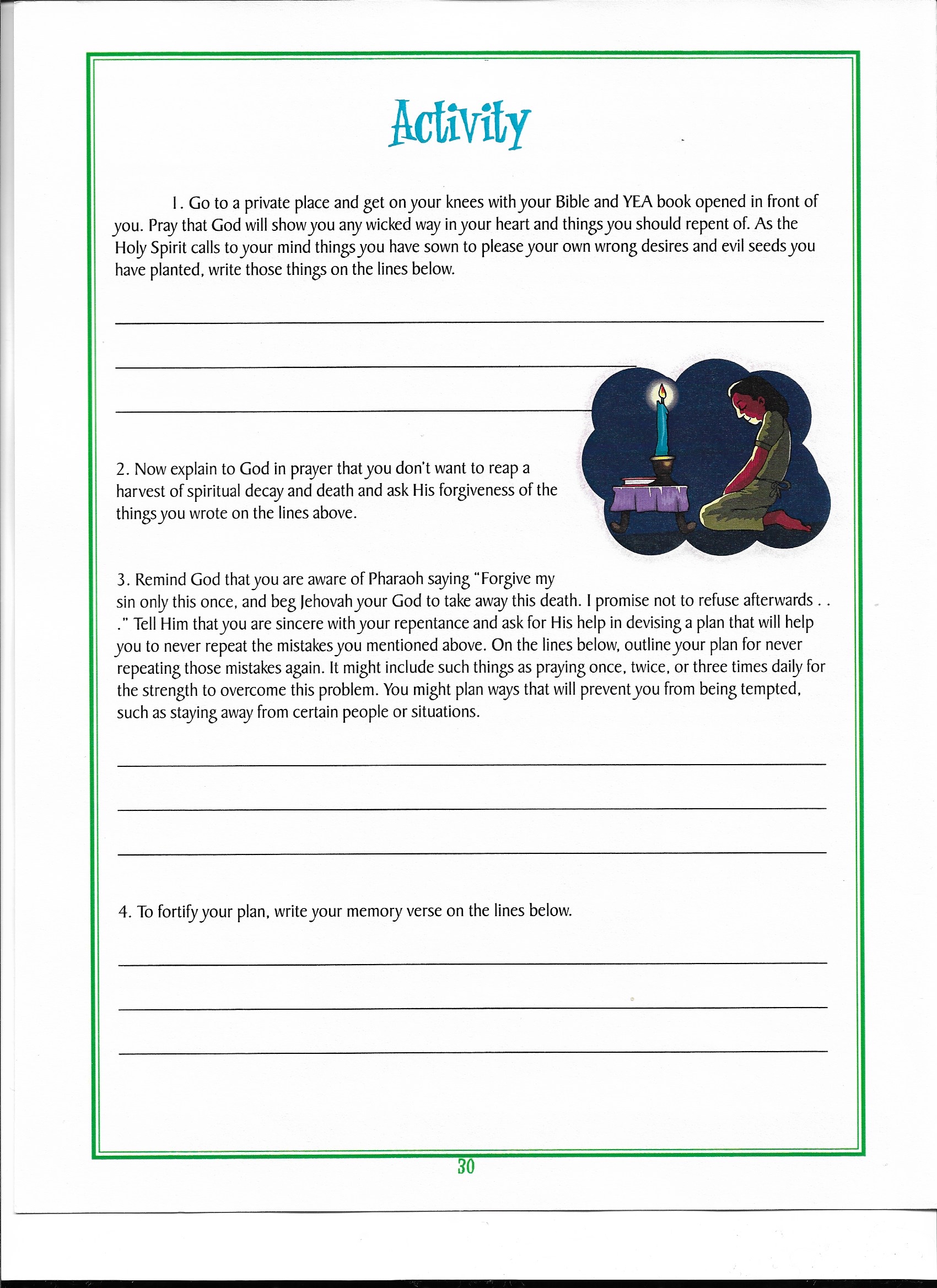
Since this Activity is done in a very personal way, only ask that students share their plan to help, or prevent, them from being tempted to renege on their repentance
REACH Activity
Memory Verse Spotlight: Galatians 6:7-8
Look up the word “misled.” Write down the Greek word and its meaning. Then find three other Scriptures where this word is used. What would cause a person to be “misled” or “deceived”? Think of several reasons and write them in your Bible notebook. Now, what is the remedy? How can you avoid being misled?
Where in the World? Bad Leaders
If you want a country to prosper, you have to have a good leader. A good leader is characterized by concern for the people he governs. He shows compassion and wisdom, justice and mercy. A good leader realizes that he cannot be good at everything so he surrounds himself with wise counselors to aid him in making benevolent decisions. His whole goal is the prosperity and protection of the country.
A bad leader is in it only for himself, for what he can accumulate. He is not concerned about the populace. He doesn’t have a long-term vision for prosperity. Do some research and write down the worst leaders in history. They were the ones who killed off their own people. They starved them or enslaved them harshly.
Now, consider: was Pharaoh a good leader or a bad leader? Why do you think so?
They Did What Back Then? Burial
For those who did not put the blood on the doorposts and lintels, the death angel killed someone in their home. There was not a house that didn’t have someone who had died. That’s a lot of people to die in a single night. That’s a lot of burials. Do some research. Find out what the burial practices of the Egyptians were at that time. We often think of the pyramids, but how many people were actually buried in pyramids? Write down what you find in your Bible notebook.
Making It Mine: Renege
Renege comes from Latin. The “re” means “expressing intensive force” and “negare” means “deny.” In today’s usage, renege means to go back on what you said you would do. But it has its root in the idea of strongly denying something. Think about other words that come from the Latin “negare.” They include abnegation (self-denial), negate, and renegade. Renegade originally referred to someone who left, or denied, a religious faith. When you apply this to Pharaoh, what was he strongly denying? He was strongly denying God’s existence, God’s power, God’s claim that the people belonged to Him, and God’s command to let His people go.
Write the Latin origin of these words, its definition and the derivations in your Bible notebook.
Then spend some time thinking about denying God in any way. It’s not a good idea. Ask God for His help in honoring, serving, and loving Him. You do not want to experience the consequences of reneging.
Worldview Collisions: Coincidence
A secular worldview says that time, chance, and coincidence rule the day. Whatever happens is just the luck of the draw. There’s no rhyme or reason, so it doesn’t really matter what you do.
A Biblical worldview says that we, as physical human beings, are subject to time. We are all getting older and wearing out. But God directs our steps. He establishes our way. He guides and protects. There is nothing that happens to us that He does not permit. To attribute the events in our lives to chance or coincidence is saying that we serve the Greek god Fortuna. We, as servants of the Living God, do not say that we are fortunate (given by the god of fortune). We say that we are blessed.
Think about the terminology you use. Are you implying by your word choice that you are a servant of the One True God or another false god? Write down your thoughts and be intentional about the words you use.
Questions
As you’re working through the YEA lesson, Daily Devotionals, doing the activity, or reading the Bible, be sure to write down any questions you have. That way you’ll remember to ask someone. Also remember to share the really interesting things you’re learning with family and friends.
Song
"I Exalt Thee" is on page 39 of The Group Songbook.
Closing Prayer
Have students form a circle and hold hands. Go around the circle and let each student name one of the plagues that came upon Egypt because of Pharaoh's stubbornness. Ask a volunteer to lead in prayer thanking God for the Passover and its larger meaning to us today of Jesus dying for our sins.
Printable Pages