YEA Lesson Library
Flip Flopped
About This Lesson
Using Pharaoh’s example of reneging on letting the Israelites go, the student is taught to sincerely be repentant, not just repentant until the consequence is lifted.
Scriptures
Exodus 9:1-35
Exodus 10:1-29
Jeremiah 13:23-27
2 Corinthians 7:10
James 1:1-8
Words to Know
KLIN - an oven, furnace, or heated enclosure used for processing a substance by burning, firing, or drying
The Lesson
When did Pharaoh say, “Enough!”? The Nile River turned to blood. Pesky frogs invaded everything he and the Egyptians had. The people almost scratched themselves crazy from he plague of lice. Flies filled their homes and covered the ground. Horses, donkeys, camels, flocks, cattle, and herds became sick and died. All the while, Pharaoh still thought he was so great that he could defy God’s power every time God removed a plague. So he steadfastly refused to let God’s people go into the wilderness to worship Him.
What would it will take before Pharaoh would believe and obey God? Jeremiah 13:23-24 asks a question. “Can the Ethiopian change the color of his skin? Or a leopard take away his spots? Nor can you who are so used to doing evil now start being good. Because you have put me out of your mind and put your trust in false gods, I will scatter you as chaff is scattered by the fierce winds of the desert” (TLB). This seems to indicate that arrogant Pharaoh would yet be in for some very hard times. Hold on to your seat and let's see how this drama unfolded.
"Then Jehovah said to Moses and Aaron, ‘Take ashes from the kiln. Moses, toss it into the sky as Pharaoh watches. It will spread like fine dust over all the land of Egypt and cause boils to break out upon people and animals alike, throughout the land.’”
Moses and Aaron took the ashes and headed out to see Pharaoh. Pharaoh watched as they tossed the ashes toward the sky. Humans and animals alike broke out in painful boils throughout all of Egypt. The magicians couldn't even stand before Moses because of their agonizing boils. However, Pharaoh, in his arrogance, refused to listen, as God had predicted.
God told Moses to go back to Pharaoh and tell him to “Let my people go to worship me. This time I am going to send a plague that will really speak to you and to your servants and to all the Egyptian people, and prove to you there is no other God in all the earth. I could have killed you all by now, but I didn’t.” Then why do you think God didn’t kill them? Because He wanted to demonstrate His power to all the earth. Believing that God is the only true God who has total power offered them so many benefits. That meant they could call on this Power to protect, guide, and help them. What an awesome benefit! But Pharaoh still thought he was great stuff and could stubbornly defy the God of heaven. So he Flip Flopped! Because of this, his people got hurt badly. But there was even more to come.
"Tomorrow about this time I will send a hailstorm across the nation such as there has never been since Egypt was founded! Quick! Bring in your cattle from the fields, for every man and animal left out in the fields will die beneath the hail."
Some of the Egyptians had begun believing God, and they brought their cattle and slaves in from the fields. Those who had no regard for God's Word left them out to die in a terrible storm that defied all description. It was worse than anything in Egyptian history.
Well, it began to look like there was some hope for Pharaoh. He told Moses and Aaron that he had seen his mistake and that he'd ben wrong all along. "Beg God to end this terrifying thunder and hail, and I will let you go at once.”
Moses left the city and held his hands to heaven to the Lord, and the storm stopped. Wasn't God being more than generous after the experience He'd had, up to this point, with Pharaoh? But how real do you think Pharaoh's repentance was? When he saw that the storm had ended, he and his officials stubbornly sinned yet more and Flip Flopped on what they had promised.
God is not one to give up. He wasn't about to lose this battle. Having His people free to worship Him was extremely important; it was very much for their good. So God told His two servants to go back to Pharaoh again and make their demands. "How long will you refuse to submit to me? Let my people go so they can worship me.” If he refused this time, the penalty would be a thick layer of locusts that would finish destroying everything that escaped the hail. "They will fill your palace, and the homes of your officials, and all the houses of Egypt. Never in the history of Egypt has there been a plague like this will be!” Then Moses stalked out (Exodus 10:6 TLB). You’ve guessed it. Pharaoh Flip Flopped and did the predictable thing. He stubbornly refused to let God's people go worship Him. The plague of locusts came as God said.
Pharaoh sent an urgent cal for Moses and Aaron and said, "Forgive my sin only this once, and beg Jehovah your God to take away this death. I promise not to refuse afterwards.” But he Flip Flopped. There was yet another plague. It was darkness without a ray of light upon the land of Egypt. During all that time the people scarcely moved, but the Israelites had light. This time Pharaoh told Moses and Aaron that he'd let the Israelites go with their children, but they must leave their animals. This wasn’t good enough. What do you think God will do this time?
Have you ever Flip Flopped like Pharaoh when you sinned, then repented, and God let up on you? Did you revert to your old attitude? Your memory verse says, "Godly sorrow brings repentance that leads to salvation and leaves no regret, but worldly sorrow brings death." Any time you consider repeating a sin, remember what happened to Pharaoh. Things could be much worse the next time.
Student Prayer
All wise and powerful God,
You love us so much that you'll do what it takes to bring us to repentance and salvation. Thank you for teaching me lessons of the plagues brought on Egypt because of an arrogant, stubborn ruler. Help me to always believe you and repent with a repentance that leaves no regret.
In Jesus' name I pray.
Amen.
Daily Devotions
Sunday - Exodus 9: 1-7
Monday - Exodus 9:8-12
Tuesday - Exodus 9:13-19
Wednesday - Exodus 9:20-26
Thursday - Jeremiah 13:23-27
Friday - 2 Corinthians 7:10
Saturday - James 1:1-8
Objectives
At the end of this lesson, students will be able to:
1. Discuss why it was good for God to keep coming back with plague after plague every time Pharaoh refused to obey Him.
2. Explain the difference between sincere and insincere repentance.
3. State that if our repentance doesn't stick, there could be greater consequences.
Topics & Themes
Consequences of Sin
God’s Judgment
Moses
Pharaoh
Plagues
Repentance
Salvation
Materials Needed
YEA Students' and Teacher's books, attendance and memory verse charts, songbook, bowl, heat lamp, ice cube, marshmallow
How to Teach This Lesson
Open the class with prayer. Put the marshmallow and ice cube in the bowl and make sure the heat lamp is on and shining on them. Explain to the class that you've put these two items in the bowl with a heat lamp on them and you'll get back to it later.
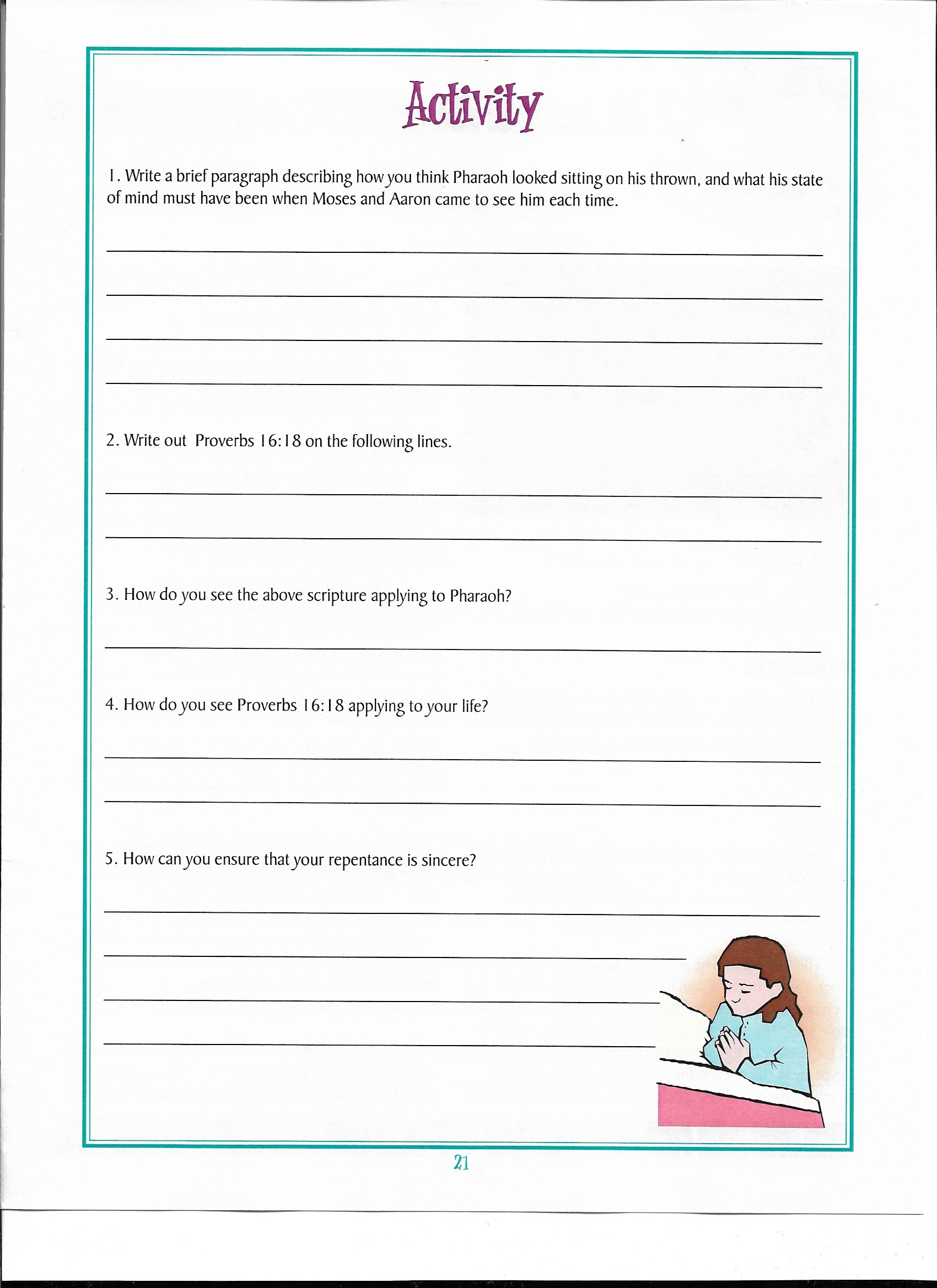
Activity - If the Activity in the Students' Book is not covered in class, students will see no reason to do it. So go over the Activity in the Students' Book with the class and get their answers to every question. Explain there is no right answer for the first question. You want everyone to get a visual picture in their minds so today's lesson will be in context.
Background - Have your best reader read the first three paragraphs of Background aloud to the class.
Debrief - Ask: Who can recall what (use the name of the student) read to us about what salvation is? Salvation is God doing for us what we can't do for ourselves. What was God trying to accomplish with the plagues he sent on Egypt? He was trying to save the Israelites from Egyptian slavery. What is the bigger lesson in all of this? God wants to save us from our sins. Why do we need to be saved from our sins? Ask a student to read Romans 6:23 aloud. We learned in our lesson Pharaoh was arrogant and stubborn. You may think you're not as bad as Pharaoh. So are you worthy of death? Ask a student to read Romans 3:23. Does "all"mean every person who has ever lived? Then why do we need to be saved from our sins?
Repentance - Ask: Who can tell us about the times that Pharaoh said he was sorry for his sins?Ask a student to read Exodus 10:16. What did God do? He sent a strong wind and blew the locusts away. Then what did Pharaoh do? He Flip Flopped on his repentance. How genuine do you think Pharaoh's repentance was? Why do you think that?
Sincere repentance - Ask: What kinds of wrong things do teens do and then go to God and ask that He forgive them? Did you ever do something again that you repented of? How was that similar to what Pharaoh did? What must you do for God to believe your repentance is sincere? Have the students recite their memory verse at this time. Ask: Is death a word that frightens you? Can you think of a word that is just the opposite of death?Salvation. Then what do you have to do to obtain salvation? You must sincerely repent of your sins and believe in Jesus Christ. What do you gain by doing this? Eternal life. What are you going to do about today's lesson?
Ice cube and marshmallow - Ask the students to consider that in this experiment the heat lamp is like God 's Word. The marshmallow is like Pharaoh. The longer God dealt with Pharaoh the harder his heart became. If you keep the heat lamp on the marshmallow long enough it will harden. The ice cube is like the heart of people who trust God. Let the melted ice and the hardened marshmallow always remind you to keep your heart soft and obey God's Word.
Teacher-Directed Activity
It is embedded in “How To Teach This Lesson.”
REACH Activity
Memory Verse Spotlight: 2 Corinthians 7:10
Look up the word “sorrow.” Write down the Greek word and its meaning. Then find three other Scriptures where this word is used.
If you were going to translate 2 Corinthians 7:10, how would you phrase it? Could you write a hypothetical example to explain the difference between godly sorrow and worldly sorrow? After you write this in your Bible notebook, share it with your family.
Where in the World? Hail
Research the spectacular hail storms over the past few years. What is the record size of a hail stone? Where did it fall? What kind of damage did it do? In Exodus 9:19, the Egyptians are warned that the hail would kill any animal or man that was outside when the hail hit. Why weren’t the Hebrews warned? Because there was no hail in the land of Goshen. What size would the hail have to be to kill a man? a cow? a horse?
Write down what you find in your Bible notebook.
They Did What Back Then? Locusts
Did you know that Egypt experiences a cloud of locusts almost every spring? But this plague was going to be a plague unlike anything they had ever seen.
Have you ever wondered how they could have had hail that destroyed even the trees and then they had locusts that ate every green thing still in the field? Wouldn’t the hail have flattened everything so there was nothing for the locusts to eat? What do you think? Is it possible that there was more time in between these plagues that we might have thought? Is it possible that Pharaoh had time to think that maybe the plagues weren’t from God? Could he have decided that it was just bad luck or the natural cycle of nature?
Mankind has the natural inclination to ask for relief from God when undergoing some fiery trial, but then, when God relents and gives relief, we tend to think that the trial wasn’t that bad. We stupidly tend to believe what we want to believe - the belief that allows us to behave as we want to.
Write about this in your Bible notebook.
Making It Mine: Making a Deal With God
Have you ever told God that you would do something, if He would just (you fill in the blank)? If you made that deal with God, He fully expects that you keep your promise. (Ecclesiastes 5:6.) God didn’t force you to make that promise, but He does expect that you will honor the ones you make.
It’s a good idea to think carefully about what you say. You want to be known as a person who keeps his or her word. You want to be known as a person of integrity. So let’s practice. If your best friend asks you, “Can you come over to my house for supper tonight at 6?” what do you say? You have the choice of saying, “Sure, I’ll be there” or “I have to ask my parents” or “I will plan to be there at 6:00.” Why might you choose the third option? You can make all the plans you want, but sometimes things come up, things that are completely out of your control.
Write about this in your Bible notebook.
Worldview Collisions: Weather
A secular worldview says that weather just happens; it’s a product of the ocean currents, wind currents, and position of the earth to the Moon and the Sun.
A Biblical worldview says that God controls the weather. Whether He normally pushes the clouds along so that we get rain when we should, but not too much, or He holds the clouds back so that we get just what we need, God causes it to rain on the just and the unjust alike. (Find that scripture.) Find five scriptures that talk about God controlling the weather - the storehouses of hail in the heavens, etc. Write down the entirety of the verse and their reference citation in your Bible notebook.
Questions
As you’re working through the YEA lesson, Daily Devotionals, doing the activity, or reading the Bible, be sure to write down any questions you have. That way you’ll remember to ask someone. Also remember to share the really interesting things you’re learning with family and friends.
Song
“Create in Me a Clean Heart” is on page 36 of The Group Songbook.
Closing Prayer
Ask the students to form a circle and join hands. Ask each student to name one time when Pharaoh hardened his heart and showed his repentance was insincere. It's okay if incidents are repeated. Lead in prayer asking God to help each student to grasp the meaning of sincere repentance, that they will never Flip Flop, but they will sincerely repent of their sins and be baptized.
Printable Pages