YEA Lesson Library
From Bad to Worse
About This Lesson
This lesson teaches the story of God sending Moses and Aaron to Pharaoh, telling him to let the Israelites go. When Pharaoh refused, God displayed His power. Similarly, the student is encouraged to see suffering as a tool to help make them stronger, if they are trusting God and following His ways.
Scriptures
Exodus 4:1-31
Exodus 5:1-23
Exodus 6:1-30
Exodus 7:1-25
Colossians 3:25
Words to Know
BRIEFED - to give final precise instructions
AGENDA - a list of things to be done
The Lesson
Have you ever dreaded giving a speech, or speaking before people? Have you wished that someone else could do the job for you? Well then, you'll understand how Moses felt.
Last week we learned that God called Moses from the burning bush to go to Pharaoh. He said, "Let my people go." Moses pleaded with God and said he was not a good speaker and, "Please get someone else." This wasn't what God wanted to hear from Moses. He became angry. "All right,” He said, “your brother Aaron is a good speaker. And he is coming here to look for you and will be very happy when he finds you. So I will tell you what to tell him, and I will help both of you to speak well, and I will tell you what to do. He will be your spokesman to the people. And you will be as God to him, telling him what to say. And be sure to take your rod along so that you can perform the miracles I have shown you.”
God sent Aaron to Mount Horeb to meet Moses in the wilderness. Moses briefed Aaron on the miracles God told him they must do before Pharaoh. They went on to Egypt and called all of the Israelite elders together and told them what God had told them. Moses performed miracles as the elders of Israel watched. After learning that God had visited them, had seen their sorrows, and had decided to rescue them from the cruel Egyptian slavery, they were so happy they bowed their heads in worship.
The next thing on Moses' and Aaron's agenda was to go visit Pharaoh. They told him the God of Israel said, "Let my people go, worship me in the wilderness." Pharaoh was not impressed and retorted, "Is that so?" But that didn't discourage Moses and Aaron. They insisted that Pharaoh let the Israelites take a three-day journey into the wilderness to worship Him and sacrifice to the Lord. They explained that if they didn’t do this they could die.
Again, Pharaoh wasn't at all impressed. He claimed that they were distracting the Israelites from work. So he sent word to the taskmasters not to give the Israelites straw for making bricks while not reducing their production requirement. "Load them with work and make them sweat; that will teach them to listen to Moses' and Aaron's lies!"
Things went From Bad to Worse. The taskmasters became very brutal and whipped the Israelite work-crew bosses. "Why haven’t you fulfilled your quotas either yesterday or today?” they roared. The Israelites explained that they weren't given any straw and were expected to make the same number of bricks. The Israelites became very angry with Moses and Aaron for the treatment the Egyptians were giving them.
Moses didn't like this kind of heat, so he started blaming God. "How can you mistreat your own people like this? . . . Ever since I gave Pharaoh your message, he has only been more and more brutal to them, and you have not delivered them at all!" Moses must have forgotten what God told him. He said He would make Pharaoh stubborn so that he would not let His people go (Exodus 3:19; 7:14).
Again God told Moses that Pharaoh wasn't going to be a knock-over, that he would have to be forced to let the Israelites go. God told Moses to tell the Israelites that He would use mighty power and perform great miracles to deliver and free them from slavery. In the end, God would bring them to the land He promised to give Abraham, Isaac, and Jacob. The Israelites were not impressed and wouldn't listen.
God spoke to Moses again and told him, "Go back again to Pharaoh and tell him that he must let the people of Israel go." Moses simply wasn't ready for this and he objected. “My own people won't even listen to me any more; how can I expect Pharaoh to? I'm no orator!" God wasn't going to take no for an answer, so He ordered Moses to go back to Pharaoh, demanding that the people be allowed to leave.
God appointed Aaron to be the spokesman and Moses was to tell Aaron everything God told Moses. Again, He warned that Pharaoh would stubbornly refuse. But God promised to multiply His miracles in Egypt and crush those people with a final major disaster and then lead His people to freedom.
Moses and Aaron went back to Pharaoh and performed miracles to prove that God had sent them. He threw down his rod and it became a serpent. But Pharaoh called in his magicians and they were able to do the same thing. God sent Moses and Aaron back to be at the Nile River as Pharaoh arrived the next morning. God instructed Moses to hit the water of the Nile with his rod and the water would turn to blood. Why the Nile? This was the very first plague to come upon Egypt and it happened at the exact place where Pharaoh had commanded the boy babies to be thrown to die. Things really had gone From Bad to Worse, and God had not forgotten the evil that Pharaoh had brought upon His people. Will Pharaoh get off scot-free? What does your memory verse say?
Student Prayer
Great Eternal God,
Thank you for your power and wisdom. When things don't go like we want them to, it's so easy to doubt you. Yet we have so much proof in this lesson of your love for your people. You may not do what we want to get things done and when, but you always keep your promises. Help me to trust and obey you.
In Jesus' name I pray.
Amen.
Daily Devotions
Sunday - Colossians 3:25
Monday - Exodus 4:1-4
Tuesday - Exodus 4:5-9
Wednesday - Exodus 4:10-12
Thursday - Exodus 4:13-17
Friday - Exodus 4:29-3 1
Saturday - Exodus 5:1-9
Objectives
At the end of this lesson, students will be able to:
1. Recognize that God has a bigger picture in mind than just our comfort.
2. Explain that God was preparing the Israelites for what was ahead in their lives.
3. State that God wanted to teach the Israelites and us to trust Him.
Topics & Themes
Aaron
Egypt
God’s Plan
Israelites
Moses
Pharaoh
Plagues
Trusting God
Materials Needed
Bible, YEA Students and Teacher's books, attendance and memory verse charts, songbook, dry eraser board, marker, prize
How to Teach This Lesson
Open the class with prayer. Ask the students to put all of their things on the floor except their Bibles and Students' books which are to be used in today’s class. Explain that the students on the right side are on the A Team, and the students of your left are on the B Team. You will ask a question, and any person on either team is to raise their hand when he comes up with an answer from 1) their own knowledge, 2) the Bible, or 3) their YEA Students' book. As kids call out the answers, write them on the board and give the correct team credit for the answers.
1) What things are evil in the world today?
2) What evil things did Pharaoh do to the Israelites?
3) Explain how the following is good or evil: God promised to crush the Egyptians with a final major disaster.
4) How would you rank Moses when he pled with God to “please get someone else” to speak to Pharaoh? A) Wimpy; B) Evil; C) Righteous; D. Fearful?
5) How did you feel when God became angry with Moses for asking Him to get someone else?
6) How did you feel about God telling Moses that He would make Pharaoh stubborn?
7) What was God trying to accomplish by making Pharaoh stubborn?
8) How did you feel about Moses arguing with God?
9) What did Moses argue with God about?
10) Why do you think God chose the Nile River for the location of the first plague?
Total the scores and give a prize to the team who gave the most correct answers.
Debrief: How did you feel about this contest as a way to learn the Bible better? How was it like or unlike other things you’ve done? How do you think this will help you read your lesson more carefully?
The Big Picture - Why do you think God hardened Pharaoh's heart when He knew people would suffer? Then why do you think God did this? Ask a student to read Exodus 6:6-7 from The Living Bible. When an athlete is in training for the Olympics, does his trainer go easy on him or does he push him to the limit? Why? How do we grow spiritually when we're being tested and life is difficult for us? Ask a student to read James 1:3 in The Living Bible. Is God more interested in you having patience with your mom, dad, and your friends, or your comfort? Why do you think God wants you to develop such character traits as patience or kindness? How do you think you fit into God's big picture?
Israelites had needs too - What was about to happen with the Israelites? (They were about to gain their freedom and start on a trek towards the Promised Land.) How do you see God making life difficult for the Israelites helping them?What do you think this preparation would do for them? (Help them to trust God, make them stronger, and get them in better shape to confront the evil that was ahead.)
Application - What have you learned from this lesson? What are some things you can put into practice in your life? What are you going to do about it?
Background - Read the first three paragraphs under Background to your class.
Teacher-Directed Activity
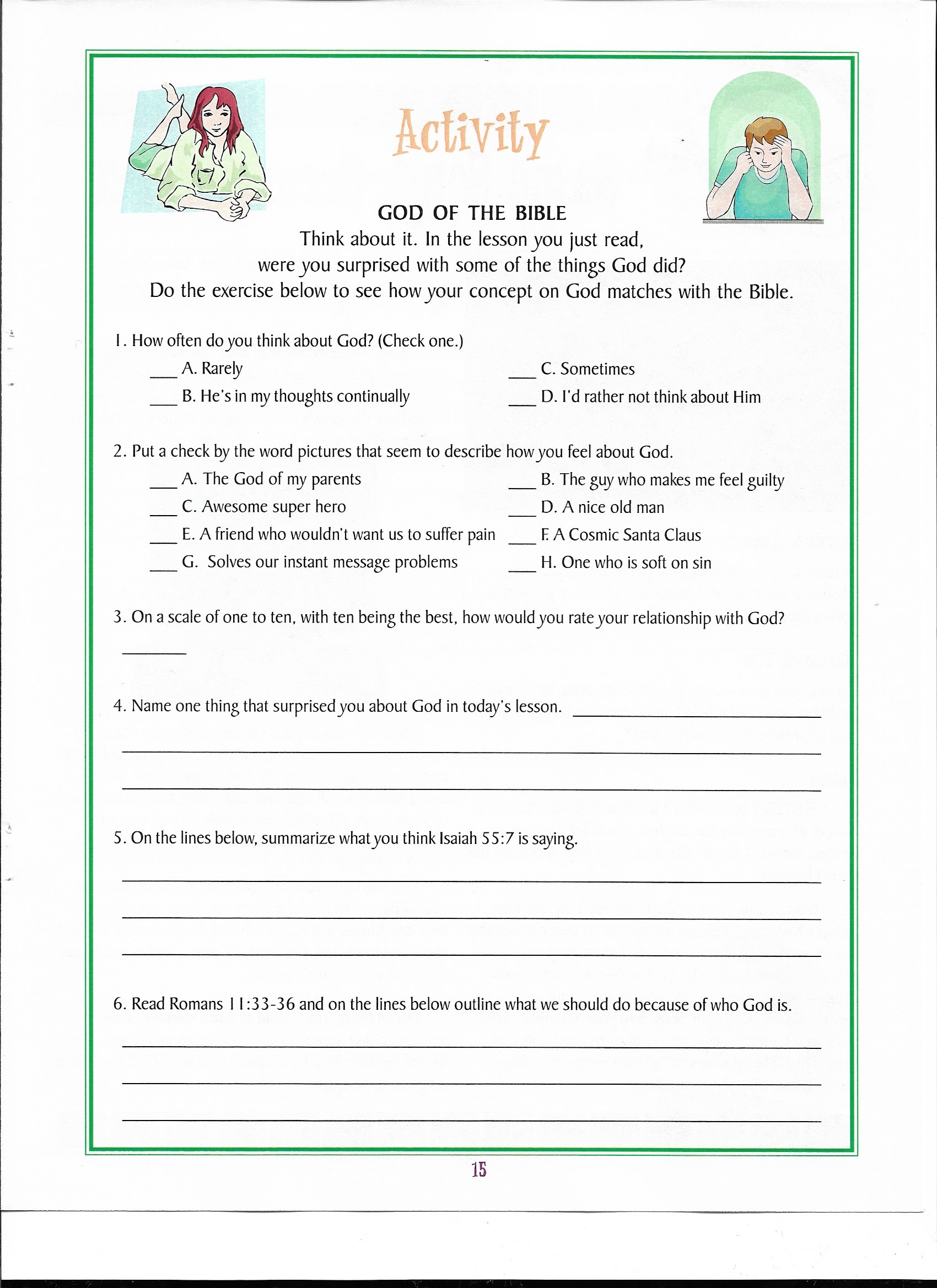
Go over the Activity in the students' Book with your class.
REACH Activity
Memory Verse Spotlight: Colossians 3:25
Look up the word “partiality.” Write down the Greek word and its meaning. Then find three other Scriptures where this word is used.
What is the difference between mercy and partiality? Give an example of each, preferably from the Bible. Write an essay comparing and contrasting these two terms.
Where in the World? Bricks
Do some research into brick-making today. Where are most bricks made? What is their composition? What did the Hebrews make bricks out of in Moses’ day? How many bricks can be made every day? How many bricks do scholars think were made every day during the height of the Egyptian economy? How long do bricks last? Does their endurance depend on weather, what they’re used for, and the materials? Anything else?
Write down what you find in your Bible notebook. Be sure to include your sources!
They Did What Back Then? Slave Labor
Egypt, at that time, was the leading country in the region. They were the superpower. Because of their influence and strength, Pharaoh had one building project after another. He was displaying his greatness to the world and extending his power. But building projects are expensive and they require workers. Pharaoh had the military might to keep the Hebrews in slavery to him. Perhaps he provided housing. We know he provided food. He likely provided security from enemies. The Hebrew people were taken care of - maybe they were forced to work too hard and were mistreated - but I expect that many of them were content with the trade-off. They might have been willing to give up some freedom if the government would take care of them.
Uh-oh. Are we still talking about Egypt? Or are we talking about the freedoms we have willingly relinquished in this country in exchange for security, health care, food, education, etc? We would never do that - give up our freedom so easily - would we? Do we still have the same freedoms our Founding Fathers fought so hard for? Talk about this with your parents.
Making It Mine: God’s Got a Job For You
What would you do if you knew God wanted you to do something? Would you do it? What if it meant going before a powerful ruler? (Like Moses) What if it meant saving people that would harm you in the future? (Like Jonah) What if it meant completely changing how you lived your life? (Like Saul who became Paul) What if it meant building a boat and collecting animals and preaching to your neighbors for 100 years? (Like Noah)
God does have a job for you.
Do you know what it is? God wants each of us to preach the gospel, as workers in the harvest field (Luke 10:2) to bring many to righteousness (Daniel 12:3). Sometimes that means you will be ridiculed (Matthew 5:11). Sometimes that means you will endure many difficult things. But you are called to be light (Matthew 5:14) and salt (Matthew 5:13) in a world that desperately needs the Savior. So do you go jump up on a box and start preaching to the people going by? Probably not. It means living your life in such a way that people see your devotion to, and your faith in, God. People see your love, generosity, and peace. And they want whatever it is that causes you to be this way.
So how do you get to the place that people want what you have? You have to get as close to Jesus Christ as you can. You pray. You read God’s word, the Bible. You think about His ways. Then you tell yourself every day when you get up that you are an ambassador for Jesus Christ. You live in a way that doesn’t bring shame to Him. It’s a big job! The good news is that He’ll help you; you just have to ask.
Worldview Collisions: Justice
A secular worldview says that justice is for those who don’t have enough money to bribe their way out of trouble. If you are rich enough or know the right people or are important enough, you don’t have to worry about breaking the laws. They won’t apply to you. There are some people who live this way. They absolutely don’t think the laws apply to them. How does that work in your house? Is there someone who doesn’t think they have to follow the same rules that everyone else does? How does that work? Does it cause resentment to grow?
A Biblical worldview says that God is not mocked; whatever you sow, that’s what you will reap. If you are dishonest, people won’t trust you. If you are a liar, people won’t believe anything you say. If you share secrets, people won’t tell you any. If you cannot be trusted to take care of other people’s belongings, no one will lend you anything. Furthermore, justice means that there are consequences to behavior. If you break the laws, you will be punished. But it won’t be a greater punishment than someone else who broke the same law. The punishment will fit the crime. That is, you won’t serve 20 years in jail for jaywalking.
Write about this worldview collision in your Bible notebook.
Questions
As you’re working through the YEA lesson, Daily Devotionals, doing the activity, or reading the Bible, be sure to write down any questions you have. That way you’ll remember to ask someone. Also remember to share the really interesting things you’re learning with family and friends.
Song
"On Eagles Wings" is on page 68 of The Group Songbook.
Closing Prayer
Have the students form a circle and join hands. Ask each student to name one thing they learned from this lesson. Ask for a volunteer to lead in prayer asking God to help us even when things go From Bad to Worse to look at the big picture and trust God.
Printable Pages