YEA Lesson Library
Who Killed Jesus?
About This Lesson
This lesson relates the events of Jesus’ betrayal and arrest, and states that we who claim Him as our Savior are responsible for His death because He paid the penalty for our sins.
Scriptures
Matthew 26:57-68
Matthew 27:1-2
Mark 14:53-65
Luke 22:51
Luke 23:1-48
John 3:16
Romans 12:1
Romans 12:1-3
Words to Know
VERDICT - any judgment or decision
SYMBOLICALLY - serving as a symbol; something that represents something else
BLASPHEMY - an act of cursing or reviling God
The Lesson
A cloud of dust covered a café parking lot as a motorcycle gang on Harley-Davidson’s roared to a screeching halt. As they set down their kickstands, they noticed they had parked next to a Peterbilt truck whose driver they knew. “Just wait until that wimp see us,” one gang member said as they stomped into the café.
“Who’s this sissy sitting at the counter?” they asked. The man at the counter continued to eat his meal as the gang approached. One gang member grabbed the truck driver’s ice tea and poured it on his head. The driver didn’t say a word as he wiped his face and shirt with his napkin.
The12 gang members surrounded the truck driver forming a semicircle. The truck driver appeared unperturbed. One of the gang picked up a handful of mashed potatoes and stuck them in the truck driver’s ear. Then he wiped his hands on the driver’s shirt. The driver still didn’t say a word. The truck driver paid his bill and started for his truck. The gang leader laughed and said “What a wimp. That guy ain’t much of a man.”
The owner of the café paused, looking out the window of the café, and said, “No, he ain’t much of a man either. He just ran over 12 Harleys.” This story from Smokey and the Bandit reminds us of when Jesus encountered a gang of men who also thought He was a wimp. Judas arrived in the Garden of Gethsemane with a mob wanting blood. Armed with swords and clubs, they were sent by the chief priests and elders – the religious leaders of the day – to find Jesus.
Judas had given prior instructions to arrest the man he greeted. He went straight to Jesus and gave Him a “friendly” kiss. Jesus knew why Judas came with this gang. He also knew why He came to this earth. He came to be Our Lifeboat – our Savior to die for our sins. He told Judas to go ahead and do what he had come to do.
Peter immediately came to Jesus’ defense. He pulled out a sword and slashed off the ear of the High Priest’s servant. “Put away your sword.” Jesus touched the place where the man’s right ear had been and made it whole. He told Peter, “Those using swords will get killed. Don’t you realize that I could ask my Father for thousands of angels to protect us, and he would send them instantly? But if I did, how would the Scriptures be fulfilled that describe what is happening now? ‘Am I some dangerous criminal,’ he asked, ‘that you had to arm yourselves with swords and clubs before you could arrest me? I was with you teaching daily in the Temple and you didn’t stop me then.’”
Then the mob arrested Jesus and led Him to Caiaphas the High Priest’s house where the entire Jewish Supreme Court was gathered. They were trying to put a case together so they could kill Jesus. The only way they could do it was to find liars. But the liars didn’t even agree with one another.
“Finally two men were found who declared, ‘This man said, ‘I am able to destroy the Temple of God and rebuild it in three days.’
“Then the High Priest stood up and said to Jesus, ‘Well, what about it? Did you say that, or didn’t you?’ But Jesus remained silent.” Do you think the truck driver may have been a Bible reader and thought it wise to follow Jesus’ example? Whatever his reason, it was an especially wise decision since12 gang members were up against one truck driver.
Jesus was accused of blasphemy! The High Priest asked for a verdict from the mob and they shouted, “Death! – Death! – Death!”
The mob spat in Jesus’ face, struck Him and slapped Him. Then they sent Him in chains to Pilate, the Roman governor. When the Jewish religious leader accused Jesus, He said nothing. Jesus was anything but a wimp. He showed strength of character, courage and self control. He knew what He was born to do. And He was willing to do it.
It was the Jewish religious custom to release one prisoner every year on the Passover, and Jesus’ arrest happened on the Passover. Pilate’s wife had a dream, or nightmare, and sent her husband a message that he should release Jesus. Pilate knew the religious leaders had arrested Jesus out of envy because of His popularity with the people.
Barabbas, a notorious criminal was in jail. The chief priests and Jewish leaders convinced the crowed to ask that Barabbas, rather than Jesus be released on the Passover. Pilate went before the crowd and asked what he should do with Jesus, their Messiah. They shouted, “Crucify Him.”
Pilate saw that he wasn’t getting anywhere, and a riot was shaping up. So he asked for a bowl of water and washed his hands, symbolically showing that he was not responsible for Jesus’ death. He said, “I am innocent of the blood of this good man. The responsibility is yours!”
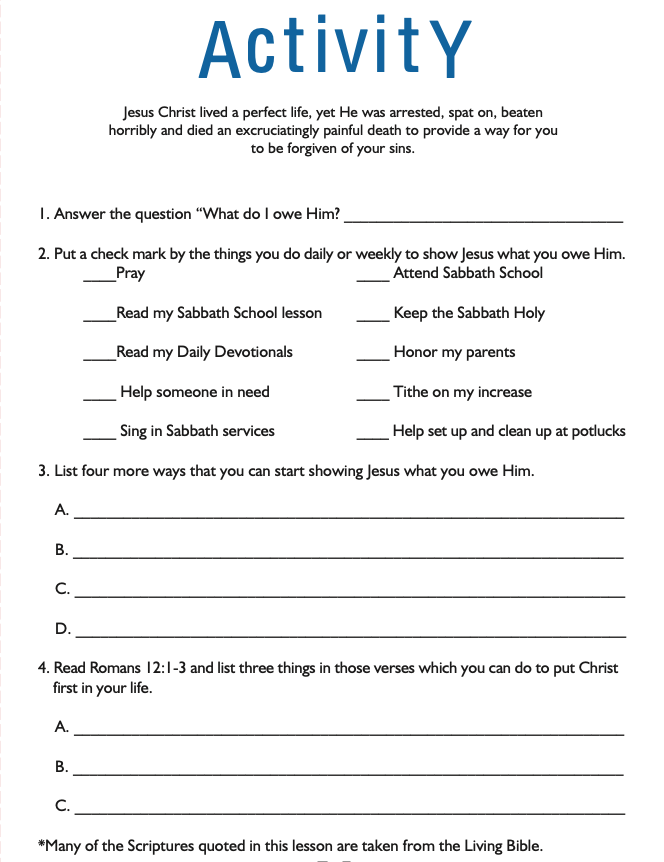
Was Pilate truly innocent? Were the religious leaders solely responsible for the death of Jesus? Or, do the Roman soldiers bear this responsibility? Who did kill Jesus? He was a perfect man who had never sinned, yet He submitted Himself to humiliation, extreme suffering and death. It was for the sins of the world, my sins and your sins, that Jesus died. “For God so loved the world (you and me) that He gave His only begotten Son that whosoever believes on Him shall not perish, but have everlasting life” (John 3:16). We are all responsible for the death of Jesus Christ. If you had been the only person to ever sin, Jesus would have still had to die to pay the penalty for your sins. Jesus set us an example of how to live, how to face suffering and how to die. He paid the supreme penalty for our sins. What do we owe Him? We owe Him a repentant obedient life that always puts Him first. We owe Him everything!
Student Prayer
Gracious Father,
Thank you for giving your Son, Jesus Christ, for my sins. I am responsible for the death of Jesus Christ. He suffered horribly to pay for my sins. Help me to always show my gratitude in an obedient life where I put Him first.
In Jesus’ name I pray.
Amen.
Daily Devotions
Sunday: Matthew 26:57-66
Monday: Luke 23:1-16
Tuesday: Matthew 27:1-2
Wednesday: Mark 14:53-65
Thursday: Luke 23:17-34
Friday: Romans 12:1-3
Saturday: Luke 23:35-48
Objectives
At the end of this lesson, students will be able to:
1. Tell the story of Jesus’ trial.
2. Discuss Jesus’ attitude when He was accused falsely, spit on and slapped.
3. Relate it to how we should respond when we’re accused fairly or falsely.
Topics & Themes
Angels
Betray
Blasphemy
Disciples
Judas
Fulfillment of Prophecy
God’s Love
Jesus, Crucifixion of
Jesus, Death of
Jesus, Savior
Jesus, Suffering of
Jesus, Without Sin
Pilate
Sword
Materials Needed
Bible, YEA students’ and teacher’s books, attendance and memory verse charts, songbook, music player, cassette tape or CD, plastic sword, club, molding clay shaped like an ear, bowl of water and towel, and any props that will make the drama more real
How to Teach This Lesson
Tell the students that today’s lesson will be a play put on by the class. Hand out the script, and give the students a few minutes to study the part they will read in the drama and brainstorm how to present it. To set the stage for this drama, go over the information under Background. Then explain that the play starts in the Garden of Gethsemane where Jesus and His disciples had gone after partaking of the Passover. Here Jesus prayed fervently that He would not have to go through with this horrible ordeal. But He always said “Not my will, but your will be done.” The Disciples (if you have enough students), Peter and Jesus stand together as Judas and a crowd of Jewish leaders arrive with swords and clubs. Judas walks up to Jesus and gives Him a hug.
Judas: “Hello, Master!”
Jesus: “My friend, go ahead and do what you have come for.” (The Jewish leaders grab Jesus. Peter pulls out his sword and cuts off the right ear of the a High Priest’s servant. Jesus touches the place where the ear was and restores it.)
Jesus: “Put away your sword. Those using swords will get killed. Don’t you realize that I could ask my Father for thousands of angels to protect us, and he would send them instantly? But if I did, how would the Scriptures be fulfilled that describes what is happening now?”
(All the disciples flee. The mob leads Jesus to Caiaphas the High Priest’s house where the entire Supreme Court was gathered. They are busy trying to find people to testify falsely against Jesus.)
Two men: “This man said, ‘I am able to destroy the Temple of God and rebuild it in three days.’”
High Priest: (Says to Jesus) “Well, what about it? Did you say that, or didn’t you?” (Jesus remains silent.) “I demand in the name of the living God that you tell us whether you claim to be the Messiah, the Son of God.”
Jesus: “Yes, I am. And in the future you will see me, the Messiah, sitting at the right hand of God and returning on the clouds of heaven.”
High Priest: (Tears his clothing and shouts.) “Blasphemy! What need have we for other witnesses? You have all heard him say it! What is your verdict?”
Crowd: “Death! – Death! – Death!” (They pretend to spit on Him and slap Him) “Prophesy to us, you Messiah! Who struck you that time?”
Teacher explains: It’s now morning and the trial has been moved to Pilate’s court. It was the governor’s custom to release one prisoner at Passover. A notorious prisoner named Barabbas was in jail. Crowds were gathered and emotions ran high. A guard hands Pilate a note from his wife that says: “Leave Jesus alone. I had a terrible nightmare about Him last night. Pilate knew Jesus had been arrested out of envy because He was popular with the people.
Pilate: “Which shall I release to you, Barabbas or Jesus your Messiah?”
Crowd: (Shouting) Barabbas!
Pilate: “Then what shall I do with Jesus, your Messiah?”
Crowd: “Crucify Him!”
Pilate: “Why? What has He done wrong?”
Crowd: “Crucify! Crucify!”
Pilate: “Get me a bowl of water.”(He washes his hands and says to the crowd) “I am innocent of the blood of this good man. The responsibility is yours!”
Crowd: “His blood be on us and our children!”
Debrief by asking 1) how they felt about Judas, 2) how they felt about the religious leaders, 3) how they felt about Pilate and 4) how they felt about how Jesus handled so much rejection and suffering. Ask: Why did Jesus do this? Who really is responsible for Jesus’ death?
REACH Activity
Spotlight Memory Verse
In your Bible notebook, write an explanation of how the memory verse relates to this YEA lesson, “Who Killed Jesus?” Other classmates and family members can do this activity with you and then all can share their explanations with one another. Were answers similar or very different? Find three supporting or connecting Scriptures relating to the memory verse.
Where in the World?
Where was Peter after Jesus’ arrest? What was he doing? What did Jesus predict Peter would do when confronted with his friendship with Jesus? Was Jesus right? What happened to Peter? Use the Gospel accounts to record what happened to Peter after Jesus’ arrest.
They Did What Back Then?
The crowd asked for Barabbas to be released and for Jesus to die instead. Who was Barabbas? Use Bible tools to find all the information you can on Barabbas and write it in your Bible notebook. Though Jesus had never sinned He allowed Himself to suffer and die for us. What are your thoughts on the life of Jesus Christ thus far? Write down any thoughts or questions you might have in your Bible notebook. You do not need to share them.
Making It Mine
Have you ever had a friend who did something really nice for you—working very hard for you, even if it cost him or her a lot? How do you feel towards that friend? How do you treat that friend? Would you try to do something nice for him or her too?
You have a Friend who did something really nice for you. He made it possible for you to be forgiven of your sins, to be born into the family of God, and to live forever in God’s Kingdom. It cost your Friend a lot to make this gift possible for you. It meant He had to be tortured for your healing. So, how do you feel towards this special Friend? How do you treat Him? Just because you can’t see Him face to face doesn’t mean He isn’t there. And He’s waiting for you to let Him be Lord of your life.
Worldview Collision
A very common, worldly and carnal, worldview says, “Me first.” I am most important. I need to work for my own pleasures and treasures. It doesn’t matter how I get what I want, as long as I get what I want as quickly as possible. No one is as important as I am. I put myself first. This sounds incredibly self-centered and absurd. No one is really like that. Oh, but there are many people just like this. They are so good at covering up how they really feel! You would have no idea they are manipulating you to get what they want. It’s the old idea of “you scratch my back and I’ll scratch yours.” But, if you notice, they will try to get you to scratch their back a whole lot longer than you end up with your back scratched.
A Biblical worldview calls for us to give up our will, desires, and goals—completely—to God. Bringing every thought into submission to Jesus Christ is hard (2 Corinthians 10:5)! It’s not at all what our carnal nature wants! We fight daily to choose Jesus Christ, and not ourselves, to be Lord. But the goal is so great! And the reward is better than whatever puny accomplishment we could achieve through our own efforts. Remember what your memory verse was for YEA Lesson 1? Look up James 4:10 and write about its application to this topic.
Song
“I Believe in Jesus” is on page 24 of The Group Songbook.
Closing Prayer
Have the students form a circle and join hands. Ask for a volunteer to lead in prayer thanking God for His Son who made the supreme sacrifice for our sins.
Printable Pages