YEA Lesson Library
The Last Supper
About This Lesson
This lesson teaches about the events of the Last Supper, the New Testament Passover. It emphasizes the need for each person to recognize the sacrifice of Jesus if they want to be saved.
Scriptures
Isaiah 53:1-6
Isaiah 53:5
Matthew 26:17-30
Mark 14:12-26
Luke 22:7-38
John 13:1-38
John 14:1-31
Hebrews 9:21-25
Words to Know
PRONOUNCEMENT - a formal or authoritative announcement
BAR MITZVAH - A ceremony that permits a boy of 13 into the Jewish community as an adult
RAMADAN - the daily fast for Islam
The Lesson
No matter where your friends attend church, they have days they celebrate and ceremonies they perform. All religions do. Some may be very different and some very similar to what you do. Your Christian friends at school may have had a confirmation ceremony. Your Jewish friends have probably had their Bar Mitzvah by now or will very soon. Islamic people celebrate Ramadan when they fast during the day and are only allowed to eat at night. Jesus had days He celebrated and ceremonies He performed. He was obedient to His Father’s commands and always celebrated the Passover.
It was the spring of the year and all of the Israelites were cleaning their homes to get the leavening out before the Days of Unleavened Bread began. The disciples went to Jesus and asked, “Where shall we plan to eat the Passover?”
“He replied, ‘Go into the city and see Mr. So- and-So, and tell him, ‘Our Master says, my time has come, and I will eat the Passover meal with my disciples at your house. So the disciples did as he told them, and prepared the supper there” (Matthew 26:17b-19).
The sun had set and the day of the Passover had arrived. Jesus sat down with His twelve disciples. He took off His robe and wrapped a towel around His waist. He poured water into a basin and begin to wash His disciple’s feet. Peter protested, “Master, you shouldn’t be washing our feet like this!” Jesus told Peter that he didn’t understand why He was doing this. Again Peter said, “you shall never wash my feet.” Jesus told him that if he wouldn’t allow Him to wash his feet, “you will have no part with me.” At that point Peter got a little excited and said, “Lord don’t just wash my feet, but my hands and head as well.”
Jesus looked at His disciples and said, “One of you will betray me.” This must have shocked eleven of His disciples because this thought had never entered their minds. They all began to ask, “Am I the One?” Jesus told them that it was the one He had served first. He went on to explain that He was going to soon die as it had been prophesied. But Jesus’ betrayer was still on His mind, and He said “woe to the man by whom I am betrayed. Far better for that one if he had never been born.”
Wow! What a pronouncement. How would you feel if Jesus told you that it would have been better if you had never been born? Judas got his courage up and asked Jesus if he would be the one to betray Him. There was no doubt in Judas’s mind that he was the one. But he had to know if Jesus really knew that he was. Notice verse 14. Judas had already gone to the chief priests and asked them how much they would pay him to deliver Jesus into their hands. They gave him 30 silver coins. Then Judas began to look for an opportunity to betray Jesus. Yes, Jesus did know and He confirmed that Judas was the betrayer.
At this Passover, Jesus introduced new symbols into the service. He took unleavened bread and broke it explaining to the disciples to “Take it and eat it, for this is my body.” What? Jesus was giving them bread, not His human flesh. So what did He mean? He meant that the bread represented or was a symbol of His body that He would give for their healing in less than 24 hours. “But he was wounded and bruised for our sins. He was chastised that we might have peace; he was lashed – and we were healed!” (Isaiah 53:5 TLB).
The next new symbol Jesus introduced into the Passover service was wine. Jesus took a cup of wine and blessed it. He gave it to the disciples and told them to drink from this cup, “for this is my blood, sealing the New Covenant.” But the Bible strictly forbids the drinking of blood.
What did Jesus mean when He said this was His blood? Again, He was using the wine as a symbol for His blood. And He knew that in less than 24 hours He would shed His life’s blood so that your sins, my sins and the sins of the world could be forgiven. He knew that this was the only way we could have forgiveness of our sins.
In Old Testament times, when people sinned, they went to the Temple and offered the blood of an animal sacrifice for their sins. This was done looking forward to this Passover when Jesus Christ would give His life’s blood for the sins of the world. He- brews 9:22 says “without the shedding of blood there is no forgiveness of sins.” In other words, the only way your sins can be forgiven is through the shedding of blood – the blood of Jesus Christ. That’s how bad and how serious sin is. And this is what the small glass of wine in the Passover service represented when Jesus took it with His disciples and when we take it today.
All Passover services should be very solemn, and this one was particularly solemn. For Jesus knew He would soon suffer horribly and die. He told His disciples that this was the last time that He would keep the Passover with them until His Kingdom is set up on earth. Then they sang a hymn and went out to the Mount of Olives.
Think about how difficult this must have been for Jesus. He knew that every one of His disciples would desert Him in this terrible trial that He was facing. Jesus told them that they would. Oh, they didn’t think they would. Peter even reassured Jesus that “if everyone else deserts you, I won’t.” Jesus knew better. He told Peter that he would deny Him three times before the rooster crows at dawn. What would it take for you to desert Jesus? Are you as sure as Peter was that it could never happen? But when you turn your back on obeying God’s law, you are deserting Jesus. That is sin. And Jesus died that you might have forgiveness of your sins. He came to be your Lifeboat and save you from your sins. Will you repent of breaking God’s law? Will you obey Him? He gave His all for you. Will you give your life to Him?
Student Prayer
Gracious Father,
It is totally inadequate for me to just say thank you for giving your Son as a sacrifice for my sins. He paid the full penalty for what I should have received – death. I owe Him my all. I want to live every day of my life for Him. Forgive me of my sins and provide me with the strength to show Jesus how much I love and appreciate Him.
In Jesus’ name I pray.
Amen.
Daily Devotions
Sunday: Matthew 26:17-30
Monday: Mark 14:12-26
Tuesday: Luke 22:7-38
Wednesday: John 13:1-28
Thursday: John 14:1-31
Friday: Isaiah 53:1-6
Saturday: Hebrews 9:21-26
Objectives
At the end of this lesson, students will be able to:
1. Explain that the bread we eat during the Passover service is symbolic of the beaten body of Jesus in order that we can be healed.
2. Discuss why Jesus had to die such a horrible death.
3. Talk about what the foot washing ceremony means.
4. Explain that sin can only be forgiven by the shedding of Jesus’ blood.
5. Explain that Jesus gave His all for us, and we owe Him a believing, obedient life.
Topics & Themes
Betray
Blood
Bread and Wine
Covenant
Disciples
Judas
Peter
Footwashing
Forgiveness
Fulfillment of Prophecy
Jesus, Suffering of
Judas
Obedience
Passover
Peter
Rooster
Sacrifice
Sin
Materials Needed
Bible, students’ and teacher’s books, attendance and memory verse charts, songbook, cassette tape or CD, music player, construction paper, Scotch tape, pins, newsprint pad, marker pen, basin, water, towel and any other props for the drama
How to Teach This Lesson
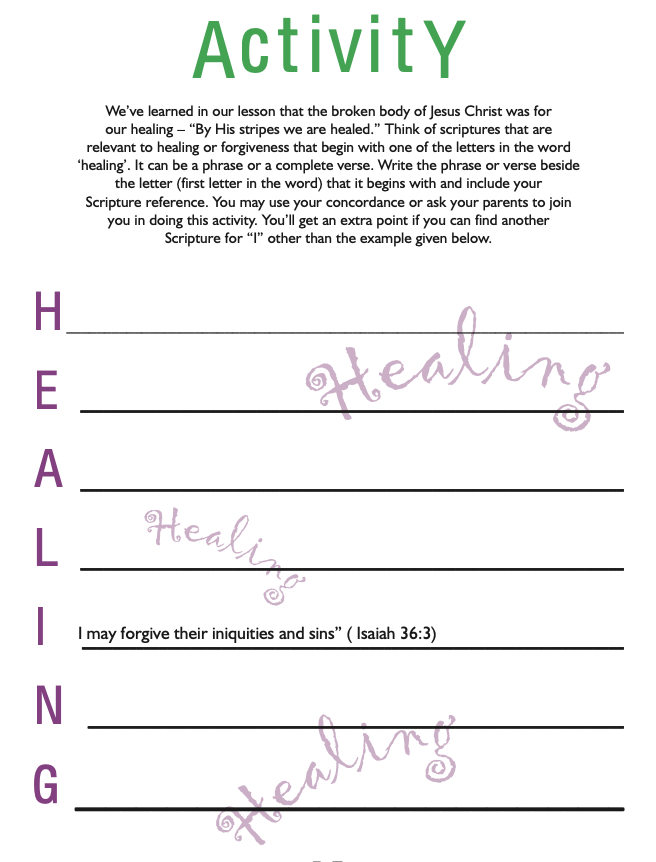
Begin the class by having the students reach under their seats and get the taped piece of paper that has their letter in “healing.” If your class is smaller than seven, allow them to draw for the remaining letters. If it is larger, two can have the same letter and work together. Tell them that you are going to want them to go to the newsprint pad and write a Scripture related to healing or forgiveness. The Scripture or phrase should begin with the letter that was under their seat. They can use the activity in the students’ book that they did prior to class to assist them. Now call for the person or persons with “H” to come to the newsprint pad and write her Scripture. Next have the student with “E” write his Scripture or phrase on the pad. Continue until every letter in healing has a Scripture with its reference beside it. Give a small award to everyone who has not only completed this assignment, but has used a different Scripture for the “I.” Then debrief.
The importance of Christ’s suffering - Why didn’t the Roman soldiers just take Jesus out and shoot Him since He had to die for our sins? Why do you think it was necessary for Jesus to suffer such a horrible beating and death? What did your lesson teach you that provides healing for us? Christ’s body – “By His stripes we are healed.” Explain that virtually all churches understand that it was necessary for Christ to shed His blood in order that we can have forgiveness of our sins. But few under- stand the importance of the “bread” in the Passover service or Lord’s Supper. Ask: How is the unleavened bread that we eat in the Passover service important to us? Ask one of the students to read aloud 1 Corinthians 11:28-30. Why are many sick? Because they don’t under- stand and believe that it is by Christ’s stripes – His body that we are healed. What does it mean for some to sleep? It means that some have died because they did not properly “discern the Lord’s body.” What does that mean? It means they did not recognize and accept the body of Christ for their healing.
The shed blood of Christ - Was there a different way for people to have forgiveness of their sins in the Old Testament than for us today? No! Even though they sacrificed an animal, blood was shed looking forward to the death of Christ through His shed blood. What did Christ mean when He blessed the cup of wine and said this is my blood?
Jesus was deserted - How did you feel when all of Jesus’ disciples deserted Him while He was undergoing the greatest trial in His life? Why do you think they deserted Him? Because of their concerns about what others would think if they found out they were with Jesus. Had you been there, would you have deserted Him? In what ways do you think we desert Him today? Jesus gave His all for us, what can we give to Him to show our love and appreciation?
Teacher-Directed Activity
This story has an awful lot of drama. Have the students act it out. Each student is to play the part of the disciple or Christ that they drew as they came into class. If there aren’t enough students in your class for all of the parts, the kids can play more than one part. Read the story aloud from a modern translation and pause in the right places for the students to act out their parts. You will need to put the narration together before class from the four different Gospels.
REACH Activity
Spotlight Memory Verse
Read Isaiah 53. Divide the chapter into sections for the class or your family to memorize. Plan a weekly Bible study based on this chapter of Isaiah until all verses are memorized. In your Bible notebook, write down what you have learned from the study, and three supporting or connecting Scriptures relating to the memory verse.
Where in the World?
Studying the culture and history of biblical times can be very exciting and challenging. One recent source that has grabbed a lot of attention is the Archaeological Study Bible published by Zondervan. If possible, check out one from your local library or view a copy at your local Christian bookstore.
Christian tradition, supported by Cyril of Jerusalem (c. 310-386), identifies the site of Holy Zion Church in Jerusalem as the place where the upper room was located (NIV Archaeological Study Bible, Zondervan, 2005). Using Bible tools, research the “upper room” and share the information with the class or your family.
They Did What Back Then?
Use your Bible and Bible tools to compare and contrast the Old Testament Passover with the Passover service instituted by Jesus Christ. Create a chart, poster, or diagram to show the similarities and differences and support them with Scriptures. Present your findings to the class or your family.
Making It Mine
Your YEA lesson memory verse says, “But he was wounded and bruised for our sins.” Have you thought about that verse seriously? As you’re reading your Daily Devotionals this week, spend a little extra time. Put yourself in Jesus’ place. After all, Jesus was innocent. He didn’t deserve what happened to Him. But you do. You have sinned and deserve punishment and death. So put yourself in Jesus’ place in the story—because it is really your place that He took instead.
Worldview Collision
False worldviews, religious and secular, may dismiss Jesus Christ as a great prophet, a myth, or a created being. But a true biblical worldview rests on the foundation that Jesus Christ was God, come in the flesh, giving up His divine glory to become fully man. God, the One who was co- Creator with the Father, became a tiny human baby and lived His life on this earth as human, so that He could become the atoning sacrifice for those who accept the free gift of life through Him. Jesus was, is, and always will be God. Your Bible says He is. Your future rests on this truth.
Song
“One Bread, One Body” is on page 48 of The Group Songbook.
Closing Prayer
Have the students form a circle and join hands. Ask for a volunteer to lead in prayer thanking God for His Son giving His body and blood that we might have healing and forgiveness of our sins.
Printable Pages