YEA Lesson Library
More Than Looks
About This Lesson
This lesson teaches that God expects us to produce fruit, especially goodness (moral excellence) in helping others.
Scriptures
Matthew 7:19-21
Matthew 21:18-22
Mark 11:12-14
Mark 11:20-24
Galatians 5:19-26
Galatians 5:22
James 3:16-18
Revelation 22:1-5
Words to Know
EXCELLENCE - the fact or state of excelling; superiority
PICTURESQUE - visually charming or quaint
ASTONISHING - causing surprise or amazement
The Lesson
Have you ever gone to the mountains to ski? Snow is a most necessary part of this excursion– no snow, no skiing. So if there’s not a good pack of snow on the ski slopes, they put up signs that say “pray for snow.” If you’ve gone to all the trouble to get your ski cloths and gear, you want it to snow, and snow a lot of that white powdery stuff. You want to see snow on the evergreens and drifts and mounds stacked high. Oh, that beautiful white stuff! What’s prettier than a fresh fall of snow? We all love the picturesque winter wonderland. It’s beautiful!
But what if that big snow fall comes as you’re starting down the mountain for home? Every car, roof top and the roads are now covered with blanket of at least a foot of snow. The weather report says flakes are piled two, three and five feet tall and getting deeper. What if you have no chains for your tires? The snow may look beautiful, but getting down the mountain safely can be more important than looks. Driving in snow can be very dangerous if you don’t have chains. Icy spots can form. Before long you can do a fast 180 and find your car pointed in a direction you had never intended to go. There is more to snow than just looks. It can cause a person’s death.
Jesus had spent the night in Bethany and the next morning He headed out to Jerusalem. He was hungry and notice a beautiful fig tree beside the road that was all leafed out. Fresh ripe figs right off the tree can taste mighty good when you’re hungry. So Jesus went over to the tree to find some figs to eat. He pushed back the branches and the leaves and began searching for at least a single fig, but only found leaves. That fig tree looked beautiful with all its leaves, but there was no fruit on the tree. The tree hadn’t served its purpose, which was to bear fruit. So Jesus made the point that there’s more to a fig tree than just looking good.
He said to the fig tree, “Never bear fruit again!” An astonishing thing happened. In just a short time, the fig tree went all limp and withered up. He had some of His disciples with Him and they were utterly amazed. They asked Jesus, “How did the fig tree wither so quickly.” You know, they may have asked the wrong question. Maybe they should have asked, “Why did the fig tree wither so quickly?”
Oh, Jesus was hungry, but was eating a fig to satisfy His hunger that important to Him? Remember, He fasted for forty days before Satan tempted Him. So He knew He wouldn’t die if He didn’t find a fig to eat on that tree. But what about the tree? It died!
If Jesus could make do without having a fig to eat, what was He trying to tell us? Jesus said, “Every tree that does not bear good fruit is cut down and thrown into the fire. Thus, by their fruit you will recognize them” (Matthew 7:19). This fig tree on which Jesus searched for figs, didn’t bear any fruit, so He told it to never bear fruit again and it immediately withered or died. What is the message for you? There are two. One message is that we must bear fruit or we will wither and die just like that fig tree did. We will be cut down and thrown into the fire. And two, Jesus knows that we are His children by the kind of fruit we bear.
What are fruits a Christian should bear? Galatians 5:22 says the fruit of the Spirit is “love, joy, peace, patience, kindness, goodness, faithfulness, gentleness and self-control.” Does this sound like the type of person you are? Can your friends at school see these fruits in your life? If Jesus went searching for fruits in your life and looked beyond the “leaves’ such as designer jeans and Tommy Hilfiger sweaters, would he see a heart filled with love, joy, and peace? What about patience and kindness? Are you a little short on patience and kindness when your sibling doesn’t do what you want and when you want it?
What about goodness? Do you know what that means? Goodness is moral excellence. Would you say a person with moral excellence wouldn’t use drugs, smoke, have sex until he’s married, including oral sex? Do you think a person filled with goodness would cheat on an exam or shoplift? Would they be home at the time their parents set for them?
Obtaining these fruits are for your own good. But if you’re going to have goodness, or moral excellence, you must go beyond doing what is good for you and do good to others. Look around you, there’s never a day that passes that someone in your community doesn’t need help that you can give. If your moral excellence is more than looks, start with your family. What can you do each day to lighten your mom’s load? She get’s tired too. Can you put the dishes in the dishwasher, fold the clothes, clean your room, feed the dog, or put the groceries away, without being asked or complaining?
What about your church? Is there an elderly or sick person you can send a card? Can you help straighten chairs after service? Can you hand out songbooks or the bulletin? What about your community? Can you serve meals to the poor and needy at your local Salvation Army on Christmas day? This is not keeping Christmas. It’s taking care of the needs of the poor and hungry. The Salvation Army usually runs short of volunteers on this holiday. Can you adopt an elderly person at a nursing home and take them flowers, read the Bible to them, pick up things they need from the store? Bearing these fruits will keep you from withering as the fig tree did. These things are goodness – moral excellence. Doing these things are more than looks!
Student Prayer
Loving God,
There was a reason why Jesus caused the fig tree to wither. It wasn’t bearing fruit. Thank you for this lesson that shows so clearly that I must bear fruit or I may wither as fast as the fig tree. Help me now to live a life that is more than looks. Grant that I may have a life filled with moral excellence.
In Jesus’ name I pray.
Amen.
Daily Devotions
Sunday: Matthew 7:19-21
Monday: Matthew 21:18-22
Tuesday: Mark 11:12-14
Wednesday: Mark 11:20-24
Thursday: Galatians 5:19-26
Friday: Revelation 22:1-5
Saturday: James 3:16-18
Objectives
At the end of this lesson, students will be able to:
1. Explain that Christ expects to find more than good looks when He returns. He expects to find the fruits of the Spirit.
2. Explain that if we do our good deeds secretly, God will reward us.
3. Tell what happens to Christians who don’t bear fruit in their lives.
4. Recite the fruits of the Spirit.
Topics & Themes
Bearing Fruit
Fig Tree
Fruit of the Spirit
Goodness
Helping Others
Obedience
Materials Needed
Bible, YEA students’ and teacher’s books, attendance and memory verse charts, songbook, cassette tape or CD, music player, poster paper, construction paper or crayons, glue, Scotch tape, marker pen, awards
How to Teach This Lesson
Remind the class that two weeks ago they were asked to do as many Secret Service projects as they could for the next two weeks. Tell them that today, we all want to hear their stories. But first, look at the fruits of the Spirit on the wall. The class wants to hear about your exciting Secret Service projects. I will tell my story first, and then we want to hear each of you tell yours. As we tell about our projects, we’ll stand in front of the particular fruit of the Spirit that best fits our project. When you have two or more projects to tell us about, if your story depicts a different fruit, move in front of it as you talk.
Give the class a few minutes to think about which fruit of the Spirit their Secret Service projects best fits. After two or three minutes, tell the class that you want to begin first to show them how its done. Select your fruit and stand in front of it and relate your story by making it as interesting and humorous as possible. Tell why you feel your project reflects love, joy or whatever fruit you choose. Let them know how you kept others from seeing you when you did your service and any results you’ve seen from doing it. Move to the next fruit that your project best fits and do the same thing. Now ask for a volunteer to tell about their Secret Service project. Allow all of the students to tell their stories in front of the fruit posters.
Debrief - by asking the following questions: How did you feel about doing good to another person when that person didn’t even know you did it? Have you had any response from the person for whom you did good? What was it? What did you learn from this project? Why do you think I asked you to keep your service project a secret? Ask one of the students to read Matthew 6:1-5. How does it feel to trust God completely for your reward when you help another person? Do you think He’s more or less likely to reward you than the person you did good to? Why or why not?
More Than Looks - What comparison can you make to the importance teens place on clothes and getting the right look to the fig tree that Jesus searched for fruit?
Purpose of bearing fruit - What is the purpose of bearing fruit? What happened to the fig tree that had no fruit? What do you think will happen to Christians who don’t bear fruit? Ask one of the students to read Matthew 7:19. Why do you think a Christian would not bear fruit? (They don’t believe God, their priorities are mixed up, and they could even be cowards.) Ask another student to read Revelation 21:8. Who wants to experience a death like that? What can you do to prevent that from happening to you?
Survey the class - to see who did the most Secret Service projects and award that person for loving God so much that they served other people. Also, give a small award to everyone who can say their memory verse.
Teacher-Directed Activity
For your class to “bear much fruit” have them brainstorm the ideas they listed in the activity in their book and plan a class community project to do. It can be serve one day in a soup kitchen, adopt a granny in a nursing home and take her flowers, read the Bible to her, send cards to her, etc. Allow the students to decide what they want to do and when. Let them follow through by making all of the arrangements.
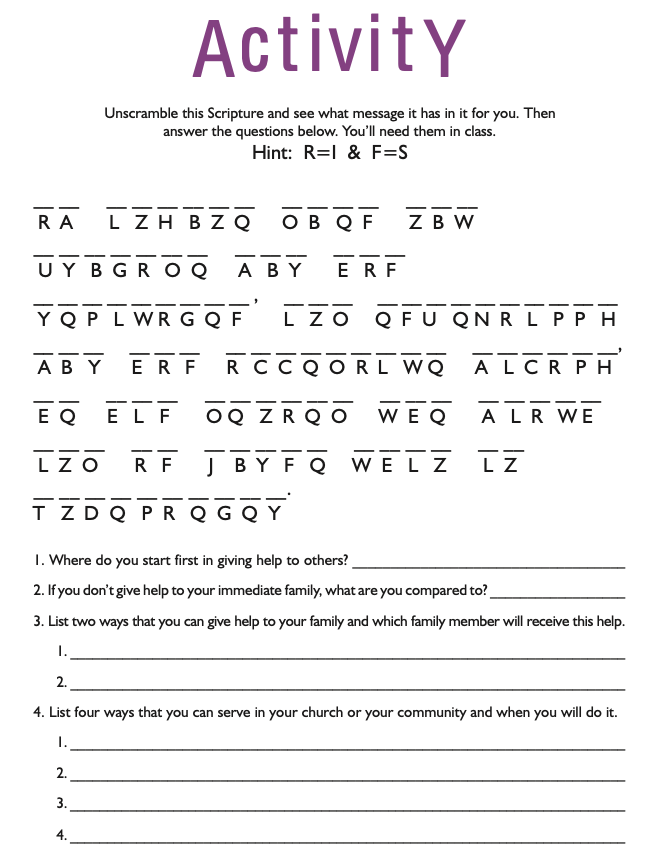
Answer to Students’ Activity: “If anyone does not provide for his relatives, and especially for his immediate family, he has denied the faith and is worse than an unbeliever.”
REACH Activity
Spotlight Memory Verse
With a classmate or family member discuss how the YEA lesson memory verse relates to the story of the fig tree. In your Bible notebook make a list of the fruit of the spirit. Next to each fruit write examples of how it is evident in your life or the life of someone you know. How does the title of the lesson relate to the memory verse? Write three supporting or connecting Scriptures relating to the memory verse in your Bible notebook.
Where in the World?
Use Bible tools to research the land between Bethany and Jerusalem. What did you find remarkable in your research? Has this land changed and if so, how? Write the information in your Bible notebook and share it with the class or your family.
They Did What Back Then?
Picture yourself as a disciple of Jesus’ listening and observing the story of the fig tree. What would you be thinking? In your Bible notebook, describe the experience as well as your feelings and reactions.
Making It Mine
Can you show love to others and not be loving? Can you be joyful and not be filled with joy? Can you show patience and not truly be patient? Of course. Actors play roles all the time, demonstrating characteristics which may or may not be a true reflection of who they really are. Just pretending you are loving doesn’t make you loving. So, how do you get these beautiful characteristics? You have to completely submit yourself to God. You have to let Him be Lord of your life. You have to let Him be in charge. When you’re ready to do that, and you take the step to baptism, God promises you’ll be given the Holy Spirit. The fruit of that Spirit in you is listed in Galatians 5:22-23.
Worldview Collision
Beauty is only skin deep, but ugly goes clear to the bone. Ever hear that statement? It may be an accurate description for someone who doesn’t know Jesus, but it is completely false for the serious Christian.
In a false worldview, beauty is defined by what is seen on the outside, the cosmetic wrapping. And sometimes worldly people show a good side only when it benefits them to do so. Their beauty is barely even skin deep. Or they can be physically beautiful—as defined by their success in front of a camera—which rapidly disappears with age. Ugly, of course, is a subjective description for whatever is repulsive to the beholder.
In God’s definition of beauty and ugliness, both go deeper than the bone. Beauty encompasses those behaviors outlined in the fruit of the Spirit. Ugly is the fruit of the carnal nature. Read these two lists in Galatians 5:19-23. If you are a child of God, and have God’s Holy Spirit inside, you are truly beautiful (1 Peter 3:3-4).
Song
“When The Spirit Says Move” is on page 92 of The Group Songbook.
Closing Prayer
Have the students form a circle and join hands. Lead them in prayer asking God to help your class individually and collectively to “bear much fruit” so they will not wither and be cast into the lake of fire.
Printable Pages