YEA Lesson Library
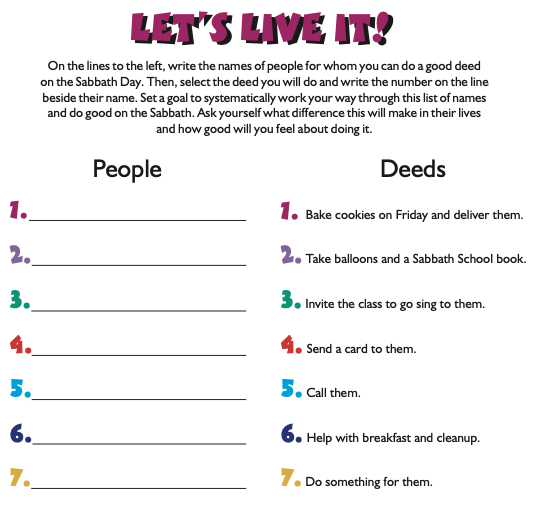
Let’s Live It!
About This Lesson
This lesson teaches the importance of obeying God by keeping the Sabbath holy and then talks about what behavior is appropriate on the Sabbath.
Scriptures
Genesis 2:1-3
Exodus 20:8-11
Exodus 20:8-10
Leviticus 23:3
Deuteronomy 5:12-15
Isaiah 58:13-14
Matthew 12:1-13
Mark 2:23-28
Luke 6:1-11
John 5:1-19
The Lesson
God stepped out in space and said, “Let there be light.” He spent six days creating the heavens with the stars, moon, and sun. He made the earth, water, light, all the animals, birds, and fish. Then He created Adam and Eve. This was an awesome project and a very busy week. God was very pleased with His creation. He took a day off and rested.
Have you ever worked so hard that you longed for a day to sleep in and rest? Rest can be a tremendous blessing. God made us so we need to rest. He never intended us to work seven days a week. He knows we need to rest and recharge our batteries.
After a good night’s sleep, you may ask, “Now what can I do on the Sabbath?” Let’s see what Jesus did. He was human like you when He lived on this earth. He faced that question every seven days just like clockwork.
One Sabbath Jesus and His disciples were walking through a grain field. They were hungry and broke off some grains of wheat. They rubbed off the husk and ate the grain. The Pharisees saw it and said, “They can’t do that, it’s illegal to work on the Sabbath.”
Jesus asked them if they had read about King David. He and his men were hungry and ate the shewbread (a special bread that’s required by the law to be placed before God) in the Temple. Jesus showed that human needs can take precedence over the law.
On another Sabbath, Jesus was in the synagogue teaching. A man with a deformed hand was present. The Pharisees watched to see if Jesus would heal the deformity on the Sabbath. They were eager to find fault in Jesus.
Jesus looked the Pharisees and teachers of the law straight in the eye and asked, “Is it right to do good on the Sabbath day, or to do harm? To save life, or to destroy it?” He asked the man to stretch out his hand. When the man obeyed, his hand became completely normal. The Pharisees were not happy because Jesus was more concerned with taking care of human needs than being picky about keeping the Sabbath.
The Bible plainly shows it is wrong to work on the Sabbath (Exodus 20:8-11). But Jesus shows that we can do good on the Sabbath. It is all right to see to human needs.
What are some human needs you can take care of on the Sabbath? Lesson eight has some suggestions. Think how happy you can make a sick child by taking him a “get well” balloon or a Sabbath School book suited to his age. The Sabbath can be a delight for the child because you cared enough to visit him. It will also be a delight for you because you made the Sabbath special for a suffering child.
What other things can you do? People in nursing homes would enjoy hearing your class sing to them. Call or visit a sick person who didn’t make it to Sabbath Services. Delight an elderly neighbor by stopping by to say “hello” or take them some cookies.
You may wonder, “What’s in it for me if I keep the Sabbath instead of doing the things my friends do on Saturday?” Proverbs 3:1-2 says, “My son, never forget the things I’ve taught you. If you want a long and satisfying life, closely follow my instructions.” Not burning the candle at both ends seven days a week has benefits—a long and satisfying life.
Isaiah 58:13-14 says, “If you keep your feet from breaking the Sabbath and from doing as you please on my holy day, if you call the Sabbath a delight and the Lord’s holy day honorable, and if you honor it by not going your own way and not doing as you please or speaking idle words, then you will find your joy in the Lord, and I will cause you to ride on the heights of the land and to feast on the inheritance of your father Jacob. The mouth of the LORD has spoken.”
Wow, what a promise! But receiving these benefits may require some waiting. Giving up something today for a much greater reward later is called, “deferred gratification.” There will always be another ball game to go to and another movie to see. You have six days a week to do those things. Is it worth it to trample on God’s Sabbath day and miss out on such a great inheritance and reward?
How do you know what you can and cannot do on the Sabbath? Search your Bible. Ask yourself, “What would Jesus do?” A good rule of thumb is not to do anything Jesus wouldn’t do on the Sabbath. Do you believe in keeping the Sabbath? Then live it!
Student Prayer
Dear Father,
Jesus says that He is the Lord of the Sabbath. He says that it is lawful to do good on the Sabbath. I’m often tempted to do things that would break your Sabbath. Help me to keep the Sabbath as you would have me do. It is for my good because the rewards and the inheritance you have for those who call your Sabbath a delight are far better than doing the things that other kids do. Help me to live it.
In Jesus’ name.
Amen.
Daily Devotions
Sunday: Exodus 20:8-11
Monday: Deuteronomy 5:12-15
Tuesday: Mark 2:23-28
Wednesday: Matthew 12:1-13
Thursday: Genesis 2:1-3
Friday: John 5:1-19
Saturday: Leviticus 23:3
Objectives
At the end of this lesson, students will be able to:
1. Explain that the Sabbath is a day of rest and a day to do good.
2. Describe how they should search the Bible to find out what Jesus did on the Sabbath and do what He did.
3. Explain that God has a wonderful inheritance and reward for those who keep His Sabbath and call it a delight.
Topics & Themes
Creation
Holy Conduct
Jesus, His Ministry
Rest
Reward
Sabbath
Sabbath Conduct
Work
Materials Needed
Bible and The Living Bible, YEA students and teacher’s books, chalkboard or newspaper pad, chalk or marker pen, pencils, 2 candles, matches, tweezers, something to protect the floor, and awards for the students who can recite the books of the New Testament, CD/cassette tape and player and songbook
How to Teach This Lesson
By sequentially following the questions laid out below, you will be well equipped to stay on track, complete every section and meet the objectives of this lesson.
How many of you were very tired last night after a hard week of school and/or work? Did you get to sleep in this morning? How did it feel? After God created the earth and all that is in it, what do you think He did on that first Sabbath? (He rested and enjoyed His creation.) Do you think He felt like He was missing out on something?
What do you feel are the pros and cons for keeping the Sabbath? Write “Pros” on one side of the chalkboard and “Cons” on the other side. List the points students give under the appropriate side.
What do you think it would do to your health if you never stopped and rested a day? Why do you think God made the Sabbath day? Ask one of the students to read Mark 2:27 aloud from The Living Bible. He made the Sabbath as a gift for man.
Since man is the one who is to benefit from the Sabbath, do you think God made it to hurt you, or was it for your good?
In Deuteronomy 5:32 we find, “So Moses told the people, ‘You must obey all the commandments of the Lord your God, following His directions in every detail, going the whole way He has laid out for you, only then will you live long and prosperous lives in the land you are to enter and possess.’” What did Moses tell the people they had to do? Write these three lines on the board: Obey all the commandments, follow God’s direction in every detail, go the whole way God has laid out for you. Under that write “benefits.”
What are the benefits for doing those things? You’ll live a long and prosper life. How do you feel about these benefits?
Do you consider the Sabbath to be the best day of the week, or does it seem to go on forever? The teacher should describe a typical Sabbath in her home giving many details. Ask each student to give a synopsis of a typical Sabbath in their home. What types of things would you like to see changed about the way you and your family keep the Sabbath?
Do your friends know that you keep the Sabbath? What things can you do to make them want to keep the Sabbath? Ask a student to read Isaiah 58:13-14 aloud. What are God’s promises to you if you call the Sabbath a delight and the Lord’s holy day honorable? You’ll ride on high places and get your full share of blessings.
Is having a “pity party” about having to keep the Sabbath really calling the Sabbath a delight?
What do you remember about the principle of deferred gratification? You defer a pleasure now to have something greater at a later time.
What good deeds did you write in your book under “Let’s Live It!” What good deeds can we do on the Sabbath as a class? Allow the class time to put forth their proposals and to agree on a plan of action.
How do you think Jesus felt when He did the good deed of healing the man’s deformed hand? How will you feel when you do good deeds?
Teacher-Directed Activity
Ask a student to hold one of the candles. Remove some of the wax from the bottom of the other candle to expose the wick. Have one of the students hold this candle in the middle with tweezers to prevent being burned. Put something on the floor to protect it from dripping wax. Light both ends of the candle where the wax has been removed, and then light the other candle. Tell the students that we want to see which candle will last the longest. Think of the candle burning at both ends as people who don’t take a day of rest each week. The other candle represents the Christian who keeps the Sabbath. Ask: What does this tell us about the benefits we gain from taking a day of rest each week? (You’ll live longer and not burn out as quickly.)
This is the day for the students to repeat the books of the New Testament. Be sure and give each student who can say the books of the New Testament a reward and commend them on a job well done.
REACH Activity
Memory Verse Spotlight
What does the word “remember” mean in the memory verse? What else does the Bible say about “remember” or “remembering”? Find two Old and two New Testament verses that teach what God wants you to “remember.” Share and compare your verses with someone else’s verses.
Where in the World?
What exactly is a “synagogue”? What does the word mean? What do synagogues look like inside and outside? Where were the synagogues in Jesus’ day and why would He be teaching in one? Where is the largest number of synagogues in the world today? Why? Choose a way to creatively share your information.
They Did What Back Then?
While Jesus had many followers, the Pharisees and Sadducees challenged Jesus at almost every turn. Why? Who were these men and why would they feel uncomfortable with what Jesus was teaching? Today people speak out against the teaching of Jesus Christ, too. Research who the Pharisees and Sadducees were and compare their complaints against Jesus with the complaints of people today. (This can be done as a group. Newspapers and news magazines, as well as Internet sites may be helpful.)
Making It Mine
Write about the last time you missed out on something because it was on the Sabbath. Include how you felt and what you did instead. Write it all down—your frustrations, discontent, whatever. Then, imagine Jesus is standing in the room with you. Stand up and read out loud what you’ve written. Jesus already knows you are frustrated (if you are). He knows your discontent (if it’s there). He knows what’s in your heart. Writing it all down and saying it out loud will help you to put it all into perspective.
Worldview Collisions (see introductory information for an explanation)
A biblical worldview promotes an attitude of seeking to please God. A secular worldview promotes an attitude of pleasing yourself. What’s better? Pleasing the Great God of the universe, the Creator of all, the Savior of the world, or pleasing yourself who cannot create anything, isn’t the god of anything, and cannot even save you. From a logical standpoint, spending time doing anything but pleasing our Awe- some God makes absolutely no sense. Find three to five Scriptures that talk about pleasing God. What pleases Him? What doesn’t please Him? Make a list. The next time you have a choice about what to do, think about those lists. Where would that choice go—the pleasing-God list or the pleasing-me list?
Questions
As you’re working through the YEA lesson, Daily Devotionals, doing the activity, or reading the Bible, be sure to write down any questions you have. That way you’ll remember to ask someone. Also remember to share the really interesting things you’re learning with family and friends.
Song
“Morning Has Broken” is on page 7 of The Group Songbook.
Closing Prayer
Ask one of the students to lead in prayer.
Printable Pages