YEA Lesson Library
An Angel Visits
About This Lesson
This lesson relates the birth of John the Baptist and our proclivity in not believing God.
Scriptures
Psalm 66:19-20
Isaiah 40:3
Malachi 3:1-6
Malachi 4:1-6
Matthew 6:9-13
Matthew 11:26-27
Matthew 17:10-13
Mark 1:1-8
Luke 1:5-25, 57-80
John 1:6-8, 19-28
James 5:15-18
The Lesson
What is the biggest surprise you’ve ever had, something good that unexpectedly happened to you? Weren’t you thrilled beyond words? Was this the happiest moment of your life? People in the Bible were no different from us. They had pleasant surprises. Sometimes these events changed their entire lives, and they can change your life, too.
The Roman king, Herod, ruled Judea. He was appointed to be in charge of the people. The Temple in Jerusalem was still standing, with priests burning incense to God daily in sacrifice. Authorities say there were so many priests at that time that a priest could only offer the daily sacrifice once in his lifetime.
A priest named Zacharias, and his wife Elizabeth, were good people, careful to please God and keep His commandments. They were old and had no children, even though they prayed earnestly for a child. Being child- less brought sorrow and shame to Elizabeth.
At last, the day came for Zacharias to enter the inner sanctuary and burn incense before God. Many people were outside the Temple praying. This was the climactic moment of Zacharias’ priestly career. It was a most dramatic moment.
Suddenly, the angel Gabriel appeared to Zacharias. He was startled and terrified.
Gabriel said, “Don’t be afraid, Zacharias! For I have come to tell you that God has heard your prayer, and your wife Elizabeth will bear you a son! And you are to name him John. You will both have great joy and gladness at his birth, and many will rejoice with you. For he will be one of the Lord’s great men. He must not touch wine or hard liquor, and he will be filled with the Holy Spirit, even from before his birth! And he will persuade many a Jew (Israelite) to turn to the Lord his God” (Luke 1:11-16).
Gabriel said that John would prepare the way for the Messiah to come. John’s preparation for Jesus fulfilled a prophecy given long before that. “The voice of one calling: ‘In the desert prepare the way for the Lord, make straight in the wilderness a highway for our God’” (Isaiah 40:3 NIV).
Zacharias couldn’t understand how he could have anything to do with this prophecy. “Zacharias said to the angel, ‘But this is impossible! I’m an old man now and my wife is also well along in years.’” Do you think you would be like Zacharias? Would you believe you could play a part this prophecy being fulfilled if you were as old as Zacharias?
The angel replied, “I am Gabriel! I stand in the presence of God. It was He who sent me to you with this good news.” Because Zacharias didn’t believe God’s message, Zacharias wouldn’t be able to talk until his son was born. How would you cope if you couldn’t talk for at least nine months? He must have written a lot of notes to Elizabeth!
The people outside the Temple became concerned that it took Zacharias so long to come out.When he finished his Temple duties, Zacharias returned home. Soon afterwards, Elizabeth became pregnant, even though she was “too old” to have a baby. She was ecstatic! God had taken away her disgrace by giving her a son.
Elizabeth and Zacharias celebrated the birth of their son with friends and neighbors. They circumcised their son when he was eight days old, according to the law. Everyone expected the baby to be named Zacharias after his father. But Elizabeth said, “His name is John.” Everyone was confused, because there was no one named John in the family.
Someone asked Zacharias what the baby’s name would be. Zacharias couldn’t speak, so he wrote, “His name is John!” As soon as he wrote this, Zacharias could talk again! He trusted God and was obedient to Him. Zacharias was filled with the Holy Spirit, and he thanked God and prophesied about his newborn son, John. Elizabeth’s and Zacharias’ friends had lots to talk about. They were probably as surprised as Elizabeth and Zacharias. They didn’t have email or telephones, but the news must have traveled fast.
When you experience dramatic answers to your prayers, as Zacharias and Elizabeth did, are you filled with praise and thanksgiving to God? Or, maybe you don’t have dramatic answers to your prayers because you don’t expect them.
Not believing God is very human, and Zacharias was just as human as you are. He prayed and didn’t believe it when God answered his prayer. Has that ever happened to you? Your prayer was answered, but you didn’t believe it actually happened. Or, maybe you didn’t believe the answer came from God. Are you like the people who prayed for rain in a drought, but didn’t believe enough to take along an umbrella? Are your prayers just idle words? When you pray, do you really believe God will answer your prayers? God wants you to pray, believing He will answer!
Student Prayer
Dear Heavenly Father,
It is such a privilege to talk with you in prayer. I know you can make things happen for me that I can never do for myself. Help me expect answers to my prayers and to learn to pray effectively and fervently.
In Jesus’ name I pray.
Amen.
Daily Devotions
Sunday: Mark 1:1-8
Monday: John 1:6-8, 19-28
Tuesday: Matthew 17:10-13
Wednesday: Matthew 11:26-27
Thursday: Malachi 4:1-5
Friday: Malachi 3:1-6
Saturday: James 5:15-18
Objectives
At the end of this lesson, students will be able to:
1. Explain that Zacharias and Elizabeth were past childbearing years when God miraculously gave them a son.
2. Explain that when Gabriel appeared to Zacharias, it was his day to offer the daily sacrifices, the highlight of his entire priestly experience.
3. Explain that Zacharias couldn’t talk for over nine months, because he didn’t believe the message God gave him through Gabriel.
4. State that when we pray, we should expect an answer.
Topics & Themes
Belief
Elizabeth
Fulfillment of Prophecy
Gabriel
John the Baptist
Prayer
Prayers, Answered
Temple
Zacharias (and Elizabeth)
Materials Needed
Bible, YEA students and teacher’s books, paper, pencils, chalkboard and chalk, tape player, songbook and CD/cassette tape of song
How to Teach This Lesson
By sequentially following the questions laid out below, you will be well equipped to stay on track, complete every section and meet the objectives of this lesson. Start the class by saying: We all like pleasant surprises. From time to time our parents or one of our friends surprises us. It may be a gift, on our birthday or at other times. Pleasant surprises add something special to our lives.
Who would like to tell us about the biggest or best surprise that you have ever had? (Piggyback on the students’ answers and encourage others to relate their experiences.) How did you feel when someone gave you a pleasant surprise?
You read in your lesson that the angel Gabriel appeared to Zacharias while he was perform- ing his duties in the Temple. How would you feel if an angel appeared to you? How would you know if it was truly an angel from God? (1 John 4: 1 Try the spirits.) How do you think Zacharias felt when an angel appeared to him? (Startled and terrified.)
Why do you think Zacharias didn’t believe the angel? (Because he and his wife were old and were beyond the childbearing years.) Zacharias and his wife Elizabeth had prayed for a child. Have you ever prayed for something, yet never really expected it to happen?
What was significant about the birth of John? (It fulfilled the prophecy of one coming to prepare the way before the Messiah.) Do you think Zacharias thought that he would have anything to do with prophecy being fulfilled?
After the angel appeared to Zacharias, he couldn’t speak for more than nine months. Why was that? (He didn’t believe the message God sent through the angel.) What lessons can we learn from Zacharias being dumb for more than nine months? (It is important to believe God.) Since having children was very important to a married couple in the days of Zacharias and Elizabeth, they must have prayed that God would give them a child. How long do you think it might have taken for Zacharias and Elizabeth to get an answer to their prayer to have a child? (They could have prayed as much as forty years before an answer came.) What would that tell us about God’s timetable for answering prayers? (Sometimes He answers our prayers a long time after we’ve given up.)
Have you heard the story about people praying for rain during a drought, but they never carried an umbrella with them? What are some things that you may have prayed for, but showed no outward signs of faith? (Provide the right kind of friends, give them favor in the eyes of their teacher when they ask to be out of school for the Feast, etc.)
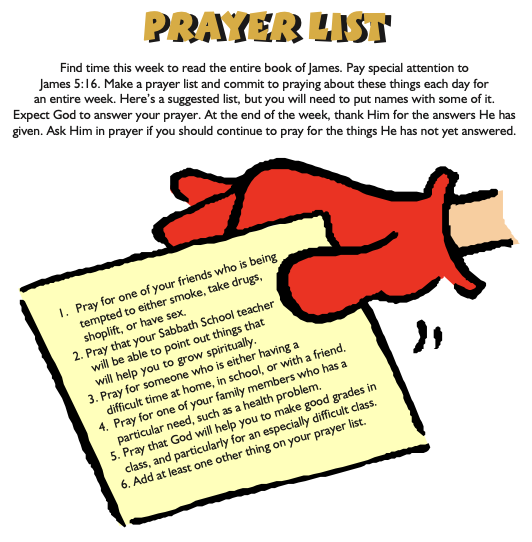
Ask one of the students to read James 5:15- 18 aloud. What does God require of you before your prayers will be answered? (Faith, confession of your faults, effectual fervent prayer, must be righteous, earnestness)
Who would like to share an incident when you had an answer to prayer? If you will set aside a time each day to kneel and pray, what difference can it make in your life? (God can go before you and make good things happen.) What difference can it make in the lives of your friends and loved ones? (God can heal them, protect them, give them courage to resist sin, help them in time of need, etc.)
What effect will prayer have on your relationship with God? (Talking with God daily keeps the doors of communication open. You will get to know Him better and He will get to know you better. It establishes a true friendship.)
Teacher-Directed Activity
Form groups of two to four and give each group member a piece of paper and pencil. Tell them: You have been chosen to translate the Bible into “Today’s Teen- agers’ Version.” Your first assignment for the TTV translation is Matthew 6:9-13. Each group should read these verses in your Bible and “translate” it in a way that teenagers would find meaningful and can understand it. You can work as a team and be creative. Make sure each one of you writes down your translation of this prayer. I’ll give you five minutes. Now start.
When five minutes are up, have them form new groups. Have the kids read their translations from the previous group as though it is their prayer.
Ask: How did you feel when you prayed a personalized version of the Lord’s Prayer? Was it different from when you pray in real life? How? What can you learn from your TTV translation to help you in your prayer life? How important is prayer in your life? How important is it to God to hear your prayers?
REACH Activity
Memory Verse Spotlight
What do you think of when you hear the word “praise”? Look up the word “praise.” Write down the Greek word and its meaning. Write out two Old and two New Testament Scriptures where this word is used.
Where in the World?
Research the Temple in Jerusalem. Create a model, brochure, or drawing of the Temple. Explain the function of each part of the Temple to your Sabbath School class or family.
They Did What Back Then?
Zacharias was confronted by the angel Gabriel on probably his only day of duty in the Temple in his lifetime. Were there requirements for serving in the Temple? What exactly were the “priestly duties” inside the Temple? Research “priestly duties” and record the facts on index cards. Use those facts to create a “Help Wanted” ad on poster board and present it to your Sabbath School class or family. Finally, search for Old and New Testament Scriptures that refer to the Temple, and record them for future reference.
Making It Mine
God can and does answer prayers, small prayers and big prayers. But God is not a genie in a bottle who is there to give you everything you desire. God’s will is that you would be in His Kingdom. The prayers He answers with a “no” are as much a part of His plan for you as the prayers He answers with a “yes.”
Imagine you are baby-sitting a younger brother or sister, neighbor, or other small child—someone that you truly like and enjoy. You are in charge of this child for a week. Do you say “no” when he wants something because you dislike the kid? Do you say “yes” because what he wants is good for him, or because you don’t want to say “no”? Sometimes it helps to understand that God answers your prayers out of His love for you. In your Bible notebook, write about God’s purpose in answering your prayers.
Worldview Collision (see introductory information for an explanation)
A biblical worldview says God exists. Other worldviews maintain that either God doesn’t exist, He is not interested in the affairs of mankind, or it is impossible to know if God exists. Knowing and believing God exists is the foundation for your belief that God can and will answer your prayers.
Do some research. What are proofs that God exists? Intelligent design is a place to start. Personal testimonies from Christians who have had their lives dramatically changed by God’s power is another possibility. Start a list of proofs for God’s existence in your Bible notebook. Add to your list as you find evidence.
Questions
As you’re working through the YEA lesson, Daily Devotionals, doing the activity, or reading the Bible, be sure to write down any questions you have. That way you’ll remember to ask someone. Also remember to share the really interesting things you’re learning with family and friends.
Song
“Father, I Adore You” is on page 60 of The Group Songbook.
Closing Prayer
Ask one of the students to thank God for answering our prayers.
Printable Pages