YE5X.1 · Activity Page
Exodus 20:1-17
Isaiah 53:5-10
Malachi 3:8-12
Matthew 26:1-56
Luke 22:15-20
John 13:3-10
John 19:31-37
1 Corinthians 11:29
1 Timothy 6:6-10
Hebrews 2:17
BETRAY - help the enemy; be a traitor; to break faith with; fail to meet the hopes of
Over 2000 years ago the chief priests and other religious leaders met with the High Priest to plan how they could capture Jesus quietly and kill him. These were the highest religious leaders devout keepers of the law - but they didn't like what He taught. They needed a useful idiot - a betrayer.
Judas was one of Jesus' 12 Apostles. He was the Apostle with the purse strings; he kept the money. He was one of Jesus' best friends. For three and a half years he had followed Jesus around the hills of Judea. From all outward appearances, Judas liked Jesus and believed what He taught.
The Bible tells us that the love of money is a root of all evil. And Judas wasn't exempt from its temptation. Before the Passover that was about to take place, Judas went to the High Priest and asked him, "What are you willing to give me if I hand him [Jesus] over to you?" They agreed on 30 pieces of silver. What a paltry amount to betray the Savior of the world. But from that time on, Judas looked for an opportunity to betray Jesus.
A very intimate Passover was prepared that evening for Jesus and the 12 Apostles. While they were eating a meal, Jesus said, "I tell you the truth, one of you will betray me." Eleven of the disciples said to Jesus, "Surely not I, Lord?" Jesus explained that it was the disciple who dipped his hand in the bowl with Him who would betray Him. And Judas said, "Surely it's not me?" But Jesus answered, "Yes, it is you." How do you think you would have felt if Jesus had singled you out during the Passover service and marked you as a betrayer?
This Passover was different from the one you learned about last year when God delivered the Israelites from Egyptian slavery. Today's lesson is about Jesus' last Passover, when He changed the Passover symbols that had been used through the ages. Jesus took bread, gave thanks, and broke it. He said, "Take and eat; this is my body.
What did He mean? And why did He break the bread? The unleavened bread in the Passover represents Jesus' body that was broken for you - for your healing. He was beaten within an inch of His life, scourged with a cat-o'-nine-tails, and experienced every type of pain known to man so that we can be healed. Isaiah 53:5 says, "But he was pierced for our transgressions [sins], he was crushed for our iniquities; the punishment that brought us peace was upon him, and by his wounds we are healed" (NIV). This important part of the Passover should not be overlooked, nor misunderstood. 1 Corinthians 11:29-30 says: "For anyone who eats and drinks without recognizing the body of the Lord eats and drinks judgment on himself. That is why many among you are weak and sick, and a number of you have fallen asleep."
Then Jesus took the second new Passover symbol, which was a cup of wine. He gave thanks and offered it to His disciples with instructions for them to drink all of it. He explained that this represented "my blood of the covenant, which is poured out for many for the forgiveness of sins."
Jesus offered a new covenant to His disciples to make with Him. To enter this covenant the disciples had to drink of the wine in that cup which represented His blood that would be poured out the next day at the crucifixion. In last year's Holy Day supplement, you read about the blood of a lamb being put on the door so the death angel would pass by without killing the firstborn. In this new covenant this symbol of the Passover was changed to the wine in that cup.
The Passover ended with Jesus and the disciples singing a hymn before leaving for the Mount of Olives where Jesus would have the most awful night of His life. Things went from bad to worse. Jesus left His disciples three times to pray because He knew that the next day He would be beaten to the point of being unrecognizable. Each time He came back from praying He found His disciples asleep. One time Jesus prayed so fervently, that His sweat became as great drops of blood. He asked His Father if He could find another way for mankind to have forgiveness of their sins, so He wouldn't have to go through this horrible ordeal. But Jesus was so obedient to His Father that He always said, "Not my will, but your will be done." The death of God's perfect Son was the only way you and I could have forgiveness of our sins.
Judas found his opportunity to betray Jesus and showed up with a large crowd armed with swords and clubs. These men were sent by the highest, the High Priest. Judas kissed Jesus on the cheek signaling His identity to this crowd of fanatics who wanted blood--Jesus' blood. Jesus then was arrested.
Jesus stood trial al night long before a biased jury. He was beaten, insulted, humiliated, and scourged so that we can be healed. Then He was told to carry His stake to Golgotha where He was crucified. Late in the day a Roman soldier pierced His side and Jesus' blood was poured out for our sins. He did this so that you can be forgiven of your sins — your betrayal of Him — and have eternal life. Even the Father turned His back on His Son so that He could die for you and for me. Christ's sacrifice was essential for your salvation.
Judas betrayed Jesus. Peter denied Christ three times before the rooster crowed. Are you going to betray Jesus in the things you do, as Judas did? Every day we have a choice to either stand up for the truth and what is right, or follow the world and reject our Lord. Judas chose death. Will you choose life? It's the choice only you can make. Will you accept the sacrifice of the Lamb of God for your sins and change your life to live by His every Word?
Dear Father in heaven,
Every day I have a choice to follow You or reject You. Help me to never let money or anything else cause me to betray You. As I take the Passover, help it to sink deeply into my consciousness that I am renewing my covenant with You and what that entails.
In Jesus' name I pray.
Amen.
Sunday - Matthew 26:14-16
Monday - 1 Timothy 6:6-10
Tuesday - Isaiah 53:5-10
Wednesday - Matthew 20:1-13
Thursday - Matthew 26:20-25
Friday - Matthew 26:47-52
Saturday - John 19:31-37
Exodus 12:14-20
Exodus 13:1-10
Leviticus 23:6-14
Deuteronomy 16:1-9
John 6:35-51
Romans 5:12-21
1 Corinthians 5:1-8
1 Corinthians 5:7-8
Galatians 5:9
Ephesians 5:1-21
CORRUPT - turn evil
SINCERITY - to really mean it, honesty
MALICE - mean-spirited
You learned in the first Christian Holy Day supplement that God selected the very last night of the 430 years of Egyptian slavery to free His people, Israel. Because He delivered our ancestors from slavery on that same night, God set aside this time for us to celebrate every year. We call it "The Night to Be Much Observed.”
Beginning with this night and continuing for seven days, God commands us to eat unleavened bread. He also says that no leavening (yeast, baking powder, baking soda, and any product which contains leavening) should be seen in all our dwellings: “. . . there must be no yeast in your homes or anywhere within the borders of your land!" (Exodus 13:7 TLB).
Why would God give us such a command? What does all of this mean? And how does it impact you? To better understand this, let's look at what the Greek word for leaven means. It means "to ferment." The bread of the Israelites in Egypt was sourdough-fermented bread. They couldn't go to the grocery store and buy packets of yeast. When they didn't have a starter from previous bread, they left their dough to collect yeast spores from the air and to rise.
Leavening is used in the Bible as a type of sin. Jesus was without sin and not corrupted in any way. Jesus says in John 6:48: "I am that bread of life." Jesus was our pure sacrifice without sin - there was no corruption in Him; He was the unleavened Bread of Life.
Yeast brings about a fermentation process. It causes bread to rise and become puffed up. Sin, just as tiny grains of yeast in bread, will grow and invade other parts of your life, if given the time and space. During the Passover season, the Apostle Paul compared leavening (causing bread to rise) to sin (causing a person to be arrogant or puffed up.) A man in the Corinthians church was committing a gross sin, so Paul developed the idea of one corrupt individual corrupting the whole. He said, “Your glorying is not good, Do you not know that a little leaven leavens the whole lump? . . . Purge out therefore the old leaven” (1 Corinthians 5:6-7), speaking of the corrupt individual.
The Feast of Unleavened Bread is a wonderful reminder that God wants us to remove all sin from our lives and replace that sin with righteousness. During the Feast of Unleavened Bread, leavened bread represents sin, and unleavened bread depicts Jesus Christ and His righteousness. Jesus said, “I am the Bread of life.”
Simply abstaining from eating foods with leavening for seven days does not meet the requirements of God's Law. We are to do the positive act of eating unleavened bread (Exodus 12:15). For the Christian, that unleavened bread symbolizes Jesus, the Bread of Life. Because leaven is seen as a symbol of sin, and because Jesus was sinless, the Bread of Life is unleavened. When we eat unleavened bread during this festival, it is a positive act of symbolically making Jesus a part of our lives. It is a daily reminder to take Jesus Christ into our lives through prayer, Bible study, and meditation.
1 Corinthians 5:8 says, "Therefore let us keep the Festival, not with the old yeast, the yeast of malice and wickedness, but with bread without yeast, the bread of sincerity and truth." Malice is a state of mind that causes wicked actions. If we change our state of mind, we can change our actions. 2 Timothy 2:22 says, "Flee the evil desires of youth, and pursue righteousness, faith, love and peace, along with those who call on the Lord out of a pure heart." Fleeing is an action word! We must actively choose to do right and not wrong, putting Christ first in our lives.
Since leavening is a type of sin during the Days of Unleavened Bread, we should refuse to eat it. The same as yeast, sin is sometimes overlooked because it may seem small. Sin spreads and infects everything it touches, corrupting what was once good and pure. 1 Thessalonians 5:22 says, “Avoid every kind of evil.” Also, Ephesians 5:3 says, “But among you there must not be even a hint of sexual immorality or of any kind of impurity, or of greed, because these are improper for God’s holy people.” Sin separates us from God. If we let sin remain in our lives, it will lead us down the path to destruction. Think about this: Jesus would have suffered and died for even one “little” sin of ours, because that one sin would sentence us to eternal death.
Jesus Christ knows we're only imperfect humans; after all, He's the one who created us. He walked this earth and was tempted in all points as we are, but never sinned. He requires excellence from His children. He knows we will fall, but He expects us to put Him first, to seek His Kingdom above all things, and to overcome evil with good. You can do it! Read Philippians 4:13. Celebrate the Feast of Unleavened Bread with the Bread of Life. Put Jesus first in your life and think of Him as you eat that flat bread. Keep your eyes on the prize, your focus on Christ. Remember the covenant you made with Him at baptism and live it!
Dear Father in Heaven,
Please help me to put sin out of my life and follow You. Help me each day as I eat unleavened bread to remember that Your Son and My Savior is the Bread of Life. Teach me to follow You and live in righteousness. Please forgive me when I sin and give me the help to overcome.
I pray all things in His name.
Amen.
Sunday - 1 Corinthians 5:1-8
Monday - Exodus 12:14-20
Tuesday - John 6:35-51
Wednesday - Romans 5:12-21
Thursday - Exodus 13:1-10
Friday- Deuteronomy 16:1-9
Saturday - Leviticus 23:6-14
Exodus 19:16-19
Deuteronomy 16:10
Joel 2:25-32
Mark 16:14-20
Acts 1:1-26
Acts 2:1-47
Acts 2:38
Acts 10:37-46
PENTECOST - fiftieth
CHARISMATIC - designating any of various religious groups or movements that stress direct divine inspiration, manifested as in glossolalia [speaking in tongues] or healing powers
Have you often felt you are the only person, besides your family and people in the church, who celebrates the holy days? Take heart! Today's lesson is about a holy day that many Christian churches observe, so you're not the odd guy out when you celebrate the Feast of Pentecost. However, there are still many other American churches which remain blissfully unaware of this Festival. Pentecostal, to many, is a word connected with the charismatic movement that includes speaking in tongues, but has little to do with the Feast of Pentecost.
Pentecost is called Whitsunday in England, and the day after is a national holiday, Whitmonday. The Catholic church says that Pentecost is a feast which commemorates the descent of the Holy Spirit upon the Apostles 50 days after the resurrection of Christ (Exodus 34:22; Deuteronomy 16:10). But what is Pentecost really all about, and why should you celebrate it?
You learned in last year's Pentecost lesson that while the Israelites were camped at the foot of the mountain, God called Moses to the top of Sinai and warned that the people were not to come up. Then according to God's instructions, the people purified themselves in preparation for the spectacular event that was about to take place. Smoke billowed as though Sinai was a furnace on fire. The whole mountain trembled violently and the sound of the trumpet grew louder and louder. Then Moses spoke and the voice of God answered him (Exodus 19:16-19). You remember the story. It was on this Pentecost that God gave the Ten Commandments. It was nothing short of awesome! But that was only one awesome Pentecost - there was another.
In the New Testament. Jesus had been crucified and resurrected on the third day. He was with His disciples on a different mountain this time. It was the Mount of Olives. His disciples were quizzing Jesus about when His Kingdom would come to this earth and He told them, "You don't get to know the time. Timing is the Father's business. What you'll get is the Holy Spirit. And when the Holy Spirit comes on you, you will be able to be my witnesses in Jerusalem, all over Judea and Samaria, even to the ends of the world" (Acts 1:7, 8 The Message). These were Jesus' last words before He ascended to heaven.
The disciples stood on the mountain watching in astonishment as Jesus was taken up in the clouds. Suddenly two men dressed in white robes appeared. "Why do you just stand here looking up at an empty sky? This very Jesus who was taken up from among you to heaven will come as certainly — and mysteriously — as he left" (v. 1 Ibid). But there is more.
The disciples left the mountain and returned to the room where they were staying. They had a job to do that fulfilled a prophecy. Judas had to be replaced by another disciple, because he had committed suicide after betraying Jesus for 30 pieces of silver. Matthias was the man God led them to select to replace Judas. But there is yet more.
Jesus had instructed the disciples not to leave Jerusalem before Pentecost because He would send the Holy Spirit to baptize them (Acts 1:5). The Day of Pentecost came. As on holy days today, everyone had come together in one place. But this wasn't a normal holy day. Without warning, a great sound and a strong wind, probably gale force, filed the whole building. The people saw what appeared to be flames of fire resting on each of them. They were all filled with the Holy Spirit and began to speak in foreign languages they hadn't known before. The Bible lists the languages given to specific groups of people: Parthians, Medes, Elamites, the people of Jews and proselytes, Mesopotamia, Judea, Cappadocia, Pontus, Asia, Phrygia, Pamphylia, Egypt, Libya, and Rome, Cretans, and Arabians (Acts 2:9-11). These were not gibberish words no one understood. People were hearing the Gospel taught in their own native language supernaturally! They were amazed and perplexed and asked each other, "What does this mean?”
There were 120 people who saw Jesus alive after His death and burial. Peter doesn't rely only on that day's phenomenon to establish his point to this Jewish audience well trained to reject mere miracles as proof of anything. Such matters had to be established by Scripture, and Peter cited Scripture in a tough, to-the-point speech. "This Jesus God has raised up . . . having received from the Father the promise of the Holy Spirit, He poured out this which you now see and hear. Therefore let all the house of Israel know assuredly that God has made this Jesus, whom you crucified, both Lord and Christ" (vv. 32-36). The resurrection of Jesus trumped everything and led to the climax.
These disciples came to realize that they were responsible for the death of Christ and it crushed their souls. Peter told them how to resolve the pain in Acts 2:38, 39: "Repent and be baptized, every one of you, in the name of Jesus Christ for the forgiveness of your sins. And you will receive the gift of the Holy Spirit. The promise is for you and your children and for all who are far off - for all whom the Lord our God will call" (NIV).
Do you, like the disciples on the first Pentecost after Jesus' resurrection, realize you are responsible for the death of Jesus Christ? Has your soul been crushed? Are you cut to the heart as the Apostles were? Peter laid out the cure--repent and be baptized. What is the gift God gives you when you do? His Holy Spirit! What good is the Holy Spirit to you? It can impact your physical and eternal life. It is a Spirit of power that can change you into the very image of Christ. It's that small voice that says, "Don't do that" when you're tempted to break the Sabbath, have premarital sex, shoplift, talk back to your parents, or use words that do not honor your Savior. How can you have the Holy Spirit? You must repent, be baptized, and have the laying on of hands, and you'll have that gift that will continually help you to become like Jesus Christ.
Awesome Father,
Thank You for revealing to me the things that happened on two spectacular days of Pentecost. You gave me Your holy and righteous Law to show me what sin is. Then You gave Your Son as a sacrifice to be my Savior. Help me to repent of my sins and follow in Jesus' footsteps and receive Your Spirit.
In Jesus' name I pray.
Amen.
Sunday - Exodus 19:16-19
Monday - Deuteronomy 16:10
Tuesday - Joel 2:25-32
Wednesday- Acts 2:1-16
Thursday - Acts 2:32-36
Friday - Acts 10:37-46a
Saturday - Mark 16:14-20
Leviticus 23:23-25
Psalm 81:3
Zechariah 14:1-9
Matthew 24:36-42
Acts 1:11
1 Corinthians 15:51-52
1 Thessalonians 2:1-12
Revelation 5:5-6
Revelation 10:1-11
Revelation 11:14-19
EVOKE - to draw forth or elicit (a particular mental image, reaction, etc.)
CULMINATE - to bring to its climax
ASPIRATIONS- strong desires or ambitions, as for advancement, honor, etc.
ANNIHILATE - to destroy completely; put out of existence; demolish
We're all fascinated by a mystery. The Apostle Paul tells us about one in 1 Corinthians 15:51-52: "Listen, I tell you a mystery. We will not all sleep, but we will all be changed--in a flash, in the twinkling of an eye. For the trumpet will sound the dead will be raised imperishable, and we will be changed" (NIV).
What is this mystery Paul is speaking of? It is the resurrection of the dead. When did he tell us this would happen? At the last trumpet. How many trumpets are there? Seven. A trumpet was blown on the first day of every month (Psalm 81:3). “The LORD said to Moses, say to the Israelites: 'On the first day of the seventh month you are to have a day of rest, a sacred assembly commemorated with trumpet blasts. Do no regular work, but present an offering made to the LORD by fire'" (Leviticus 23:24-25 NIV). Why were the people commanded to rest, blow trumpets, and have a sacred assembly - a worship service? Because it was the Feast of Trumpets which culminates in our ultimate hope - the resurrection from the dead.
A generation ago, icons meant little to us, but as a computer user, you're very familiar with icons. You know they are little pictures or images that stand for something. As you read the Bible, you'll notice icons in many places that are intended to evoke mental images. This is especially true in the Book of Revelation.
Revelation is a description of a vision seen by the Apostle John, and he tells us what he heard and saw. What he saw was symbolic, and it didn’t take place in real time any more than your dreams do. John saw a throne and the One sitting on it was none other than God Himself.
As in other dreams, John was crying his heart out because he saw a scroll and he thought no one was worthy to open the scroll and loose its seal. But an elder told John not to weep. "See, the Lion of the tribe of Judah, the root of David, has triumphed. He is able to open the scroll and its seven seals. Then I saw a Lamb, looking as if it had been slain, standing in the center of the throne, encircled by the four living creatures and the elders. He had seven horns and seven eyes, which are the seven spirits of God sent out into al the earth" (Revelation 5: 5, 6 NIV).
Did you notice all the icons in that verse? The icon of Jesus Christ being the slain Lamb is well understood across all of Christianity. The Lamb proceeds to open the seven seals. "When He opened the seventh seal, there was silence in heaven for about half an hour. And I saw the seven angels who stand before God, and to them were given seven trumpets" (Revelation 8:1-2 NIV). When the seventh trumpet is blown it is the moment of the resurrection of the dead at the end of the period the Bible calls "the Great Tribulation" and just before the period called "The Wrath of God" (Revelation 11:14-19).
As a young adult whose life looks most promising, have you secretly wished that Christ would delay His coming? After all, you'd like to get that degree, that coveted high-salary job, get married, and have a family. These are normal aspirations. But how do you reconcile your desire for not wanting to pray "Thy kingdom come”?
As Sodom and Gomorrah got so bad, God destroyed everyone except Lot and his family who got out of there. Our world is getting more dangerous, more corrupt by the day. In Revelation 9:13-16 the sixth angel sounded, “and I heard a voice from the four horns of the golden altar which is before God, Saying to the sixth angel which had the trumpet, Loose the four angels which are bound in the great River Euphrates. And the four angels were loosed, which were prepared for an hour, a day, and a month, and a year, for to slay the third part of men. And the number of the army of the horsemen were two hundred thousand thousand: and I heard the number of them.”
Keep in mind this is a specific time of one year, one month, one day, and one hour when one-third of the earth's population will be slain! This may sound like science fiction, but when this happens, it will be much easier to pray "Thy kingdom come" and really mean it. This world will be on the brink of total destruction. There won't be a lot left to live for. Your only hope will be in Jesus Christ returning to this earth on a rescue mission to save this world from utter annihilation.
The Bible tells us that no man knows the day nor hour that Christ will return. When you put the Scriptures together, they seem to indicate that Christ will return on the Feast of Trumpets, but we have no idea which Feast of Trumpets. How will delving into the Bible mysteries in this seminar cause you to look at the Feast of Trumpets in a different way than before? What changes will you make in your life? Will you be prepared for that awesome day when Christ's feet stand on the Mount of Olives? The saints will meet Christ in the air and return to this earth with Him. Will you be one of the saints on the Mount of Olives? "And his feet shall stand in that day upon the mount of Olives, which is before Jerusalem on the east, and the mount of Olives shall cleave in the midst thereof toward the east and toward the west, and there shall be a very great valley; and half of the mountain shall remove toward the north, and half of it toward the south" (Zechariah 14:4).
Great God and Father,
Thank You for showing me that You love me so much that You will send Your Son on a rescue mission to this earth to save us from utter annihilation. Help me to keep the Feast of Trumpets with that hope and to pray "Thy kingdom come."
In Jesus' name I pray.
Amen.
Sunday - 1 Corinthians 15:51-52
Monday - Leviticus 23:23-25
Tuesday - Matthew 24:36-42
Wednesday - Zechariah 14:1-9
Thursday - Revelation 11:14-19
Friday - Revelation: 10:1-11
Saturday - 2 Thessalonians 2:1-12
Exodus 40:1-33
Leviticus 16:1-34
Leviticus 23:26-32
Psalm 103:11-12
Hebrews 9:26-28
Hebrews 13:8-10
ATONEMENT - a day of covering
MERCY SEAT - cover
SCAPEGOAT - departing goat
INNOVATIVE- to introduce new methods, devices, etc.
Have you noticed the similarities in the Passover and the Day of Atonement? fI so, have you asked why two appointed times of God seem to accomplish the same thing? At first glance, they may seem to. But do they? As a matter of fact, not many Christians truly understand the difference in the two days. But let's take a closer look in this seminar and discover deeper truths even your parents may not have understood before.
The Day of Atonement ceremony is found in Leviticus 16. This follows a most unfortunate event when Aaron the High Priest's two sons became innovative in their worship at the Tabernacle. They offered "strange fire" which meant they offered incense that God had not instructed them to offer, nor at that time. They had no business doing these offerings. These two fellows got too close to the power in the Tabernacle and got burned to a crisp for their extra curricular activities. Did God destroy them because He is short-tempered and kills people when they don't get things exactly right? Never forget that God is the Awesome God. These two sons of Aaron came into the presence of enormous power. You don't wander in among high tension lines without taking safety precautions; you follow the rules. And they didn't. If you’ve seen the movie, Raiders of the Lost Ark, you will probably remember that most dramatic scene of power when the Ark was opened.
God told Moses, "Tell your brother Aaron not to come whenever he chooses into the Most Holy Place behind the curtain in front of the atonement cover" (Leviticus 16:2 NIV). The High Priest, and only the High Priest, could go into the Most Holy Place once a year on the Day of Atonement — or he would die.
Aaron had to be prepared with certain offerings for purification and had to bathe and be properly dressed. He had to be ceremonially perfect, because in this ceremony he would represent Christ and His work. He carefully followed the ceremony God laid out by presenting two goats before the Lord at the door of the Tabernacle. He cast lots to determine which goat was for Jehovah, and which was for the scapegoat.
Following instructions to take incense, Aaron put hot coals inside the Holy of Holies to create an intense smoke screen because God would appear there and he couldn't look upon God and live. Next he took the blood of a bullock and sprinkled it on the cover of the Ark to make an atonement for himself and for his family. You already know that the Jews call the Day of Atonement Yom Kippur, which literally means a day of covering. Another aside is that "mercy seat" in the Bible, if translated accurately, would be "cover" which specifies the lid on the Ark of the Covenant. After the goat that represented Jehovah was killed, its blood was taken into the Holy of Holies to make an atonement for the sins of the children of Israel.
Now let's recap and clarify. The High Priest made an atonement for himself, so he could represent Christ. Then, representing Christ, he took the blood of the goat into the Holy of Holies to make an atonement for everyone. The symbolism for the Christian is Christ presenting His blood before the Father's throne as an atonement for mankind. This event literally took place on the Sunday morning after the resurrection of Jesus.
The next thing that happened in the Day of Atonement ceremony was the High Priest returned to the people. Since the High Priest represented Christ, wouldn't this logically follow that this pictures Christ returning to earth?
But what about the live goat? In Hebrew, he is the Azazel, which means the goat of departure or the goat that escapes. This goat is not killed. The High Priest laid both his hands on the goat and confessed all the sins of the house of Israel on this goat. How would you have felt had you been there and heard your sins orally cataloged before the goat departed — Sabbath breaking, taking God’s name in vain, shoplifting, getting drunk, committing fornication, disrespecting your parents, coveting another's possessions, stealing from God by not tithing, etc.? Would you have recalled Psalm 103:12? "As far as the east is from the west, so far hath he removed our transgressions from us." How awesome! Wouldn't that portion of the Day of Atonement ceremony put tears of gratitude in your eyes knowing that God had provided a way for your sins to be completely removed? We must not only be forgiven of our sins, as the Passover pictures, but the effect of sins, the continuing burden of the sins must be sent away from us to free us of the lingering consequences.
Are you still left wondering why two holy days picture the sacrifices of Christ? When the Temple stood, there was a continual round of sacrifices offered. The purpose seems to have been to keep man mindful of the fact that he is a sinner, something we find all too easy to forget.
The Passover pictures Christ dying for your sins. Had you been the only person who had ever sinned, Christ would have died for you, so you could have forgiveness and escape eternal death. Did you notice that on the Day of Atonement the High Priest made atonement for "the children of Israel," "everyone," all of "mankind," and the "house of Israel." The Passover is a day of individual forgiveness when you renew your covenant with Christ. Atonement is a day of national forgiveness because, we have all sinned — our nation has sinned and needs forgiveness.
On the Day of Atonement, the High Priest symbolically went into the presence of God, into the Holy of Holies, and sprinkled blood to make an atonement for the people. Jesus is at the right hand of the Father, appearing in the presence of God on our behalf. What kind of person should you be, knowing that your sins have been paid for by the blood of our Savior? How will this change your life?
Awesome and Powerful God,
Thank You for this seminar that helps me realize the seriousness of sins, how You have provided away for them to be forgiven, and how You've provided a way for them to be removed. How great You are! Your holy days are so important and give me insights into Your divine plan. Open my mind to understand.
In Jesus' name I pray.
Amen.
Sunday - Exodus 40:1-19
Monday - Exodus 40:20-33
Tuesday - Leviticus 23:26-32
Wednesday - Hebrews 9:26-28
Thursday - Hebrews 13:8-10
Friday - Exodus 26:1-21
Saturday - Exodus 26:22-37
Leviticus 23:34-43
1 Kings 8:1-66
2 Chronicles 6:1-42
2 Chronicles 7:1-22
2 Chronicles 7:14-16
2 Chronicles 8:1-18
Nehemiah 8:14-18
Job 28:23-24
Psalm 34:15-19
Zechariah 14:16-19
John 1:14
OBBLIGOTAS - music not to be left out; indispensable
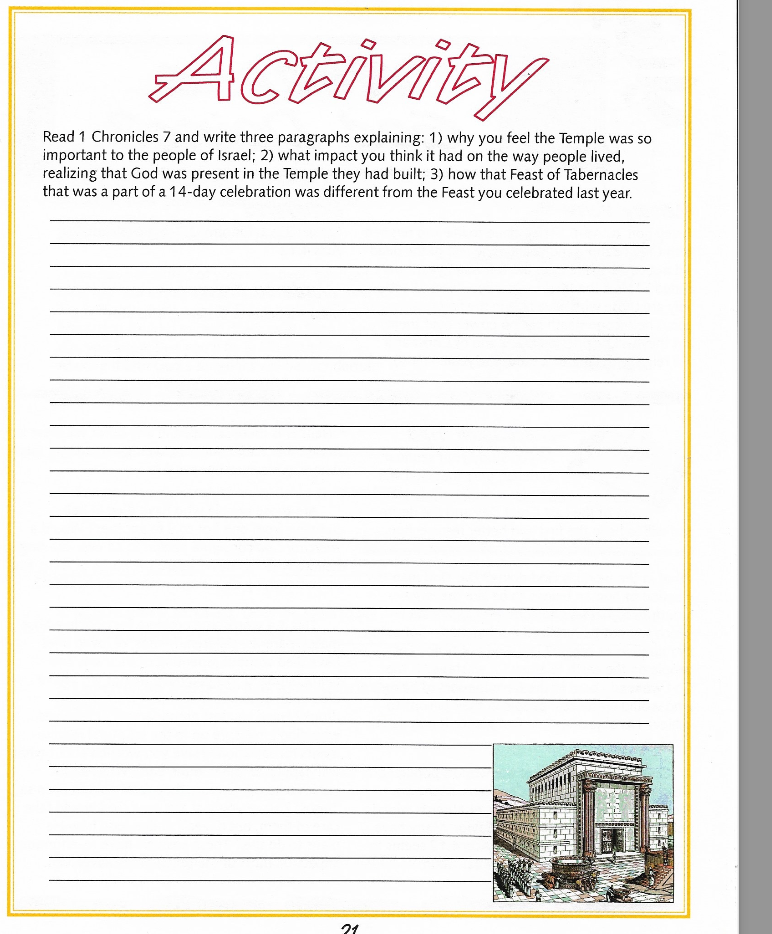
King David wanted to build a house for God. It was his idea, not God's. Would you ever be so ambitious? But God didn't allow David to build a house for Him because of sins he had committed. However, God said that David's son, Solomon, could build the Temple, a house for God.
The foundation of the Temple was laid around May in the fourth year of Solomon’s reign. Every detail of the building was completed in the 11th year, in the eighth month (1 Kings 6:38) - taking seven years to complete.
Seven years! Yes it was an awesome structure! It had to be. God would dwell there. There was no earthly thing that was too good to be in this Temple. Its walls, ceilings, and even the floors were overlaid with gold. All the furnishings were of gold.
Since the temple was completed in the eighth month, Solomon waited nearly a year to dedicate it. What a celebration that was! King Solomon took the silver, gold, and all the vessels dedicated for that purpose by his father, David, into the Temple. He called a very special meeting of all the leaders of Israel to be present when the Ark of the Covenant was taken from the Tabernacle and placed in this brand-new sparkling Temple.
The instructions God had given them were carefully met. To have done otherwise would have meant sudden death. Everyone involved in transporting the Ark treated it with the utmost respect. The priests took the Ark into the inner sanctuary of the Temple - the Most Holy Place - and placed it under the wings of the angels. The two stone tablets with the Ten Commandments written on them by God's finger when He made a covenant with Israel at Mt. Sinai were the only things in the Ark.
The Priests had to undergo special purification rites. As they came out of the Holy of Holies they were praising God. The singers, dressed in finespun linen robes, stood at the east side of the altar. The choir was accompanied by 120 priests who were trumpeters, while others played cymbals, lyres, and harps. The band and chorus united as one to praise and thank God. Their music selections were interspersed with trumpet obbligatos. This was no ordinary band or orchestra. You can count on every one of them having been an accomplished musician. It would have certainly inspired our Youth Day participants. There was even a theme for this production as we have for Youth Day. The theme was "He is so good! His lovingkindness lasts forever!" Think about it. How could you use that theme to put on a Youth Day production?
The glory of the Lord came as a bright cloud and filled the Temple. It was impossible for the priests to continue their work. This was an awesome way to begin the Feast of Tabernacles.
The people watched as their king, Solomon, stood before the altar of the Lord with his hands spread towards heaven and prayed. This is probably the most beautiful prayer in the Bible. "O Lord God of Israel, there is no god like you in heaven or earth, for you are loving and kind, and you keep your promises to your people if they do their best to do your will. Today you have fulfilled your promise to my father David, who was your servant; and now, O Lord God of Israel, fulfill your further promise to him: that if his descendants follow your ways and try to do your will as he did, one of them shall always sit upon the throne of Israel . . .
"Is it possible that God would really live on earth? Why, even the skies and the highest heavens cannot contain you, much less this Temple I have built! And yet, O Lord my God, you have heard and answered my request: Please watch over this Temple night and day--this place you have promised to live in — and as I face toward the Temple and pray, whether by night or by day, please listen to me and answer my requests. Listen to every plea of the people of Israel whenever they face this place to pray. . .
"Then when the people realize their sin and pray toward this Temple, hear them from heaven and forgive and answer all who have made an honest confession; for you know each heart. (1 Kings 8:38,39 TLB).
After Solomon finished praying he rose from before the altar and pronounced a blessing. Then he said, "O my people, may you live good and perfect lives before the Lord our God; may you always obey his laws and commandments, just as you are doing today" (v. 61). A total of 22,000 oxen and 120,000 sheep and goats were sacrificed as peace offerings.
This celebration didn't last seven or eight days as we are accustomed to celebrating the Feast of Tabernacles. It lasted 14 days! The king sent the people home. They were happy for all the goodness that God had shown to David and the Israelites. The people blessed King Solomon.
Wouldn't you like to have been there for this historic Feast of Tabernacles that exceeded all others? Think of the best Feast you've attended and multiply it by. .. it would be difficult to give a number. But you get the point. There was plenty of food, celebrating, singing, and a deep and reverent worship of the True God for His goodness and mercy. How could it have been better? Think about this every year as you celebrate the Feast of Tabernacles.
"O Lord God of Israel,
there is no god like you in heaven or earth, for you are loving and kind, and you keep your promises to your people if they do their best to do your will." Thank You for including this awesome story about Israel celebrating the Feast of Tabernacles for 14 days when the Temple was completed. Help me to love You more and celebrate the Feast more joyfully because of this occasion.
In Jesus' name I pray.
Amen.
Sunday - Job 28:23-24
Monday - Psalm 34:15-19
Tuesday - Leviticus 23:34-43
Wednesday - Zechariah 14:16-19
Thursday - John 1:14
Friday - 1 Kings 8:65-66
Saturday - Nehemiah 8:14-18
Leviticus 23:36-39
Isaiah 65:17-25
Ezekiel 37:1-28
Matthew 13:44-45
Acts 4:12
1 Timothy 2:3-4
Revelation 20:1-15
Revelation 20:4-6
Revelation 21:1-7
DEIST - a believer in deism; atheist
What in the world is God doing? Did God plan His creation of human beings to be like the large-mouth bass that lays millions of eggs, most of which will not be fertilized nor hatched, but eaten by minnows or bream? Did God put billions of people on the earth to allow for wastage? Is the God we read about in the Bible the sort of being who would waste real people in their billions to achieve His objectives? At first glance it may seem like it, but read on.
Only a small fraction of the world's population are confessing, practicing Christians. Many are Muslims, Hindus, Shintos, Jews, or atheists who do not believe Jesus Christ is their Savior. Many have never heard the name of Jesus. Acts 4:12 seems to say these people will not receive salvation:
"Neither is there salvation in any other, for there is none other name under heaven given among men, whereby we must be saved."
Are those people who have died in hell jumping from one hot coal to another? Would a merciful God consign a person to an ever-burning hellfire who has never heard the name of Jesus and knows nothing about repentance and baptism?
This is a worrisome problem for people whose mates, parents, children, friends, or loved ones have died without repenting of their sins and being baptized. Do you have friends who have died in an automobile accident from driving drunk? Have you lost grandparents or relatives who didn't measure up to the scriptural requirements for salvation? Have you worried about what will happen to them in the end? What about babies who died before they were able to even say "Jesus"? Have you just assumed God would take care of them, but haven't understood how He plans to do this? These answers have an enormous impact on most of the people who have lived.
The fascinating answer lies in understanding what the Last Great Day pictures. The hope that lies in the meaning will help you to truly rejoice in God's love and mercy. You will see how it is a Great Day! Understanding that God is a God of love, mercy, and justice is where we begin. Exploring His plan that is depicted in the holy days makes these characteristics of God more vivid and understandable. 1 Timothy 2:3-4 says, "For this is good and acceptable in the sight of God our Saviour; Who will have all men to be saved, and to come unto the knowledge of the truth.” This seems to say that God has a plan with no intentions of creating mankind with wastage.
But was Timothy speaking of universal salvation, where every last person will be saved regardless of how he lives his life? I think not. The term "all men" is speaking generally, and not of universal salvation. Revelation 21:8 says: "But the fearful, and unbelieving, and the abominable, and the murderers, and whoremongers, and sorcerers, and idolaters, and all liars, shall have their part in the lake which burneth with fire and brimstone: which is the second death." This makes it clear that there are people who won't make it into God's Kingdom.
Every holy day pictures part of God's plan and is entirely relevant to the Christian faith. God not only desires that all men be saved, He lays out an intriguing plan to accomplish this that is revealed in the holy days of the Bible.
The Feast of Trumpets' lessons have taught us that, at Christ's return, the dead in Christ will be raised and Christians who are alive will meet Him in the air to live and reign with Him for a thousand years on this earth. The Book of Revelation is a vision John had with a time sequence from the first resurrection to the end of the Millennium. Where does this vision lead?
Since John speaks of "the first resurrection" wouldn't you agree there must be another one? Revelation 20:5 sheds light on this by saying, "But the rest of the dead did not live again until the thousand years were finished." This takes us to Revelation 20:11-12: "And I saw a great white throne, and him that sat on it, from whose face the earth and the heaven fled away; and there was found no place for them. And I saw the dead, small and great, stand before God and the books were opened: and another book was opened, which is the book of life. .." What is the Book of Life? When a dead person stands, wouldn't that mean he is resurrected back to life?
The Book of Life is the book in which the names of the saints and all those in Christ are written. Everyone whose name is in the Book will be raised in the first resurrection. So, why will this Book of Life be opened again in the second resurrection? To make new entries? Who will be those new entries? In Ezekiel 37 God told Ezekiel to prophecy to very dry bones and to "hear the word of the Lord!” Breath will come to these bones and they will be covered with skin. The bones begin to rattle and come together. They come to life and stand up - - a vast army! Who are they? The whole house of Israel who were in their graves. They will be converted. God will give them His Spirit and take them back to their own land. This is a loving, merciful God who will give babies, and those who died never having had a chance for salvation, the opportunity to be resurrected to life, to know and obey God, and have their names written in the Book of Life. What an awesome God! Is your name in the Book of Life? If not, it should be or you could miss out on 1000 years of being with Christ, your friends, and family.
This is only a portion of the meaning of the Last Great Day. It contains enormous hope and has such beautiful, satisfying meaning. Please call -1 888-BIBLE-44 to order The Thread, God's Appointments With History and read it from cover to cover. You will find God's plan, pictured in the holy days, so fascinating, so intriguing, and so enlightening.
Great God and Father,
You are an Awesome God for You want all of us to be a part of Your very family and You provide a way for the heathen, babies who have died, and people who haven't understood Your plan in this life to have an opportunity to do that. I'm awestruck because Your love is boundless and merciful.
It's in Christ's name I pray.
Amen.
Sunday - Acts 4:12
Monday - 1 Timothy 2:3-4
Tuesday - Isaiah 65:17-25
Wednesday - Revelation 21:1-7
Thursday - Mathew 13:44-45
Friday - Leviticus 23:36-39
Saturday - Ezekiel 37:1-14
Isaiah 66:1-6
Jeremiah 7:17-20
Matthew 12:39-40
Mark 15:37-43
Luke 23:50-54
John 19:28-31
Acts 12:4
LENT - the period of forty weekdays from Ash Wednesday to Easter, observed variously in Christian churches by fasting and penitence to commemorate Jesus' fasting in the wilderness
While driving in the city on a four or six-lane street, have you ever noticed how there is often a much longer line in one or two lanes and one lane is virtually traffic free? The conclusion l've come to is people are like sheep and follow the car in front of them, even though there is a better way available. The "sheep" instinct in humans seems to be strong. It seems to carry over into people's religion. All too often we follow rather than think, analyze, and choose the right course. This seems to be true with the days that are generally celebrated by Christians.
Easter is one of those days to which Christian churches have attached significance and celebrate with nostalgia and assumed meaning--albeit the meaning is wrongly placed. Too many find it easier to be a sheep and follow than to search the Bible to see what it really says. Are you a sheep, or do you dare learn the truth?
Christendom places the resurrection of Christ on Easter Sunday. To them, it is perhaps the most holy of all days celebrated. But how did Christian churches come to believe and teach that Christ was resurrected on Easter Sunday morning? Getting up in the wee hours of the morning to attend an Easter Sunrise Service is done to deepen the experience. Those who do this are usually devout in their beliefs. But is their devotion misplaced? Is this what God would have you do? Is Easter a day God would have His people celebrate?
Try this little test on one of your friends who celebrates Easter. Ask him what Easter means. You're likely to hear that it means the "resurrection of Christ." For about 1600 years, Christian churches have taught that Christ rose from the dead on Easter Sunday morning. But did He? We'll discuss that later. First let's understand the meaning of Easter. You will find the derivation in Webster’s dictionary: "AS. (Anglo-Saxon), from name of old Teuton goddess of spring.”
Your Christian friends will likely tell you that Easter is in the Bible. That is true. But it is mentioned only once in the King James translation, in Acts 12:4, and the word "Easter" should have been translated "Pascha" or "Passover" as the Revised Version correctly has it.
Easter, this ancient pagan goddess of spring, had different names. In Babylon she was called Astarte, and Ishtar in Nineveh (Layard's Nineveh and Babylon). Baal was the Sun-god in Chaldean idolatrous worship. His wife or consort was Astarte.
"The festival, of which we read in church history, under the name of Easter, in the third or fourth centuries, was quite a different festival from that now observed in the Romish (and Protestant) church, and at that time was not known by any such name as Easter. It was called Passover, and was very early observed by Christians... That festival agreed originally with the time of the Jewish Passover, when Christ was crucified. That festival was not idolatrous, and was preceded by no lent" so says Hislop in The Two Babylons.
That brings us to another question. What is Lent? Is it commanded of God? What are its connections to Easter? Did Jesus observe Lent? No! How did the observance of Lent start? This 40-day period of abstinence begins with Ash Wednesday and continues to Easter. It was directly borrowed from Babylonian goddess worshipers. Ask friends who observe Lent what they gave up. Often it is something trivial such as chewing gum, popcorn, or watching a particular TV show. Do you think it impresses God for a person to give up something so minor for 40 days, that's not essential to life and may seldom be eaten or used by many people? Is that what the Bible says God is looking for in a person? "For all those things hath mine hand made, and all those things have been, saith the LORD, but to this man will I look, even to him that is poor and of a contrite spirit, and trembleth at my word" (Isaiah 66:2). This is what's important to God.
So how did Easter, a pagan festival, become a part of Christian worship? The 11th edition of the Encyclopedia Britannica says: "There is no indication of the observance of the Easter festival in the New Testament or in the writings of the Apostolic Fathers. . . The first Christians continued to observe the Jewish Festivals though in a new spirit, as commemorations of events which those festivals had foreshadowed. Thus the Passover, with a new conception added to it, of Christ as the true Paschal Lamb and the first fruits from the dead, continued to be observed."
Hislop says: "Only by violence and bloodshed the idolatrous festival of the Chaldean goddess Easter came to supersede what God ordained in the Passover to be observed forever!"
Was Jesus crucified on Good Friday and resurrected on Easter Sunday, as nearly every Christian believes? Hidden in your memory verse is a problem for those who believe this. Jesus said he would be in the grave three days and three nights. That's 72 hours. Friday night, Saturday, and Saturday night to Sunday morning come to half that time--only 36 hours. Yet Jesus said the only proof of His Messiahship was the length of time He would be in the grave. The answer lies in putting together such Scriptures as Mark 15:37-43; Luke 23:50-54 and John 19:28-31. Belief in a Friday crucifixion and a Sunday resurrection overlooks that holy days are also Sabbaths. This assumes that when Joseph of Arimathea and Nicodemus rushed to get Jesus in the tomb because the Sabbath was coming, that the Sabbath was a Saturday. But it was a Thursday - the first Day of Unleavened Bread. If you count Wednesday night (days began at sunset), Thursday, Thursday night, Friday, Friday night, Saturday to sunset, you will have three days and three nights as Jesus said. A Good Friday crucifixion and Easter Sunday resurrection won't work. Easter does not teach the message of Christ. The Passover and Days of Unleavened Bread do!
Loving and Gracious Father,
Thank You for revealing the truth of Your Son's crucifixion and resurrection to me and for showing me how it differs from the common practice of keeping Easter. Your truths are so precious. Help me always to rejoice in celebrating Your holy days.
In Jesus' name I pray.
Amen.
Sunday - Acts 12:4
Monday - Mark 15:37-43
Tuesday - Luke 23:50-54
Wednesday - John 19:28-31
Thursday - Isaiah 66:1-6
Friday - Matthew 12:39-40
Saturday - Jeremiah 7:17-20

Leviticus 17:7-9
Deuteronomy 18:9-11
Isaiah 8:19-20
Jeremiah 32:17-29
Matthew 22:32
Philippians 4:8-9
James 4:14-17
OUTHOUSE - a small structure used for defecating or urinating, typically having a seat with a hole over a deep pit
REVELING - to make merry; be noisily festive
INDIGENOUS -existing, growing, or produced naturally in a region or country; belonging (to) as a native
EXTORTION - the act of extorting, or getting money, etc. by threats, misuse of authority, etc.
Does Halloween seem like a lot of harmless fun to you? Do you get a kick out of seeing costumes - monsters, vampires, witches, werewolves, evil spirits, and ghosts - in the stores and on kids, or even adults? Do a lot of pumpkins made into jack-o'-lanterns on street corners and in front of homes say to you that a night of reveling is near?
“A common symbol of Halloween is the jack- o'-lantern (the name possibly was derived from that for a night watchman). It is a hollowed-out pumpkin carved in the appearance of a demonic face and with a lighted candle inside" ( The New Encyclopedia Britannica, pg. 862).
Is Halloween just a day when kids dress up in costumes and go trick-or-treating and adults make fools of themselves wearing ridiculous costumes and getting drunk? How you may feel about this celebration could depend on where you are in this "game" of Halloween.
In the first half of the 20th century, indoor plumbing was not the norm in many a country home. Teenagers, about your age, thought it was great fun to turn over outhouses on Halloween night. Again, this depended on where you were. It wasn't a lot of fun to the person who happened to be in the outhouse when it was turned over. Fun really isn't fun if it's at someone else's expense.
Since Halloween is observed more by small children than adults, how can this be wrong for Christians? "Small children, go from house to house, often in costume, demanding ‘trick or treat' (the treat, often candy, is generally given and the trick rarely played)" (Ibid).
If you're trying to teach a child to be an honest, hardworking, responsible, giving citizen, wouldn't this be contrary to all of those good character teachings? In essence what a child is saying is, "If you don't treat me, I'll play a bad trick on you." Isn't that a form of extortion? Doubtless, the trick rarely follows when treats aren't given, but allowing kids to do this goes contrary to clear biblical teaching that it is more blessed to give than to receive.
Some Christian churches celebrate Halloween with haunted houses in the church basement. Lights are turned low and kids make their way through scary shrieks and sounds as they see skeletons and ghosts coming towards them. They may even be given peeled grapes and told these are eyeballs. Is this harmless? Is this one of the holy days of God that depicts a part of His plan? Where did this day that celebrates death, evil, and the dark side come from?
"Traditionally, the festival was a time used by the ancient pagans to take stock of supplies and slaughter livestock for winter stores. The ancient Gaels believed that on October 31, the boundary between the alive and the deceased dissolved, and the dead become dangerous for the living by causing problems such as sickness or damaged crops. The festivals would frequently involve bonfires, where the bones of slaughtered livestock were thrown. Costumes and masks were also worn at the festivals in an attempt to mimic the evil spirits or placate them" (Wikipedia).
In the autumn of the year, Mexicans hold a festival that is a mixture of indigenous Aztec and Hispanic cultures to celebrate a feast for dead children. Faces are painted black and the celebrations are accompanied by mournful funeral songs.
Many theologians say that a religion can be measured by its teaching about death. Jesus said He was the God of the living, not the dead (Matthew 22:32). We are created to live! God has "set eternity in the hearts of men." It's as though God put in man an instinct to live, and He never intended that we waste our time celebrating death. The resurrection of Christ made it possible for death, our enemy, to be conquered.
What does the Bible say about things Halloween seems to celebrate - wizards that peep and mutter, and familiar spirits? Isaiah 8:19-20says, "And when they shall say unto you, Seek unto them that have familiar spirits, and unto wizards that peep, and that mutter: should not a people seek unto their God? for the living to the dead? To the law and to the testimony: if they speak not according to this word, it is because there is no light in them."
The evidence seems heavily weighted that Halloween was begun with pagan symbols and celebrations. Has Halloween changed enough over the years to the point where Christians can join in the festivities and make this celebration an honor to God? Would Jesus attend one of these parties? As it has been mentioned we are to celebrate life and not death. Philippians 4:8-9 says, "Finally, brothers, whatever is true, whatever is noble, whatever is right, whatever is pure, whatever is lovely, whatever is admirable, if anything is excellent or praiseworthy - think about such things. Whatever you have learned or received or heard from me, or seen in me - put it into practice. And the God of peace will be with you" (NIV). Should you celebrate Halloween? Do what Jesus would do!
Almighty God,
Thank You for revealing Your truths to me about the history of Halloween. You are such a pure, good and gracious God. Halloween in no way portrays Your character. You want us to think on good and right things instead of death, destruction, and morbid things.
It's in Jesus' name I pray.
Amen.
Sunday - Isaiah 8:19-20
Monday - Matthew 22:32
Tuesday - Philippians 4:8-9
Wednesday - James 4:14-17
Thursday - Deuteronomy 18:9-11
Friday - Jeremiah 32:17-29
Saturday - Leviticus 17:7-9
Deuteronomy 12:31-32
Proverbs 10:1-10
Isaiah 7:13-17
Matthew 1:18-25
James 1:16-18
James 1:17
James 4:17
Revelation 12:5
Revelation 22:19-21
MYTH - any imaginary person or thing spoken of as though existing
CREDULITY - a tendency to believe too readily, esp. with little or no proof; lack of doubt
REAL - existing or happening as or in fact; actual, true, etc.; not merely seeming
NOSTALGIA - a longing to go back to one's home, hometown, or homeland; homesickness
Did you and your family ever celebrate Christmas? If so, you may experience some pains of nostalgia when all the Christmas trappings show up in stores and everywhere you go there is a constant sound of carols being sung. You're a maturing young adult who desires things that are real. You may have seen old reruns of Dragnet on TV where Sargent Friday says, "Just the facts." That's what this generation of teens wants - you want the facts - what’s real.
You may analyze your YEA teacher and wonder is he or she real? Does he really believe what he’s teaching you? Being a part of this sophisticated generation, you should be objective enough to look at the most celebrated holiday of all and see if it's real.
Even before you celebrate Thanksgiving, you will likely hear this little Christmas song many times, "Up on the house top click, click, click. Down through the chimney with good Saint Nick." It's a catchy little tune that reflects much of what Christmas is all about: it’s mostly a myth! Some might say it is based on many untruths. So are the nostalgic things about Christmas real - factual and true? Let's explore some of the myths that go with Christmas to discover what is real.
What about Santa Claus? I think you would agree he doesn't exist. However, he is an imaginary person spoken of as though he exists. This jolly, imaginary, bearded, mythical character is depicted dressed in a red suit with white cuffs and a black belt and boots. He supposedly lives at the North Pole with his wife and elves who help him make toys for good children which he carries on a sleigh pulled by eight reindeer. This caravan lands on roof tops and supposedly this overweight Santa goes down many hot, smoke-filled chimneys with a large pack on his back without even getting singed. He delivers gifts under Christmas trees around the world all in one night. Now that stretches my credulity. These are God-like characteristics a fraud is supposed to have. Does that somehow step out of the realm of being real?
How can most parents foster these beliefs on their gullible, innocent children and encourage them to believe that there is a Santa Claus? Yet it's done with devotion and virtual worship. But is it good for them? What is it teaching them? Is this biblical? Is it real?
Many parents try hard to keep the myth going. They hide presents from their kids and get up in the wee hours of the night to sneak bicycles, toy cars, and gifts too large to wrap under the tree to give the illusion that Santa is rewarding their child for being good.
How would you feel if you gave a person everything he has and he gave credit to some mythical being? James 1:17 clearly tells us that "Every good gift and every perfect gift is from above, and cometh down from the Father of lights, with whom is no variableness, neither shadow of turning." Why don't parents teach their children to praise God from whom all blessings flow instead of perpetuating a total untruth and giving credit to a giver other than God?
Does leading a child to believe there is a Santa Claus prepare her for real life? We've come to the place where people expect our government to play Santa Claus and dish out entitlements that we've not earned. Proverbs 10:4 tells us that "Lazy hands make a man poor, but diligent hands bring wealth" (NIV).
A small child had been taught from birth that there was a Santa Claus. When he was about seven he found the toys his parents had hidden to perpetuate this myth. Upon learning that there was no Santa Claus, he told his parents that he was "going to look into this Jesus Christ thing as well." He must have felt he could no longer trust his parents. If they would lie to him about there being a Santa Claus, it seemed to follow that they might just lie about Jesus Christ.
Being honest, real, and factual are things Christ would have you to do. The Christmas tradition breaks many of the Ten Commandments. The true God is replaced with Santa. It places Santa above the true God. That breaks the First Commandment. The person who tells a child there is a Santa Claus breaks the commandment not to bear false witness. The Christmas tradition teaches children and even adults to covet what they don't have - to lust after things in stores, things their neighbor has, and things they often shouldn't have, nor are they willing to work to have them. Shoplifting cases go way up during the Christmas shopping period. That is breaking the commandment “Thou shalt not steal.”
There are those who do good during the Christmas season by serving in soup kitchens, and donating to organizations such as Salvation Army. That's admirable, but it shouldn't be limited to only once or twice a year. James 4:17 says, "Therefore to him that knoweth to do good, and doth it not, to him it is sin." Doing good should be a way of life. So should putting God first and not substituting someone or something, such as a mythical character, for the true God. God is real! So if you want to Get Real! put God first in your life every day.
Gracious Father,
Forgive us as a nation for putting another god before You and not giving You credit for being the "giver of every good and perfect gift." How ungrateful of us. There is no way I can thank You enough for all that You've given me.
In Jesus' name I pray.
Amen.
Sunday - Proverbs 10:1-10
Monday - James 1:16-18
Tuesday - Deuteronomy 12:31-32
Wednesday- Isaiah 7:13-17
Thursday - Revelation 22:19-21
Friday - Revelation 12:5
Saturday - Matthew 1:18-25