YEA Lesson Library
Respect the Power!
About This Lesson
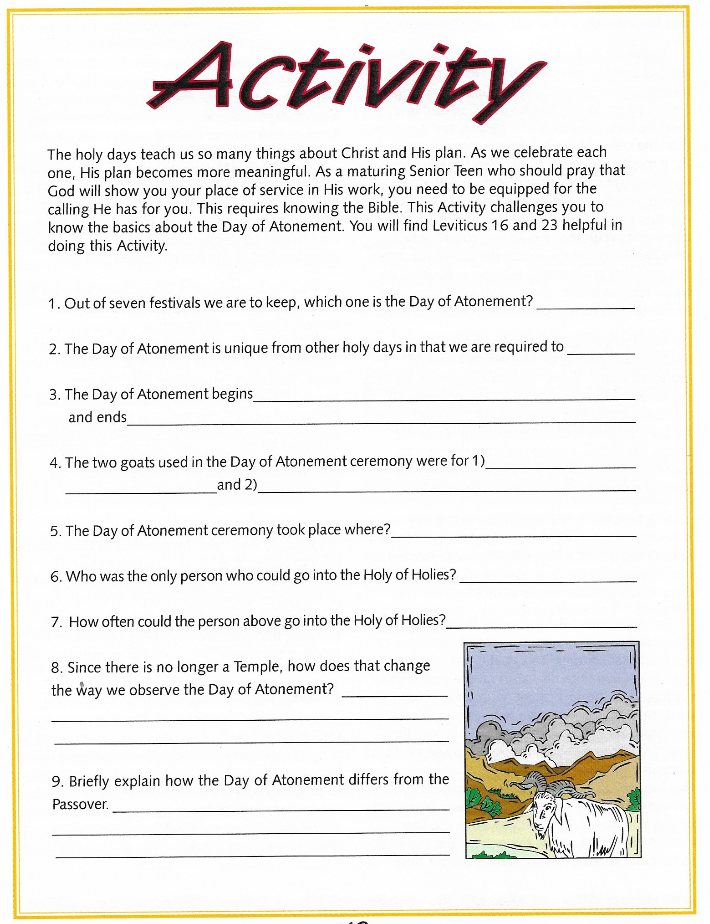
This lesson teaches the difference between Passover and the Day of Atonement.
Scriptures
Exodus 40:1-33
Leviticus 16:1-34
Leviticus 23:26-32
Psalm 103:11-12
Hebrews 9:26-28
Hebrews 13:8-10
Words to Know
ATONEMENT - a day of covering
MERCY SEAT - cover
SCAPEGOAT - departing goat
INNOVATIVE- to introduce new methods, devices, etc.
The Lesson
Have you noticed the similarities in the Passover and the Day of Atonement? fI so, have you asked why two appointed times of God seem to accomplish the same thing? At first glance, they may seem to. But do they? As a matter of fact, not many Christians truly understand the difference in the two days. But let's take a closer look in this seminar and discover deeper truths even your parents may not have understood before.
The Day of Atonement ceremony is found in Leviticus 16. This follows a most unfortunate event when Aaron the High Priest's two sons became innovative in their worship at the Tabernacle. They offered "strange fire" which meant they offered incense that God had not instructed them to offer, nor at that time. They had no business doing these offerings. These two fellows got too close to the power in the Tabernacle and got burned to a crisp for their extra curricular activities. Did God destroy them because He is short-tempered and kills people when they don't get things exactly right? Never forget that God is the Awesome God. These two sons of Aaron came into the presence of enormous power. You don't wander in among high tension lines without taking safety precautions; you follow the rules. And they didn't. If you’ve seen the movie, Raiders of the Lost Ark, you will probably remember that most dramatic scene of power when the Ark was opened.
God told Moses, "Tell your brother Aaron not to come whenever he chooses into the Most Holy Place behind the curtain in front of the atonement cover" (Leviticus 16:2 NIV). The High Priest, and only the High Priest, could go into the Most Holy Place once a year on the Day of Atonement — or he would die.
Aaron had to be prepared with certain offerings for purification and had to bathe and be properly dressed. He had to be ceremonially perfect, because in this ceremony he would represent Christ and His work. He carefully followed the ceremony God laid out by presenting two goats before the Lord at the door of the Tabernacle. He cast lots to determine which goat was for Jehovah, and which was for the scapegoat.
Following instructions to take incense, Aaron put hot coals inside the Holy of Holies to create an intense smoke screen because God would appear there and he couldn't look upon God and live. Next he took the blood of a bullock and sprinkled it on the cover of the Ark to make an atonement for himself and for his family. You already know that the Jews call the Day of Atonement Yom Kippur, which literally means a day of covering. Another aside is that "mercy seat" in the Bible, if translated accurately, would be "cover" which specifies the lid on the Ark of the Covenant. After the goat that represented Jehovah was killed, its blood was taken into the Holy of Holies to make an atonement for the sins of the children of Israel.
Now let's recap and clarify. The High Priest made an atonement for himself, so he could represent Christ. Then, representing Christ, he took the blood of the goat into the Holy of Holies to make an atonement for everyone. The symbolism for the Christian is Christ presenting His blood before the Father's throne as an atonement for mankind. This event literally took place on the Sunday morning after the resurrection of Jesus.
The next thing that happened in the Day of Atonement ceremony was the High Priest returned to the people. Since the High Priest represented Christ, wouldn't this logically follow that this pictures Christ returning to earth?
But what about the live goat? In Hebrew, he is the Azazel, which means the goat of departure or the goat that escapes. This goat is not killed. The High Priest laid both his hands on the goat and confessed all the sins of the house of Israel on this goat. How would you have felt had you been there and heard your sins orally cataloged before the goat departed — Sabbath breaking, taking God’s name in vain, shoplifting, getting drunk, committing fornication, disrespecting your parents, coveting another's possessions, stealing from God by not tithing, etc.? Would you have recalled Psalm 103:12? "As far as the east is from the west, so far hath he removed our transgressions from us." How awesome! Wouldn't that portion of the Day of Atonement ceremony put tears of gratitude in your eyes knowing that God had provided a way for your sins to be completely removed? We must not only be forgiven of our sins, as the Passover pictures, but the effect of sins, the continuing burden of the sins must be sent away from us to free us of the lingering consequences.
Are you still left wondering why two holy days picture the sacrifices of Christ? When the Temple stood, there was a continual round of sacrifices offered. The purpose seems to have been to keep man mindful of the fact that he is a sinner, something we find all too easy to forget.
The Passover pictures Christ dying for your sins. Had you been the only person who had ever sinned, Christ would have died for you, so you could have forgiveness and escape eternal death. Did you notice that on the Day of Atonement the High Priest made atonement for "the children of Israel," "everyone," all of "mankind," and the "house of Israel." The Passover is a day of individual forgiveness when you renew your covenant with Christ. Atonement is a day of national forgiveness because, we have all sinned — our nation has sinned and needs forgiveness.
On the Day of Atonement, the High Priest symbolically went into the presence of God, into the Holy of Holies, and sprinkled blood to make an atonement for the people. Jesus is at the right hand of the Father, appearing in the presence of God on our behalf. What kind of person should you be, knowing that your sins have been paid for by the blood of our Savior? How will this change your life?
Student Prayer
Awesome and Powerful God,
Thank You for this seminar that helps me realize the seriousness of sins, how You have provided away for them to be forgiven, and how You've provided a way for them to be removed. How great You are! Your holy days are so important and give me insights into Your divine plan. Open my mind to understand.
In Jesus' name I pray.
Amen.
Daily Devotions
Sunday - Exodus 40:1-19
Monday - Exodus 40:20-33
Tuesday - Leviticus 23:26-32
Wednesday - Hebrews 9:26-28
Thursday - Hebrews 13:8-10
Friday - Exodus 26:1-21
Saturday - Exodus 26:22-37
Objectives
At the end of this seminar, attendees will be able to:
1. Give a description of what happened in the Temple on the Day of Atonement.
2. Explain the benefits accrued to them pictured in the scapegoat being driven into the wilderness.
3. List what God requires of us on the Day of Atonement.
4. Tell that you don't mess around with what God tell us to do. We are to Respect the Power!
Topics & Themes
Day of Atonement
Fasting
God’s Omnipotence
Holy Days, Atonement
Obedience
Passover
Temple
Materials Needed
Bible, YEA Attendees' and Presenter's books, attendance and memory verse charts, long piece of butcher's paper, markers and crayons, Scotch tape or push pins
Song
"Abba Father" is on page 76 of The Group Songbook.
Closing Prayer
Have the young people form a circle and join hands. Go around the circle beginning with yourself and give one reason why God gave us the Day of Atonement to celebrate. Ask a volunteer to lead in prayer thanking God for gaining a deeper understanding of this day and for the message it has for us today as Christians.
Printable Pages