YEA Lesson Library
The Bread of Life
About This Lesson
This lesson teaches that, during the Days of Unleavened Bread, leavening (yeast) is a symbol of sin. Out of reverence for God, we should eat unleavened bread, symbolizing taking in Jesus’ righteousness.
Scriptures
Exodus 12:14-20
Exodus 13:1-10
Leviticus 23:6-14
Deuteronomy 16:1-9
John 6:35-51
Romans 5:12-21
1 Corinthians 5:1-8
1 Corinthians 5:7-8
Galatians 5:9
Ephesians 5:1-21
Words to Know
CORRUPT - turn evil
SINCERITY - to really mean it, honesty
MALICE - mean-spirited
The Lesson
You learned in the first Christian Holy Day supplement that God selected the very last night of the 430 years of Egyptian slavery to free His people, Israel. Because He delivered our ancestors from slavery on that same night, God set aside this time for us to celebrate every year. We call it "The Night to Be Much Observed.”
Beginning with this night and continuing for seven days, God commands us to eat unleavened bread. He also says that no leavening (yeast, baking powder, baking soda, and any product which contains leavening) should be seen in all our dwellings: “. . . there must be no yeast in your homes or anywhere within the borders of your land!" (Exodus 13:7 TLB).
Why would God give us such a command? What does all of this mean? And how does it impact you? To better understand this, let's look at what the Greek word for leaven means. It means "to ferment." The bread of the Israelites in Egypt was sourdough-fermented bread. They couldn't go to the grocery store and buy packets of yeast. When they didn't have a starter from previous bread, they left their dough to collect yeast spores from the air and to rise.
Leavening is used in the Bible as a type of sin. Jesus was without sin and not corrupted in any way. Jesus says in John 6:48: "I am that bread of life." Jesus was our pure sacrifice without sin - there was no corruption in Him; He was the unleavened Bread of Life.
Yeast brings about a fermentation process. It causes bread to rise and become puffed up. Sin, just as tiny grains of yeast in bread, will grow and invade other parts of your life, if given the time and space. During the Passover season, the Apostle Paul compared leavening (causing bread to rise) to sin (causing a person to be arrogant or puffed up.) A man in the Corinthians church was committing a gross sin, so Paul developed the idea of one corrupt individual corrupting the whole. He said, “Your glorying is not good, Do you not know that a little leaven leavens the whole lump? . . . Purge out therefore the old leaven” (1 Corinthians 5:6-7), speaking of the corrupt individual.
The Feast of Unleavened Bread is a wonderful reminder that God wants us to remove all sin from our lives and replace that sin with righteousness. During the Feast of Unleavened Bread, leavened bread represents sin, and unleavened bread depicts Jesus Christ and His righteousness. Jesus said, “I am the Bread of life.”
Simply abstaining from eating foods with leavening for seven days does not meet the requirements of God's Law. We are to do the positive act of eating unleavened bread (Exodus 12:15). For the Christian, that unleavened bread symbolizes Jesus, the Bread of Life. Because leaven is seen as a symbol of sin, and because Jesus was sinless, the Bread of Life is unleavened. When we eat unleavened bread during this festival, it is a positive act of symbolically making Jesus a part of our lives. It is a daily reminder to take Jesus Christ into our lives through prayer, Bible study, and meditation.
1 Corinthians 5:8 says, "Therefore let us keep the Festival, not with the old yeast, the yeast of malice and wickedness, but with bread without yeast, the bread of sincerity and truth." Malice is a state of mind that causes wicked actions. If we change our state of mind, we can change our actions. 2 Timothy 2:22 says, "Flee the evil desires of youth, and pursue righteousness, faith, love and peace, along with those who call on the Lord out of a pure heart." Fleeing is an action word! We must actively choose to do right and not wrong, putting Christ first in our lives.
Since leavening is a type of sin during the Days of Unleavened Bread, we should refuse to eat it. The same as yeast, sin is sometimes overlooked because it may seem small. Sin spreads and infects everything it touches, corrupting what was once good and pure. 1 Thessalonians 5:22 says, “Avoid every kind of evil.” Also, Ephesians 5:3 says, “But among you there must not be even a hint of sexual immorality or of any kind of impurity, or of greed, because these are improper for God’s holy people.” Sin separates us from God. If we let sin remain in our lives, it will lead us down the path to destruction. Think about this: Jesus would have suffered and died for even one “little” sin of ours, because that one sin would sentence us to eternal death.
Jesus Christ knows we're only imperfect humans; after all, He's the one who created us. He walked this earth and was tempted in all points as we are, but never sinned. He requires excellence from His children. He knows we will fall, but He expects us to put Him first, to seek His Kingdom above all things, and to overcome evil with good. You can do it! Read Philippians 4:13. Celebrate the Feast of Unleavened Bread with the Bread of Life. Put Jesus first in your life and think of Him as you eat that flat bread. Keep your eyes on the prize, your focus on Christ. Remember the covenant you made with Him at baptism and live it!
Student Prayer
Dear Father in Heaven,
Please help me to put sin out of my life and follow You. Help me each day as I eat unleavened bread to remember that Your Son and My Savior is the Bread of Life. Teach me to follow You and live in righteousness. Please forgive me when I sin and give me the help to overcome.
I pray all things in His name.
Amen.
Daily Devotions
Sunday - 1 Corinthians 5:1-8
Monday - Exodus 12:14-20
Tuesday - John 6:35-51
Wednesday - Romans 5:12-21
Thursday - Exodus 13:1-10
Friday- Deuteronomy 16:1-9
Saturday - Leviticus 23:6-14
Objectives
At the end of this seminar, attendees will be able to:
1. Explain that leaven pictures sin, and before the Days of Unleavened Bread begin we should clean leaven out of our homes.
2. Discuss that Jesus Christ pictures the pure unleavened bread which is the Bread of Life.
3. Explain how leaven is like sin and what it does for us.
Topics & Themes
Bread of Life
Days of Unleavened Bread
Eating Unleavened Bread
Holy Conduct
Holy Days, Unleavened Bread
Jesus, Without Sin
Leavening
Night to Be Much Observed
Relationship with God
Sin
Unleavened Bread
Yeast
Materials Needed
Bible, YEA Attendees' and Presenter's books, attendance and memory verse charts, songbook, packet of yeast (if seminar isn't presented during the Days of Unleavened Bread), markers, colored pencils, several pieces of large white paper, scissors
Teacher-Directed Activity
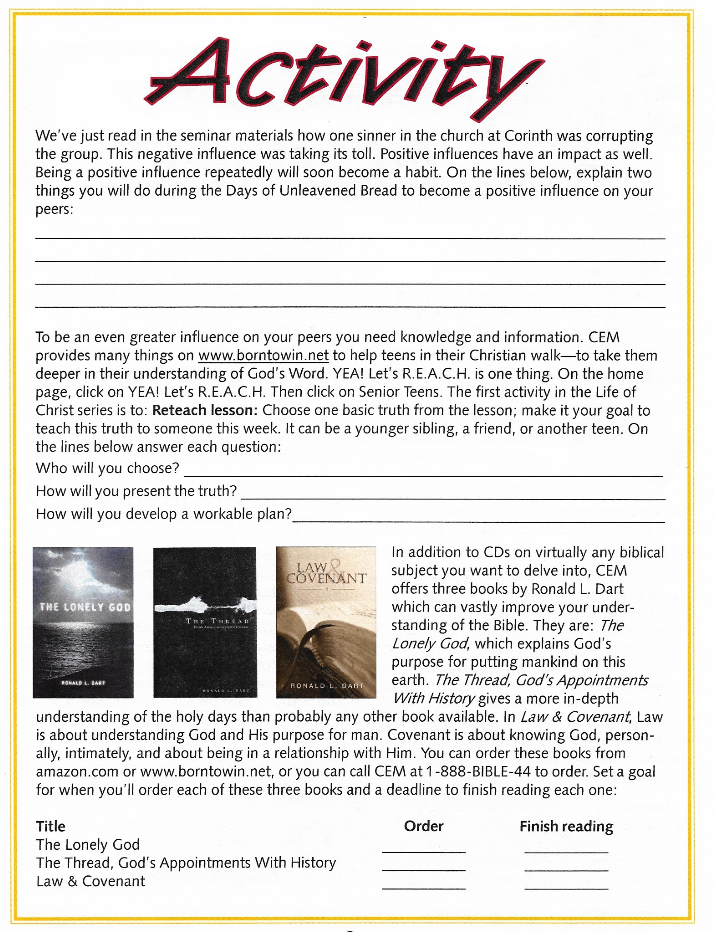
Ask the assigned person to go over the Activity with the group.
Memory Verse - Have each attendee recite their memory verse.
Song
"Jesus, My Lord" is on page 75 of The Group Songbook.
Closing Prayer
Have attendees form a circle and join hands. Ask each to tell one thing they learned from today's seminar. Ask for a volunteer to lead in prayer thanking God for His Son who is the Bread of Life.
Printable Pages