YE5W.1 · Activity Page
Exodus 3 - 12
Exodus 3: 7-10
Exodus 3:16-17
Exodus 6:6-12
Exodus 12:29-30
Exodus 12:41
2 Chronicles 36:23
Ezra 1:1-4
Jeremiah 34:8-11
FREEDOM - the absence of necessity, coercion, or constraint in choice or action. Liberation from slavery.
PLANNED PARENTHOOD CENTER - usually an abortion clinic.
SUMMONED - call, call in, convene
You’ve waited for freedom all through your middle and late teen years. Sometimes you may have groaned within yourself wondering when that day would ever come. Then one day it’s graduation day. When you walk across the stage, take your high school diploma in your left hand and shake the Principal’s right hand, you feel like saying Let Freedom Ring! Leaving the nest is usually a step toward adulthood where you become part of a new social system. You may have opportunities for new social roles and responsibilities. A new life awaits you.
At last, freedom rang for the Israelites. A traditional view says the Exodus occurred 1446 B.C. The years of oppressive slavery was an experience none of us would like to repeat. The Israelites groaned and cried out in their slavery. Their cries went up to God and He heard their groaning. Why? Because He remembered His covenant with Abraham, Isaac and Jacob. God remembered that because of Abraham’s obedience, He promised to make of his descendants great nations. Being held in slavery where their lives were bitter with hard labor did nothing to portray that the Israelites were great nations.
Moses was an Israelite reared by an Egyptian princess right in Pharaoh’s house. God had a job for him to do. That job was to free His people. It was time for His people to keep a feast unto Him.
While Moses was tending the flock of his father- in-law. an angel appeared to him in flames of fire from within a bush. Moses noticed that even though the bush was burning, it didn’t burn up. Then God called out to Moses, “Take off your sandals, for the place where you are standing is holy ground. I am the God of our father, the God of Abraham, the God of Isaac and the God of Jacob.” This was awesome! It was so awesome that Moses hid his face. God went on to tell Moses that He had seen the misery of the Israelites and heard their crying. He was concerned about the suffering of His people. He told Moses that He had come down to give them their freedom and He would be using Moses to bring His people out of Egyptian slavery.
Moses was overwhelmed with such a task and didn’t want to be the one to go to Pharaoh. God promised to make the Egyptians favorably disposed toward Moses. But Moses still did not want the job. To build Moses’ confidence, God told him to throw his staff on the ground. He obeyed and it became a snake. God had Moses put his hand inside his coat and it became white as snow and leprous. Then God had him put his hand back in his coat and the hand was restored.
But even these miracles didn’t convince Moses that he was the man to do this job. He made another excuse: “O Lord, I have never been eloquent, neither in the past nor since you have spoken to your servant. I am slow of speech and tongue.” God must have been a little exasperated by this time and He asked Moses, “Who do you think gave you your mouth in the first place?” But Moses insisted that he couldn’t speak to Pharaoh. God’s anger burned against Moses and He decided to let Aaron, Moses’ brother do the speaking with Pharaoh.
Moses and Aaron went to Pharaoh many times telling him to let God’s people go free so they could keep a festival unto God. The first time they went to Pharaoh, things got worse for the Israelites. The slave drivers made them gather their own straw to make bricks, as they were required to meet the same quotas. God sent plague after plague upon the Egyptians, but Pharaoh continued to harden his heart and say no. The water turned to blood. Frogs were in their beds, in their food, and everywhere they looked. The gnats came in maddening swarms. Then came the flies swarming everywhere and biting them when they lit on them. The Egyptians’ livestock got sick and men, women and children had boils all over their bodies. But God was unrelenting. He sent plagues of hail, locusts and darkness. Pharaoh still wasn’t going to give in. Keeping the Israelites was a matter of simple economics to him. He had an unpaid work force, so why should he let them go? Over a million people leaving would put a big dent in production. Pharaoh overlooked the fact that God is more powerful than any king.
God told Moses that He was going to bring one more plague on the Egyptians and then Pharaoh would relent and let His people go. God gave instructions that this was the first month of the year. On the tenth day of this month, each man was to take a one year-old male lamb without defect for his family, take care of it until the 14th day of the month, and kill it at twilight. They were to put some of its blood on the sides and tops of the doorframes of their houses. Then they were to roast the lamb and eat it, fully dressed with their shoes on, and their staffs in their hands.
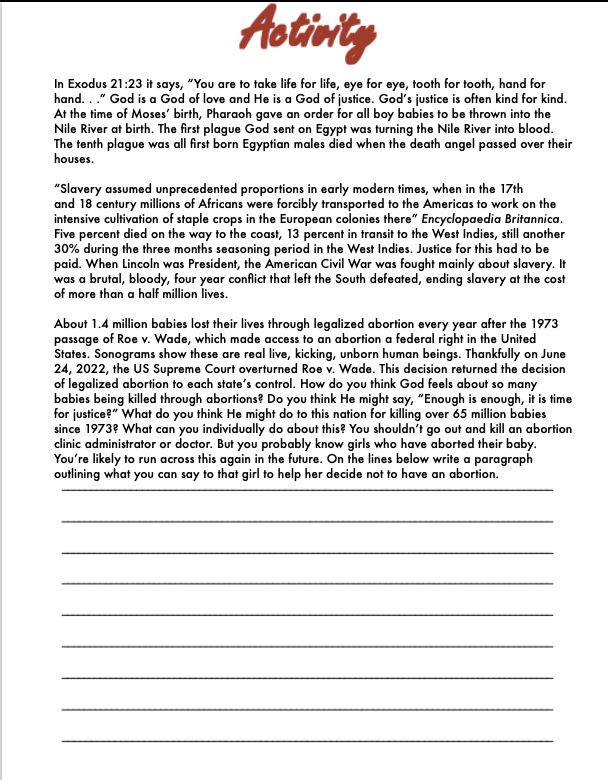
On that same night, God told Moses that He would pass through Egypt and kill every firstborn – both man and animal. When Moses was but a tiny infant, Pharaoh put out a decree that every first born baby boy was to be killed at birth? God has a way of making consequences fit the crime. At midnight God killed all the firstborn males and wails went up mightily. Pharaoh summoned Moses and Aaron to his palace and told them to take the Israelites and get out. After 430 years to the very day, the Israelites were free to go worship God with a Feast. A new life awaited them with new social roles and responsibilities. This was the first recorded Passover. Let Freedom Ring!
Merciful God,
Thank you for your patience with us. Thank you for remembering your promise to Abraham and freeing the Israelites. You are a loving merciful God and a God of justice. Without justice there could be no mercy. Help us always to remember that.
In Jesus’ name we pray.
Amen.
Sunday - Exodus 12:29-30
Monday - Jeremiah 34:8-11
Tuesday - 2 Chronicles 36:23
Wednesday - Ezra 1:1-4
Thursday - Exodus 3: 7-10
Friday - Exodus 3:16-17
Saturday - Exodus 6:6-12
Exodus 12:1-41
Leviticus 23:4-8
Numbers 28:17-25
Deuteronomy 16:3-8
Matthew 26:26
John 6:35
1 Corinthians 5:1-8
DISCIPLINE - training that corrects, molds or perfects.
Throughout the history of mankind people have been held captive as slaves in foreign countries. They’ve been held against their will, mistreated, and abused. God’s chosen people – the Israelites were no exception – they experienced slavery as others have down through the years.
After 430 years of living in Egypt, eventually being enslaved, 600,000 freed men with their wives and children left Egypt at night on foot. All sorts of other people went with them. With a full moon shining brightly above, flocks, herds, and a vast exodus of cattle started on their way out of Egypt.
Can you imagine the excitement? There would be no more mean task masters. They had made their last bricks, at least for a while. Free at last, but they didn’t know where they were going. They were following Moses, the man who had gone before Pharaoh many times and asked him to let these people go have a feast to God and worship Him. What a sight this must have been!
These people had nothing they could call their own. They were slaves – the poorest of the poor. Before leaving Egypt, God instructed these poor slaves to ask the Egyptians for gold, silver and clothes. And the Egyptians gave these things to them. The sons of Jacob and their descendants left with a high hand, happy hearts, and their kneading troughs bound with spare clothing over their shoulders.
They left in such a hurry, there was no time to allow for bread to rise and to bake it. The dough that was in their kneading troughs had no yeast. When they stopped to eat, they baked bread from the yeastless dough and ate unleavened bread.
God selected the very last night of the 430 years of slavery to free His people from Egyptian bondage. Because He delivered our ancestors from slavery on that same night, God selected this time for us to celebrate every year. We call it The Night To Be Much Observed.
Beginning with this night and continuing for seven days, God commands us to eat unleavened bread. Before this Feast begins, we’re to clean our homes and get rid of any leavening – baking powder, baking soda and yeast, and any product such as baked goods that contain leavening. “There must be no yeast in your homes, or anywhere within the borders of your land!” (Exodus 13:7 TLB).
“The Festival of Unleavened Bread: This is to be celebrated beginning the day following the Passover. On the first day of this festival, you shall gather the people for worship, and all ordinary work shall cease. You shall do the same on the seventh day of the festival” (Leviticus 23:6-8a TLB).
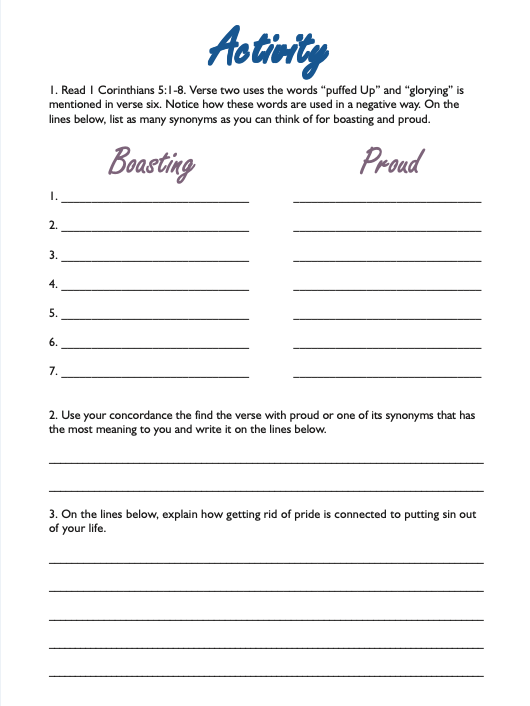
There is a lot of symbolism connected with this Feast. So what does it all mean to you? Why should a Christian celebrate the Days of Unleavened Bread? I Corinthians 5:6b-8 says “Know ye not that a little leaven leaveneth the whole lump? Purge out therefore the old leaven, that ye may be a new lump, as ye are unleavened (physically). For even Christ our passover is sacrificed for us: Therefore let us keep the feast, not with old leaven, neither with the leaven of malice and wickedness; but with the unleavened bread of sincerity and truth.”
Leavening is a type of sin for these seven days in a year. At other times, it’s not wrong to eat leavening or to have leavening in our homes. The NIV Study Bible says about 1 Corinthians 6:5-6 “Paul alludes to the prohibition against the use of leaven (or yeast) in the bread eaten in the Pass- over Feast (see Ex. 12:15). Leaven in Scripture usually symbolizes evil or sin (see note on Mk. 8:15), and the church here is called on to get rid of the yeast of sin (v.8) because they are an unleavened batch of dough – new creations in Christ” (1 Co. 5:6-7).
This tells us quite a bit. First, leavening symbolizes sin in the Bible. It also tells us that the church in Corinth had put leavening out of their homes (because they are an unleavened batch of dough) because these were the Days of Unleavened Bread. On the Passover we eat and drink the symbols of Christ’s broken body and shed blood (unleavened bread and wine) sacrificed for us so that we can have forgiveness of sin. When a person accepts this sacrifice and is converted, they should not want to continue living a life filled with sin. We should work at getting rid of every sin in our lives. So, putting leavening out of our home, symbolizes putting sin out of our lives. Since no leavening is to be seen in our homes during the Days of Unleavened Bread, leavening is put out before those days begin.
There is also another command. It is that we must eat unleavened bread for seven days – yes some every day. But why? Jesus Christ is the Bread of Life. Eating this flat bread for seven days symbolizes filling ourselves with the pure Bread of Life which is Christ. How do we do this? Just eating unleavened bread for seven days is a very physical act. God expects more of us than that. We fill our minds and hearts with the Bread of Life when we study the Bible, meditate, and pray. We should spend extra time each day during the Days of Unleavened bread drinking in God’s Word. This is certainly a recipe for sin to diminish in our lives as we feast on God’s Word. The Days of Unleavened Bread is a time to free our lives from the bondage of sin and grow in His love.
Loving and Merciful Creator,
Thank you for freeing the Israelites from the bondage of slavery. Thank you also for freeing us from the bondage of sin. Help us each day during
the Feast of Unleavened Bread as we eat unleavened bread to remember the importance of the sacrifice of Jesus Christ and spend more time in prayer and Bible study.
In Jesus’ name we pray.
Amen.
Sunday - Exodus 12:12-16
Monday - Exodus 12:17-20
Tuesday - Exodus 12:31-41
Wednesday - Leviticus 23:4-8
Thursday - Numbers 28:17-25
Friday - Deuteronomy 16:3-8
Saturday - Matthew 26:26
Exodus 19:16-19
Leviticus 23:15-17
Deuteronomy 16:9-12
John 20:10-17
John 20:26-29
John 20:29
Acts 2:1-4
1 Corinthians 15:20
BILLOWS - a rolling mass that resembles a high wave
EPHAH - a measure of dry grain
Can you imagine what it must have been like with more than a million freed slaves of all ages, physical conditions, and attitudes making this trek out of Egypt? The sick, handicapped, elderly, children, babies, pregnant women – some ready to deliver – along with a bunch of animals putting one foot before another. No modern conveniences were available. Sanitation for this many people would be an enormous problem, yet there was not even one flushing toilet. They didn’t have wet wipes, paper towels or Kleenex. There were no hot or cold showers. There were no McDonald’s, Burger Kings, or Pizza Huts to get a quick bite. These people experienced the most primitive standard of living.
In less than 50 days from departing Egypt, they had crossed the Red Sea and had seen one of the most awesome miracles of all times. They watched in fear as they saw the Egyptian army coming as fast as it could after them. The Egyptians had experienced a real blow to their economy by not having their unpaid slave labor. This would rapidly affect their economy and standard of living. So they wanted the Israelites back. As the Israelites approached the Red Sea, they saw the waters part while they walked across on dry land. By now, it should have been evident to every last person that they could trust God – He was taking care of them.
This mass of people made their way to Sinai and they camped in front of the mountain. “On the morning of the third day there was thunder and lightning, with a thick cloud over the mountain, and a very loud trumpet blast. Everyone in the camp trembled. Then Moses led the people out of the camp to meet with God, and they stood at the foot of the mountain. Mount Sinai was covered with smoke, because the LORD descended on it in fire. The smoke billowed up from it like smoke from a furnace, the whole mountain trembled violently and the sound of the trumpet grew louder and louder. Then Moses spoke and the voice of God answered him” Exodus 19:16-19 (NIV).
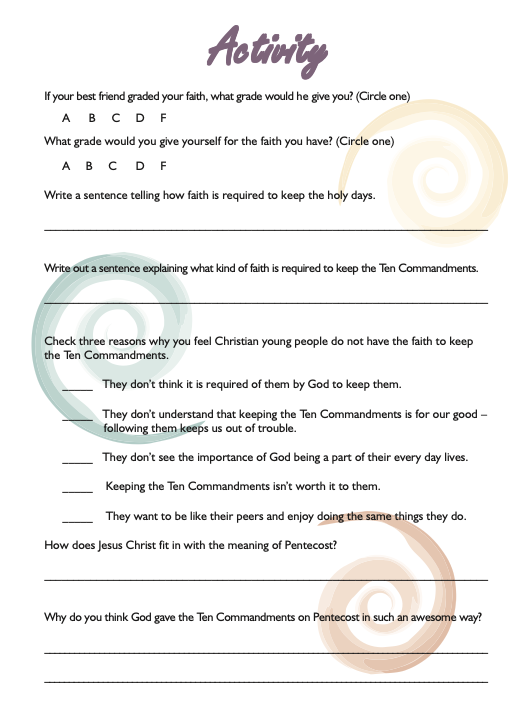
God called Moses and Aaron to the top of the mountain and warned that the people were not to come up. Then God gave the Ten Commandments.
The Ten Commandments were very likely given on the Feast of Pentecost. In Leviticus 23:15-17 God lays out the instructions for the Feast of Pentecost. “From the day after the Sabbath, the day you brought the sheaf of the wave offering, count off seven full weeks. Count off fifty days up to the day after the seventh Sabbath, and then present an offering of new grain to the LORD. From wherever you live, bring two loaves made of two-tenths of an ephah of fine flour, baked with yeast, as a wave offering of firstfruits to the Lord.”
This Scripture shows you how to determine when the Feast of Pentecost should be kept. Unlike all the other holy days, it is not a set day of the month on the calendar. One must count 50 days up to the day after the seventh Sabbath. This shows you that Pentecost is always on a Sunday.
Another thing that is interesting about these verses is that two loaves of bread were baked with yeast – they were leavened. These two loaves were offered as a wave offering of firstfruits to the Lord.”
Pentecost and the fall festivals are harvest festivals. Pentecost being the early wheat harvest and the fall festivals being the later harvest. There is to be a holy convocation and we are to abstain from ordinary work on Pentecost. This is one of the “three seasons in the year,” when God commands us to bring an offering.
As in all of God’s festivals, Christ is very much in Pentecost. 1 Corinthians 15:20 sheds some light on this. “But Christ has indeed been raised from the dead, the firstfruits of those who have fallen asleep.” Jesus was crucified on the Passover and raised from the dead on the third day.
Do you recall that Mary Magdalene went to the tomb where Jesus had been buried and He was not there. As she wept, she bent over and looked in the tomb and saw two angels. They asked her why she was crying. She explained it was because they had taken Jesus away. As she turned around she saw Jesus standing there. But He would not let her touch Him because “I have not yet returned to the Father.” Some time that Sunday, Jesus ascended to His Father and presented Himself as the wave sheaf offering. He was the firstfruits of many brethren – the first to be resurrected.
A week later in John 20:24-29 doubting Thomas said, “Unless I see the nail marks in his hands and put my finger where the nails were, and put my hand into his side, I will not believe.” Jesus told Thomas to put his finger in his hand and side. Now it was okay to touch Jesus because He had presented Himself to His Father as the wave sheaf offering.
The Israelites were fearful and doubtful when the Egyptian army was bearing down on them and the Red Sea was in front of them. God delivered and then gave the gift of the Ten Commandments. Thomas also doubted Jesus’ resurrection. As you celebrate Pentecost this year, do you doubt that Jesus can save you from your sins - or do you doubt?
Holy and Awesome God,
You parted the Red Sea and the Israelites walked across it on dry land. Jesus was crucified and resurrected the third day and was the wave sheaf offering as the firstfruits of many brethren. Thomas doubted Jesus’ resurrection. Sometimes I don’t believe you and your Word as I should. Help my unbelief.
In Jesus’ name I pray.
Amen.
Sunday - Exodus 19:16-19
Monday - Leviticus 23:15-17
Tuesday - John 20:10-17
Wednesday - John 20:26-29
Thursday - 1 Corinthians 15:20
Friday - Deuteronomy 16:9-12
Saturday - Acts 2:1-4
Leviticus 23:23-25
Numbers 29:1
Matthew 24:1-50
Matthew 24:43-44
Matthew 25:1-13
Luke 21:25-36
1 Corinthians 15:50-52
1 Thessalonians 5:1-11
MANIFESTATION - a phenomenon; a public demonstration of power or intent
MANNA - it literally means, “What is it.” It was the small grains or flakes left miraculously on the ground around the Israelite’s camp for them to eat.
The Israelites celebrated their first Feast of Pentecost with such awesome manifestations! Smoke billowed up as the mountain trembled violently, then God spoke the Ten Commandments. This wasn’t long after God miraculously saved the Israelites from Pharaoh’s approaching armies by parting the Red Sea. The children of Israel had watched as Pharaoh’s chariots tried to cross the sea and were drowned as God brought the water back over them. But those weren’t the only miracles the Israelites experienced as they continued their journey towards the Promised Land. Even though the Israelites did a lot of grumbling, God took care of them and gave them sweet water to drink and fed them with manna and quail.
God continued to instruct this massive group of people in His way. While they were slaves in Egypt, they had lost sight of the worship of the True God. After giving the Ten Commandments to Moses on Mount Sinai, God outlined other social responsibilities, regulation of servants, personal injuries, protection of property, and other laws they were to obey. In the middle of these laws, God instructed Moses about the Holy Days. This is found in Exodus 23:14-17, “Three times a year you are to celebrate a festival to me. Celebrate the Feast of Unleavened Bread; for seven days eat bread made without yeast, as I commanded you. Do this at the appointed time in the month of Abib, for in that month you came out of Egypt.
“No one is to appear before me empty handed.“
“Celebrate the Feast of Harvest with the firstfruits of the crops you sow in your field.”
“Celebrate the Feast of Ingathering at the end of the year, when you gather in your crops from the field.
“Three times a year all the men are to appear before the Sovereign LORD.”
There were three seasons of Holy Days which God commanded the Israelites to observe. The first autumn holy day is the Feast of Trumpets. Leviticus 23:23-25 says, “The LORD said to Moses, Say to the Israelites: On the first day of the seventh month you are to have a day of rest, a sacred assembly commemorated with trumpet blasts. Do no regular work, but present an offering made to the LORD by fire.” This is the only one of God’s holy days which falls on the first day of the month. Historically, God’s people looked for the new moon which signaled the beginning of the month. When it was seen by trained observers, trumpets were blown and signal fires were lit to announce to all the people that a new month had begun. Each month was announced this way. On the Feast of Trumpets, it was a day of rest, a day of the blowing of trumpets, and a day of special sacrifices. But there’s no other direct explanation of the reason behind the celebration in the Old Testament.
Then how are we to celebrate the Feast of Trumpets today? We still have the command: “On the first day of the seventh month hold a sacred assembly and do no regular work” ( Numbers 29:1 NIV). In addition, we have Paul’s explanation of what sounds like the Feast of Trumpets, with trumpet blasts and the return of Jesus, in 1 Corinthians 15:50-52, “I tell you this, brothers: flesh and blood cannot inherit the kingdom of God, nor does the perishable inherit the imperishable. Behold! I tell you a mystery. We shall not all sleep, but we shall all be changed, in a moment, in the twinkling of an eye, at the last trumpet. For the trumpet will sound, and the dead will be raised imperishable, and we shall be changed (ESV).
Because every one of the holy days, including the Feast of Trumpets points directly to Christ, we can make a good case for the return of Jesus happening on the Feast of Trumpets. We know that He will return when the last trumpet is blown. Many believe the seventh trumpet is blown on the Feast of Trumpets. But we also have this warning: Christ says, “No one knows about that day or hour, not even the angels in heaven, nor the Son, but only the Father.”
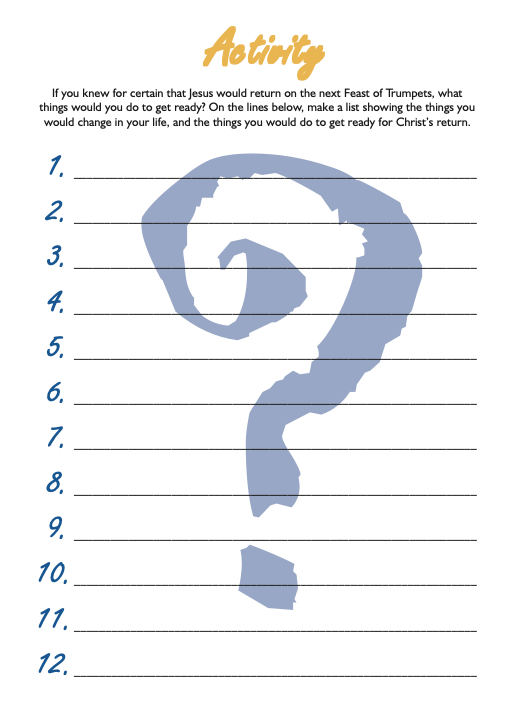
Since we don’t know if Christ will return next year on the Feast of Trumpets or at another time, what do we do? We must be ready whenever that wonderful event takes place. Jesus tells us, “So you also must be ready, because the Son of Man will come at an hour when you do not expect Him” (Matthew 24:44 NIV).
How do you get ready? To be ready to be caught up in the air to meet Christ when He returns, you must be a converted Christian. That means that you must have repented of your sins and been baptized. That’s the first act of obedience, but it doesn’t stop there. You must choose to follow God’s ways (His laws and principles) every day. That requires daily submission to the changing power of the Holy Spirit in your life. But the reward is great! So I just have one question for you: Are you ready?
Holy Father,
Thank you for revealing your holy days to me. Help me to always celebrate them in a way that would please you. Thank you for the Feast of Trumpets and the hope of Jesus Christ returning to this earth. We’ll never have real peace until He returns. Hasten the day.
In Jesus’ name I pray.
Amen.
Sunday - Leviticus 23:23-25
Monday - Numbers 29:1
Tuesday - 1 Corinthians 15:50-52
Wednesday - Luke 21:25-36
Thursday - 1 Thessalonians 5:1-11
Friday - Matthew 24:1-28
Saturday - Matthew 24:29-50
Leviticus 23:26-28
Leviticus 25:8-10
Leviticus 25:20-22
Psalm 103:11-12
Jeremiah 34:8, 15-17
Matthew 11:29
ATONEMENT - cover
LIBERTY - the quality or state of being free; one being able to do as he pleases
The Day of Atonement is one of the most remarkable holy days with some of the deepest significance that God has given us. Ten days after we celebrate the Feast of Trumpets, we are to keep the Day of Atonement by resting and doing no work, afflicting ourselves from the evening of the ninth day to the evening of the tenth day. We are also to attend a sacred assembly on that day.
God commanded the High Priest to perform a special ceremony on the Day of Atonement in the Temple. The ceremony that the High Priest performed was like acting out a play on the stage of the Temple. The characters in this play were the High Priest, a bull, two goats and another man. This ceremony was so sacred that the High Priest had to do it exactly as God told him, or he would die. The High Priest was the only one who could go behind the curtain into the Holy of Holies, and he could only go on the Day of Atonement.
God instructed the High Priest to cast lots to determine which goat would represent Christ and which one would be the scapegoat that would be turned loose in the wilderness. He was to bathe himself and put on clean white linen garments from the skin out – including a cap. Then he was to sacrifice a bull, sprinkle some of its blood behind the curtain, and make an atonement for himself and his family.
The High Priest was to come back out and sacrifice the goat representing Christ and sprinkle some of its blood behind the curtain and on the altar of incense. Then he was to lay his hands on the head of the scapegoat, confess the sins of all of Israel over that goat, and have another man take it into the wilderness, and let it go. How is this day different from the Passover? And what significance does it have for you as a Christian today?
When we partake of the Passover we are accepting Christ’s sacrifice for our personal sins. Christ died for us individually. If you were the only person in the world who had sinned, Christ would have had to die for you to have forgiveness. The Day of Atonement is a day when our communal or national sins can be covered. God gave it is as communal or national day of forgiveness when liberty was proclaimed throughout the land. The scriptures below will show this.
As God led the Children of Israel towards the Promised Land with a cloud by day and a pillar of fire by night, He continued to teach them such wonderful things to make their lives better. He told them, “Count off seven sabbaths of years – seven times seven years – so that the seven sabbaths of years amount to a period of forty-nine years. Then have the trumpet sounded everywhere on the tenth day of the seventh month on the Day of Atonement sound the trumpet throughout your land. Consecrate the fiftieth year and proclaim liberty throughout the land to all its inhabitants. It shall be a jubilee for you; each one of you is to return to his family property and each to his own clan. The fiftieth year shall be a jubilee for you; do not sow and do not reap what grows of itself or harvest the untended vines. For it is a jubilee and is to be holy for you; eat only what is taken directly from the fields” (Leviticus 25:8).
Every seventh year God commanded that the land rest and the people were not to sow or reap. On the Day of Atonement every seventh year, all debts were forgiven. In the fiftieth year, the Jubilee, all the land reverted back to its original owner and slaves were to be set free. Liberty was proclaimed throughout the land. This is a community or national thing.
It took faith to obey these commands. God knew that the people would want to know what they would eat in the seventh year if they couldn’t plant or harvest crops. But God promised to give them such a blessing in the sixth year that they would have enough for three years. (Leviticus 25:20-22).
Jesus says in Matthew 11:29, “Take my yoke upon you and learn from me, for I am gentle and humble in heart, and you will find rest for your souls. For my yoke is easy and my burden is light.” One message in the Day of Atonement is to Proclaim Liberty! Slaves are set free. The land rests. It reverts back to its original owner. And God bountifully blesses those who have faith enough to obey Him.
Do you have the faith to do no work on the Day of Atonement? Do you have the faith to attend a sacred assembly and to afflict your soul from evening to evening? The same as the High Priest confessed the sins of all of Israel over the head of the goat, we should confess our sins to God and ask forgiveness. Then we can Proclaim Liberty – we have been liberated from the penalty of sin.
Why was this goat taken out into the wilder- ness and let go? When sins are forgiven, God doesn’t remember them again. “For as high as the heavens are above the earth, so great is his love for those who love him; as far as the east is from the west, so far has he removed our transgressions from us” (Psalm 103:11-12).
Awesome God,
Your ways are so much higher than my ways and so wonderful! You want us to be free from sin and its consequences. You have provided a way through Jesus Christ our High Priest that we can be. I have sinned against you. Please forgive me. Thank you for the Day of Atonement. Help us to celebrate it with deep humility and gratitude.
In Jesus’ name I ask these things.
Amen.
Sunday - Leviticus 23:26-27
Monday - Leviticus 25:8
Tuesday - Leviticus 25:20-22
Wednesday - Matthew 11:29
Thursday - Psalm 103:11-12
Friday - Leviticus 25:10
Saturday - Jeremiah 34:8, 15-17
Exodus 23:16
Exodus 34:22
Leviticus 23:33-35
Leviticus 23:39-43
Numbers 29:12-34
Deuteronomy 14:22-23
Zachariah 14:16-19
Matthew 18:20
PILGRIMAGE - a journey of a pilgrim, especially to a shrine or sacred place.
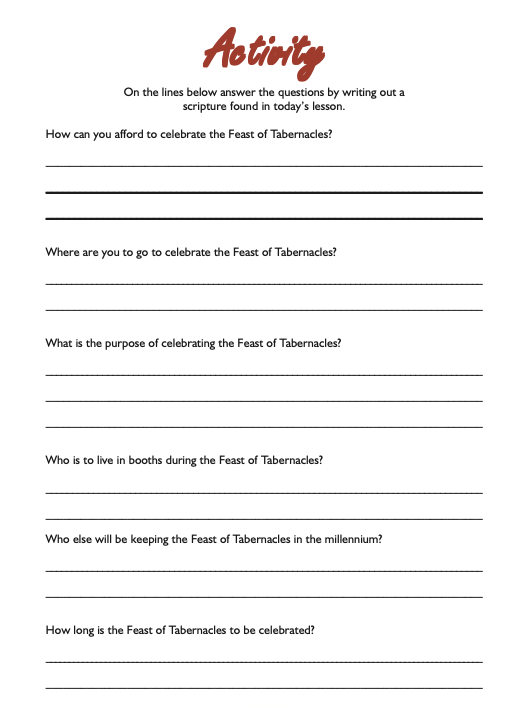
Five days after the Day of Atonement, God commands His people to celebrate another Feast. This was the last of the three pilgrimage festivals. A pilgrimage festival meant that they had to Put it Together and take a journey. How could they afford to go? What was the place they were to go? And what was the purpose of doing all of these things?
Deuteronomy 14:22-23 says, “Be sure to set aside a tenth of all that your fields produce each year. Eat the tithe of your grain, new wine and oil, and the firstborn of your herds and flocks in the presence of the LORD your God at the place he will choose as a dwelling for his Name so that you learn to revere the LORD your God always. . .”
We’ve found the answers to all of those three questions in these two verses. The first answer is that God has provided a way for His people to have enough money to make this trip and to rejoice before Him. We are to save ten percent of our increase. Yes, it is a tithe. But this tithe is not given to God to do His work. This is a different tithe that you save so that you can enjoy the Feast. It’s a tithe that you can eat in God’s presence.
Have you known people who say they can’t Put it Together and afford to go to the Feast of Tabernacles? Maybe you’ve known some who had to go to a site very close to home because they didn’t have enough money to go where they really wanted to go. Then there are some who can barely afford to go, and really have to watch their pennies. Most of these people probably haven’t obeyed this command to save one tenth of their increase so they can celebrate the Feast. God doesn’t want us to go in debt to go to the Feast. He wants us to have enough money before we go to the Feast so that we can rejoice! Carefully following this one principle makes the Feast an affordable and a joyous occasion
We’ve also found in those two verses where we are to go to celebrate the Feast of Tabernacles. We are to go where God chooses as a dwelling for His Name. Where does God dwell during the Feast of Tabernacles? He dwells where His people are – where they are celebrating the Feast. In Bible times, many made the pilgrimage to Jerusalem to celebrate the Feast. It would not be feasible for the entire world to go to Jerusalem today. Matthew 18:20 says, “For where two or three come together in my name, there am I with them” (NIV).
The third answer given in those two verses is the purpose of going to the Feast. We go to “learn to revere the LORD your God always.” Some things you should look for in the Feast site that you attend is where can you have good youth classes, seminars, uplifting sermons and inspiring music. These should be your priorities in selecting the Feast site you attend.
Okay, we’ve learn how we can afford to go to the Feast of Tabernacles, where we are to go, and what we’re to do when we get there. So when is this Feast and how do we celebrate it?
“The LORD said to Moses, Say to the Israelites: On the fifteenth day of the seventh month the LORD’S Feast of Tabernacles begins, and it lasts for seven days. The first day is a sacred assembly; do no regular work. . .
“So beginning with the fifteenth day of the seventh month, after you have gathered the crops of the land, celebrate the festival to the LORD for seven days; the first day is a day of rest, and the eighth day also is a day of rest. On the first day you are to take choice fruit from the trees, and palm fronds, leafy branches and poplars, and rejoice before the LORD your God for seven days. Celebrate this as a festival to the LORD for seven days each year. This is to be a lasting ordinance for the generations to come; celebrate it in the seventh month. Live in booths for seven days: All native-born Israelites are to live in booths so your descendants will know that I had the Israelites live in booths when I brought them out of Egypt. I am the LORD your God.” (Leviticus 23:33-35, 39-43)
There are a couple of interesting things we need to notice. “This is a lasting ordinance for the generations to come.” So we should still celebrate the Feast of Tabernacles. You may ask if it’s only for those who are Israelite born. Those who are Israelite born are to live in temporary dwellings so our descendants will remember that our forefathers lived in booths when they came out of Egypt. But all nations – even the Egyptians will celebrate the Feast of Tabernacles in the millennium, or they will suffer the consequences. “Then the survivors from all the nations that have attacked Jerusalem will go up year after year to worship the King, the LORD Almighty, and to celebrate the Feast of Tabernacles. If any of the peoples of the earth do not go up to Jerusalem to worship the King, the LORD Almighty, they will have no rain. If the Egyptian people do not go up and take part, they will have no rain. The LORD will bring on them the plague he inflicts on the nations that do not go up to celebrate the Feast of Tabernacles” (Zechariah 14:16-19). The entire world will learn that they must Put it Together and keep the Feast.
Almighty God,
Thank you for giving us the Feast of Tabernacles and providing a means where we can afford to go. Help us to keep in mind the purpose of your Feast and accomplish it in our celebration.
In Jesus’ name I pray these things.
Amen.
Sunday - Leviticus 23:33-35
Monday - Leviticus 23:39-43
Tuesday - Deuteronomy 14:22-23
Wednesday - Matthew 18:20
Thursday - Zachariah 14:16-19
Friday - Exodus 23:16; 34:22
Saturday - Numbers 29:12-34
Leviticus 23:36
Numbers 29:35-38
Isaiah 51:16
John 1:1-5
John 7:37-39
Revelation 21:1-7
Revelation 22:12-16
USHER - to conduct to a place.
TRUSTWORTHY - fidelity; constancy
INTRICATE - Having many interrelating parts
Let’s pretend for a minute that God gave you a planet and said, “I want you to plan it and create intelligent life on it. When you put intelligent beings on your planet, they are going to mess up very badly. So you’ve got to provide a way to save them from the consequences of their mistakes.” Where would you start and what would be your plan?
At the very beginning of time, God gave this responsibility to Jesus Christ. We’re told about this in John 1:1-5 “In the beginning was the Word, and the Word was with God, and the Word was God. He was with God in the beginning.
“Through him all things were made, without him nothing was made that has been made. In him is life, and that life was the light of men. The light shines in the darkness, but the darkness has not understood it” (NIV).
Jesus is the Word of God. He created this world and everything in it. He put intelligent life on this earth – Adam and Eve. And they messed up badly when they ate the forbidden fruit. This carried the death penalty. Every person after Adam and Eve has messed up as well and all of us have been condemned to receive the penalty of eternal death. The only way to reverse this was for Jesus Himself to pay our penalty with His own life.
A plan was laid out from the foundation of the world that is pictured in the holy days. The Passover shows our forgiveness of sin through the death of Jesus Christ. We are commanded to put leavening out of our homes (which represents putting sin out of our lives), before the days of Unleavened Bread start. Then we are to eat unleavened bread for seven days. This unleavened bread pictures the Bread of Life, who is Jesus Christ. Eating unleavened bread for seven days pictures making Jesus Christ an intricate part of our lives. The purpose of this exercise is to change us into be- coming more like Him. Pentecost was the day the New Testament church was empowered with God’s Holy Spirit to do a work.
The Autumn festivals are ushered in with blowing the trumpet on the first day of the seventh month – the Feast of Trumpets. When the seventh trumpet sounds Jesus Christ will return to this earth. But remember, we’ve learned that we’re not to set dates. This festival is followed by the Day of Atonement when the Jubilee year begins. Slaves are set free and the land returns to its original owner. Our national sins are forgiven. Next we celebrate the Feast of Tabernacles by living in temporary housing for seven days showing this life is only temporary. This shows that we’re looking for a better world to come – the Kingdom of God on this earth.
There is yet one more day to celebrate. This day pictures God’s final plan for man – the day God closes everything out. “For seven days, present offerings made to the LORD by fire, and on the eighth day hold a sacred assembly and present an offering made to the LORD by fire. It is the closing assembly; do no regular work (Leviticus 23:36 NIV).
Jesus celebrated this day as well. “On the last and greatest day of the Feast, Jesus stood and said in a loud voice, ‘If anyone is thirsty, let him come to me and drink. Whoever believes in me, as the Scripture has said, streams of living water will flow from within him.’ By this he meant the Spirit, whom they who believed in him were later to receive” (John 7:37-39 NIV).
As Jesus returns to this earth, the first resurrection takes place and He sets up His Kingdom and reigns for 1000 years. But the best is yet to come. The second resurrection takes place (Revelation 20:5). This is a time when all the babies and people who never had a chance to know Christ and be converted will be resurrected to physical life.
Ezekiel 37 tells the story of the “Valley of Dry Bones” when the “whole house of Israel” (verse 11) comes back to physical life and will be given God’s Spirit (becomes converted, verse 14).
Then God Himself comes down to live with us. Revelation 21:1-7 says, “Then I saw a new heaven and a new earth, for the first heaven and the first earth had passed away, and there was no longer any sea. I saw the Holy City, the new Jerusalem, coming down out of heaven from God, prepared as a bride beautifully dressed for her husband. And I heard a loud voice from the throne saying, ‘Now the dwelling of God is with men, and he will live with them. They will be his people, and God himself will be with them and be their God. He will wipe every tear from their eyes. There will be no more death, or mourning or crying or pain, for the old order of things has passed away.
“He who was seated on the throne said, ‘I am making everything new!’ Then he said, ‘Write this down, for these words are trustworthy and true.’
“He said to me; ‘It is done. I am the Alpha and the Omega, the Beginning and the End. To him who is thirsty I will give to drink without cost from the spring of the water of life. He who overcomes will inherit all this, and I will be his God and he will be my son” (NIV).
How absolutely awesome! The Last Great Day seems to picture the beginning of eternity! Eternity is a very long time. What will you do for all eternity? Will you be given a planet to create? Would you put intelligent life on it? What will be your plan if intelligent life messes up? Would you be willing to be their savior as Jesus Christ was for you?
Awesome Father,
Truly your ways are past finding out. Your plan is so beautiful and well thought out. Help me to overcome so that I will inherit all the things you’ve prepared for me.
It’s in Jesus’ name that I pray.
Amen.
Sunday - Leviticus 23:36
Monday - John 1:1-5
Tuesday - John 7:37-39
Wednesday - Isaiah 51:16
Thursday - Numbers 29:35-38
Friday - Revelation 21:1-7
Saturday - Revelation 22:12-16

Exodus 20:2-3
Deuteronomy 4:2
Deuteronomy 12:2-3
Deuteronomy 12:29-32
Deuteronomy 12:32
Deuteronomy 19:2-18
Deuteronomy 28:1,2
Revelation 22:18
EXPLICIT - fully revealed or expressed without vagueness or ambiguity.
PAGAN - heathen – a follower of a polytheistic religion (as in Rome).
You’ve journeyed with the Israelites as they left Egypt in the first seven lessons in this book. God continued to teach them how to obey and worship Him. He outlined seven specific holy days that we are to celebrate because each one adds a piece of the puzzle to His awesome plan.
Before crossing the Jordan River into the Promised Land, Moses summoned all the Israelites to renew their covenant with God. Moses reminded them of what God had done for them during their 40 years of wandering. Their cloths didn’t wear out, neither did their sandals. And God fed them with manna all those years.
Moses exhorted them to, “Carefully follow the terms of this covenant, so that you may prosper in everything you do.” He reminded them of the detestable images and idols of wood and stone, silver and gold that were in Egypt, and in the countries they had passed through. “Make sure there is no man or woman, clan or tribe among you today whose heart turns away from the LORD our God to go and worship the gods of those nations; make sure there is no root among you that produces such bitter poison” (Deuteronomy 29:18).
Peace, prosperity and abundant happiness were promised for obedience. But following after other gods would bring sorrow, suffering and curses, Moses warned. God was specific about days and customs whereby they could worship Him. Idolatry was a very serious sin that He warned His people not to practice. “I am Jehovah your God who liberated you from slavery in Egypt. You may worship no other god other than me” (Exodus 20:2,3 TLB).
In the book of Judges Israel goes through five different patterns – sin, slavery, supplication, salvation, and silence. “They forsook the LORD, the God of their fathers, who had brought them out of Egypt. They followed and worshiped various gods of the peoples around them. They provoked the LORD to anger because they forsook him and served Baal and the Ashtoreths.”
Who or what were the Ashtoreths? Astarte was one of them. She was goddess of the evening star and renowned for her beauty. She was a goddess of fertility, love and war, often linked with Baal” (The Expositor’s Bible Commentary, page 395). Astarte is another name for Easter.
Hundreds of years before Christ was even born, a feast was held to celebrate this goddess. This took place in the spring of the year about the time of the Passover. Before the sun came up on Sunday morning, the people met outside and faced the rising sun to praise Easter, their goddess. This celebration included games, hiding and finding colored eggs in the grass around trees and other hiding places. Rabbits were added to this celebration. (You can read more about this in the Encyclopaedia Britannica, Marcropaedia Knowledge in Depth, volume 7, page 475).
Doubtless, this was a very fun day, especially for the children. But does it make it right, just because it is fun? Are you left with a disconnect when you look at what God told Israel to do and the celebration of Easter? Hundreds of years before Christ’s birth people used rabbits and eggs as a fertility rite to celebrate Easter – the goddess of love and fertility. Today people do the same things claiming it’s to celebrate the resurrected Christ. Think about it. What in the world do rabbits and hunting colored eggs have to do with the resurrection of our Lord and Savior? Yet we’ve seen that it has everything to do with a pagan custom that God condemns.
“You must destroy all the heathen altars wherever you find them – high in the mountains, up in the hills, or under the trees. Break the altars, smash the obelisks, burn the shameful images, cut down the metal idols, and leave nothing even to remind you of them!” (Deuteronomy 12:2-3 TLB). God was very explicit with His instructions to Israel that they were not to be involved in idolatrous worship or there would be consequences. Down through history Israelites and Gentiles alike ignored God’s warning and have worshiped other gods. This was most displeasing to Him.
In the previous seven lessons, we’ve explored God’s plan revealed through His holy days and laid out in the Bible. His plan does not include a sunrise service, Easter egg hunts, nor bunny rabbits. God is so pure, so good, so righteous! It would be a terrible mistake to confuse Him with other gods or goddesses. His plan focuses our attention on Jesus Christ, our repentance, taking in the Bread of Life, receiving of His Holy Spirit, His return to liberate us, and to set up His Kingdom, so that we can live forever with Him. His plan is goal-oriented with eternal significance. But where is the eternal significance in bunny rabbits laying colored Easter eggs that are hidden and found?
It does not please God when we add to or take away from what He has said, “Don’t add to what I’m commanding you. Don’t subtract from it either. Instead, obey the commands of the LORD your God that I’m giving you” ( Deuteronomy 4:2 NIrV Kid’s Devotional Bible). God is very serious about this.
In Revelation 22:18 He says, “I am warning everyone who hears the words of the prophecy of this book. If you add anything to them, God will add to you the plagues told about in this book. If you take any words away from this book of prophecy, God will take away from you your share in the tree of life. He will also take away your place in the Holy City. This books tells about these things.” We’ve seen in this lesson the horrible consequences for worshiping a false god or goddess such as Easter. We’ve seen in previous lessons in this book how that celebrating the Holy Days God has given us leads to eternal life.
“If you fully obey the LORD your God and carefully follow all his commands I give you today, the LORD your God will set you high above all the nations on earth. All these blessings will come upon you and accompany you if you obey the LORD your God” (Deuteronomy 28:1-2 NIV).
Great God and Creator,
Thank you for showing explicitly how you want me to worship you. You are so pure, so righteous, and so good. Help me never to corrupt my worship of you by adding to or subtracting what you have revealed in your Holy Word.
In Jesus’ name I pray.
Amen.
Sunday - Exodus 20:2-3
Monday - Deuteronomy 4:2
Tuesday - Deuteronomy 12:2-3
Wednesday - Deuteronomy 19:2-18
Thursday - Deuteronomy 28:1, 2
Friday - Revelation 22:18
Saturday - Deuteronomy 12:29-32
Leviticus 19:31
Leviticus 20:6-27
1 Samuel 28:3
1 Samuel 28:7-25
Micah 5:12
Galatians 5:19-22
Philippians 4:8
PLACATE - appease, mollify.
DIVINATION - a practice that seeks to foresee future events
COUNTERFEIT - an imitation of something else intended to deceive
ORGIES - a secret ceremonial rite held in honor of an ancient Greek or Roman deity; drunken revelry; a sexual encounter involving many people.
Let’s pretend for a moment that it’s 50 years ago and you live in the country with no electricity, running water or flushing toilet. You’re elderly and bothered with arthritis. Nature calls after you’ve gone to bed and you have to get up and make your way about 60 feet from your house to the outhouse. It just happens to be Halloween. And while you’re sitting there, three young thugs sneak up and turn your outhouse over with you in it. To say that would be a Not-So-Good Night would be the understatement of the year. Would you say that was a Christian thing to do to turn over another person’s outhouse? Well, this, along with breaking windows and severely damaging property are some of the mischievous things boys and young men have done on Halloween. These customs were made popular in the late 19th century, according to the Encyclopaedia Britannica, IV, page 862.
The modern celebration of Halloween originated from the ancient fire festival, “Samhain,” (Pronounced “sow-in” with sow rhyming with cow). Samhain was a joyful celebration held on November first of the final harvest that was first observed hundreds of years before Christ by the ancient Celtic people. Samhain symbolized the death of the old year and the beginning of the new one. The eve of Samhain, October 31, was the most feared time of the year because the Celts believed that at this time the division between the physical earth and the supernatural world became very thin. At this time ghosts and spirits of the dead were free to wander as they pleased.
In the seventh century Pope Boniface IV established All Saints Day to recognize all of the saints who did not have their own day. It was originally celebrated on May 13, but was moved by Pope Gregory to November 1 in the eight century. Many believe this was done to appease both the pagans and the Christians by putting a ‘Christian’ label on the pagan rituals. Halloween was originally called All Hallows’ Eve. This means the evening or night before All Saint’s Day. “Hallow” is an old English word for “saint.” This was eventually shortened to Halloween.
Some of the earlier rituals the Celtic priests (Druids) carried out during this celebration involved offering sacrifices to placate the various gods. The ritual was to frighten away evil spirits to ensure that the sun would return after winter. Is that what Jesus did when He encountered an evil spirit?
A father brought his son, who was suffering from seizures that caused him to fall into the water, to Jesus for healing. “Jesus rebuked the demon, and it came out of the boy, and he was healed from that moment.” Jesus didn’t offer sacrifices to placate the various gods. He did no ritual to frighten away evil spirits to ensure that the sun would return after winter. He had such a close relationship with His Father that when He prayed and rebuked a demon, the demon obeyed Him and left. It is Jesus’ example that Christians are to follow.
The Samhain, or Halloween festival included witchcraft, fortune telling, Ouija boards, divinations, casting spells, general destructions. The focus of Samhain was fear, death, horror and evil. Witchcraft, fortune telling, Ouija boards, divinations, casting spells, tarot cards and dabbling in satanic acts are certainly things a Christian should never be involved in.
How does Halloween stack up with God’s festivals? God’s festivals picture His mercy, forgive- ness, deliverance, salvation, and they give you hope beyond your greatest expectations.
Philippians 4:8 tells us, “Finally, brothers, whatever is true, whatever is noble, whatever is right, whatever is pure, whatever is lovely, what- ever is admirable – think about such things. Whatever you have learned or received or heard from me, or seen in me – put it into practice. And the God of peace will be with you” (NIV). We learned in our lesson about the Last Great Day that Jesus Christ will put an end to death and even tears and crying. God’s plan is of such awesome magnitude! It is so pure, so holy, and so good. We don’t need counterfeit days to celebrate that distort God’s plan.
Halloween observance in the United States, was looked upon as Not-So-Good Night and was outlawed until 1845. According to the Dauphin County Library System, the first official city wide observance of Halloween occurred in 1921 in Anoka, Minnesota. New York City followed in 1923 and Los Angeles in 1925. Halloween has grown into the second only to Christmas holiday in total retail sales. But does this observance make things better for our world? People are still keeping the old evil spirit and hiding needles and razor blade in candy given to children who trick or treat. It’s become necessary for parents to take the loot their kids receive to the local hospital and have it x-rayed before the child starts eating it.
These are not the fruits pictured in God’s festivals. This holiday does not picture the fruits of God’s Spirit – love, joy, peace, patience, kindness, goodness, faithfulness, gentleness and self-control. Halloween, like no other holiday, depicts things God hates, “idolatry and witchcraft; hatred, discord, jealousy, fits of rage, selfish ambition, dissensions, factions and envy, drunken- ness, orgies, and the like” (Galatians 5:19-21). Paul goes on to warn us that, “those who live like this will not inherit the kingdom of God.” Do you want to inherit God’s Kingdom. Then don’t substitute a Not-So-Good Night for God’s wonderful holy days.
Heavenly Father,
Thank you for your holy days that help us to learn more about your character – love, joy, peace, patience, kindness, goodness, faithfulness, gentleness and self control. Help me never to even be tempted to participate in Halloween. It depicts the dark side and all the things you hate.
In Jesus’ name I pray.
Amen.
Sunday - Galatians 5:19-22
Monday - Philippians 4:8
Tuesday - Micah 5:12
Wednesday - Leviticus 19:31
Thursday - Leviticus 20:6, 27
Friday - 1 Samuel 28:7-25
Saturday - 1 Samuel 28:3, 9
Exodus 20:2-6
Deuteronomy 12:30-32
Psalm 119:30-31
Jeremiah 10:2-4
Luke 2:1-22
John 1:1-14
SANTA CLAUS - folklore; a fat red suited, bearded man who distributes gifts at Christmastime
IMBIBE - to receive into the mind and retain
FOLKLORE - an often unsupported notion, story or saying that is widely circulated; myth
Let’s be honest. Christmas is exciting. There is a spirit about Christmas that is enticing. The songs are pretty, the smell of spices and fir trees is heavenly. And even Jolly Ole St. Nick seems like a benevolent fellow as he asks kids sitting in his lap what they want for Christmas. Do you know where Santa Claus came from? Is December 25th really the birthday of our Savior? Do you really understand why you shouldn’t keep Christmas? Is the spirit of Christmas something Christ would want you to participate in? Christmas involves a lot of work, time and expense. It takes a long time to prepare special foods, buy presents, trim the tree, put lights on the house, and decorate the yard. A special service has been created to decorate the outside of homes just for the Christmas season. Using that service can run into the thousands of dollars.
You’ve been in the mall after Thanksgiving and have seen the elaborate decorations. Do those shop keepers go to all of that trouble because they love Christ so much? Or, do they have other motives? Friday after Thanksgiving is called “Black Friday.” But why? No, it’s not given that name because it is evil. It was given that name because it is the first day in the year when most retail businesses begin to operate in the black. Generally speaking, retail stores operate in the red every year until the day after Thanksgiving – the record day for Christmas shopping. Our economy has become dependent on people buying enough Christmas presents between Thanksgiving and December 24th to give the retail store a profit. Think about it. The birth of Christ is not the driving force behind Christmas – it’s commercial business – money!
An enormous amount of thought and planning have gone into duping the public into spending their money. A warm, joyful Christmas atmosphere is created to keep unsuspecting customers adding more to their credit cards. Some of the psychology behind this even includes making you feel guilty if you don’t give until you’re grossly in debt.
The Christian world keeps saying, “Put Christ back into Christmas.” But does Christ really want to be in Christmas? Contrary to popular belief, Jesus wasn’t born on December 25th. Bullinger’s Companion Bible establishes this. Dr. Bullinger concludes that Jesus was born on the night when the Feast of Tabernacles begins and was circumcised on the Last Great Day – the eighth day of the Feast (Luke 2:21). Putting Christ back into Christmas is a contradictory term since Jesus wasn’t born on Christmas day, nor was He ever in it. Why wasn’t Christ in Christmas?
A day was celebrated many years before Christ was ever born, in much the same way, and at the same time of the year as Christmas. But this day was not to celebrate the birth of the Son of God. Rather it was to celebrate the sun god named Sol Invictus. Jeremiah 10:2b - 4, shows that people decorated a tree much the same as they do today: “Do not learn the ways of the nations, or be terrified by signs in the sky, though the nations are terrified by them; they cut a tree out of the forest, and a craftsman shapes it with his chisel. They adorn it with silver and gold; they fasten it with hammer and nails so it will not totter” (TNAB). Since Jeremiah was written prior to 560 B.C., this tradition was being celebrated long before Christ. This celebration was so much fun and so popular that several centuries after Christ was born, Christian churches began including it as a part of their worship of God. That may sound like a perfectly harmless thing to do, but what does your Bible say about it?
“Don’t ask questions about their gods. Don’t say, ‘How do these nations serve their gods? We’ll do it in the same way.’ You must not worship the LORD your God the way they worship their gods. . . Be sure you do everything I’m commanding you to do. Don’t add anything to my commands. And don’t take anything away from them” (Deuteronomy 12:30-32 NIrV Kid’s Devotional Bible).
Our God is Holy, Righteous, True, Supreme, the Beginning and the End, and the “Giver of every good and perfect gift.” Children are led to believe that Santa is the giver of every good gift. This folklore expects us to believe that Santa rides through the air on a sleigh pulled by reindeer. He lands on the roof top and goes down the chimney bringing his bag full of gifts.
What does the Bible say about this folklore? “You shall have no other gods before me. You shall not make for yourself an idol in the form of anything in heaven above or on the earth beneath or in the waters below. You shall not bow down to them or worship them; for I the LORD your God, am a jealous God, punishing the children for the sin of the fathers to the third and fourth generation of those who hate me, but showing love to a thousand generations, of those who love me and keep my commandments” (Exodus 20:3-6 TNAB).
The consequences for substituting another god for the True God follows through to the third and fourth generation. But the flip side of the coin is that God will show “love to a thousand generations, of those who love me and keep my commandments.” Now that’s a real bargain!
God richly blesses you for not following pagan folklore. At the same time, He hasn’t left you without great days to celebrate. You’ve gone through seven holy days in this book that God commands you to celebrate. They keep you mindful of the True God and His plan. They contain no myths, no falsehoods, no folklore and no punishment, only blessings for keeping them. These days should become a joyful tradition in your family that you plan for, learn from, and enjoy to the full. God wants you to celebrate big with no regrets about not keeping a folklore that steers you off the path from truly understanding Him, His love and His plan. He wants to bless you!
Holy Father,
The Giver of every good and perfect gift, help me to never substitute another God for you. Your plan is not a folklore, it’s true! So are your blessings for obedience. Help me never to condemn those who keep Christmas, but always be a living example.
In Jesus’ name.
Amen.
Sunday - Jeremiah 10:2-4
Monday - Deuteronomy 12:30-32
Tuesday - Psalm 119:30-31
Wednesday - Exodus 20:2-6
Thursday - Luke 2:1-20
Friday - Luke 2:21-22
Saturday - John 1:1-14