YEA Lesson Library
Not-so-Good Night
About This Lesson
This lesson contrasts the celebration of Halloween, with its darkness and evilness, with God’s Holy Days.
Scriptures
Leviticus 19:31
Leviticus 20:6-27
1 Samuel 28:3
1 Samuel 28:7-25
Micah 5:12
Galatians 5:19-22
Philippians 4:8
Words to Know
PLACATE - appease, mollify.
DIVINATION - a practice that seeks to foresee future events
COUNTERFEIT - an imitation of something else intended to deceive
ORGIES - a secret ceremonial rite held in honor of an ancient Greek or Roman deity; drunken revelry; a sexual encounter involving many people.
The Lesson
Let’s pretend for a moment that it’s 50 years ago and you live in the country with no electricity, running water or flushing toilet. You’re elderly and bothered with arthritis. Nature calls after you’ve gone to bed and you have to get up and make your way about 60 feet from your house to the outhouse. It just happens to be Halloween. And while you’re sitting there, three young thugs sneak up and turn your outhouse over with you in it. To say that would be a Not-So-Good Night would be the understatement of the year. Would you say that was a Christian thing to do to turn over another person’s outhouse? Well, this, along with breaking windows and severely damaging property are some of the mischievous things boys and young men have done on Halloween. These customs were made popular in the late 19th century, according to the Encyclopaedia Britannica, IV, page 862.
The modern celebration of Halloween originated from the ancient fire festival, “Samhain,” (Pronounced “sow-in” with sow rhyming with cow). Samhain was a joyful celebration held on November first of the final harvest that was first observed hundreds of years before Christ by the ancient Celtic people. Samhain symbolized the death of the old year and the beginning of the new one. The eve of Samhain, October 31, was the most feared time of the year because the Celts believed that at this time the division between the physical earth and the supernatural world became very thin. At this time ghosts and spirits of the dead were free to wander as they pleased.
In the seventh century Pope Boniface IV established All Saints Day to recognize all of the saints who did not have their own day. It was originally celebrated on May 13, but was moved by Pope Gregory to November 1 in the eight century. Many believe this was done to appease both the pagans and the Christians by putting a ‘Christian’ label on the pagan rituals. Halloween was originally called All Hallows’ Eve. This means the evening or night before All Saint’s Day. “Hallow” is an old English word for “saint.” This was eventually shortened to Halloween.
Some of the earlier rituals the Celtic priests (Druids) carried out during this celebration involved offering sacrifices to placate the various gods. The ritual was to frighten away evil spirits to ensure that the sun would return after winter. Is that what Jesus did when He encountered an evil spirit?
A father brought his son, who was suffering from seizures that caused him to fall into the water, to Jesus for healing. “Jesus rebuked the demon, and it came out of the boy, and he was healed from that moment.” Jesus didn’t offer sacrifices to placate the various gods. He did no ritual to frighten away evil spirits to ensure that the sun would return after winter. He had such a close relationship with His Father that when He prayed and rebuked a demon, the demon obeyed Him and left. It is Jesus’ example that Christians are to follow.
The Samhain, or Halloween festival included witchcraft, fortune telling, Ouija boards, divinations, casting spells, general destructions. The focus of Samhain was fear, death, horror and evil. Witchcraft, fortune telling, Ouija boards, divinations, casting spells, tarot cards and dabbling in satanic acts are certainly things a Christian should never be involved in.
How does Halloween stack up with God’s festivals? God’s festivals picture His mercy, forgive- ness, deliverance, salvation, and they give you hope beyond your greatest expectations.
Philippians 4:8 tells us, “Finally, brothers, whatever is true, whatever is noble, whatever is right, whatever is pure, whatever is lovely, what- ever is admirable – think about such things. Whatever you have learned or received or heard from me, or seen in me – put it into practice. And the God of peace will be with you” (NIV). We learned in our lesson about the Last Great Day that Jesus Christ will put an end to death and even tears and crying. God’s plan is of such awesome magnitude! It is so pure, so holy, and so good. We don’t need counterfeit days to celebrate that distort God’s plan.
Halloween observance in the United States, was looked upon as Not-So-Good Night and was outlawed until 1845. According to the Dauphin County Library System, the first official city wide observance of Halloween occurred in 1921 in Anoka, Minnesota. New York City followed in 1923 and Los Angeles in 1925. Halloween has grown into the second only to Christmas holiday in total retail sales. But does this observance make things better for our world? People are still keeping the old evil spirit and hiding needles and razor blade in candy given to children who trick or treat. It’s become necessary for parents to take the loot their kids receive to the local hospital and have it x-rayed before the child starts eating it.
These are not the fruits pictured in God’s festivals. This holiday does not picture the fruits of God’s Spirit – love, joy, peace, patience, kindness, goodness, faithfulness, gentleness and self-control. Halloween, like no other holiday, depicts things God hates, “idolatry and witchcraft; hatred, discord, jealousy, fits of rage, selfish ambition, dissensions, factions and envy, drunken- ness, orgies, and the like” (Galatians 5:19-21). Paul goes on to warn us that, “those who live like this will not inherit the kingdom of God.” Do you want to inherit God’s Kingdom. Then don’t substitute a Not-So-Good Night for God’s wonderful holy days.
Student Prayer
Heavenly Father,
Thank you for your holy days that help us to learn more about your character – love, joy, peace, patience, kindness, goodness, faithfulness, gentleness and self control. Help me never to even be tempted to participate in Halloween. It depicts the dark side and all the things you hate.
In Jesus’ name I pray.
Amen.
Daily Devotions
Sunday - Galatians 5:19-22
Monday - Philippians 4:8
Tuesday - Micah 5:12
Wednesday - Leviticus 19:31
Thursday - Leviticus 20:6, 27
Friday - 1 Samuel 28:7-25
Saturday - 1 Samuel 28:3, 9
Objectives
At the end of this lesson, students will be able to:
1. Explain where the celebration of Halloween came from.
2. Contrast what Halloween depicts and what the holy days portray.
3. Discuss why God does not want Christians to participate in Halloween.
Topics & Themes
Death
Evil
Fruit of the Spirit
God’s Kingdom
God’s Plan
Halloween
Holidays, Halloween
Holy Days
Jesus, His Miracles
Healing
Jesus Sets Example
Materials Needed
Bible, YEA students’ and teacher’s books, CD or cassette tape, music player, paper, pencils, dictionaries, concordances, chalkboard or newsprint pad, marker, timer
How to Teach This Lesson
After opening the class with prayer, have the students draw one or more (depending on the size of your class) pieces of paper that you prepared with the words in Background. Divide the class into groups of threes.
Ask each group to take their Bibles with them and go to separate areas of the room to brainstorm. Give each group a concordance, dictionary, pencil, and paper. Explain that this exercise is to help them contrast Halloween, and the events related to it, with God’s holy days. First they are to find the meanings of the words they drew and write them on their paper. They are to find any place in the Bible where their words are used in relation to one of God’s holy days and write that on their paper. Then they are to see if they can find a reason why God would not want them to use, participate, or even play with the words they drew. Write the Scripture reference and verse on their paper. Give them about five to eight minutes to complete their assignment. Set the timer and say go. When the timer rings, call the students back to sit in the chairs in the semicircle.
Debrief - Ask: How many of the words on your papers did you find associated with any of the Feast days? What trend, similarity, or tone do you feel the words your group drew reflect? How do you feel this trend or tone expresses God’s character? How do you see this trend or tone expressed in God’s holy days? Ask one of the students to read Philippians 4:8. As the student reads the verse, list the following words on the chalkboard: true, noble, right, excellent, and praiseworthy. Explain that the words you gave them to brainstorm are all related to Halloween. Ask them to look at their papers and tell you which word matches up with the words on the board.(They should not be able to find any.) What have you discovered from this exercise?
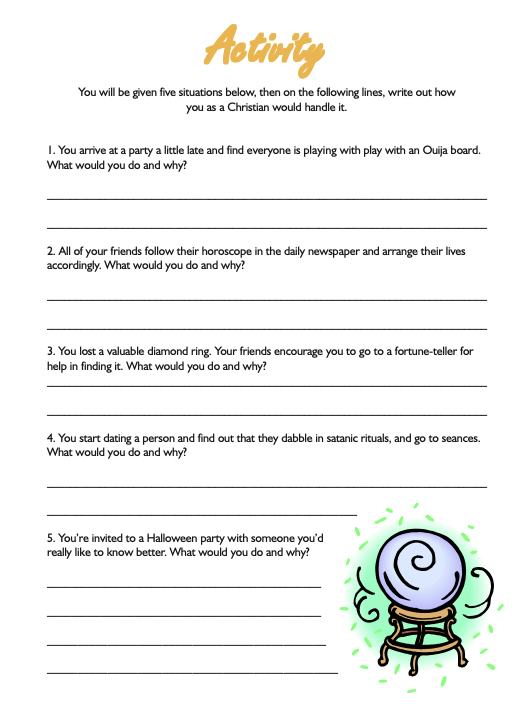
Go over the students’ Activity - Situation one: You arrive at a party a little late and find everyone is involved playing with an Ouija board. What would you do and why? Situation two: All of your friends follow their horoscope in the daily newspaper and arrange their lives accordingly. What should you do and why? Situation three: You lost a valuable diamond ring. Your friends encourage you to go to a fortune-teller for help in finding it. What would you do and why? Situation four: You start dating a person and find out that he dabbles in satanic rituals, and goes to seances. What would you do and why? Situation five: You’re invited to a Halloween party with someone you’d really like to know better. What would you do and why?
Contrast the effect Halloween vs the holy days has on you - What are the repeated themes for Halloween? What kind of a mood would death, destruction, ghosts, divination, orgies, etc. put you in? Who do you think is responsible for these moods? How do you think God feels about these things? Ask one of the students to read Deuteronomy 18:10. Why do you think God hates witchcraft, mediums, casting spells, etc., so much? This spirit is contrary, or just the opposite to God’s Spirit. It’s a spirit that is no good and has a negative influence. It can cause you to be depressed, to think about death, destruction and even suicide.
Suicide is far too prevalent among teenagers. How do you see that the spirit of Halloween could make a person more likely to commit suicide? God gives us so much hope in His holy days. These are days of love, happiness, service. God does not want us to allow our minds to dwell on the dark things Halloween depicts. Anytime your mind begins to think on these things or you become depressed, immediately call on God to help you focus on good, pure, and loving things. Ask a student to read Philippians 4:8. This is the recipe for happiness.
Teacher-Directed Activity
The activity is incorporated under How to Teach This Lesson.
Song
“By My Spirit” is on page 56 of The Group Songbook.
Closing Prayer
Have the students form a circle and join hands. Ask for a volunteer to lead in prayer asking God to help us keep our minds focused on the things His holy days and character portray.
Printable Pages