YEA Lesson Library
It’s Not In The Plan
About This Lesson
This lesson teaches that Easter is pagan and has pagan origins and therefore falls under the prohibition to add to what God has commanded us to do in worship of Him.
Scriptures
Exodus 20:2-3
Deuteronomy 4:2
Deuteronomy 12:2-3
Deuteronomy 12:29-32
Deuteronomy 12:32
Deuteronomy 19:2-18
Deuteronomy 28:1,2
Revelation 22:18
Words to Know
EXPLICIT - fully revealed or expressed without vagueness or ambiguity.
PAGAN - heathen – a follower of a polytheistic religion (as in Rome).
The Lesson
You’ve journeyed with the Israelites as they left Egypt in the first seven lessons in this book. God continued to teach them how to obey and worship Him. He outlined seven specific holy days that we are to celebrate because each one adds a piece of the puzzle to His awesome plan.
Before crossing the Jordan River into the Promised Land, Moses summoned all the Israelites to renew their covenant with God. Moses reminded them of what God had done for them during their 40 years of wandering. Their cloths didn’t wear out, neither did their sandals. And God fed them with manna all those years.
Moses exhorted them to, “Carefully follow the terms of this covenant, so that you may prosper in everything you do.” He reminded them of the detestable images and idols of wood and stone, silver and gold that were in Egypt, and in the countries they had passed through. “Make sure there is no man or woman, clan or tribe among you today whose heart turns away from the LORD our God to go and worship the gods of those nations; make sure there is no root among you that produces such bitter poison” (Deuteronomy 29:18).
Peace, prosperity and abundant happiness were promised for obedience. But following after other gods would bring sorrow, suffering and curses, Moses warned. God was specific about days and customs whereby they could worship Him. Idolatry was a very serious sin that He warned His people not to practice. “I am Jehovah your God who liberated you from slavery in Egypt. You may worship no other god other than me” (Exodus 20:2,3 TLB).
In the book of Judges Israel goes through five different patterns – sin, slavery, supplication, salvation, and silence. “They forsook the LORD, the God of their fathers, who had brought them out of Egypt. They followed and worshiped various gods of the peoples around them. They provoked the LORD to anger because they forsook him and served Baal and the Ashtoreths.”
Who or what were the Ashtoreths? Astarte was one of them. She was goddess of the evening star and renowned for her beauty. She was a goddess of fertility, love and war, often linked with Baal” (The Expositor’s Bible Commentary, page 395). Astarte is another name for Easter.
Hundreds of years before Christ was even born, a feast was held to celebrate this goddess. This took place in the spring of the year about the time of the Passover. Before the sun came up on Sunday morning, the people met outside and faced the rising sun to praise Easter, their goddess. This celebration included games, hiding and finding colored eggs in the grass around trees and other hiding places. Rabbits were added to this celebration. (You can read more about this in the Encyclopaedia Britannica, Marcropaedia Knowledge in Depth, volume 7, page 475).
Doubtless, this was a very fun day, especially for the children. But does it make it right, just because it is fun? Are you left with a disconnect when you look at what God told Israel to do and the celebration of Easter? Hundreds of years before Christ’s birth people used rabbits and eggs as a fertility rite to celebrate Easter – the goddess of love and fertility. Today people do the same things claiming it’s to celebrate the resurrected Christ. Think about it. What in the world do rabbits and hunting colored eggs have to do with the resurrection of our Lord and Savior? Yet we’ve seen that it has everything to do with a pagan custom that God condemns.
“You must destroy all the heathen altars wherever you find them – high in the mountains, up in the hills, or under the trees. Break the altars, smash the obelisks, burn the shameful images, cut down the metal idols, and leave nothing even to remind you of them!” (Deuteronomy 12:2-3 TLB). God was very explicit with His instructions to Israel that they were not to be involved in idolatrous worship or there would be consequences. Down through history Israelites and Gentiles alike ignored God’s warning and have worshiped other gods. This was most displeasing to Him.
In the previous seven lessons, we’ve explored God’s plan revealed through His holy days and laid out in the Bible. His plan does not include a sunrise service, Easter egg hunts, nor bunny rabbits. God is so pure, so good, so righteous! It would be a terrible mistake to confuse Him with other gods or goddesses. His plan focuses our attention on Jesus Christ, our repentance, taking in the Bread of Life, receiving of His Holy Spirit, His return to liberate us, and to set up His Kingdom, so that we can live forever with Him. His plan is goal-oriented with eternal significance. But where is the eternal significance in bunny rabbits laying colored Easter eggs that are hidden and found?
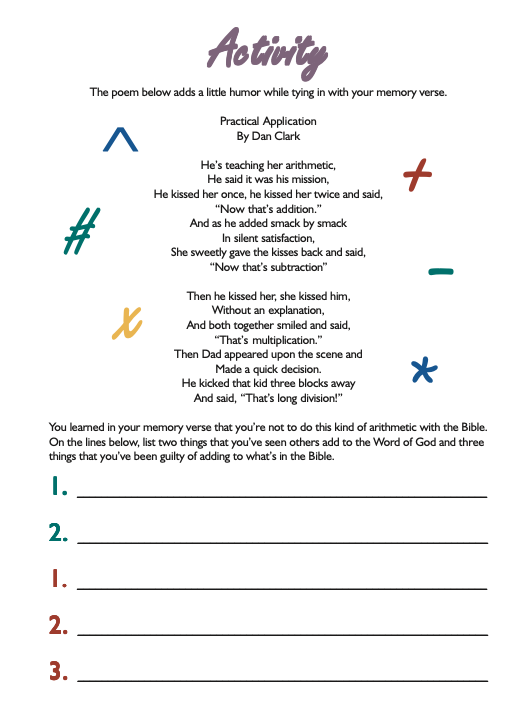
It does not please God when we add to or take away from what He has said, “Don’t add to what I’m commanding you. Don’t subtract from it either. Instead, obey the commands of the LORD your God that I’m giving you” ( Deuteronomy 4:2 NIrV Kid’s Devotional Bible). God is very serious about this.
In Revelation 22:18 He says, “I am warning everyone who hears the words of the prophecy of this book. If you add anything to them, God will add to you the plagues told about in this book. If you take any words away from this book of prophecy, God will take away from you your share in the tree of life. He will also take away your place in the Holy City. This books tells about these things.” We’ve seen in this lesson the horrible consequences for worshiping a false god or goddess such as Easter. We’ve seen in previous lessons in this book how that celebrating the Holy Days God has given us leads to eternal life.
“If you fully obey the LORD your God and carefully follow all his commands I give you today, the LORD your God will set you high above all the nations on earth. All these blessings will come upon you and accompany you if you obey the LORD your God” (Deuteronomy 28:1-2 NIV).
Student Prayer
Great God and Creator,
Thank you for showing explicitly how you want me to worship you. You are so pure, so righteous, and so good. Help me never to corrupt my worship of you by adding to or subtracting what you have revealed in your Holy Word.
In Jesus’ name I pray.
Amen.
Daily Devotions
Sunday - Exodus 20:2-3
Monday - Deuteronomy 4:2
Tuesday - Deuteronomy 12:2-3
Wednesday - Deuteronomy 19:2-18
Thursday - Deuteronomy 28:1, 2
Friday - Revelation 22:18
Saturday - Deuteronomy 12:29-32
Objectives
At the end of this lesson, students will be able to:
1. Explain the origins of Easter.
2. Discuss the disconnect with Easter and the plan of God.
3. Talk about different ways they and others add to the Word of God.
4. Discuss the consequences for following after false gods.
Topics & Themes
Blessings
Covenant
Easter
God’s Plan
Holidays, Easter
Miracles
Obedience
Pagan Traditions
Putting God First
Ten Commandments
Putting God First
Worship God
Materials Needed
Bible, YEA students’ and teacher’s books, songbook, CD or cassette tape, music player
How to Teach This Lesson
After opening the class with prayer, begin with playing a game of Bible Trivia. Let the students draw a card. Kids learn from different teaching methods such as games. Explain that they are to ask the person to their left one questions. Then when it’s their turn, ask the next question, and then the next. Don’t reveal the answer until the person has a chance to give it. If the person being asked does not answer correctly, the one who asked the question should give the answer. Keep each student’s score. The winner should receive an award.
Card #1
Q. Give the month and day of the Passover. A. 14th day of the first month
Q. Where is it said in the Bible that we should not add to or take a way from His Word? A. Deuteronomy 12:32
Q. Who was Astarte or Easter? A. Goddess of fertility, love, and war
Card #2
Q. How many holy days does God command us to celebrate? A. Seven
Q. What are the benefits for “Carefully following the terms of this covenant?” A. Prosper in everything you do
Q. What is the penalty for adding to or taking from God’s Word? A. Plagues told about in this book
Card #3
Q. What is the word used in the Bible for Easter? A. Ashtoreth
Q. Name the five patterns Israel went through in Judges. A. Sin, slavery, supplication, salvation, and silence
Q. How long did the Israelite’s clothes last? A. Forty years
Card #4
Q. Name God’s holy days in order. A. Unleavened Bread, Pentecost, Trumpets, Atonement, Tabernacles, Last Great Day (Passover is technically not a Holy Day.)
Q. How long were the Israelites in Egypt? A. Accept either 400 or 430
Q. What does Pentecost mean? A. Fifty
Card #5
Q. Where were the Ten Commandments given? A. Mt. Sinai
Q. What did the Israelites eat journeying to the Promised Land? A. Manna and quail
Q. Name three things we should do on Atonemnt. A. Don’t work, fast, and have a sacred assembly.
Card #6
Q. How many years did the children wander in the wilderness? A. Forty years
Q. What feast were the Israelites keeping when The Law was given? A. Pentecost
Q. What kind of bread was offered on Pentecost? A. Two leavened loaves
Debrief - Ask: What is the origin of Easter? Explain how you see a disconnect with this day and God’s plan pictured in the holy days? What are some ways that people add to or take away from God’s Word? What are some ways that we add to or take from God’s law? What are the consequences of adding to or taking away from God’s law. How do you treat other people who celebrate Easter? You don’t argue with them. You answer their questions if they ask you why you don’t keep it. You set the right example before them. Read the Background to the class.
Teacher-Directed Activity
The activity is the Bible Trivial game in How to Teach This Lesson.
Song
“I Am the Resurrection and the Life” is on page 23 of The Group Songbook.
Closing Prayer
Have the students form a circle and join hands. Ask for a student to lead in prayer thanking God for His wonderful plan revealed in the holy days, asking that they will always be the right example to those around them, and not argue the Bible.
Printable Pages