YEA Lesson Library
Count 50
About This Lesson
This lesson ties the wave sheaf to the crossing of the Red Sea and the giving of the Ten Commandments at Sinai to Pentecost.
Scriptures
Exodus 19:16-19
Leviticus 23:15-17
Deuteronomy 16:9-12
John 20:10-17
John 20:26-29
John 20:29
Acts 2:1-4
1 Corinthians 15:20
Words to Know
BILLOWS - a rolling mass that resembles a high wave
EPHAH - a measure of dry grain
The Lesson
Can you imagine what it must have been like with more than a million freed slaves of all ages, physical conditions, and attitudes making this trek out of Egypt? The sick, handicapped, elderly, children, babies, pregnant women – some ready to deliver – along with a bunch of animals putting one foot before another. No modern conveniences were available. Sanitation for this many people would be an enormous problem, yet there was not even one flushing toilet. They didn’t have wet wipes, paper towels or Kleenex. There were no hot or cold showers. There were no McDonald’s, Burger Kings, or Pizza Huts to get a quick bite. These people experienced the most primitive standard of living.
In less than 50 days from departing Egypt, they had crossed the Red Sea and had seen one of the most awesome miracles of all times. They watched in fear as they saw the Egyptian army coming as fast as it could after them. The Egyptians had experienced a real blow to their economy by not having their unpaid slave labor. This would rapidly affect their economy and standard of living. So they wanted the Israelites back. As the Israelites approached the Red Sea, they saw the waters part while they walked across on dry land. By now, it should have been evident to every last person that they could trust God – He was taking care of them.
This mass of people made their way to Sinai and they camped in front of the mountain. “On the morning of the third day there was thunder and lightning, with a thick cloud over the mountain, and a very loud trumpet blast. Everyone in the camp trembled. Then Moses led the people out of the camp to meet with God, and they stood at the foot of the mountain. Mount Sinai was covered with smoke, because the LORD descended on it in fire. The smoke billowed up from it like smoke from a furnace, the whole mountain trembled violently and the sound of the trumpet grew louder and louder. Then Moses spoke and the voice of God answered him” Exodus 19:16-19 (NIV).
God called Moses and Aaron to the top of the mountain and warned that the people were not to come up. Then God gave the Ten Commandments.
The Ten Commandments were very likely given on the Feast of Pentecost. In Leviticus 23:15-17 God lays out the instructions for the Feast of Pentecost. “From the day after the Sabbath, the day you brought the sheaf of the wave offering, count off seven full weeks. Count off fifty days up to the day after the seventh Sabbath, and then present an offering of new grain to the LORD. From wherever you live, bring two loaves made of two-tenths of an ephah of fine flour, baked with yeast, as a wave offering of firstfruits to the Lord.”
This Scripture shows you how to determine when the Feast of Pentecost should be kept. Unlike all the other holy days, it is not a set day of the month on the calendar. One must count 50 days up to the day after the seventh Sabbath. This shows you that Pentecost is always on a Sunday.
Another thing that is interesting about these verses is that two loaves of bread were baked with yeast – they were leavened. These two loaves were offered as a wave offering of firstfruits to the Lord.”
Pentecost and the fall festivals are harvest festivals. Pentecost being the early wheat harvest and the fall festivals being the later harvest. There is to be a holy convocation and we are to abstain from ordinary work on Pentecost. This is one of the “three seasons in the year,” when God commands us to bring an offering.
As in all of God’s festivals, Christ is very much in Pentecost. 1 Corinthians 15:20 sheds some light on this. “But Christ has indeed been raised from the dead, the firstfruits of those who have fallen asleep.” Jesus was crucified on the Passover and raised from the dead on the third day.
Do you recall that Mary Magdalene went to the tomb where Jesus had been buried and He was not there. As she wept, she bent over and looked in the tomb and saw two angels. They asked her why she was crying. She explained it was because they had taken Jesus away. As she turned around she saw Jesus standing there. But He would not let her touch Him because “I have not yet returned to the Father.” Some time that Sunday, Jesus ascended to His Father and presented Himself as the wave sheaf offering. He was the firstfruits of many brethren – the first to be resurrected.
A week later in John 20:24-29 doubting Thomas said, “Unless I see the nail marks in his hands and put my finger where the nails were, and put my hand into his side, I will not believe.” Jesus told Thomas to put his finger in his hand and side. Now it was okay to touch Jesus because He had presented Himself to His Father as the wave sheaf offering.
The Israelites were fearful and doubtful when the Egyptian army was bearing down on them and the Red Sea was in front of them. God delivered and then gave the gift of the Ten Commandments. Thomas also doubted Jesus’ resurrection. As you celebrate Pentecost this year, do you doubt that Jesus can save you from your sins - or do you doubt?
Student Prayer
Holy and Awesome God,
You parted the Red Sea and the Israelites walked across it on dry land. Jesus was crucified and resurrected the third day and was the wave sheaf offering as the firstfruits of many brethren. Thomas doubted Jesus’ resurrection. Sometimes I don’t believe you and your Word as I should. Help my unbelief.
In Jesus’ name I pray.
Amen.
Daily Devotions
Sunday - Exodus 19:16-19
Monday - Leviticus 23:15-17
Tuesday - John 20:10-17
Wednesday - John 20:26-29
Thursday - 1 Corinthians 15:20
Friday - Deuteronomy 16:9-12
Saturday - Acts 2:1-4
Objectives
At the end of this lesson, students will be able to:
1. Discuss the evidence for the Ten Commandments being given on Pentecost.
2. Describe the living conditions for the freed slaves as they left Egypt.
3. Talk about what a Christian is to do on Pentecost.
4. Discuss how Christ was the Wave Sheaf offering presenting Himself to the Father.
5. Explain the events surrounding the giving of the Law.
6. Relate the part faith plays in celebrating Pentecost and the holy days.
7. Explain how to determine when Pentecost is to be celebrated.
Topics & Themes
Counting
Egypt, Coming Out
Faith
God’s Protection
God’s Provision
God’s Voice
Harvest
Holy Days, Pentecost
Israelites
Miracles
Mt. Sinai
Pentecost
Red Sea
Ten Commandments
Trumpet
Two Loaves
Wave Sheaf
Materials Needed
Bible, YEA students’ and teacher’s books, songbook, CD or cassette tape, music player, copies of Background, concordances and two loaves of French bread for the students to use in their presentations, timer, awards
How to Teach This Lesson
After opening the class with prayer, give every student a copy of the Background that you made, and divide the class into four sections. If your class is small, each group can have two parts. Explain that every group can use the Background you gave them from this lesson, their Bible, and their YEA book. They are to brainstorm and prepare to tell the class about the assignment you are going to give them. They can use other information from the Bible to supplement their presentation and they can be creative. (Provide every group with a concordance.) Each group is to decide if everyone, part of their group, or just one person in their group will tell/teach their portion of the lesson and how it will be done. They can do it in the form of a drama, a lecture, discussion or how- ever their particular group determines it should be done. After all four presentations are finished, the class will vote on the best presentation and there will be an award for that group.
Group number one will take the first portion of the lesson in the students’ book beginning with paragraph one through the second para- graph. Group number two will do the third and fourth paragraphs. The third group’s assignment is the fifth through the eighth paragraphs. The fourth group will pick up with paragraph nine and complete the lesson. Give them eight minutes to brainstorm and prepare to present their portion of the lesson. Start the timer.
Debrief - What do you feel was the most remarkable thing about the group of Israelites that came out of Egypt? What do you think was the most difficult thing for the Israelites to endure the first 50 days of their journey out of Egypt? Can you think of any event in history that was more awesome than everything that surrounded the giving of the Ten Commandments? How do you think you would have felt if you had been there? How do you think it would have changed your life? What future events can you think of that will be more impressive than this one? (The return of Jesus Christ to this earth). Why do you think that God may have chosen the Day of Pentecost to give the Ten Commandments? How do you determine when Pentecost is to be celebrated?
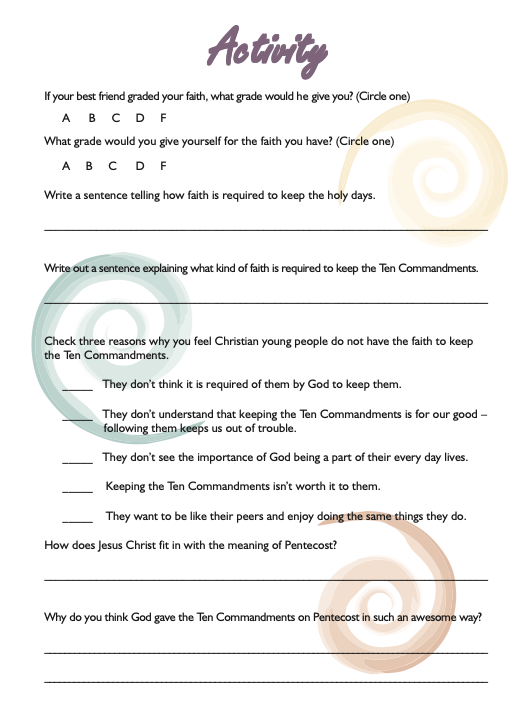
Students’ Activity - What part do you think faith plays in celebrating the holy days? What kind of faith is required to celebrate Pentecost and the other holy Days? Why do you feel that so many Christian young people don’t have the faith to celebrate Pentecost or the other holy days? How does Jesus Christ fit into Pentecost?
Teacher-Directed Activity
The activity is incorporated in the lesson under How to Teach This Lesson.
Song
“Be Not Afraid” is on page 86 in The Group Songbook.
Closing Prayer
Have the students form a circle and hold hands. Ask for a volunteer to lead in prayer asking God to give them a greater understanding and appreciation for the Feast of Pentecost and all that it means to us today.
Printable Pages