YEA Lesson Library
Sin Out, Christ In
About This Lesson
This lesson teaches why we celebrate the Days of Unleavened Bread and the significance of being unleavened and eating unleavened bread all seven days.
Scriptures
Exodus 12:1-41
Leviticus 23:4-8
Numbers 28:17-25
Deuteronomy 16:3-8
Matthew 26:26
John 6:35
1 Corinthians 5:1-8
Words to Know
DISCIPLINE - training that corrects, molds or perfects.
The Lesson
Throughout the history of mankind people have been held captive as slaves in foreign countries. They’ve been held against their will, mistreated, and abused. God’s chosen people – the Israelites were no exception – they experienced slavery as others have down through the years.
After 430 years of living in Egypt, eventually being enslaved, 600,000 freed men with their wives and children left Egypt at night on foot. All sorts of other people went with them. With a full moon shining brightly above, flocks, herds, and a vast exodus of cattle started on their way out of Egypt.
Can you imagine the excitement? There would be no more mean task masters. They had made their last bricks, at least for a while. Free at last, but they didn’t know where they were going. They were following Moses, the man who had gone before Pharaoh many times and asked him to let these people go have a feast to God and worship Him. What a sight this must have been!
These people had nothing they could call their own. They were slaves – the poorest of the poor. Before leaving Egypt, God instructed these poor slaves to ask the Egyptians for gold, silver and clothes. And the Egyptians gave these things to them. The sons of Jacob and their descendants left with a high hand, happy hearts, and their kneading troughs bound with spare clothing over their shoulders.
They left in such a hurry, there was no time to allow for bread to rise and to bake it. The dough that was in their kneading troughs had no yeast. When they stopped to eat, they baked bread from the yeastless dough and ate unleavened bread.
God selected the very last night of the 430 years of slavery to free His people from Egyptian bondage. Because He delivered our ancestors from slavery on that same night, God selected this time for us to celebrate every year. We call it The Night To Be Much Observed.
Beginning with this night and continuing for seven days, God commands us to eat unleavened bread. Before this Feast begins, we’re to clean our homes and get rid of any leavening – baking powder, baking soda and yeast, and any product such as baked goods that contain leavening. “There must be no yeast in your homes, or anywhere within the borders of your land!” (Exodus 13:7 TLB).
“The Festival of Unleavened Bread: This is to be celebrated beginning the day following the Passover. On the first day of this festival, you shall gather the people for worship, and all ordinary work shall cease. You shall do the same on the seventh day of the festival” (Leviticus 23:6-8a TLB).
There is a lot of symbolism connected with this Feast. So what does it all mean to you? Why should a Christian celebrate the Days of Unleavened Bread? I Corinthians 5:6b-8 says “Know ye not that a little leaven leaveneth the whole lump? Purge out therefore the old leaven, that ye may be a new lump, as ye are unleavened (physically). For even Christ our passover is sacrificed for us: Therefore let us keep the feast, not with old leaven, neither with the leaven of malice and wickedness; but with the unleavened bread of sincerity and truth.”
Leavening is a type of sin for these seven days in a year. At other times, it’s not wrong to eat leavening or to have leavening in our homes. The NIV Study Bible says about 1 Corinthians 6:5-6 “Paul alludes to the prohibition against the use of leaven (or yeast) in the bread eaten in the Pass- over Feast (see Ex. 12:15). Leaven in Scripture usually symbolizes evil or sin (see note on Mk. 8:15), and the church here is called on to get rid of the yeast of sin (v.8) because they are an unleavened batch of dough – new creations in Christ” (1 Co. 5:6-7).
This tells us quite a bit. First, leavening symbolizes sin in the Bible. It also tells us that the church in Corinth had put leavening out of their homes (because they are an unleavened batch of dough) because these were the Days of Unleavened Bread. On the Passover we eat and drink the symbols of Christ’s broken body and shed blood (unleavened bread and wine) sacrificed for us so that we can have forgiveness of sin. When a person accepts this sacrifice and is converted, they should not want to continue living a life filled with sin. We should work at getting rid of every sin in our lives. So, putting leavening out of our home, symbolizes putting sin out of our lives. Since no leavening is to be seen in our homes during the Days of Unleavened Bread, leavening is put out before those days begin.
There is also another command. It is that we must eat unleavened bread for seven days – yes some every day. But why? Jesus Christ is the Bread of Life. Eating this flat bread for seven days symbolizes filling ourselves with the pure Bread of Life which is Christ. How do we do this? Just eating unleavened bread for seven days is a very physical act. God expects more of us than that. We fill our minds and hearts with the Bread of Life when we study the Bible, meditate, and pray. We should spend extra time each day during the Days of Unleavened bread drinking in God’s Word. This is certainly a recipe for sin to diminish in our lives as we feast on God’s Word. The Days of Unleavened Bread is a time to free our lives from the bondage of sin and grow in His love.
Student Prayer
Loving and Merciful Creator,
Thank you for freeing the Israelites from the bondage of slavery. Thank you also for freeing us from the bondage of sin. Help us each day during
the Feast of Unleavened Bread as we eat unleavened bread to remember the importance of the sacrifice of Jesus Christ and spend more time in prayer and Bible study.
In Jesus’ name we pray.
Amen.
Daily Devotions
Sunday - Exodus 12:12-16
Monday - Exodus 12:17-20
Tuesday - Exodus 12:31-41
Wednesday - Leviticus 23:4-8
Thursday - Numbers 28:17-25
Friday - Deuteronomy 16:3-8
Saturday - Matthew 26:26
Objectives
At the end of this lesson, students will be able to:
1. Tell that Christians must have all leavening and leavened products out of their homes when the Days of Unleavened Bread start.
2. State that for these seven days, leaven depicts sin.
3. State why they should eat some unleavened bread every day during the Days of Unleavened Bread.
4. Explain that keeping the Days of Unleavened Bread is a Christian discipline.
5. Discuss how Christ is very much in the Days of Unleavened Bread.
6. Tell how many years the Israelites were slaves in Egypt.
7. Explain how we know that the New Testament Church was keeping the Days of Unleavened Bread as late as 55 A.D.
Topics & Themes
Bible Study
Bread and Wine
Days of Unleavened Bread
Eating Unleavened Bread
Egypt, Coming Out
Holy Days, Unleavened Bread
Leavening
Meditation
Prayer
Sin
Slaves
Symbols
Unleavened Bread
Yeast
Materials Needed
Bible, YEA students’ and teacher’s books, CD or cassette tape, music player, popcorn, popcorn popper, paper or plastic bowls, newsprint pad or chalk board, marker, prizes
How to Teach This Lesson
After opening the class with prayer, give each student a bowl of popcorn. Ask them to think about its characteristics as they eat it. The corn was once firm and smaller and now it is puffed up.
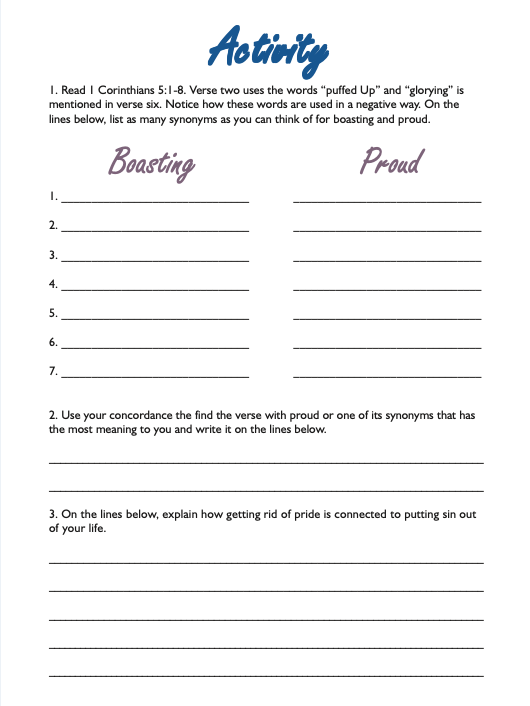
Proud – Puffed Up - Explain that you are going to start at the right end of the semicircle, and each person is to give one thing that has caused them to be proud, get the “big head” or be puffed up. If they can’t give one, they have to go to the end of the semicircle. They’ll have more time to think about it and have a second chance when it’s their turn again.
Student’s Activity - Ask the students to get out their YEA book and turn to the Activity. Start at the right of the semicircle and tell them that each one is to give a different synonym for “proud.” Continue until everyone has given every word they included in their activity or that they can think of. Write these on the chalk board as they give them. The one who can give the most synonym wins this game. Give them a small prize. Do the same thing using the word boast. Again, the person with the most synonyms wins the game and a prize. Have each student read the verse that they wrote under Activity in their book about “proud” or one of its synonyms that meant the most to them.
The New Testament Church Kept the Days of Unleavened Bread - Say: “Most of the questions and problems that confronted the church at Corinth are still very much with us – problems like immaturity, instability, divisions, jealousy and envy, lawsuits, marital difficulties, sexual immorality and misuse of spiritual gifts” (NIV Study Bible). Paul wrote 1 Corinthians about 55 A.D. and the church was still keeping the Days of Unleavened Bread. How do we know this?
Spiritual Discipline - Read the second paragraph under Background. Ask: In what way do you see the Days of Unleavened Bread as being a spiritual discipline? What kinds of goals should you set for yourself to accomplish during the Days of Unleavened Bread? What does it do for you personally to physically put leavening out of your house? What correlation do you see between pride and putting sin out of your life? What does it mean to you to eat unleavened bread every day for seven days. What part do you see that Christ plays in the Days of Unleavened Bread? How do you think keeping the Days of Unleavened Bread will change your life?
Teacher-Directed Activity
The activity is integrated into the lesson under How to Teach This Lesson.
Song
“One Bread, One Body” is on page 48 of The Group Songbook.
Closing Prayer
Have the students form a circle and hold hands. Ask for a volunteer to lead in prayer asking God to give us greater understanding of the meaning of the Days of Unleavened Bread and how they are Christian disciplines.
Printable Pages