YE5H.1 · Activity Page
Genesis 1:27-30
Exodus 14:1-18
Exodus 14:13-14
Leviticus 18:22-26
Isaiah 9:6-8
DESTROYER - the agent of God’s wrath against the Egyptians is described as “a band of destroying angels.”
MONOTHEISM - the doctrine of belief that there is but one God
POLYTHEISM - the belief in many gods
BLASPHEME - the act of insulting or showing contempt or lack of reverence for God
Every year thousands of young athletes from all over the world come together for the Special Olympics. It's a festive time with celebrities, music, and excitement second only to the International Olympics. These young athletes understand what it means to give their best. They want to win. So they train for months and even years.
Not many years ago, five handicapped finalists were on the starting line. Each athlete wanted to win. Their hearts were pounding as they crouched in the starting position and readied themselves for the race. The gun fired and these five finalists started running with all their hearts. The crowd quickly came to their feet shouting and cheering.
Only a few yards out, a runner stumbled and fell on his face. He tried hard to get up, but couldn't make it. A dead silence fell over the stadium. But suddenly another child stopped running and reached down and helped the fallen runner back to his feet. The two of them finished the race together.
Under the same big, round full moon you see on the Night to Be Much Remembered, the children of Israel walked out of Egypt as a free people. After all these people had been through, many must have been exhausted. It would have been easy to stumble and fall on their way out. But, you know, one very interesting thing about these people is that there was not one feeble person among them - a healthy crowd numbering more than a million people (Psalm 105:37).
God led the Israelites with a pillar of cloud by day, and a pillar of fire gave them light to travel at night.
God instructed Moses to have the people turn toward Pihahiroth, between Migdol and the sea, and camp there. He did this so Pharaoh would think the Israelites were trapped between the desert and the sea. Again, Pharaoh's heart would become hardened and he and his armies would chase after God's people. This was all in God's plan. Why? So that He would gain great honor and glory over Pharaoh and all his armies. Then the Egyptians would know that He is God. Why was this important? Because He is the True God, the Creator of this universe who has the power to make man's life work. God could do for them what their gods couldn't.
How do you think word got to Pharaoh about where the Israelites were camped? Communication has advanced so much over the past ten years. When Pharaoh walked this earth, there were no cell phones, not even line phones, no radios, no e-mail, no faxes, nor televisions. Yet somehow, word reached Pharaoh that the children of Israel were not planning to return to Egypt after the three-day feast Moses had asked that they attend in the desert.
When Pharaoh learned that he would not have his slaves back to shore up his economy and do the hard labor, his mourning for his firstborn son turned to anger. His anger surpassed his grief for his firstborn son who was killed the night the Destroyer passed over. But then his grief somehow turned to arrogance which made him bolder than ever. "What is this we have done, letting all these slaves get away?" he asked.
Pharaoh felt a strong urgency to act. He selected 600 chariots from his corns and instructed his officers to get aboard them fast! He was determined to chase down the Israelites. These people had been at the core of his economy - cheap, hardworking slaves. But now they had fled with most of his nation's wealth - gold, silver, and expensive clothing.
The sound of 600 chariots chasing toward the Red Sea must have made a deafening noise. The Israelites probably heard them before they saw them in the distance racing toward them. The noise of Pharaoh's chariots and the thought of them coming after the Israelites was very disturbing. The Israelites did cry out to God, and that was in their favor. But their faith must have been rather weak. They turned against Moses, the man God called to lead them out of Egypt. They whined, "Have you brought us out here to die in the desert because there were not enough graves for us in Egypt? Isn't this what we told you, while we were slaves, to leave us alone? We said it would be better to be slaves to the Egyptians than dead in the wilderness."
At this point God the Father must have felt very much like Jesus felt when He saw Peter walk on water and then saw him begin to sink. Jesus said to Peter, "You of little faith. . . why did you doubt?" The Israelites had seen miracle after miracle to free them from slavery and deliver them to freedom. But just the sight and sound of the Egyptian chariots caused the Israelites to doubt and turn against Moses.
Moses, being the strong leader that he was, reassured the Israelites by saying, "Stand firm and you will see the deliverance the LORD will bring you today. The Egyptians you see today you will never see again. The LORD will fight for you, you need only to be still. (Exodus 14:13-14 NIV).
Think about it. The gods of Egypt were useless. Puny man is so limited, but God is all powerful. When God fights your battles, you don't have to be afraid. You may not even have to lift a finger. When trials come, it is such a waste of effort to start whining, finger pointing, and blaming someone else. Oh, it's so human, but so wrong. If you will only ask and put your faith in God, He will fight your battles for you.
Great God and Father,
Thank you that You are the one true God who delivered the Israelites time and again. This increases my faith in You that You will be there to help me through life. I just need to put my faith in You.
In Jesus' name I pray.
Amen.
Sunday - Exodus 14:1-4
Monday - Exodus 14:5-9
Tuesday - Exodus 14:10-12
Wednesday - Exodus 14:13-14
Thursday - Genesis 1:27-30
Friday - Isaiah 9:6-8
Saturday - Leviticus 18:22-26
Exodus 14:15-31
Proverbs 21:21-24
Proverbs 29:1-3
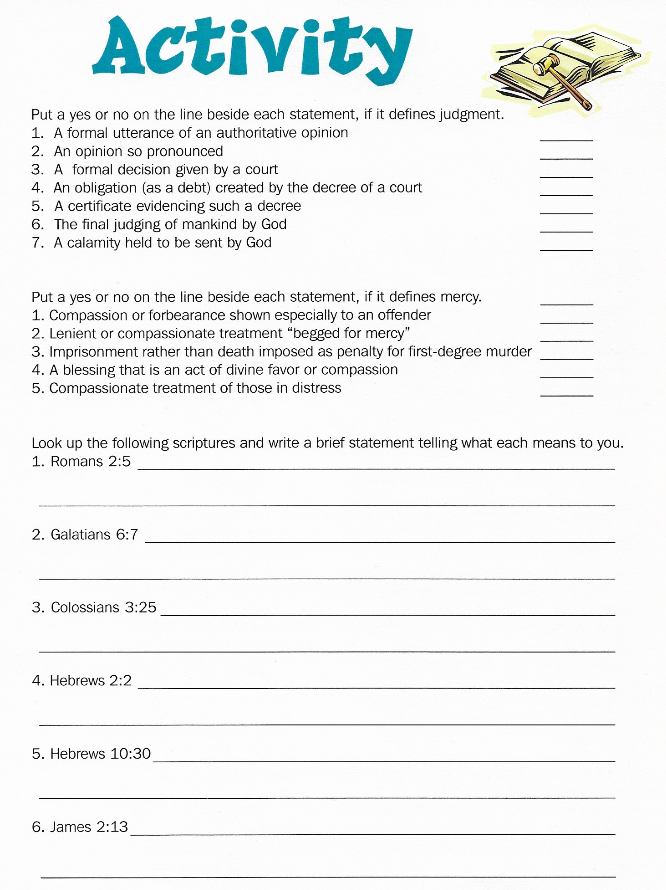
Romans 2:1-5
Romans 11:22
Romans 11:22-23
MERCY - Unmerited pardon
JUDGMENT - an obligation (as a debt) created by the decree of a court
OFFENSE - wrong doings or sin
“There was a young man in Napoleon’s army who committed a deed so terrible that it was worthy of death. The day before he was scheduled for the firing squad, the young man's mother went to Napoleon to plead for mercy for her son.
"Napoleon replied, 'Woman, your son does not deserve mercy.'
'I know,' she answered, 'If he deserved it then it would not be mercy'" (Stories For The Heart - Understanding Mercy, by Alice Gray).
In today's seminar you will see God's judgment and His mercy. Remember, judgment is the opposite side of mercy. No mercy can be shown if there is not an offense or sin. Sin requires a penalty or judgment because you deserve it. When the person who can exact the penalty or judgment decides not to require it, even though you deserve it, that is mercy. This seminar shows God's great mercy to Israel while showing His judgment upon Pharaoh and the Egyptians because of their offenses.
Pharaoh thought the Israelites were trapped in the wilderness with no way out. Stubborn, determined Pharaoh thought his army could chase them down. Again, his repentance didn't last. He was sorry he had let his slave labor go.
As Pharaoh and his army approached, the Israelites looked up and saw them coming. They were scared to death. Moses spoke to them and told them not to be afraid. "Stand firm and watch God do his work of salvation for you today. Take a good look at the Egyptians today for you're never going to see them again. God will fight the battle for you." This was a reminder that even though Israel was armed for battle and marching out, the victory would be won by God alone.
God told Moses that it was time to get the Israelites moving. "Hold your staff high and stretch your hand out over the sea: Split the sea!" Moses stretched out his rod over the sea and God opened up a path through the Red Sea. A huge foaming wall of water stood on each side.
The angel of the Lord, that had been leading the Israelites, now changed positions and got behind them. The pillar of cloud that had been in front went to the rear as well. That put the cloud between the Israelites and the Egyptians. When this happened, the Egyptians were left in darkness, but the Israelites had light. The two camps didn't come near each other all night long.
Moses stretched his hand over the sea and God provided an east wind all night long that dried the ground. This made it possible for the Israelites to walk through the Red Sea on dry ground. There was a wall of water on their right and one on their left, as they made their way through the sea.
The Egyptians wasted no time in going full speed after the Israelites. God looked down on the Egyptians and began harassing them. This threw them into a real panic. He clogged the wheels of their chariots. They were Stuck in The Mud and their wheels came off in the middle of the Red Sea. Not a very good place to be at this time.
God told Moses to stretch out his hands again over the sea. Moses did. At daybreak the water from both sides came crashing down on the Egyptians and covered their chariots and horsemen in the middle of the Red Sea. Not one of Pharaoh's men survived.
God delivered the Israelites from the oppression of the Egyptians. They looked at the Egyptians' dead bodies that washed up on the sea shore, and began to realize the tremendous power that God had brought against them. After seeing all of this, the people were in reverent awe before God and trusted Him and His servant Moses.
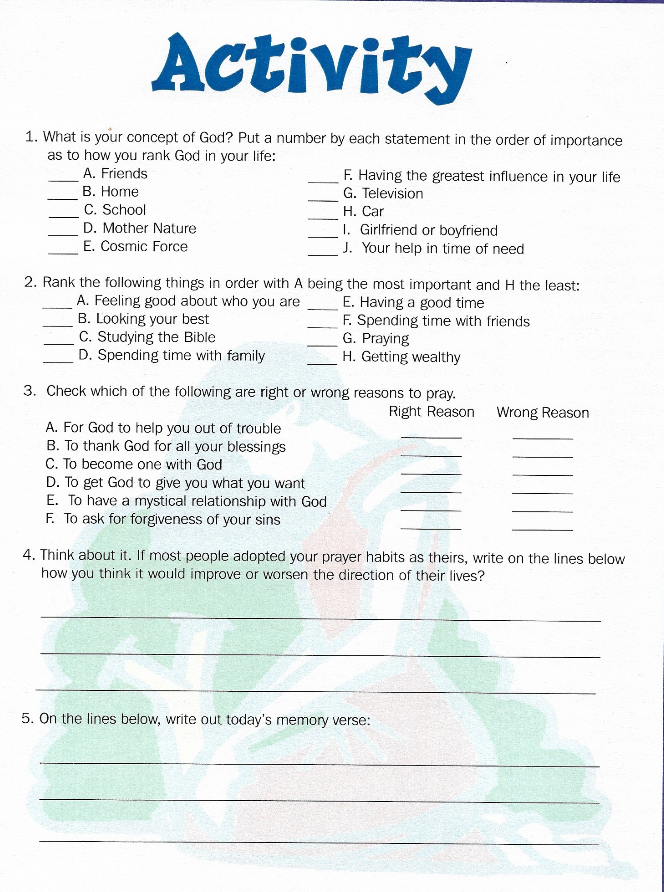
Does it bother you that a merciful God would cause the Egyptian chariots to get Stuck in The Mud and drown? In your last seminar, we discussed the characteristics of The God to Know. You learned that the true God is a God of love - He is long suffering and merciful. Today's memory verse says, "Notice how God is both kind and severe. He is very hard on those who disobey, but very good to you if you continue to love and trust him. But if you don't you too will be cut off."
God wants a righteous people who walk in His law. He wants a people who are not mean-spirited, selfish, and spiteful. He wants a people who are willing to submit themselves to His will and obey Him. God had shown Pharaoh miracle after miracle. Pharaoh experienced the wrath of God time and again. He was a free moral agent who could have chosen to do right at any time, but he didn't. Proverbs 29:1 says, "A man who remains stiff-necked after many rebukes will suddenly be destroyed - without remedy." And Pharaoh was suddenly destroyed!
What about you? How far do you think you can push God with a selfish, self-willed, spiteful spirit? Mercy didn't seem to be in Pharaoh's vocabulary. But it's a good place for us to start. Remember Jesus said, "Blessed are the merciful: for they shall obtain mercy." Proverbs 21:21 says, "He that followeth after righteousness and mercy findeth life, righteousness, and honour."
Merciful Father,
Thank You for this lesson that contrasts mercy and judgment. Help me to practice mercy in my everyday life so that I won't have to experience judgment as Pharaoh did.
In Jesus' name I pray.
Amen.
Sunday - Exodus 14:15-18
Monday - Exodus 14:19-25
Tuesday - Exodus 14:26-31
Wednesday - Romans 11:22-23
Thursday - Proverbs 29:1-3
Friday - Proverbs 21:21-24
Saturday - Romans 2:1-5
Exodus 15:1-27
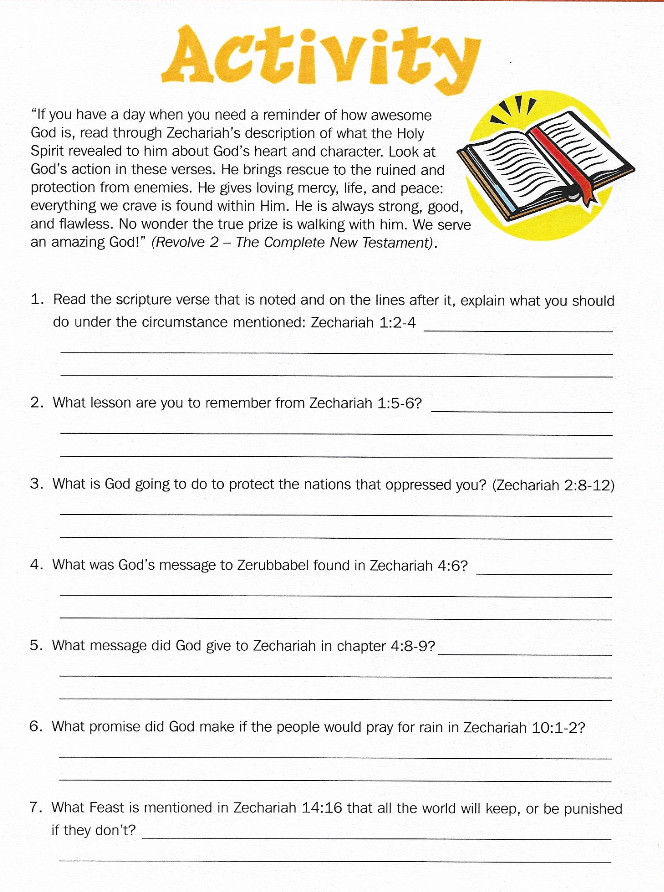
Zechariah 1:2-12
2 Corinthians 9:15
HOBO- vagabond, derelict, drifter, tramp
PAUPER - a person having no financial resources except those derived from charity
A 72 year-old blind man stood tall on the streets of Rio de Janeiro singing with a tin cup in his hand. Some who passed by put a coin in his cup. Other stared at him with pity or with disdain.
A minister passing by had been studying John 9 and decided to talk with him. He asked if he was blind from birth, but learned his blindness was from an accident. His eyes were missing from their sockets. He was single, living with his parents and seven siblings. After getting acquainted, the minister asked if he was hungry and he was. So the minister went to the nearest eatery to get him a sandwich and something cold to drink.
When he returned, the blind man was still singing. What in the world did he have to sing about? He was a sightless, penniless hobo who had a song in his heart. The minister concluded that he was singing from contentment. Somehow this eyeless pauper had discovered a candle called satisfaction, and it glowed in his dark world.
After reaching the other side of the Red Sea and seeing Pharaoh and his chariots and armies drown in it, Moses and the Israelites sang a song to God. This song may have been from contentment, but it was a song of praise to God and rejoicing for triumphing over Pharaoh's chariots and armies. This song is in Exodus 15:
I will sing to the Lord, for he has triumphed gloriously;
He has thrown both horse and rider into the sea.
The Lord is my strength, my song, and my salvation.
He is my God, and I will praise him.
He is my father's God - I will exalt him.
The Lord is a warrior - Yes, Jehovah is his name.
He has overthrown Pharaoh's chariots and armies.
Drowning them in the sea.
The famous Egyptian captains are dead beneath the waves.
The water covers them.
They went down into the depths like a stone.
Your right hand, O Lord, is glorious in power;
It dashes the enemy to pieces.
In the greatness of your majesty
You overthrew all those who rose against you.
You sent forth your anger, and it consumed them as fire consumes straw.
At the blast of your breath the waters divided!
They stood as solid walls to hold the seas apart.
The enemy said, I will chase after them,
Catch up with them, destroy them.
I will cut them apart with my sword and divide the captured booty.
The song continues with telling the events of God drowning the Egyptians. It tells about how God, in His loving kindness, was taking them to the land He had promised.
Then Miriam, the sister of Moses, took a timbrel and led the women in a dance. Miriam began singing:
"Sing to the Lord, for he has triumphed gloriously.
The horse and rider have been drowned in the sea."
Moses led the Israelites from the Red Sea. They moved out into the wilderness of Shur and were there three days without water. They made it to Marah, and they couldn't drink the water because it was bitter. This must have been very disappointing. But this tested their attitudes. Would they trust God and believe Moses? No, they turned against Moses. "Must we die of thirst?" they demanded. Does getting thirsty give us the right to turn against God's leader? Does it give us the right to accuse and complain?
Think about it. The Israelites had seen such mighty miracles as the ten plagues God brought on Egypt to set them free. They had seen God part the Red Sea. They had walked through it on dry land. This was something to sing and dance about. But with a little human discomfort, all that changed to complaining.
Moses cried out to God for help and God came through. He showed Moses a tree that, if he put it in the bitter water, it would become sweet. Should God have the right to ask something from the Israelites after He'd taken care of them? He said, "If you will listen to the voice of the Lord your God, and obey it, and do what is right, then I will not make you suffer the disease I send on the Egyptians, for I am the Lord who heals you." That's fair enough, isn't it?
Trials, adversities, problems, and hardships are all a part of life and are bound to come. The question is, how are you going to handle them? Will you stand tall and sing with contentment as the blind man did in Rio de Janeiro? Or will you forget God's blessings, begin to complain, and stop obeying Him? God is looking for young men and women whose faith will endure to the end.
Gracious Father,
Help me to always have a song of contentment in my heart because I trust in You. You've given me so much to be thankful for. Help me never forget that and keep on singing Your praises.
In Jesus' name I pray.
Amen.
Sunday - Exodus 15:1-8
Monday - Exodus 15:9-13
Tuesday - Exodus 15:14-16
Wednesday - Exodus 15:17-19
Thursday - Exodus 15:20-27
Friday - 2 Corinthians 9:15
Saturday - Zechariah 1:2-12
Exodus 16:1-31
Numbers 14:1-25
Ephesians 1:9
Ephesians 1:9-12
Colossians 1:15-19
MANNA - What is it?
PURPOSE - something set up as an object or end to be attained
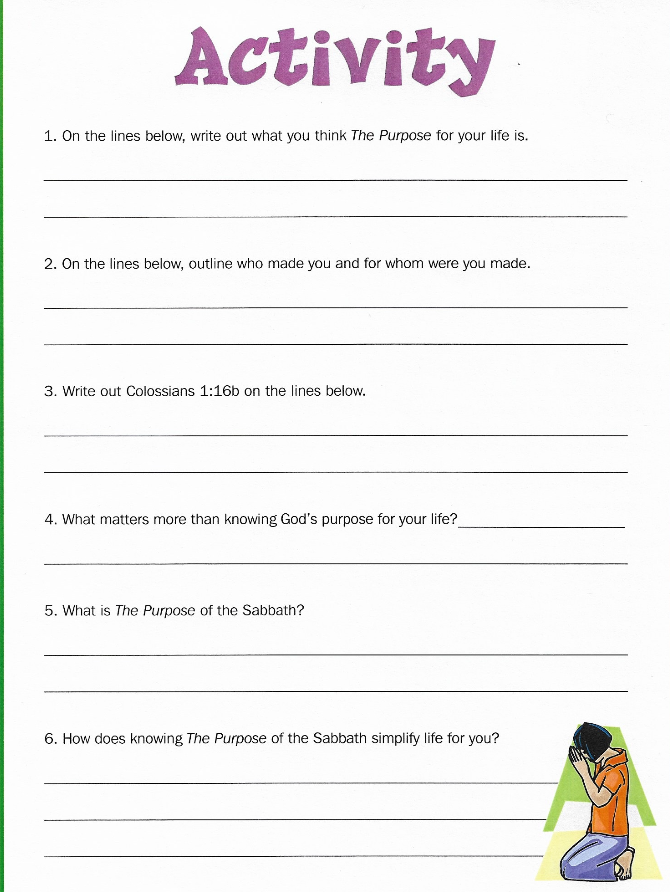
Rick Warren says in his book, Purpose Driven Life, "Contrary to what many popular books, movies, and seminars tell you, you won't discover your life's meaning by looking within yourself. You've probably tried that already. You didn’t create yourself, so there is no way you can tell yourself what you were created for! If I handed you an invention you had never seen before, you wouldn't know its purpose, and the invention itself wouldn't be able to tell you either. Only the creator or the owner's manual could reveal its purpose."
Mr. Warren talks about a 40-day journey with purpose. God planned a journey with a purpose for the Israelites of old. It wasn't 40 days, it was 40 years. We don't know how many Israelites looked inside themselves to discover the meaning of their life. We do know that God created them, as He has you, for a purpose. He expected them to believe Him and obey Him. They didn't have the Bible as an "owner's manual." But they had God's presence in a much more personal way. They had His servant Moses to tell them what God wanted them to do. They even had a pillar of cloud to guide them by day and a pillar of fire to give light at night. But were these things enough to ensure they would obey their Creator?
The Israelites continued their journey towards the Promised Land. They left Elim and went on into the Sin wilderness. This is between Elim and Mount Sinai. They arrived there on the 15th day of the second month.
The whole company of Israel complained against Moses and Aaron while they were in the wilderness. "Why didn't God let us die in comfort in Egypt where we had lamb stew and all the bread we could eat? You’ve brought us out into this wilderness to starve us to death,” they said.
About one million people - the entire company of Israel - turned on Moses and Aaron and began accusing them and God of trying to kill them with starvation. Now, put yourself in Moses' and Aaron's sandals. It's difficult enough to control your temper when just one person starts accusing you, especially if the situation is heated. It could be downright scary to have one million unhappy people upset with you. This had the potential to get out of control in a hurry. What kind of leadership skills do you think you would use at a time like this? How would you calm and reassure the people? They really weren't the patient type.
Do you realize it had only been a month since God miraculously delivered the Israelites by performing ten miracles? Oh, how soon they forgot God's power and began to gripe and complain. These hungry, tired Israelites were far from happy campers. They certainly didn't seem very concerned about God's purpose for them.
But God did have a purpose for them and He did love them very much. Moses and Aaron didn't have to do a crash course on leadership skills at this point. God intervened. He told Moses that He would rain down manna from heaven for them. Every day the people would go out and gather their daily ration - there would be plenty for everyone.
God said He would test them. On the sixth day of the week they were to gather twice as much and prepare it for the Sabbath. During the week, if they gathered too much and tried to hold it over to eat the next day, it would breed maggots and stink. On Friday, they could gather twice as much and it wouldn't breed maggots and stink. But there would be no manna from heaven on the seventh day.
God put this test, along with a miracle, in place for a purpose. The purpose was to show Israel, without a doubt, which day the Sabbath was. God told them to gather twice as much manna on Friday and prepare it so they wouldn't have to work on the Sabbath. Then on the Sabbath there would be no manna. Think about how much this short section of scriptures shows us. It shows God is our loving and merciful provider. It shows that the Sabbath is not just one day out of seven, but the seventh day. And it shows that we are to prepare on Friday so that we will be ready to rest on the Sabbath.
But did the Israelites do what God told them to do? Some did and some didn't. A few men kept back some of the manna until morning. It got wormy and smelled really bad. This was more than Moses could take, and he lost his cool.
On the Sabbath, some of the people went out to gather manna anyway, but they didn't find it on the ground.
"God said to Moses, 'How long are you going to disobey my commands and not follow my instructions? Don't you see that God has given you the Sabbath. So on the sixth day he gives you bread for two days. So, each of you, stay home. Don't leave home on the seventh day.'"
Manna means "What is it?" It wasn't the only thing God gave them. In the morning there was a layer of manna on the ground. Manna looked whitish, like coriander seed, and tasted like crackers with honey. In the evening, quail flew in the camp. So they ate quail in the evenings and manna during the day.
What about you? Will you obey God's purpose for the Sabbath, or will you be like the Israelites who went out to get manna on the Sabbath? Will you make every preparation you can on Friday so that you can rest and spend time with your Maker on the Sabbath?
God of the Sabbath,
Thank You for this section of the Bible that shows Your love, care and concern for Your people. Thank You for showing us clearly that the Sabbath is the seventh day of the week, and we have an obligation to prepare for it so we can rest and honor You.
In Jesus' name I pray.
Amen.
Sunday - Numbers 14:1-9
Monday - Numbers 14:10-16
Tuesday - Numbers 14:17-25
Wednesday - Exodus 16:1-9
Thursday - Exodus 16:10-17
Friday - Colossians 1:15-19
Saturday - Ephesians 1:9-12
Exodus 16:32-36
Numbers 4:5-15
Numbers 11:4-9
Deuteronomy 8:1-6
Deuteronomy 10:1-5
2 Samuel 6:6-8
Proverbs 16:6
Hebrews 9:1-5
MUSEUM - an institution devoted to the procurement, care, study, and display of objects of lasting interest or value
SPECIMEN - an individual, item, or part considered typical of a group, class or whole
EXCAVATION - 1: the action or process of excavating, 2: a cavity formed by cutting, digging, or scooping
What item or article can you think of that is 3500 years old? You would certainly have to go to a museum to find anything, except the dirt under your feet, which is that old. Not a lot of things in a museum would be that old. But if you were on an archeological dig, somewhere around what people commonly call "the Holy Land," and found the Ark of the Covenant, there should be three quarts of manna in it. According to the NIV Study Bible, "It has been traditionally held that the exodus occurred c. 1446." Add the current year to 1446 and you're not far short of 3500 years.
In last week's seminar, we discussed that in spite of the Israelites' griping and complaining, God miraculously fed them with manna, which means "What's It?" God rained down this white stuff from heaven and the Israelites could go out in the early morning and gather their food for the day. But if some anxious person feared the manna wouldn't be on the ground the next day and tried stashing some away, just in case, it would breed worms and stink. That is. . . except on Friday. Then God instructed them to gather twice as much manna and prepare it to eat on the Sabbath, so they could rest and keep their minds focused on Him. But there's also another exception we need to know about.
"Then Moses gave them this further instruction from the Lord: they were to take three quarts of it (manna) to be kept as a museum specimen forever, so that later generations could see the bread the Lord had fed them with in the wilderness, when he brought them from Egypt. Moses told Aaron to get a container and put three quarts of manna in it and to keep it in a sacred place from generation to generation. Aaron did this, just as the Lord had instructed Moses, and eventually it was kept in the Ark in the Tabernacle" (Exodus 16:32-34, TLB).
In your excavation, if you should find the Ark of the Covenant and open it, would the manna be moldy? According to Exodus 16:33, it would still be preserved; it would not be wormy or stink. God would see to that.
But you could never open the Ark of the Covenant. Why? God put in place some very strict laws concerning the Ark of the Covenant. In Numbers 4:5-15, He lays out how the Ark of Covenant is to be prepared for moving. He says in verse 15: "When Aaron and his sons have finished packing the sanctuary and all the utensils, the clan of Kohath shall come and carry the units to wherever the camp is traveling; but they must not touch the holy items, lest they die. This, then, is the sacred work of the sons of Kohath" (TLB).
There is an incident in 2 Samuel 6:7 where this did happen. "But when they arrived at the threshing floor of Nacon, the oxen stumbled and Uzzah put out his hand to steady the Ark. Then the anger of the Lord flared out against Uzzah and he killed him for doing this, so he died there beside the Ark." Now this would make a believer out of you - you don't touch the Ark or you die!
Then why is the Ark of the Covenant so special, so sacred? "The ark (GNB: covenant box) was a gold-covered wooden box, two and a half cubits long, one and a half cubits wide, and one and a half cubits high. . . It was the only piece of furniture in the Most Holy Place. . . Inside the ark were two stone tablets on which the law was written, as a constant reminder to the people of Israel that the God who dwelt among them was also their law-giver. . . (Deuteronomy 10:1-5). (Later Aaron's rod and the golden pot of manna were also placed in the ark; see Hebrews 9:4.)
"A special sacred part of the ark was its richly ornamented lid, called the mercy seat. The two cherubim (GNB: winged creatures) attached to the top of the mercy seat apparently symbolized divine protection of the seat, the ark and the contents (Exodus 25:17-21). This mercy seat appears to have been a visible throne for
the invisible God. It was the place where God spoke with Moses and where the high priest made atonement for the sins of the people when he entered the Most Holy Place once a year (on the Day of Atonement) (Leviticus 16:1-19, 29-31; Hebrews 9:7). . ." (Concise Bible Commentary).
Did you catch what made the Ark so special? The visible throne for the invisible God was there. Not only that, it was the place where God spoke with Moses and where the high priest atoned for the sins of the people on the Day of Atonement. Do you recall that only the High Priest was allowed in the Most Holy Place, and only on the Day of Atonement, or they would die?
"So the people of Israel ate the manna forty years until they arrived in the land of Canaan, where there were crops to eat. The omer - the container used to measure the manna - held about three quarts; it is approximately a tenth of a bushel" (Exodus 16:35-36 TLB).
When God puts His laws in place and warns you that if you transgress them you will die, you better not muck around with them. You'd better believe God and do exactly what He says. Are you ready to take God at His Word and do exactly what He says?
Awesome Father,
Thank You for this lesson I have learned today. Help me to always believe You and Your Word, and even fear You. You've given very plain instructions. Help me to fear to take Your Word lightly.
In Jesus' name I pray.
Amen.
Sunday - Exodus 16:32-36
Monday - Numbers 11:4-9
Tuesday - Deuteronomy 8:1-6
Wednesday - Hebrews 9:1-5
Thursday - Numbers 4:5-15
Friday - 2 Samuel 6:6-8
Saturday - Deuteronomy 10:1-5
Exodus 17:1-7
2 Chronicles 7:14
Psalm 84:1-10
Psalm 139:23
Ezekiel 18:23
Luke 19:12-27
1 Peter 1:3-7
1 Peter 1:7
1 Peter 4:12-18
2 John 7-9
ARBITRARILY - using individual discretion and not bound by law
IMMUNE - marked by protection
God commanded that the Israelites leave the Sin desert and go to Rephidim. When they arrived there was no water! We know that water is essential to life. Without it, you really can't live very long. Being without water can be very serious.
We need two or three quarts of fluid every day. Dehydration occurs when we take in less fluid than we lose. The progressive effects of dehydration are serious. When a child becomes dehydrated, heart rate increases, blood flow to the skin decreases, and body temperature rises steadily to dangerous levels. When the Israelites’ thirst began to torment them, they asked Moses, "Why did you ever take us out of Egypt. Why did you bring us here to die, with our children and cattle too?"
Life had become desperate for the Israelites. They went beyond their usual griping and complaining and started growling and wailing. The cattle didn't have any water either. By this time, they could have been complaining as well. It must have been a terrible noise.
Moses must have felt like shouting, "shut up" at the top of his voice. He did tell them to be quiet and asked, "Are you trying to test God's patience with you?" Am I saying that God could get impatient with them when they didn't have water, an essential to life? Read on.
Moses started praying. "What shall I do?" he asked God. "For they are almost ready to stone me." How would you have liked to have been in Moses' shoes? Poor Moses got the blame for every bad thing that happened, and little or no credit for the good things they had and the blessings they received. Doubtless, the Israelites were uncomfortable, but that was no excuse.
Jehovah came to Moses' rescue. "Take the elders of Israel with you and lead the people out to Mt. Horeb. I will meet you there at the rock. Strike it with your rod - the same one you struck the Nile with - and water will come pouring out, enough for everyone." I doubt that Moses wasted any time doing exactly what God told him to do. The water began to gush out. I'm sure he must have prayed a silent prayer saying, "Thank you, Lord."
Moses named this place Massah, which means "tempting Jehovah to slay us." It was sometimes referred to by the name of Meribah, which means "argument" and "strife," because it was here that the children of Israel argued against God and tempted Him to slay them.
Have you ever wondered if God acts arbitrarily? Does He randomly pick a person and say, "I think, today, I'll give Jo Blow a severe trial without any rhyme or reason?" Or does God have a purpose behind every trial you have? If so why would He? "He uses circumstances to develop our character. In fact, he depends more on circumstances to make us like Jesus than he depends on our reading the Bible. The reason is obvious: You face circumstances 24 hours a day.
"Jesus warned us that we would have problems in the world. No one is immune to pain or insulated from suffering, and no one gets to skate through life problem-free. Life is a series of problems. Every time you solve one, another is waiting to take its place. Not all of them are big, but all are significant in God's growth process for you. Peter assures us that problems are normal, saying, 'Don't be bewildered or surprised when you go through the fiery trials ahead, for this is no strange, unusual thing that is going to happen to you'" (The Purpose Driven Life, page 193).
We are God's children the same as the Israelites of old. He knew what was best for them and He knows what is best for us today. He knows that for us to become all that we can be, life cannot be a seamless trip with no pain or adversity. Why? 1 Peter 4:13 tells us to be glad when trials come our way. Now that's not easy to do. It certainly wasn't for the Israelites. When their parched throats cried out for water and there wasn't any, they were not happy about it.
God looks at the big picture. He has something far greater in mind for us than this physical life. This is because "these trials will make you partners with Christ in his suffering, and afterwards you will have the wonderful joy of sharing his glory in that coming day when it will be displayed" (TLB). Man's glory is temporary like a tattoo, body piercing, beautiful flowing hair, or a good body. God's glory is lasting throughout all eternity.
You've read the scripture that says, "I would rather be a doorman of the Temple of my God than live in palaces of wickedness" (Psalm 84:10b, TLB). This is a very worthy goal. But God wants you to set your sights even higher than making it into His Kingdom as a doorman. The Bible says we are saved by grace through the blood of Jesus Christ that was shed for our sins. But we are rewarded according to what we do - our works. 2 John 8 tells us, "See to it that you win your full reward from the Lord. For if you wander beyond the teaching of Christ, you will leave God behind; while if you are loyal in Christ's teachings, you will have God too. Then you will have both the Father and the Son" (TLB).
The Israelites' complaints tempted God to slay them. This is something we must be very careful not to do. The flip side of the coin is wanting God to give you your full reward. Study carefully the Parable of the Pound in Luke 19:13-27. The more you do with what God gives you, the greater your reward will be. When trials come, will you complain like the Israelites and make God want to slay you? Or will you get busy now and make the most of every trial you face?
Great God and Rewarder of those who follow You,
Help me to grasp this lesson and apply it every day to my life. Help me be a winner with each trial I have and trust You all the way.
In Jesus’ name I pray.
Amen
Sunday - Exodus 17:1-7
Monday - 1 Peter 1:3-7
Tuesday - Psalm 84:1-10
Wednesday - 1 Peter 4:12-18
Thursday - Luke 19:12-17
Friday - 2 John 7-9
Saturday - Luke 19:18-27
Exodus 17:8-16
Deuteronomy 25:17-19
Zechariah 4:1-7
Zechariah 4:6
Matthew 5:41-48
Romans 12:19-21
Romans 13:1-5
1 Peter 2:13-14
RECONNAISSANCE - an exploratory military survey of enemy territory
VENGEANCE - punishment inflicted in retaliation for an injury or offense: retribution.
“THE TARMAC ROARED WITH THE ENGINES OF REFUELING TANKERS and reconnaissance jets taking off.
"I paused, climbing the stairs to my place. The President had just ordered me to go to war. The troops were ready. The question in my mind was, am I ready?
"Watching a huge gray jet lumber down the runway and climb into the desert sky, I felt a deep well of confidence. But strangely, I did not think of my seasoning in combat, my years as a commanding officer, or the military education I'd received in my career.
"Instead, my thoughts cast back to the small towns of the American Southwest where I'd grown up. It was this environment, my family, my friends, and my faith that had formed my values, my character. It was these elements that had made me who I was, years before I ever put on the uniform of a soldier.
"Success in the campaign ahead would depend more on character, sense of purpose, and values - the nation's, the President's, my own, and the troops' - than on raw military power." (An American Soldier, General Tommy Franks).
Like it or not, world history is filled with wars. "The Amalekites came and attacked the Israelites at Rephidim. Moses said to Joshua, 'Choose some of our men and go out to fight the Amalekites. Tomorrow I will stand on top of the hill with the staff of God in my hands.
"So Joshua fought the Amalekites as Moses had ordered, and Moses, Aaron and Hur went to the top of the hill. As long as Moses held up his hands, the Israelites were winning, but whenever he lowered his hands, the Amalekites were winning. "When Moses' hands grew tired, they took a stone and put it under him and he sat on it.
Aaron and Hur held his hands up - one on one side, one on the other - so that his hands remained steady till sunset. So Joshua overcame the Amalekites' army with the sword.
"Then the LORD said to Moses, ‘Write this on a scroll as something to be remembered and make sure that Joshua hears it, because I will completely blot out the memory of Amalek from under heaven.’
"Moses built an altar and called it The LORD is my Banner. He said, 'For hands were lifted up to the throne of the LORD. The LORD will be at war against the Amalekites from generation to generation'" (Exodus 17:8-16 NIV Study Bible).
War is nasty. It maims and it kills. Judging from history, it has been a necessary evil down through the ages. Nations just aren't willing to accept the blessings God gives them within their borders and leave well enough alone. General Tommy Franks said, "Success in the campaign ahead would depend more on character, sense of purpose, and values - the nation's, the President's, my own, and the troops' - than on raw military power." So where do character, sense of purpose, and values fit in to this war between the Israelites and the Amalekites?
The battle with Amalek was the first attempt, outside of Egypt, to interfere with Israel's march to Canaan. As a result, God commanded that Amalekites be exterminated. But why? "You must never forget what the people of Amalek did to you as you came from Egypt. Remember that they fought with you and struck down those who were faint and weary and lagging behind, with no respect or fear of God. Therefore, when the Lord your God has given you rest from all your enemies in the Promised Land, you are utterly to destroy the name of Amalek from under heaven. Never forget this" (Deuteronomy 25:17-19 TLB).
When the US finds a wounded enemy, we treat him. Yet the Amalekites struck down the faint and weary and the people who had a difficult time keeping up with the crowd. This was such a low thing that God said they should utterly be destroyed. Those people lacked that character, that sense of purpose, and the values that General Franks spoke of.
When a nation is at war, there should be a national unified front that supports its troops. That's what General Franks meant when he spoke of the nation's and the President's character, sense of purpose, and values being required for success in war. Moses and his men had that. But there came a point when Moses simply couldn't hold his hands up, as he prayed for victory. Aaron and Hur gave him the support he needed and held up his hands. These were men of character with a sense of purpose and values. They understood the importance of working together as a team at a time like this, so they held up Moses' hands as he prayed.
You might ask, how could a loving God tell the Israelites to utterly destroy the Amalekites? Isn't human life sacred? Sacred simply means "devoted to God." "If human life is devoted to God, then God has the right to decide that, in certain cases, life is forfeited. He did exactly that when He mandated the death penalty for murderers. It was left to the civil authority to carry it out - " (Capital Punishment: A Christian Dilemma, by Ronald L.Dart). He also had the right to decide that the Amalekites be utterly destroyed.
All wise and loving God,
Thank You for our country and the blessings You've poured out upon it. We are so undeserving. Grant our nation and our President the character that You will respect, especially in time of war. Thank You for the men and women who are willing to fight for our freedom. Please watch over them and protect them.
In Jesus' name I pray.
Amen.
Sunday - Exodus 17:8-16
Monday - Zechariah 4:1-7
Tuesday- Deuteronomy 25:17-19
Wednesday- Romans 13:1-5
Thursday - Romans 12:19-21
Friday - 1 Peter 2:13-14
Saturday - Matthew 5:41-48
Exodus 18:1-27
Proverbs 4:1-10
Proverbs 4:5-7
Romans 12:6-8
2 Peter 1:5-9
NEMESIS - one that inflicts retribution or vengeance; a formidable and usually victorious rival or opponent
VIABLE - capable of working, functioning, or developing adequately
“A man was walking in a wilderness. He became lost and was unable to find his way out. Another man met him. 'Sir, I am lost, can you show me the way out of this wilderness?' ‘No,' said the stranger, ‘I cannot show you the wav out of the wilderness, but maybe if I walk with you, we can find it together' (“Together” by Emery Nester from Stories for the Heart).
Moses was a man with a family. He had two sons. When the first was born, he named him Gershom, which means “foreigner.” He named him that because when the boy was born, Moses said, "I have been wandering in a foreign land." When the second child came along, it was a boy as well. He named him Eliezer, which means “God is my help.” When this little fellow was born, Moses said, "The God of my fathers was my helper, and delivered me from the sword of Pharaoh.”
The deliverance of Moses from Pharaoh's "sword" may be speaking of Pharaoh's daughter saving him when he was put in a basket in the Nile River as a baby. It appears that Pharaoh was Moses' nemesis virtually all of his life.
When God called him to lead His people out of slavery, Moses sent his wife home to her father, Jethro. Moses had shown enormous courage, leadership, and compassion through all the plagues leading up to the exodus and their journey so far. But like so many leaders, he tried to do it all by himself. And, like the man walking in a wilderness, there are times we all need someone to walk with us.
When Jethro, Moses father-in-law, arrived with Zipporah and the two boys, they went into Moses' tent to talk. Jethro had heard how God delivered the Israelites and was happy about all the Lord had done. "Bless the Lord," Jethro said, “for He has saved you from the Egyptians and from Pharaoh, and has rescued Israel. I know now that the Lord is greater than any other god because he delivered his people from the proud and cruel Egyptians."
Jethro offered sacrifices to God. Aaron and the leaders of Israel met Jethro and Moses. All of them ate this sacrificial meal together before the Lord.
Being The Leader that Moses was, he was back to work as usual the next day. Jethro seemed to be kind of an efficiency expert. He observed how Moses spent his day and noticed that he tried to do everything himself. It didn't take long for Jethro to realize this wasn't going to work. Moses was going to experience burnout in a hurry, not to say what it would do to his health. Moses was so dedicated that he worked from morning to evening listening to the complaints the Israelites had against one another.
Jethro knew there had to be a better way and came up with a viable plan. He asked Moses to listen to his advice. "Find some capable, godly, honest men who hate bribes, and appoint them as judges, one judge for each 1000 people; he in turn will have ten judges under him, each in charge of a hundred; and under each of them will be two judges, each responsible for the affairs of fifty people, and each of these will have five judges beneath him, each counseling ten persons. Let these men be responsible to serve the people with justice at all times. Anything that is too important or complicated can be brought to you. But the smaller matters they can take care of themselves. That way it will be easier for you because you will share the burden with them. If you follow this advice, and if the Lord agrees, you will be able to endure the pressures, and there will be peace and harmony in the camp" (Exodus 18:21-23 TLB).
Moses listened to Jethro's advice. He charted a course to follow his suggestions. And Jethro's suggestions worked. Jethro soon returned home.
All the way through the story of Moses' life, we see one leadership quality after another in the man - The Leader. An old Chinaman was asked, "What is leadership?" He said, "There are those that are movable, those that are immovable, and those that move them." It is really saying that some people won't move and some will. A leader knows who will, so he leads them. Proverbs for Graduates lists many qualities a good leader must posses and develop. It goes like this: "Vision (I once heard a man say, 'It would be better if our leaders had more vision and fewer nightmares.'), wisdom, decision, courage, humility, humor (Sanders writes, 'Clean, wholesome humor will relax tension and relieve a difficult situation more than anything else.'), anger (properly controlled for the things that are right), patience, friendship, tact and diplomacy, and Inspirational Power (a familiar quote reads, ‘A good leader inspires his followers to believe in him. A great leader inspires people to believe in themselves.' I might add, 'A godly leader inspires them to trust God’)."
Moses had these qualities. As you will see, when the Israelites were at the foot of Mount Sinai where they prepared for God to give them His law, they trusted Him.
How many of these leadership qualities do you possess? Why not select one of these characteristics a day, research it and make it a part of your character. Leaders are winners, and you were Born to Win!
Great Father in Heaven,
You are my Leader day and night. I'm inspired by Your Word to trust You. Thank You for the bounty that You've given me. Help me to always be grateful and develop my leadership abilities.
In Jesus' name I pray.
Amen.
Sunday - Proverbs 4:1-4
Monday - Proverbs 4:5-10
Tuesday - Romans 12:6-8
Wednesday - 2 Peter 1:5-9
Thursday - Exodus 18:1-6
Friday - Exodus 18:7-14
Saturday - Exodus 18:15-20

Genesis 9:22-25
Genesis 35:2-5
Exodus 12:12
Exodus 19:1-8
Exodus 19:3-5
Psalm 119:160
Psalm 135:1-3
Matthew 5:17-18
Matthew 23:23
SOJOURNING - to stay a s a temporary resident
UNANIMOUS - being of one mind; having the consent of all
CODIFY - to reduce to a code; systematize; classify
Alex and Kim’s budget had been a little tight after buying a home and the birth of their first child, Amie. Alex received a good raise, and it was time to celebrate at the best restaurant they could afford. So the three of them went out for dinner. Midway through their meal, a shabbily dressed stranger walked in for a cup of coffee and seated himself at the counter.
The foul odor from this man reached a few feet away indicating he hadn't bathed for days. His pants had holes in them and the hemline was shredded. The blue coat he wore to keep warm was filthy. Shoulder length oily hair looked as though it hadn't been washed or combed for days. Dirt could be seen under his fingernails as they extended out of his fingerless gloves.
Alex and Kim tried to ignore this man while they enjoyed their rare evening out. Amidst all the conversation and laughter in the restaurant, Amie let out this shriek of joy. Her parents immediately looked to see what was causing the excitement. As their heads turned, they saw this filthy man smiling at their daughter and playing peekaboo. His toothless grin almost made Kim sick. But Amie's big blue eye grew even larger as this stranger tried to make her laugh. As Amie became more and more intrigued with her new friend, she stretched her arms out inviting the man to come pick her up. This will never do, thought Kim. She totally disapproved of this filthy, toothless stranger playing with her little daughter. Something had to be done, and done fast, she thought.
As soon as the waiter came with the bill, she grabbed Amie from the highchair and headed for the car to wait for Alex. But she miscalculated. She hadn't noticed that she had to go right by this man to leave the restaurant.
As Kim passed this man with her baby in her arms, Amie leaped, without warning, from Kim’s arms into the waiting embrace of this dirty, smelly stranger. Amie was delighted. He held her close to him and rocked her back and forth while the little girl laughed and cooed. Suddenly Kim realized the tenderness of the moment as she saw tears in the eyes of the stranger.
Do you recall how God looked down from heaven with tenderness and heard the deep sorrow of His people who were slaves in Egypt? He too was touched by the children of Israel. He heard their pleas for freedom from their harsh taskmasters. God called Moses from the burning bush and told him that He had come to "deliver them from the Egyptians and to take them out of Egypt into a good land, a large land, a land 'flowing with milk and honey.’" Some of the sufferings the Israelites' experienced could have been similar to this poor, dirty stranger in the restaurant. Unlike Kim's first reaction towards this filthy man, God had compassion for His people. Kim rejected the needs of this stranger and didn't want him involved with her daughter in any way. The Israelites may not have been clean nor attractive by today's standards. But God loved them anyway, even though they didn't appreciate what He was trying to do for them.
Three months after the Israelites left Egypt, they came to the base of Mount Sinai and set up camp facing that rugged mountain. Pentecost was approaching and God had a very special gift to give them.
“As Moses went up to meet God, God called down to him from the mountain: 'Speak to the House of Jacob, tell the People of Israel: “You have seen what Idid to Egypt and how I carried you on eagles' wings and brought you to me. If you will listen obediently to what I say and keep my covenant, out of all peoples you'll be my Special Treasure. The whole Earth is mine to choose from, but you're special: a kingdom of priests, a holy nation.” This is what I want you to tell the People of Israel.’
"Moses came back and called the elders of Israel together and set before them all these words which GOD had commanded him.
"The people were unanimous in their response: 'Everything, GOD says, we will do.' Moses took the people's answer back to GOD. (Exodus 19:3-8, The Message).
Preparations were made for the major drama in the history of man to take place. This will not be just another day in the life of the sojourning Israelites. Why? Because what is about to happen is so awesome and revolutionary. God is about to codify His law so His people will have a written record of what He expects from them - what will make their lives work.
Make no mistake, this was not the beginning of God's law. It was here from the beginning. Every one of the Ten Commandments is seen in the Bible prior to the giving of the law at Mount Sinai. The nation of Egypt believed in a host of deities and in gods of all shapes and forms. The Israelites had lost track of the true God and His law during the 430 years that Israel was held captive as slaves in Egypt. Do you recall when God told Moses to tell the Israelites that their fathers' God sent him to free them, Moses said they would ask, "Which God are you talking about?" (Exodus 3:13). They were so ignorant of the true God that they would think He was just one of the many gods. You too are God's Special Treasure. Do you know the true God?
Great God and Father,
I'm so inspired to know that I can be Your Special Treasure if I will listen obediently to what You say and keep Your covenant. Thank You for such an honor. Help me to live up to it.
In Jesus' name I pray.
Amen.
Sunday - Psalm 135:1-3
Monday - Matthew 5:17, 18
Tuesday - Matthew 23:23
Wednesday - Psalm 119:160
Thursday - Exodus 12:12
Friday- Genesis 35:2-5
Saturday - Genesis 9:22-25

Genesis 12:1-2
Genesis 15:7-21
Exodus 6:6-8
Exodus 19:9-25
Psalm 119:160
Romans 3:23
Romans 6:23
ROTUNDA- a building, especially one covered by a dome
“The national project of placing the Ten Commandments in stone monuments was conceived in 1955 when Cecil Demille was in Israel filming the Ten Commandments Movie. Cecil Demille thought it would be a good idea to place the Ten Commandments in permanent markers across the United States. He called Judge E.J. Ruegemer, who was famous for placing Ten Commandments plaques in public places across the United States. Judge Ruegemer, working with the Fraternal Order of Eagles, had placed over 25,000 Ten Commandments plaques in courthouses, city halls, and where ever anyone would allow the Ten Commandments to be posted. Judge Ruegemer was honored in August 1952, as he gave a copy of the Ten Commandments to President Harry Truman." You can check this out at www.foe.com/tencommandments/demille ten commandments2.html.
Things have changed a lot since then. On November 14, 2003, workers removed the Ten Commandments from the rotunda of Alabama's judicial building by order of the Federal Court. The following is part of a poem written by
Judge Roy S. Moore that will help you understand the changes:
While truth and law were founded on the God of all Creation,
Man now, through law, denies the truth and calls it 'separation.'
No longer does man see a need for God when he's in full control,
For the only truth self-evident is in the latest poll.
But with man as his own master we fail to count the cost,
Our precious freedoms vanish and our liberty is lost.
Children are told they can't pray and they teach them evolution,
When will they learn the fear of God is the only true solution.
Our schools have become the battleground while all across the land,
Christians shrug their shoulders afraid to take a stand.
And from the grave their voices cry the victory has been won.
Just glorify the Father as did His only Son.
When your work on earth is done, and you've traveled where we've trod,
You'll leave the land we left to you, ONE NATION UNDER GOD!
Alexander de Tocqueville said: "America is great because America is good, and if America ever ceases to be good, America will cease to be great." Does the removal of the Ten Commandments indicate that our nation, or at least our judicial system, wants no reminders of God in public life in the United States? The Israelites in captivity lost sight of the true God because they had no teaching, no reminders of Him. YEA seminars that follow will show you why America has been good and what will keep it good. It is through the teaching and keeping of the Ten Commandments that America is made good.
The current Iraqi Constitution was adopted in September 2005. It was written to codify their laws. The first constitution came into force in 1925, but war and regime change made it necessary to update the codification of laws so that everyone would understand their legal position in their nation - what is right and what is wrong.
As our next seminar will show, God will codify His law (we don't know if this is the first time or not) so not only the Israelites will fully understand what is right and what is wrong, everyone can know. Just as the Iraqis had laws before they completed the rewriting of their constitution, God had laws that were very much in effect. By that, I mean that if a person went contrary to those laws, they were guilty of sin. And sin carries a penalty (Romans 6:23).
Pentecost was approaching and God was getting ready to codify His perfect law of truth. This law would be a lamp shining on their path, and a light to their feet. It would be well worth meditating on, day and night. Those, who would live by it, would have a blessed life that would work.
"God said to Moses, 'Get ready, I'm about to come to you in a thick cloud so that the people can listen in and trust you completely when I speak with you.’ Again Moses reported the people's answer to GOD.
"God said to Moses, ‘Go to the people. For the next two days get these people ready to meet the Holy GOD. Have them scrub their clothes so that on the third day they'll be fully prepared, because on the third day GOD will come down on Mount Sinai and make his presence known to all the People. Post boundaries for the people all around, telling them, “Warning! Don't climb the mountain. Don't even touch its edge. Whoever touches the mountain dies a certain death. And no one is to touch that person, he's to be stoned. That's right - stoned. Or shot with arrows, shot to death. Animal or man, whichever - put to death.” A long blast from the horn will signal that it's safe to climb the mountain.’
"Moses went down the mountain to the people and prepared them for the holy meeting. They gave their clothes a good scrubbing. Then he addressed the people: 'Be ready in three days. Don't sleep with a woman.'
"On the third day at daybreak, there were loud claps of thunder, flashes of lightning, a thick cloud covering the mountain, and an ear-piercing trumpet blast. Everyone in the camp shuddered in fear" ( Exodus 19:9-16, The Message). Moses was to go down one more time and warn the people not to break the barricades, not even the priests. Only Moses and Aaron could break through and go up to God. One of the most important things in all of history was about to happen. This was serious business.
Holy God and Father,
Help us to really pay attention to what You say and never take Your Word or Your law lightly. You made a very big deal out of codifying Your law because it is so pure, so good, and so important. Help me always to obey it.
In Jesus' name I pray.
Amen.
Sunday - Exodus 19:9-13
Monday - Exodus 19:14-20
Tuesday - Exodus 19:21-25
Wednesday - Romans 3:23
Thursday - Genesis 12:1, 2
Friday - Genesis 15:7-21
Saturday - Exodus 6:6-8