YEA Lesson Library
Answer the Call
About This Lesson
This lesson uses the example of Abraham’s willingness to sacrifice Isaac to teach the student to similarly be willing to obey God in all things, to answer His call.
Scriptures
Genesis 22:1-19
Genesis 22:11-12
Jeremiah 7:13-16
Matthew 20:16
Luke 13:1-5
2 Thessalonians 2:14-17
2 Timothy 1:7-10
Revelation 22:16-18
Words to Know
PREREQUISITE - Something required beforehand.
FORFEIT - Something deposited as for making a mistake in a game and then redeemed on payment of a fine.
The Lesson
Have you ever wanted something very badly, you waited a very long time for it, and after you got it you were asked to give it up? How hard was it to give up this person or thing? You're not the only person to have this happened. It happened to Abraham in the Bible.
Abraham and Sarah were childless until he was 100 years old and she was 90. God had promised all sorts of blessing to Abraham's heirs, but he didn't have any children. Eventually, God answered their prayers and gave them their son, Isaac. Can you imagine what a joy it was to have a rightful heir to receive all of the promises God had made to Abraham? When Isaac was a young person, the day came when Abraham was asked to give up this heir to God's promises. This had to be a test of a lifetime for him.
One day God called, “‘Abraham.’ ‘Yes, Lord?’ he replied. ‘Take with you your only son - yes, Isaac whom you love so much - and go to the land of Moriah and sacrifice him there as a burnt offering upon one of the mountains which I'lI point out to you!’"
This couldn't have been an easy decision that Abraham made lightly even though he knew this calling was from God. He may have loved this son more than Sarah or his own life. God had given him Isaac in his old age. Children born to parents later in life are often very special to them. But Abraham had walked with God for years. He knew Him as no other man had. This knowledge of God led to an unwavering trust in God - a trust so firm that no matter what God required, he would do it.
Abraham didn't delay, nor did he argue with God about this command. The very next morning after God called to him, Abraham got up early, chopped wood for a fire for the altar, and saddled his donkey. He took Isaac and two servants with him and headed off on a three-day trip to Mount Moriah. As Mount Moriah came into sight, Abraham told the servants to wait there. “The lad and I will travel yonder and worship, and then come right back." He gave Isaac the wood to carry, he took the knife and flint for making a fire, and they made their way up the mountain.
Isaac had grown up learning about God from his father. He knew that God had never before commanded or accepted a human sacrifice. So he asked Abraham, "Father, we have the wood and the flint to make the fire, but where is the lamb for the sacrifice?" Notice Abraham’s faith in action. “‘God will see to it, my son.' Abraham replied. And they went on."
The two of them arrived at the place where God had told them to go. Abraham built an altar and made it ready for a fire by placing wood on it. He even tied Isaac and laid him on the altar. Like no other human being, Abraham had the faith to follow God's command. Never before, and never again has God required of another man to sacrifice his only son. This was high drama! Abraham took the knife in his hand and raised it over Isaac, ready to kill his son.
Suddenly, the Angel of God shouted to Abraham, “‘Abraham! Abraham!' ‘Yes, Lord,’ Abraham replied. ‘Lay down the knife; don't hurt the lad in any way,’ the angel said, 'for I know that God is first in your life - you have not withheld even your beloved son from me.’"
Again, at that very moment, Abraham noticed a ram caught by its horns in a bush. God had provided a sacrificial offering to worship Him as Abraham believed that He would. He sacrificed the ram as a burnt offering instead of his son. Abraham named that place, "Jehovah provides."
"Then the Angel of God called again to Abraham from heaven. ‘I, the Lord, have sworn by myself that because you have obeyed me and have not withheld even your beloved son from me, I will bless you with incredible blessings and multiply your descendants into countless thousands and millions, like the stars above you in the sky, and like the sands along the seashore. These descendants of yours will conquer their enemies, and be a blessing to all the nations of the earth all because you have obeyed me.’" Then all four men headed for home.
What Abraham did was a forerunner to what God was going to do when He offered His only Son as a sacrifice for our sins. Abraham was a type of God and Isaac a type of Christ. God didn't ask Abraham to do anything He was not willing to do. One difference is that God went all the way and offered His Son, Jesus Christ, as a sacrifice for the sins of the world. Had He not done this, you could have no forgiveness for your sins, and you would be doomed to eternal death, "For the wages of sin is death." Think about it. Abraham gained this faith in God by knowing Him intimately. Even though he didn't have the advantage of having a Bible to study as you do, and he had no YEA lessons to teach him, he knew and believed God. He could see God in creation. Everything around him pointed to God as Creator, and He wasn't going to deny this. Melchizedek, the one who became Jesus Christ in the New Testament, spoke to him and blessed him. Abraham tithed to Melchizedek. Abraham prayed and worshiped God. He had a very personal relationship with God.
What kind of relationship do you have with God? How well do you know Him? If He should ask you to give up something very dear to you, would you be willing to do it? What about tithing as Abraham did? Are you willing to give back to God ten percent of your increase? Abraham was willing to give up his greatest physical possession, and God promised, "I will bless you with incredible blessings and multiply your descendants into countless thousands and millions, like the stars above you in the sky, and like the sands along the seashore." Knowing God and believing Him were absolute prerequisites for Abraham's willingness to offer his son. At this point God knew Abraham would never withhold anything from Him. This act of faith paid enormous dividends. Is there anything you're not willing to give up for God? If so, what blessing are you forfeiting to hang on to it?
Student Prayer
God of Abraham,
Thank you for this lesson that has been used to motivate me to know you better through prayer and Bible study, and to believe and trust you completely. Help me never to forfeit your blessings because of unbelief.
In Jesus' name I pray.
Amen.
Daily Devotions
Sunday: Genesis 22:1-19
Monday: Jeremiah 7:13-16
Tuesday: Matthew 20:16
Wednesday: Luke 13:1-5
Thursday: Revelation 22:16-18
Friday: 2 Thessalonians 2:14-17
Saturday: 2 Timothy 1:7-10
Objectives
At the end of this lesson, students will be able to:
1. Tell the story of Abraham going to Mount Moriah to offer Isaac.
2. Explain that God has different types of callings and list some of them.
3. Discuss what the consequences could be if they fail to hear God's call and answer it.
Topics & Themes
Abraham
Baptism
Blessings
Calling
Faith
Follow God
God’s Leading/Guidance
God’s Promises
God’s Provision
Isaac
Jesus, Sacrifice of
Mt. Moriah
Obedience
Relationship with God
Repentance
Sarah
Trusting God
Materials Needed
Bible, YEA Students' and Teacher's books, attendance and memory verse charts, songbook, CD or cassette tape of music, music player, two cell phones, newsprint pad, marker
How to Teach This Lesson
After opening the class with prayer, begin explaining that our lesson today was a test. By this time your phone should be ringing. But ignore it. Continue to read or explain Background above as the phone rings. Explain to the class that if this is an important call, they will call back, and ask the class to ignore the ringing. Keep on teaching until someone asks you to answer the phone. Then ask: Why should I answer the phone? How is this like or unlike other experiences you may have had?
Debrief - Ask: How did you feel about having the phone ringing while I was trying to teach the class? Was it a distraction? How did you feel about me letting the phone keep on ringing and never answering it? What did it mean to you when I ignored the ringing?
Abraham- In today's lesson, how soon did Abraham answer God's call to take his only son to Mount Moriah to sacrifice him? Who would like to tell us how hard you think this was for Abraham to do? Would you say it was harder for him to take a three or four day trip with servants to Mount Moriah and make all the preparations to kill his son than for you not to go to a movie on the Sabbath? How much easier was this for Abraham than it is for you not to yield to peer pressure to use bad language?
Calling - Who did God "call" in today's lesson? What did God call him to do? How many different types of callings can you think of that are in the Bible? Write these on a newsprint pad as the students give them. They should include a calling to repentance, baptism, and salvation, a call to be a minister or an Apostle, a call to prayer, a call to obedience, etc. Who are some people God called to do a specific job? These should include Abraham, Moses, Paul, Jesus, Mary to be the mother of Jesus, etc. Can you think of any scriptures that say God called people, but they didn't answer? Ask a student to read Jeremiah 7:13. Ask: What did these people do when God called them? (They didn't listen and they didn't answer.) Then what was God's reaction when they refused to listen and to answer? Ask a student to read Jeremiah 7:14.
Application - How was Abraham able to come to be so obedient to God that he was willing to offer his only son as a sacrifice? (It was a deep relationship of trust that was built over many years.) What kind of calling do teenagers have from God? Are teenagers called now to repent of their sins and be baptized? Ask a student to read Matthew 20:16. Ask: Since many are called, what are the chances that God is not calling you when you’re already attending church and your parents are likely in the church? Would a merciful God not call the children of His children? How do you answer this call? What are the consequences for not listening to this call and answering God? What will be the consequences if Christ should come before you are baptized or you die before He returns to this earth? (At best they will be in the second resurrection, which is not the better resurrection. This means they miss 1000 years in God's Kingdom.) Will you answer God's call or let the phone keep on ringing like I did at the beginning of class?
Teacher-Directed Activity
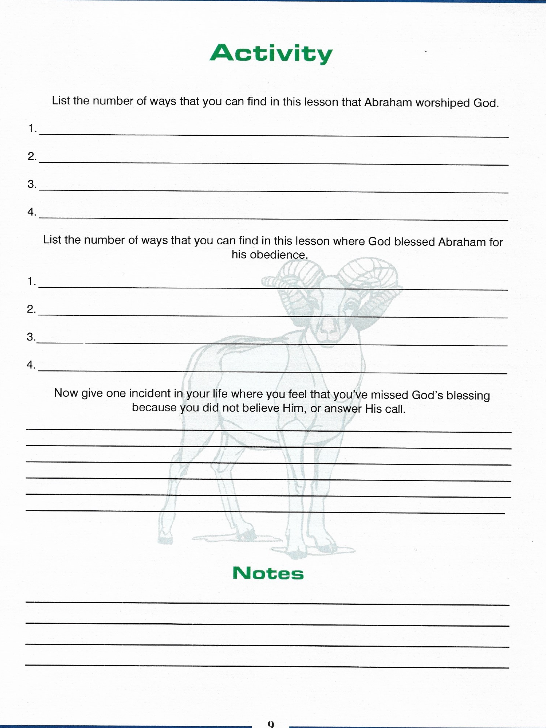
Go over the activity in the students book with the class.
Song
"Here I Am Lord" is on page 85 of The Group Songbook.
Closing Prayer
Ask the students to form a circle and join hands. Have each student give one thing they learned from this lesson. Ask for a volunteer to lead in prayer thanking God for Abraham's example and for their own calling to follow Christ. Ask for God's help each day to listen carefully for God's calling and to always answer Him.
Printable Pages