YEA Lesson Library
A Remarkable Man!
About This Lesson
This survey of Abraham’s life, from God’s call, to the sin in Egypt, to the incident with Hagar, all is used to teach the student that when we sin, God will forgive us if we repent. However, there are consequences of sin that don’t disappear with God’s forgiveness.
Scriptures
Genesis 12:1-20
Genesis 15:1-21
Genesis 16:1-15
2 Samuel 22:28-29
Psalm 23:1-3
Psalm 23:1-6
Psalm 48:1-14
Words to Know
ENTOURAGE - ones attendants and associates
The Lesson
Do you think people will say you were a remarkable person when you’re gone? If so, in what ways? After Jesus Christ, who do you think was the most remarkable person who ever lived? Was it a president - Washington, Lincoln, Kennedy, or Bush? All of these men are remarkable men. But none of these men measured up to how God looks upon Abraham. The Bible calls him the father of the faithful and a friend of God.
After the tower of Babel, God scattered the people all over the earth. After Abram's father died, God told him to leave his country and people behind and go to the land where He would guide him. Abram didn't say, "Why me, Lord?” He just did what God said. This blessing came with these instructions - "I will bless those who bless you and curse those who curse you; and the entire world will be blessed because of you." Think about it. The entire world will be blessed because of Abram. That's awesome!
Abram, a very wealthy man, got up and went just like God told him to do. He took his wife Sarah, Lot his nephew, his cattle, servants, and all of his wealth and trekked off to Canaan. When he arrived God said He was going to give this land to Abram's descendants. So Abram built an altar to commemorate God's visit and kept on traveling to Egypt.
Abram was human just like you and me. He had choices to make. And sometimes they weren't choices he really wanted to make. As his entourage entered Egypt, he was afraid that the Egyptians would kill him if they knew that Sarah was his wife. She was such a beautiful woman, and he feared they would want her. So Abram asked Sarah to tell them that she was his sister. This was a half-truth. Sarah was his half sister, but she was very much his wife. Pharaoh had every right to assume that Sarah wasn't Abram's wife, so he took her into his harem. Plagues came immediately. The Egyptians knew something was wrong and demanded to know why Abram hadn't leveled with them about Sarah being his wife. Pharaoh wasn't very happy. So he sent Abram, Sarah, and their entourage out of the country under armed escort.
Even after this mistake God appeared to Abram in a vision and promised to defend him and give him great blessings. Abram and Sarah had no children. So He replied to God, "O Lord Jehovah, what good are all your blessings when I have no son? For without a son, some other member of my household will inherit all my wealth.
"Then Jehovah told him, 'No, no one else will be your heir, for you will have a son to inherit everything you own.' He took Abram outside at night and told him to look up at the sky and count the stars. Your descendants will be like that - too many to count!' Abram believed God; then God considered him righteous on account of his faith.”
But apparently Sarah didn't have as much faith as Abram. She was about 75 years old and not getting any younger. She wanted a baby to love and cuddle. .. now! So she devised a plan and told it to Abram. “Since the Lord has given me no children you may sleep with my servant girl, and her children shall be mine.”
Abram had his wife's permission and her encouragement to commit adultery. He too wanted a son that Sarah had not yet provided. So he agreed to this. Hagar conceived, and when she realized she was pregnant, she became very proud and arrogant toward Sarah. Doubtless, she must have felt superior since she could have a child by Abram and Sarah was unable to do it. So the family fight started. Sarah blamed Abram even though she gave him permission to do this. Then Abram gave Sarah permission to punish Hagar. So Sarah beat her and Hagar ran away.
An angel found this beaten, pregnant servant girl beside a desert spring and asked "What in the world are you doing out here?" The angel told Hagar to return home to her mistress. "This son of yours will be a wild one - free and untamed as a wild ass! He will be against everyone, and everyone will feel the same towards him. But he will live near the rest of his kin."
What lessons can you learn from this Remarkable Man, Abram? He was very human the same as we are. He sinned. And his sins carried consequences much longer than he had expected. The descendants of his son born from an adulterous relationship are the Arab people today. Abram did not wait for God to provide him and his wife a legitimate son. The angel's prophecy to Hagar
about her son lingers to this very day. There are two lessons for you in this. First, wait on God to provide and don't take matters into your own hands. Second, God can forgive sin, but He doesn't always remove the consequences - they may linger for many generations to come.
Since Abram sinned, how can it be that he was A Remarkable Man? Even though he had the same weaknesses that all humans have, he believed God. And God considered him to be righteous on account of his faith. When God said get up and go, he got up and went even when he didn't know where God was leading him. He believed God. What about you? Do you believe God? Do you believe God enough to give up everything you have and follow Him?
Student Prayer
God of Abraham, Isaac, and Jacob,
Thank you for Abraham's example of faith. Help me to remember it daily. Also, help me to never forget that even Abram's sins had consequences that followed, even to this day. May I always think of this before I sin or commit an evil or even a hurtful act that is not pleasing in your sight.
In the name of Jesus I pray.
Amen.
Daily Devotions
Sunday - Psalm 23:1-6
Monday - Genesis 15:1-12
Tuesday - Genesis 15:12-21
Wednesday - Genesis 16:1-6
Thursday - Genesis 16:7-15
Friday - 2 Samuel 22:28-29
Saturday - Psalm 48:1-14
Objectives
At the end of this lesson, students will be able to:
1. Explain that God is merciful. He is willing to lead us, even though we sin, if we trust in Him.
2. Discuss that sins can be forgiven, but that does not mean that consequences won't stalk us and our children, grandchildren, and great-grandchildren for many years.
3. Explain that Christ is the light of the world and that is the Light needed to guide our Christian walk.
4. Give their favorite Scripture verse that inspires them to let God lead their lives.
Topics & Themes
Abraham
Blessings
Children
Consequences of Sin
Faith
Forgiveness
God’s Leading/Guidance
God’s Mercy
Hagar
Ishmael
Light
Obedience
Pharaoh
Plagues
Sarah
Sin
Trusting God
Wait on God
Materials Needed
Bible, YEA Students' and Teacher's books, attendance and memory verse charts, songbook, CD or cassette tape, music player, enough rope for every student to have a three-foot piece and a blindfold for everyone
How to Teach This Lesson
If weather permits and you have a place to take your class, do this object lesson outside. After opening the class with prayer, have your students form a circle and put on blindfolds. Place one piece of rope in each student's hands for him to hold on to. Tell them to form a straight-sided square. They can tug on the rope and use their voices to accomplish this, but can't look. Tell them to let you know when they feel that they have a perfect, straight-sided square. When they say they've accomplished this task, have them take off their blindfolds to see if they have.
Debrief - Ask: How did you feel trying to make a perfect square without being able to see where you were going or what you were doing? How would a guide have helped? How much easier would it have been if you could have seen where you were going and what you were doing? What did it take to say you had made the perfect square? (Faith.) How does this Activity resemble Abram getting his entire entourage - his family, servants, animals, etc. together and leaving home without knowing where he was going? (Without knowing where they were going it was like preparing in the dark.) Who did he have to guide him each step of the way? How did God's guidance make a difference? What would you compare God's guidance to? (Shining a light on his path.) Ask one of the students to read Psalm 119:105 aloud.
Out of the light and into darkness - Ask: How many times did Abram get off the path and into darkness in today's lesson? (Twice.) Why do you think he left the lighted path? (Weakness, pressure from his wife, and a lack of faith in God.) What happened when he left the path? Even though Abram made these mistakes, God took him out side to look at the stars and promised "Your descendants will be like that - too many to count!" Why did God make Abram this promise? (Abram believed God; then God considered him righteous on account of his faith.) How does Abram's experience change your impression of God? (Even though we sin, He's merciful and forgiving. If we have the kind of faith Abram had in God He will bless us too.)
Background - Ask: How do you picture Abram's society- what do you think it was like? Start with the sentence toward the end of the second line under Background and read the remaining part of that paragraph to your students. Ask: What do you think it meant for that civilization and culture to reach a high level? Now how would you visualize it?
Teacher-Directed Activity
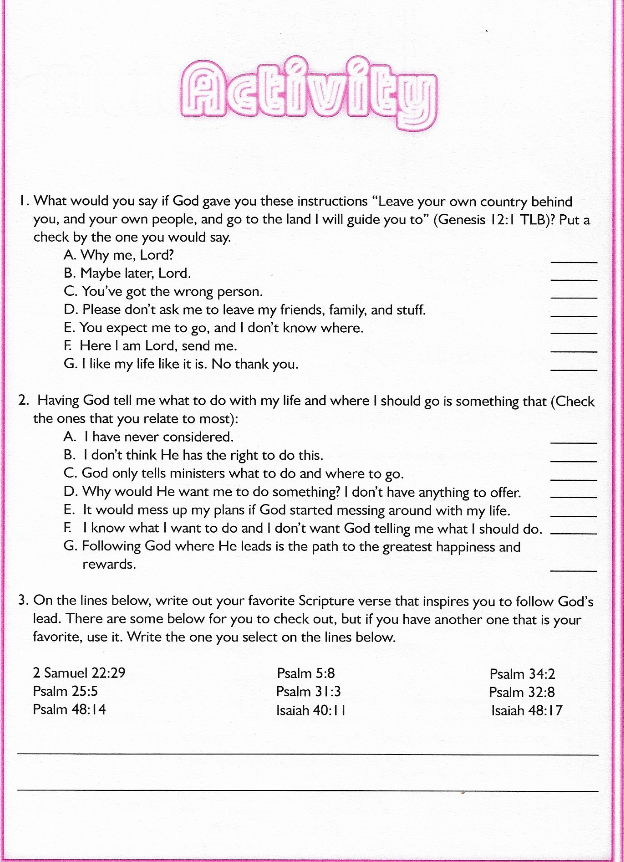
Pass out the copies of the Activity you made before class and ask the students to complete the first two questions and turn them in without their names on them. Ask them to be
completely honest since no one will know who completed each Activity. When they have completed it, take up their papers. Doing such measurements will give you an idea of how much progress you are making in your classes and how students really feel about God leading their lives.
Now have the students form partners and arrange the seats far enough apart so that talking softly won't disturb another pair. Explain that they are to read the Scripture verse to their partner they wrote under number three that inspires them to follow God and tell how it does. Someone has said that you really don't understand something unless you can explain it to someone else. This is one step in teenagers gaining confidence in talking about the Bible to someone else and explaining their beliefs.
Song
"Shine on My Life With Your Love" is on page 5 of The Group Songbook.
Closing Prayer
Ask the students to form a circle and join hands. Ask for a volunteer to lead in prayer thanking God for Abram's faith and for the blessings we receive because of it today.
Printable Pages