YE5D.1 · Activity Page
Genesis 1:3-5, 14-19
Exodus 16:23-31
Leviticus 23:26-32
Numbers 15:32-36
Deuteronomy 16:4-6
Joshua 24:15
Nehemiah 13:15-21
Proverbs 25:2
Isaiah 58:13-14
Malachi 3:6
John 19:41-42
Acts 17:1-4
Acts 18:1-6
1 Corinthians 14:33
Hebrews 4:1-6
Teenagers have asked YEA to write a lesson answering the question, “Why do days begin at night?” Let’s explore this subject to see what we can discover. As you study the Bible, there’s an important principle to keep in mind – you often don’t find the complete answer in one place. Proverbs 25:2 says, “It is the glory of God to conceal things, but the glory of kings is to search them out.” You’ll find a little gem here and another piece to the puzzle some place else in the Bible and they all go together. And God designed it that way.
Genesis gives the order of things that God created. At first the earth was formless and empty. Everything was dark. God said, “Let there be light and there was light. God saw that the light was good, and he separated the light from the darkness. God called the light ‘day’ and the darkness he called ‘night.’ And there was evening, and there was morning – the first day” (Genesis 1:3-5 The NIV Study Bible For Kids). Not only did God create the universe, He began the day cycle with the evening – evening and morning made up the first day.
“God made two great lights – the greater light to govern the day and the lesser light to govern the night. He also made the stars. God set them in the expanse of the sky to give light on the earth, to govern the day and the night, and to separate light from darkness. And God saw it was good. And there was evening, and there was morning – the fourth day” (verses 14-19).
The Great God has a purpose for everything He does. He has a plan that has order. “For God is not a God of disorder but of peace” ( 1 Corinthians14:33). Few things are as frustrating as having a friend that is unstable and changeable. This type person is totally unpredictable. If he says he’ll meet you at two this afternoon, he may or may not show up. People like him can leave you in a lurch and always guessing. But God is not that way. As the old saying goes, “He’s as predictable as the sun coming up in the morning.” He doesn’t do one thing today and then something contradictory at another time. “For I am the Lord – I do not change (Malachi 3:6).
We’ve seen that the first and fourth days of creation began at evening. With what you’ve learned so far, would you expect to find the same pattern as you proceed through the Bible?
In Leviticus 23 God lays out all of the Holy Days we are to celebrate. “The Lord said to Moses, The tenth day of this seventh month is the Day of Atonement. Hold a sacred assembly and deny yourselves, and present an offering made to the LORD by fire. Do no work on that day, because it is the Day of Atonement, when atonement is made for you before the LORD your God. Anyone who does not deny himself on that day must be cut off from his people. I will destroy from among his people anyone who does any work on that day. You shall do no work at all. This is to be a lasting ordinance for the generations to come, wherever you live. It is a Sabbath of rest for you, and you must deny yourselves. From the evening of the ninth day of the month until the following evening you are to observe your Sabbath” (verses 26-32). God wanted no misunderstanding about when we are to begin and end the observance of this day. Just as the first and fourth day of creation, this day starts at evening – there is a consistent pattern.
Your next question might be “How do we know what time the evening begins?” Instructions about the observance of the Passover will shed more light on this subject. “The Passover is not to be eaten in your homes. It must be eaten at the place the Lord shall choose as his sanctuary. Sacrifice it there on the anniversary evening just as the sun goes down” (Deuteronomy 16:4-6 TLB).
What about the New Testament, did days begin at evening then? We all know that Jesus was our Passover Lamb and was crucified during the after- noon hours of the Passover day. We also know a Holy Day – the First Day of Unleavened Bread is the next day. We add another piece of the puzzle with Joseph of Arimathaea and Nicodemus taking Jesus’ body and preparing it for burial. “The place of crucifixion was near a grove of trees, where there was a new tomb, never used before. And so, because of the need for haste before the Sabbath (a high day – the First Day of Unleavened Bread), and because the tomb was close at hand they laid him there” (John 19:41-42). This tells us they had to rush to get Jesus in the tomb because the First Day of Unleavened Bread would be starting as the sun was going down.
In our searching and digging, we are getting the answer to your question “Why Do Days Begin at Night? The answer is very simple. God made it that way from creation and never changed it. If you have problems with thinking of a day beginning at sunset, try turning it around and think of it as a day ends as the sun sets. Either way, the question for you is how does this impact your life? And more important, what are you going to do about it?
The question teenagers asked “Why do days begin at night” would probably not have been asked if it were not because the Sabbath begins as the sun is going down on Friday. This often presents teens with a problem because of ball games, proms, etc. are often scheduled on Friday nights. Nowhere in the Bible does it say that Friday night is less holy than the time you are in Sabbath service on Saturday. It’s a commitment that you have to make before your God.
When Joshua was old, he called all the Israelites together and said, “As for me and my household, we will serve the LORD” (Joshua 24:15). What about you? Ask your mom and dad when they decided to serve God and why? Ask them to tell you what a difference faithfully serving God has made in their lives?
Great God,
Thank you for creating the world with such order. Thank you for being a God that we can count on to always be the same. Increase our understanding of you and your way. Give us the courage to always do what is right in your sight.
In Jesus name.
Amen.
Sunday: Exodus 16:23-31
Monday: Numbers 15:32-36
Tuesday: Nehemiah 13:15-21
Wednesday: Isaiah 58:13-14
Thursday: Hebrews 4:1-6
Friday: Acts 18:1-6
Saturday: Acts 17:1-4
Job 14
Ecclesiastes 3:16-23
Isaiah 66:22
Matthew 10:28
Luke 16:19-31
John 11:25, 26
Romans 2:1-10
I Corinthians 15:53
2 Corinthians 5:1-17
1 Thessalonians 5:10
I Timothy 6:15-16
Hebrews 11:10-13
IMMORTAL - not subject to death
MORTAL - subject to death; having a transitory life
Have you ever seen the picture in Dante’s Inferno with a man face down in a hole and his feet sticking out? Dante was trying to depict his idea of an ever-burning hell. But how can a loving God torment people, in hell fire, for all eternity? How did some people get this idea of an ever-burning hell anyway?
Back in time, Christian theologians decided that man has an immortal soul. This immortal soul is like having a little man inside of you. When you die, it can’t die, because it’s immortal. Then if this little man, or soul cannot die, logic would say at death it has to go someplace. It must live forever because it cannot die.
But does your Bible say that man has an immortal soul? Before you make up your mind, let’s call some witnesses and see what they say. All of the witnesses we will call are from the Bible.
Our first witness is Job. He was truly a great man – he feared God and stayed away from evil. Even God said he was righteous. In the course of time he became the object of a test between God and the devil. All of his children were killed when a tornado struck their house. His livestock were stolen, leaving him totally bankrupt. Boils covered his body. His wife had had it! She couldn’t stand to see Job suffer any more so she asked him to curse God so that he would die. But Jobs troubles didn’t end there. His friends showed up to explain why he was suffering so much. They found more things to point out about how Job was simply not righteous enough. Now that’s the kind of friends you don’t want around when everything is going wrong. At a time like this Job knew He could talk with God, and he did.
“For there is hope for a tree – if it’s cut down it sprouts again, and grows tender, new branches. Though its roots have grown old in the earth, and its stump decays, it may sprout and bud again at the touch of water, like a new seedling. But when a man dies and is buried, where does his spirit go? As water evaporates from a lake, as a river disappears in drought, so a man lies down for the last time, and does not rise again until the heavens are no more; he shall not awaken, nor be roused from his sleep. Oh, that you would hide me with the dead, and forget me there until your anger ends, but mark your calendar to think of me again!
“If a man dies, shall he live again? This thought gives me hope, so that in all my anguish I eagerly await sweet death! You would call and I would come, and you would reward all I do. But now, instead, you give me so few steps upon the stage of life, and notice every mistake I make. . .” (Job 14:7-16). Job saw death as sleep. He never thought that he was immortal. Job knew that when you’re dead you’re dead. But he knew there is life after death and asked God to mark his calendar and remember him in the resurrection. So our first witness had no illusions of being immortal.
Our second witness is the wisest man whoever lived – King Solomon. God told this king that he could ask anything of Him and He would give it to him. Solomon asked for wisdom and got it and riches. In his great wisdom he concluded that man is no better than an animal. They breathe the same air and they both die. “All go to one place – the dust from which they came and to which they return” (Ecclesiastes 3:20). Solomon knew that man is mortal the same as animals. “There is hope only for the living. ‘It is better to be a live dog than a dead lion!’ For the living at least know that they will die! But the dead know nothing; they don’t even have their memories” (Ecclesiastes 9:4-5). Solomon acknowledged that their love, hatred, and envy perish. He exhorted us “Whatever you do, do well, for in death, where you are going, there is no working or planning, or knowing, or understanding.” This doesn’t sound like Solomon thought he would go immediately to heaven or hell when he died, for in heaven or hell you would be conscious. The wisest man that ever lived knew well that he was mortal – that when he died he wouldn’t know anything.
For the third witness, let’s call Ezekiel. In Ezekiel 18, people were saying that the children are punished for their father’s sins and God is unfair. In no uncertain terms Ezekiel tells the people that “the soul that sins, it shall die” (verses 4 and 20). If a soul can die, it cannot be immortal!
We could call Isaiah and Jeremiah as witnesses, but space does not permit. So let’s call Jesus as a witness and see if He says man has an immortal soul. In Matthew 10:28 Jesus taught that contrary to the soul being immortal, it is very mortal. He said, “Fear him which is able to destroy soul and body in hell.” The “soul” has to be mortal or it cannot be destroyed.
Since our witnesses from both the Old and New Testaments say the soul is mortal, we know that this teaching that man has an immortal soul doesn’t come from the Bible. Then what is the source of this doctrine. It came from Greek philosophers. With this belief came a problem. If the soul can never die, then at death it has to go some place. So the doc- trine of the immortal soul led to another mistaken doctrine – that man goes immediately to heaven or hell at death. One mistaken belief led to another.
Even though man does not have an immortal soul, there is a mystery the Bible speaks of that has significance here. Paul says, “Behold, I shew you a mystery; We shall not all sleep, but we shall all be changed, In a moment, in the twinkling of an eye, at the last trump: for the trumpet shall sound, and the dead shall be raised incorruptible and we shall be changed. For this corruptible must put on incorruption, and this mortal must put on immortality” (I Corinthians 15:52-56). Man does not have an immortal soul. However, he can put on immortality. At the resurrection of the dead those in Christ become immortal and will live forever!
Loving Father,
Thank you for a better understanding of man and what you have in store for us. You have told us in your Word that we “shall know the truth and the truth shall make us free.” Your truth allows us to understand your love, mercy and awesome plan. As Job asked, mark your calendar and remember me in the resurrection when I shall put on immortality.
In Jesus’ name I pray.
Amen.
Sunday: Hebrews 11:10-13
Monday: I Corinthians 15:53
Tuesday: 1 Thessalonians 5:10
Wednesday: I Timothy 6:16
Thursday: Ecclesiastes 3:16-23
Friday: Romans 2:1-10
Saturday: John 11:25, 26
Job 11:8
Psalm 55:15
Proverbs 23:12-18
Amos 9:2
Jonah 2:2
Malachi 4:1
Matthew 5:22
Matthew 7:13-14
Matthew 8:11-12
Matthew 13:31-42
Acts 2:31
2 Thessalonians 1:7-12
James 3:6
2 Peter 2:4
Revelation 6:8
Revelation 20:13-15
Revelation 21:7-8
Revelation 21:8
THEOLOGICAL - pertaining to religious studies
GEHENNA - a deep east-to-west valley located about one thousand yards south of the Temple Mount
HADES - the abode of the dead
SHEOL - the abode of the dead
TARTAROS - The name of a subterranean region, regarded by the ancient Greeks as the abode of the wicked dead, where they suffer punishment for their evil deeds (Thayer’s Greek- English Lexicon).
INCINERATE - to cause to burn to ashes
One very hot August night in Mississippi, a red headed, red faced minister preached a sermon about how awful hell is for unrepentant sinners who have died. He vividly described how condemned sinners could find no relief from the flames of fire as they jumped from one hot coal to another in hell. Adulterers, thieves, wife beaters, child molesters, drug users, shoplifters, and gossips in his congregation became increasingly more restless.
Copious sweat poured from his brow that hot summer’s eve, for there was no air-conditioning in that church building. The preacher became more and more excited and his voice got louder and louder. His passion for those sinners in his audience drove him to draw detailed verbal images of an ever-burning hell fire.
As his sermon built to a climax he said, “Let’s lift the lid off of Hell, and see what Joe the drunkard, Two Gun Willie, Priscilla, the naughty lady some of you men have visited, and all of those other sinners are doing.” As he lifted the “lid off of hell,” he screamed at the top of his voice because of the suffering he supposedly saw. Doubtless, this had a powerful impact on those in that hot church building. But was this fact or fiction?
This is a true story. And it is the way many people envision hell to be. But is it what your Bible teaches? Will the God of the greatest mercy torture and torment sinners in hell fire for all eternity? What is the punishment for unrepentant sinners? If you die without repenting of your sins, are you doomed to eternal punishment in an ever burning hell fire? Is there a real hell fire? Is there justice with God? Is our Lord a merciful God? You owe it to yourself to know the truth of these matters.
“Hell” in theological usage is a place of punishment after death. Although there exists a bewilder- ing array of doctrines on hell, there are some broadly accepted elements. Hell is generally conceived as a place beneath the surface of the earth, for example. It is a place where the wicked are tormented by fire, suffering excruciating pain – both the pain of loss and pain of the senses. Somehow the fire causes pain but does not consume. It torments, but the usual relief caused by the destruction of nerves and tissue, passing out, or numbness, is denied the sufferer. How long does this go on? Since man is believed to have an immortal soul, his torment continues time without end, unremitting, for all eternity.
There are four words used in the Bible which are translated “Hell.” Those words are Gehenna, hades, sheol and tartaros. Gehenna was a specific location on the earth that is well known to all Jews. Psalm 55:15 tells us that the direction to hell is down. It is a deep place (Job 11:8), it is a place from which one can be delivered (Proverbs 23:14), it is a place one can dig into (Amos 9:2), Jonah even considers the belly of the whale to be a “hell” of sorts (Jonah 2:2).
In the broadest terms, sheol simply means “the abode of the dead.” Since most of the dead are buried, then hell, in the sense of sheol or hades, is well translated by the English word “grave.”
The Greek word tartaros is the name of a subterranean region, doleful and dark, regarded by the ancient Greeks as the abode of the wicked dead, where they suffer punishment for their evil deeds.”
Many teach that Jesus suffered the torture of flames in hell fire for three days and nights after He was crucified. They use Acts 2:31 to support their belief. “He seeing this before spake of the resurrection of Christ, that His soul was not left in hell (hades), neither His flesh did see corruption.” They read more into this Scripture than it says. It just says that Jesus was not left in the grave.” (For a complete explanation of each of these Scriptures and this subject call 1-888-BIBLE 44 for Ronald Dart’s free booklet “Is There Really a Hell Fire?” Excerpts from this booklet are included in this lesson.)
Not one New Testament reference has anything at all to say in support of the traditional doctrines of hell fire. This booklet will show you that eternal punishment in hell fire is likely derived, not from the Scriptures, not from the teachings of Jesus, but from Jewish traditions!
But the observant reader will notice that there is a Bible reference to a lake of fire. Could this be the kind of “hell” of which Jesus spoke? Absolutely! For indeed there is to come a time when a great sea of fire, such as lava, or molten rock, becomes the ultimate destruction of the wicked. But what happens to a human being when you cast him into a lake of molten fire? Obviously, he is incinerated. There is not one suggestion of even a lingering death, much less eternal punishing.
Well then, is there really a hell fire after all? Absolutely! At the very end of history, when every man has heard the Gospel and every man has had a chance to be saved, then everyone who “was not found written in the book of life was cast into the lake of fire” (Revelation 20:15).
There is justice with God! There is also virtually limitless mercy. To those who repent; to those who turn from their sins, receive Jesus Christ as personal Savior; as their Lord, who rules in their lives – as their ever-present High Priest, and their soon- coming KING, there is salvation! That means living forever – in the Kingdom of God – not being destroyed by a veritable sea of flames, which will render the wicked as ashes under the feet of the righteous (Malachi 4:1).
Awesome and Merciful God,
Your plan is so wonderful! Show me how to live my life that it might be pleasing to you. I want you to be my High Priest and soon-coming King. I need your salvation.
In Jesus’ name I pray.
Amen.
Sunday: 2 Thessalonians 1:7-12
Monday: Matthew 7:13-14
Tuesday: Matthew 8:11-12
Wednesday: Matthew 13:31-42
Thursday: Matthew 5:22
Friday: Revelation 21:7-8
Saturday: Proverbs 23:12-18
Deuteronomy 28:1-2
Isaiah 55:6-7
Isaiah 65:16-25
Matthew 13:44-46
Matthew 18:4-10
Matthew 24:22
Mark 10:13-16
Mark 10:14
Luke 21:34-36
John 18:36
1 Corinthians 15:51-52
Revelation 21:7
INHERIT - To receive property or possessions by inheritance
Maria’s husband died and left her with a little baby girl,Christiana. Maria knew that she must find a job so that she could put food on the table and provide a home for her baby. She had no skills or formal training. So she found a job as a maid. It provided the necessities, but no luxuries. Maria loved Christiana very much and never wanted to remarry. She watched her daughter grow into a beautiful young lady. But the poverty level life her mother provided left the girl wanting more.
One day Christiana left home for the city to start a life of her own. She began looking for work. But jobs were hard to find. Soon she ran out of the few dollars she had in her purse – she had no place to live and no food to eat. When she left home she took a stack of her own pictures with her. On the back of each of her pictures she wrote a note that said she was looking for work and left them in bars, hotels, nightclubs – places where men would be looking for a street walker or a prostitute. Now her money was gone, along with her pictures. Her mother knew Christiana was somewhere and needed her help. She set out to search for her. And she too left her pictures taped to mirrors in hotel lobbies.
The hard life Christiana was living took its toll on the way she looked – her beauty had sadly faded. She looked tired and used as she descended the stairs in the hotel where she had spent the night. As she walked down the steps, she noticed a picture she recognized taped to a mirror. Could it possibly be, she thought? Yes, it was her mother’s picture. Anxiously, she went to retrieve it. As she turned it over she saw a note from her mother that said, “Whatever you have become, or whatever you have done, it doesn’t matter. Please come home.”
A mother’s love is very deep for her children. So is God’s love for His children. Like a mother, God does not want His Children to be left behind.
One day some mothers brought their children to Jesus for Him to bless them. His disciples didn’t like this and tried to shoo the mothers away telling them not to bother Jesus. But when Jesus realized what was happening He was very displeased with His disciples. “Let the children come to me, for the Kingdom of God belongs to such as they. Don’t send them away! I tell you as seriously as I know how that anyone who refuses to come to God as a little child will never be allowed into his Kingdom.” Then Jesus picked up the children and put His hands on their heads and blessed them” (Mark 10:14-17). Did you catch the answer to the question teenagers want YEA to answer? Jesus said “Let the children come to me, for the Kingdom of God belongs to children such as they.” God does not want children of any age left behind. His Kingdom belongs to them!
But do you want to be left behind? Have peers led you to believe that you will be better off if this present world continues? Do you really want this world to continue so that more people can die of AIDS, cancer, drug overdose, or murder? Do you want to see more parents divorce and more children grow up without a father? Do you want to see more homeless people on the streets, more wars fought or more crimes committed? If this world continues, this is exactly what will happen, except for one thing. The world around you will continue to get worse and worse. Is that what you want to be a part of?
Let’s take a look at what it will be like in God’s Kingdom. We report and you decide if you really want to be in God’s Kingdom or if you want to be left behind.
“Violence will disappear out of your land – all war will end. Your walls will be ‘Salvation’ and your gates ‘Praise.’ No longer will you need the sun or the moon to give you light, for the Lord your God will be your everlasting light, and he will be your glory. Your sun shall never set; the moon shall not go down – for the Lord will be your everlasting light; your days of mourning all will end. All your people will be good. They will possess their land forever, for I will plant them there with my own hands, this will bring me glory. The smallest family shall multiply into a clan; the tiny group shall be a mighty nation. I, the Lord will bring it all to pass when it is time” (Isaiah 60:18-22 TLB).
Well then, what happens to the kids when Christ returns? That will depend on whether you have accepted Christ as your Savior and have been baptized. If you are a living, obedient, baptized Christian when Christ returns you will be changed to spirit being (1 Corinthians 15:51,52). You will then be a very son or daughter of God with all that entails.When you compare what you will gain to the things you will miss out on, how does it stack up? Christ promised that you will inherit all things if you will commit your life completely to Him. “I will give to the thirsty the springs of the Water of Life – as a gift! Everyone who conquers will inherit all these blessings, and I will be his God and he will be my son” (Revelation 21:7 TLB).
Those who focus on having more of what this world offers, stand the chance of being left behind. If you are left behind, you’ll miss out on something more wonderful than your mind can imagine. This will be the most exciting time in the history of man. “No eye has seen, no ear has heard, no mind has conceived what God has prepared for those who love him” (1 Corinthians 2:9).
God doesn’t want you to be left behind. He wants to give you a life, a family, a world that will surpass anything you have imagined. What a fantastic reward is waiting for you if you will but believe and receive. You have a choice – don’t allow yourself to be left behind. “So don’t be afraid, little flock. For it gives your Father great happiness to give you the Kingdom” (Luke 12:32 TLB).
Father,
Please open my mind to understanding how awesome what you have in store
for those who believe in you really is. Help me not to be left behind.
In Jesus’ name I pray.
Amen.
Sunday: Isaiah 55:6-7
Monday: Matthew 18:4-10
Tuesday: Matthew 13:44-46
Wednesday: John 18:36
Thursday: Luke 21:34-36
Friday: Mark 10:14-16
Saturday: 1 Corinthians 15:51-52
Psalm 51:11
Luke 11:11-13
John 6:63
John 14:16
John 16:13
Acts 1:4-5
Acts 2:38-39
Romans 8:26
2 Corinthians 1:22
Galatians 4:6-8
Galatians 5:16-26
Galatians 6:8
Ephesians 1:11-14
Ephesians 4:25-32
2 Timothy 1:7
INTERCESSION - pleading on behalf of another person
Imagine this scene. Jesus has been tried and then crucified. He was resurrected on the third day and then He appeared to 500 people at one time. These momentous events all happened between Passover and Pentecost– in less than fifty days.
His apostles’ emotions had been jerked in every direction. But there was more to come. Jesus had explained to them that He would soon be going to heaven. The Apostles realized they would be faced with the task of getting the Gospel out. But if Jesus left them, they would have to do it without the strength of their Leader. This prospect left the Apostles faced with a very uncertain future.
The time for Him to ascend to heaven to be with His Father had come. And the Apostles were with Him. There was one more thing He needed to tell them before He disappeared in the clouds as He was lifted up to heaven. He commanded His apostles,“Do not leave Jerusalem, but wait for the gift my Father promised, which you have heard me speak about. For John baptized with water, but in a few days you will be baptized with the Holy Spirit” (Acts 1:4,5). The Apostles did as they were told. The Day of Pentecost came and the gift Jesus promised was poured out without measure on all the people there.
We all like to receive gifts. So what is this “gift” the Father promised – the gift the Apostles and the people received on this Pentecost? This “gift” is the Holy Spirit. Why is the Holy Spirit important to you? What can the Holy Spirit do for you?
John 14:16 calls the Spirit a helper. Then this gift of the Holy Spirit can help you. How can the Holy Spirit help you? “By our faith – the Holy Spirit helps us with our daily problems and in our praying. For we don’t even know what we should pray for, nor how to pray as we should; but the Holy Spirit prays for us with such feeling that it cannot be expressed in words” (Romans 8:26). At times of great joy or gratitude, or when we are deeply troubled, our prayers can seem far too inadequate. But think what a gift it is to have the Holy Spirit making intercession for you to the Father – feelings that can’t be expressed in mere words.
Down through the ages the Holy Spirit has been helping teenagers to come to God. This Spirit communicates through the Word of God and will lead you into all truths (John 16:13). The Holy Spirit gives life (John 6:63). It even gives eternal life (Galatians 6:8).
To say the least, the Holy Spirit has exceptional abilities. What a fantastic gift it is that can do so much for you. Should it be one that you desire more than popularity, fame or fortune?
Then what do you have to do to get this gift? Jesus had just ascended to heaven and the day of Pentecost had come. Peter preached a powerful sermon and the people were “cut to the heart” and asked him and the other apostles what they should do. Their reply is just as relevant to you as it was to these people that day of Pentecost. “Repent and be baptized every one of you in the name of Jesus Christ for the forgiveness of your sins. And you will receive the gift of the Holy Spirit” (Acts 2:38). These people were given power beyond their greatest expectations.
Do you want power in your life to resist sin, power to help others, power to make a difference in this world, power to be all that you can be, and the power to make it into God’s Kingdom? There’s no need to fear. “For God did not give us a spirit of timidity, but a spirit of power, of love and of self-discipline” (2 Timothy 1:7).
Can you think of any gift you should covet more than the gift of God’s Spirit? Can you think of another gift that can do more for you? Can you think of any gift you should try harder to get than the gift of God’s Spirit?
Life is hard for teenagers. Temptations are all around us. Peer pressure is overwhelming at times. And you want to resist sin, but you’re weak. What’s the answer? Repent of your sins and be baptized as 3000 people did on the Day of Pentecost. You too will receive the gift of the Holy Spirit. It can give you the power you need in your daily life. It can make a difference that you really need. Don’t delay. It’s a gift you need today!
Note:
The purpose of this lesson is not to prove or disprove the Trinity. As supplemental material to this lesson YEA recommends that you contact CEM and start the Bible Study Course. Lessons 2, 3, and 4 can provide you with an in-depth study of the Trinity.
Almighty God and Father,
You promised to give us the gifts of the Holy Spirit. Life is hard for teenagers in this world. Every time we turn around we’re tempted with such things as smoking, drugs, illicit sex, lying, breaking your Sabbath, etc. You have promised to give me power through your Spirit to help me resist these things. Please bring me to repentance and baptism. I want and need your Spirit to help
me every day of my life.
I ask these things in Jesus Christ’s Holy name.
Amen.
Sunday: Ephesians 1:11-14
Monday: Galatians 4:6-8
Tuesday: Galatians 5:16-26
Wednesday: Psalm 51:11
Thursday: 2 Corinthians 1:22
Friday: Luke 11:11-13
Saturday: Ephesians 4:25-32
Exodus 16:26-30
Exodus 20:8-11
Exodus 31:13
Exodus 31:13-17
Leviticus 23:1-3
Numbers 28: 9-10
Deuteronomy 5:12-15
Jeremiah 17:19-27
Matthew 28:1
Mark 16:2, 9
Luke 24:1
John 20:1, 19
Acts 20:7
1 Corinthians 16:2
THEOLOGY - the study of divine things or religious truths
PROSELYTE - a convert that has changed from one opinion or religious belief
TRANSLITERATION - to change words into corresponding characters of another language
TANTAMOUNT - equal as in value, force or significance
On the seventh day of creation God made the Sabbath. He set it apart and made it holy. For four thousand years Israel of old, and those who followed the God of the Old Testament kept the seventh day Sabbath holy. Throughout Jesus’ ministry, He and His disciples kept the Sabbath. All of them were Jews. For all of them the Sabbath was more than a tradition or a commandment, it was a matter of religious identity. The Sabbath was clearly the identifying sign that answered the question “who is your God.” To change the Sabbath to another day would not merely have been a change in doctrine, it would have been tantamount to changing their God.
The Bible says: “Speak thou also unto the children of Israel, saying, Verily my sabbaths ye shall keep: for it is a sign between me and you throughout your generations; that ye may know that I am the LORD that doth sanctify you” (Exodus 31:13). Verse 16 says it is a perpetual covenant, “It is a sign between me and the children of Israel for ever.”
Why would you, at some later time, abandon the observance of the Sabbath in favor of Sunday? And what would have been the consequences of that change? If the Sabbath had been changed to Sunday, would you have expected Jesus to say something about it, to explain the change? For there would have had to have been a moment when the change came into effect, right? It is very hard to imagine that one week the entire body of disciples of Jesus (who were all Jews at the time) kept the Sabbath, and the next week observed Sunday instead, with no explanation, no comment, not even a ripple. Yet this had been a commandment, a tradition, a religious identity for four-thousand years.
Christian churches today say the crucifixion and resurrection changed everything. Yet you would expect that a change of that magnitude would be explained somewhere in the New Testament. That there would be a passage that gives us, not merely the change, but the reason for the change. But you can search your Bible from cover to cover and find no such change or the reasons for it.
The Sabbath had a theology that went with it. It identified who your God was. You were a worshiper of Jehovah, not Baal, and it was the Sabbath that established that identity. So shouldn’t there be a statement just as strong as the original commandment to explain who our new God is? No such passage exists. And, of course, there was no change in their God.
The general presumption among Christians who keep Sunday is that the church began meeting on Sunday immediately after the resurrection of Jesus, and they did it because Jesus rose from the dead on Sunday morning.
This is based entirely on eight New Testament texts that mention “the first day of the week.” The superficial impression is that the church was meet- ing regularly on Sunday, the first day of the week. But this is entirely misleading.
Six of these Scriptures refer to the same event or the same day – the day of Jesus’ first appearance to His disciples after His resurrection. Mark 16:9 is one of those Scriptures. It says, “Now Jesus was risen early the first day of the week, he appeared to Mary Magdalene, out of whom he had cast seven devils.” Keep in mind that there is no Greek word for “week” found in the New Testament. In every case where the word “week” is found, the word is a Greek transliteration of the Hebrew word Sabbath. The Hebrews would have called Sunday “the morrow after the Sabbath.” Mark 16:9 literally says, “Now when Jesus was risen early the first of the Sabbaths.” Another important thing to know is that the passage doesn’t really say that Jesus was risen early Sunday morning. There were no witnesses to the moment of Jesus’ resurrection. This Scripture is giving the time, not of His resurrection, but of His appearing to Mary.
There is nothing in any of the six Scriptures listed above that will be covered in class to show one reason for changing the day of worship to Sunday. This leaves us with only two Scriptures that might lead us to this conclusion.
“Now concerning the collection for the saints, as I have given order to the church of Galatia, even so do ye. Upon the first day of the week, let everyone of you lay by him in store, as God hath prospered him, that there be no gathering when I come” (1Corinthians 16:2). This is not a Sabbath, but a work day of collecting the harvest grain for shipment to Palestine. It is the first day of harvest, not a regular first day of the week. Read it carefully. There is nothing here about a church meeting.
Now the only Scripture left in the New Testament that might possibly say the Sabbath was changed to Sunday is found in Acts 20:7, “Upon the first day of the week, when the disciples came together to break bread, Paul preached unto them, ready to depart on the morrow; and continued his speech until midnight.” This is the only passage in the New Testament that suggests the possibility that the church met on the first day of the week, and even here it is Saturday night, not Sunday, per se. Would you say this is thin evidence on which to base something as central to the faith as Sabbath observance?
From the beginning of the New Testament all the way through Acts 12, the church was composed entirely of Jews and circumcised proselytes. And there is not a word of any major change in the practice (including the day of worship) during this entire time. So if the change from Sabbath to Sunday didn’t take place in the time of the Apostles, when did it take place and why?
These changes took place over a long period of time. About 417, Pope Innocent I wrote a decree which became cannon law that the church should absolutely not observe the sacraments on Friday or Saturday. This reveals that a lot of people did. The Roman church was determined to stamp out the Sabbath. And it was the Roman church that changed the Sabbath to Sunday.
Great God of the Sabbath day,
The Sabbath was given as a sign to keep me ever mindful of the true God. You are my God. Help me to fully appreciate what a gift this is and never to forget its significance. You made the Sabbath for man. What a blessing! Thank you for it.
In Jesus’ name I pray.
Amen.
Sunday: Exodus 20:8-11
Monday: Deuteronomy 5:12-15
Tuesday: Numbers 28: 9-10
Wednesday: Exodus 31:13-17
Thursday: Leviticus 23:1-3
Friday: Jeremiah 17:19-27
Saturday: Exodus 16:26-30
Genesis 1:14
Exodus 5:1
Leviticus 23:4
Deuteronomy 16:11-14
Nehemiah 8:1-18
Zechariah 14:16-19
Malachi 3:6
Acts 2:1-11
Acts 20:6, 16
James 1:17
THREAD - something that runs through the whole course of a thing connecting all of its parts
TRANSCENDING - to outdo or exceed in excellence
Most of Christianity celebrates Christmas and Easter every year. Here’s a challenge for you. See if you can find one scripture to substantiate New Testament Christians keeping Christmas and/or Easter. If New Testament Christians celebrated those days, wouldn’t you expect to find Bible references showing they did? The days that you will find mentioned in the Bible are Passover, the Days of Unleavened Bread, Pentecost, the Feast of Trumpets, the Feast of Tabernacles and the Last Great Day.
Aren’t all of these days just Old Testament celebrations? Aren’t they Jewish holidays? What about the New Testament, were these days celebrated after the resurrection of Christ? Luke records in Acts 20:6 that after the Days of Unleavened Bread, Paul boarded a ship with some fellows at Philippi and arrived in Troas five days later. From there, they continued on their journey. Paul decided not to stop at Ephesus this time because he was in a hurry to get to Jerusalem to celebrate Easter? No! To celebrate Pentecost. These verses show that after the death and resurrection of Christ the early church still celebrated the Passover and Pentecost. Why? Because these days have significance to Christians.
All of the Feast days are recorded in Leviticus 23. “These are my appointed feasts, the appointed feasts of the LORD, which you are to proclaim as sacred assemblies”(verse 1). When did these become appointed times? At Creation God divided the day from the night and said “let them be for signs, and for seasons”(Genesis 1:14). By following the translations of Leviticus, you will see they were for signs and feasts. This indicates that from the very beginning, God’s plan called for feast days.
Have you seen the movies Exodus and The Prince of Egypt? Charleston Heston played the part of Moses in Exodus. You may recall that he went to Pharaoh and said, “Let my people go.” But do you remember why Moses asked Pharaoh to let the Israelites go? It was so “they might hold a feast unto me in the wilderness.” One of God’s appointed times was approaching. This feast points squarely to the Passover. The Israelites were not allowed to go into the wilderness to keep the Passover, but they kept it in Egypt, to Pharaoh’s great regret.
There is reason to believe that even before this, God already had His appointed times. When Abraham took his son Isaac up to the mountain to sacrifice him to God, could this have been the Passover season?
God always had His “appointed times”and the occasions when God acted in history often took place on his “appointed times.” As a result of God’s action, the day took on the meaning of God’s action. The 14th day of the first month took on the meaning of the Passover because on that night, God passed over the houses of Israel and took all of the first born of Egypt. So for all of Israel, all of these appointed times took on names and customs that were related to important times in their history. They and the world forgot that there is a transcendent meaning to those days.
Some say these days only had application to the Jewish people. Is that right? From the very beginning these days had a “Jewish” or historical meaning, but more important, they pointed to the work and ministry of Christ. Like a chameleon, these days took on the color or meaning of their time or background. For a time they took on a “Jewish”or historical meaning, but all along they were pointing to something higher.
In 1 Corinthians 5:8 Paul wrote a letter to a Gentile church that was observing the Days of Unleavened Bread – they had put leavening out of their houses. Paul makes this unusual statement “For even Christ our Passover is sacrificed for us. Therefore, let us keep the feast, not with old leavening, but with the leavening of sincerity and truth. Jesus Christ is tied to the Passover. Paul urged them to keep the feast at a higher and different level. There is a transcending meaning to the Passover that reaches beyond the meaning of anything the Jews had known up until this time. Now it finds its meaning in the sacrifice of Christ.
There is an assumption that the 14th day of the first month became important because Israel was delivered from Egypt on this day. But what if Israel was delivered on this day because it was one of the “appointed times”of God from creation? The Passover did not become a Christian festival because Christ was crucified on that day. Christ died on that day because it was one of the appointed times of our Creator.
There is a thread that runs through the Bible and it is unbroken. This thread is the plan of God. From the beginning God had a plan and has consistently worked it down through the ages. Christmas and Easter don’t show God’s plan. His festival, His appointed times, contain an outline of that plan. The festival gives us a point where we can pick up that thread. Everything from creation, to God telling Abraham to sacrifice his only son, to the Passover and the death of Christ points to God’s plan to save mankind and make us His very own sons and daughters.
Teenagers have asked for a YEA lesson to help them understand why we celebrate “Jewish” holidays. But are the days we celebrate really “Jewish”? The days we celebrate and those mentioned in your Bible do have Jewish historical significance, but they are Christian in their meaning and application. The early church observed the same Holy Days that most Christians today dismiss. These days are not merely Jewish. Christ is to be found in each one of them. The Holy Days do have some Jewish and historical significance. But all of them point to Christ and His great plan for you and for me. These celebrations have vital significance to Christians.
God is constant. He doesn’t do one thing now and a thousand years from now change His entire plan. “For I am the Lord – I do not change” (Malachi 3:6). James 1:17 says that God does “not change like shifting shadows.”
Almighty God and Father,
Thank you for your appointed times and for revealing to me that they do have Jewish and historical significance. But they also have transcendent meaning and point to Jesus Christ as our Lord and Savior. Increase my understanding of your Word and my appreciation for your appointed times.
It’s in Jesus Christ’s name that I pray.
Amen.
Sunday: Leviticus 23:4
Monday: Zechariah 14:16-19
Tuesday: Deuteronomy 16:11-14
Wednesday: Acts 2:1-11
Thursday: Nehemiah 8:1-8
Friday: Nehemiah 8:9-15
Saturday: Nehemiah 8:16-18

Leviticus 11:1-23
Deuteronomy 5:32-33
Deuteronomy 14:3-21
Proverbs 16:25
Isaiah 66:17
Acts 10:9-28
Acts 13:47
Romans 11:10-15
Ephesians 3:3-12
ARBITRARY - contingent solely upon one’s discretion
GENTILE - pertaining to anyone other than Israelites; nations
Mom, what’s for dinner?” “Fried earthworms, bird’s nest soup, cock- roach and June bug stew, a salad made of lice, fleas, spiders, and ticks, barbecued cat sandwiches. For dessert we’re having ice cream topped with ants,” Mom replied. Do these things sound like what you want for dinner tonight? Why not?
Some people eat many such things. Properly prepared, some of these things must taste good or people surely wouldn’t eat them. But is taste the only standard we should use to determine what we put into our mouths? Does it make something eatable simply because it tastes good? If taste is the standard God uses to determine what we eat, why didn’t He say so? Why shouldn’t we eat a ham sandwich or pepperoni on our pizza? If taste isn’t the standard we use to determine what we eat, what is it?
The Israelites were slaves in Egypt for over 400 years. Egypt didn’t know or keep God’s law and Israel completely lost track of it while they were in slavery. After Israel gained their freedom God began to clean up His people and restore His wonderful law to them. “All Mt. Sinai was covered with smoke because Jehovah descended upon it in the form of fire; the smoke billowed into the sky as from a furnace, and the whole mountain shook with a violent earthquake. As the trumpet blast grew louder and louder, Moses spoke and God thundered his reply. So the Lord came down upon the top of Mt. Sinai and called Moses up to the top of the mountain, and Moses ascended to God.” God told Moses to go back down and tell the Israelites not to come up the mountain or He would destroy them. The Great God of the Universe was about to speak. This was an awesome occasion! He gave the Ten Commandments, laws concerning people, the Ark of the Covenant, plans for the tabernacle, etc.
Then in Leviticus God speaks to Moses from the tabernacle with further instructions and laws. In chapter 11 He explains in detail what foods are eatable and which ones people shouldn’t eat. The standard for what is good for food and what isn’t is laid out here.
This chapter is often referred to as the “dietary laws given to the Jews.” God gave these laws to the entire nation of Israel, not just the Jews. Did He give it to the Israelites to make them “His peculiar people?” Were the dietary regulations God gave Israel an arbitrary law? Did God just pick something at His whims, like not eating pork and say, “mankind shouldn’t eat it – I want to make things more difficult for him?” No, God’s law is based on the way things are – the nature of things. He gave His law so we would know what is good for us and what isn’t. His law is to keep us out of trouble and provide us with a healthy, happy life. There are things that are not good for human consumption – they do not make us healthy. Animals that chew the cud and have cloven hooves, have two stomachs and digest their food in a different way than other animals. These animals are good for human consumption while those that don’t have these characteristics are not. God’s law is not arbitrary.
Well then, were the dietary laws nailed to the cross when Christ was crucified? You can read every gospel account of the crucifixion and not find one word about any law being nailed to the stake. Matthew’s account of the crucifixion mentions that Jesus was nailed to the stake, and a sign above His head that said, “This is Jesus, the King of the Jews” (Matthew 27:37). Those were the only two things nail to the stake on which Jesus died.
Then what about Peter’s vision in Acts 10:9-29? Doesn’t it show that it is no longer required of Christians to abstain from eating unclean foods? In this vision Peter saw the sky open and a sheet filled with all manner of unclean animals, birds, and snakes. He heard a voice say to him, “Go kill and eat any of them you wish.” But notice Peter’s response. “‘Surely not, Lord! Nothing impure or unclean has ever entered my mouth.’ The voice spoke from heaven a second time, ‘Do not call anything impure that God has made clean.’” This happened three times, and then it was all pulled up to heaven again. There is nothing to indicate that Peter began eating unclean animals, birds, and snakes. There is nothing in this Scripture that says God changed the flesh of these animals and birds to be wholesome food good for human consumption. Quite the contrary!
Rather than Peter’s vision showing that it is now all right for Israelites, Christians or anyone else to eat unclean birds or animals, the vision showed Peter that Gentiles are not “unclean.” Notice Acts 10:28 “Peter told them, ‘You know it is against the Jewish laws for me to come into a Gentile home like this. But God has shown me in a vision that I should never think of anyone as inferior. . .’” (TLB). Notice also in the King James Version “God hath shewed me that I should not call any man (not bird or animal) common or unclean (verse 28b). Did Peter’s vision change the law in Leviticus 11 regarding what we can and cannot eat? No! What this vision shows is that salvation is now extended to all nations, including the Gentiles. And the Apostles had a responsibility to preach the gospel to everyone regardless of their race and so do we. “Whosoever believeth in him shall receive remission of sins ( verse 43).
Remember, we learned that God’s law is not arbitrary. He gave His law to save us from the consequences of breaking them. It’s in the nature of how these animals were originally created that they should not be human food. Why shouldn’t we eat them? Their flesh is not good for us. God created better things for us to eat than earthworms, cockroaches, ants, lice, pig, cat, catfish, etc. “Haven’t you learned that your body is the home of the Holy Spirit. God gave you, and that he lives with you? Your own body does not belong to you. For God has bought you with a great price. So use every part of your body to give glory back to God, because he owns it” (1 Corinthians 6:19-20 TLB).
Loving Father,
Thank you for showing me another wonderful lesson from your law. You gave your law to show us how to stay out of trouble, how to be healthy and happy. Help me to grow to respect every aspect of it more each day as I obey you.
In Jesus’ name I pray.
Amen.
Sunday: Leviticus 11:1-12
Monday: Deuteronomy 14:3-8
Tuesday: Isaiah 66:17
Wednesday: Leviticus 11:13-23
Thursday: Romans 11:10-15
Friday: Acts 13:47
Saturday: Ephesians 3:3-12
Deuteronomy 30:19
Deuteronomy 30:19-20
Psalm 10:4-11
Psalm 71:19
Proverbs 17:13
Isaiah 45:7
Ezekiel 28:12-15
Matthew 7:17-20
Philippians 4:8
1 Thessalonians 4:8-2
1 Thessalonians 5:22
2 Timothy 3:1-7
PARADOX - a seemingly contradictory statement contained in a truth
Would it surprise you to learn that your Bible says that God created evil? Consider this paradox. Isaiah 45:7 says, “I formed the light, and create darkness: I make peace, and create evil: I the Lord do all these things.” How can we reconcile a Scripture that says God created evil with this one? “Thy righteousness also, O God, is very high, who hast done great things: O God, who is like unto thee! (Psalm 71:19). How could a righteous God expects you to obey His commandments when He created “evil?” Would God deliberately set a booby trap for human beings by creating evil?
To understand this paradox, we must first understand that the Hebrew word for “evil” in Isaiah 45:7 means “adversity.” To the Hebrew, a bolt of lightening that killed a man was “evil.” In English “evil” includes intent, but in the Hebrew language the word translated “evil” does not carry intent. The New Adventure Bible says, “I bring prosperity and create disaster.” At creation God put into action the laws of nature that can bring about adversity. Adversity is not always bad. It gives us the opportunity to make right choices and build godly character.
Then what about Satan, he is evil. Did God create him? Well, yes and no. God created an arch angel named Lucifer who was the “model of perfection, full of wisdom and perfect in beauty”and put him in the Garden of Eden. He was adorned with rubies, topaz, emeralds and many other precious and semiprecious stones. From the day he was created he was anointed as a guardian cherub and was blameless in his ways until wickedness was found in him (Ezekiel 28:12-15).
What happened to this “model of perfection”? Let’s pick up the story in verse 17. “Your heart became proud on account of your beauty, and you corrupted your wisdom because of your splendor. So I threw you to the earth.” Isaiah 14 sheds more light on this. “You said in your heart, I will ascend to heaven; I will raise my throne above the stars of God. . . I will make myself like the Most High” (verse 12, 14).
God created Lucifer beautiful, wealthy and a model of perfection. He created him with the ability to choose. He could be content with his beauty and perfection, or he could break God’s commandments and lust after power. His heart became proud and he set out to replace God as the King of this universe. So God cast this adversarial being down to the earth. God did not create him as an evil being. Lucifer chose to become evil. What followed then was Lucifer became Satan. Satan means adversary, the opponent, the accuser.
To continue our understanding of this, we must go back to the creation of man. God put Adam and Eve in the Garden of Eden which He had planted with all sorts of beautiful trees producing the choicest fruits. He told Adam and Eve they could eat fruit from any of the trees in this garden except the one in the middle. He went on to warn them that if they ate of this tree their eyes would be opened to see right and wrong, good and bad. Like Lucifer, Adam and Eve made the wrong choice and sin entered the world.
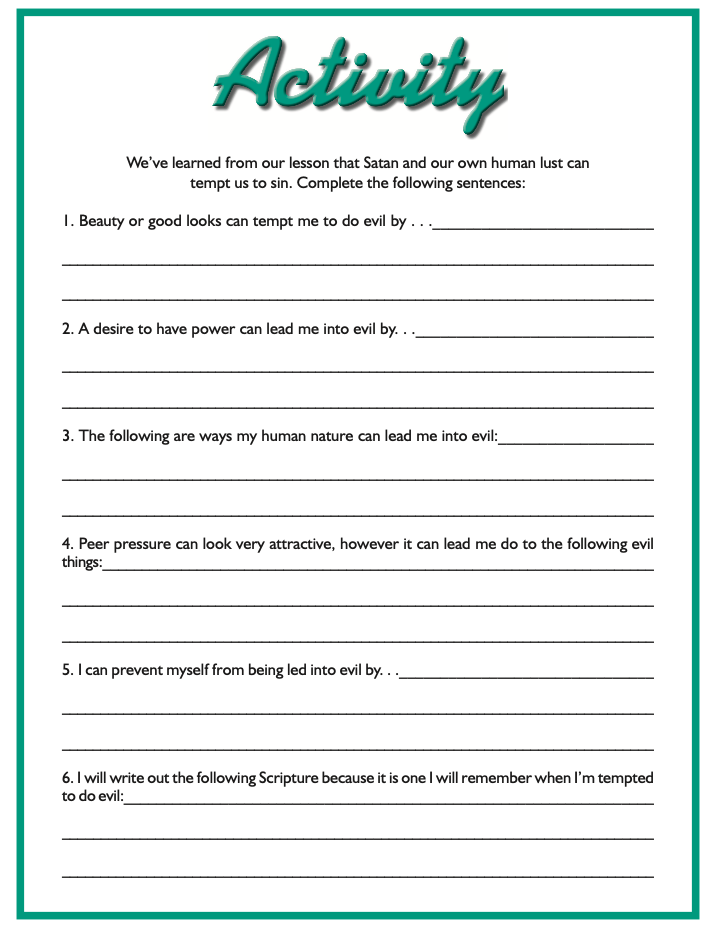
Many years ago there was a comedian named Flip Wilson. His favorite saying was, “The devil made me do it.” Is it Satan that always makes us sin? There was no Satan when Lucifer sinned. It was his jealousy and desire for power that made him sin. He had a choice, without Satan’s help, and he sinned. He then became Satan. There may be times when Satan tempts you to sin. But there may be many times when your own lusts lead you to sin. Satan is evil, but don’t be deceived. There is human evil as well.
Let’s consider another paradox of evil. Do you think of evil people as being those who are incarcerated and behind bars? Prisoners will tell you that they’ve been caught because they are the “honest criminals.” The truly evil people are not in jail, they will say.
You’ve seen horror movies where all the bad people have ugly, distorted faces. The villains are depicted as people you would never want to emulate – totally detestable characters. Movies and television picture evil as grotesque and being the epitome of ugliness. But is it that easy to recognize evil? Would you know evil if you saw it? Could evil possibly come in a beautiful, attractive package? Yes! “Satan himself is transformed into an angel of light” – he was beautiful! Keep in mind that evil doesn’t look anything like the villains in horror movies. This is another evil paradox.
Before the children of Israel entered the Promised Land, Moses gave instructions for six tribes to stand on Mount Gerizim and six to stand on Mount Ebal. The Levites were to stand between them and shout the blessings the Israelites would receive for obedience and the curses that would come upon them for disobedience. Then in Deuteronomy 30:19-20, Moses pled with the Israelites to choose life. “Choose to love the Lord your God and to obey him and to cling to him, for he is your life and the length of your days.”
God created mankind as free moral agents. He didn’t program man or angels with predetermined choices. He gives us the freedom to choose right or wrong, good or bad. Then we receive the consequences or benefits based on our choices. The paradox is that evil often looks beautiful and tempting. Evil rarely comes in an ugly package. Just as Lucifer, the angels, Adam and Eve, and the Children of Israel all had life and death, blessings and curses set before them, so do you. Don’t be deceived by the beautiful great deceiver. And don’t allow your lusts to make you evil. Choose life and length of days!
Holy Father,
Thank you for showing me the paradox of evil. It can look beautiful, fun and glamorous. Yet evil is deceitful and leads to sin and hurt. Help me always to recognize evil and to choose life and length of days!
In Jesus name I pray.
Amen.
Sunday: 1 Thessalonians 4:8-12
Monday: 1 Thessalonians 5:22
Tuesday: Psalm 10:4-11
Wednesday: Proverbs 17:13
Thursday: Philippians 4:8
Friday: Matthew 7:17-20
Saturday: 2 Timothy 3:1-7
Psalm 50:10
Haggai 2:8-9
Matthew 25:34-40
Mark 10:21
John 3:1-16
Acts 26:18
Romans 8:15-19
1 Corinthians 15:50
Galatians 4:7
Ephesians 1:11-14
James 2:5
BIOLOGICAL - related by blood rather than adoption.
REPLETE - abundantly supplied
Tammy Harris had her 21st birthday. It was time to know who her biological mother really was. She started an almost daily search to find her. A year had passed with no success. But there was something she didn’t know. Her real mother was also searching for her. As a matter of fact, she had been looking for Tammy for twenty long years.
As the story was told in many newspapers, there was yet another thing that Tammy didn’t know. Her mother, Joyce Schultz, actually worked with her at a convenience store.
One day, Tammy was talking with another co-worker about trying to track down her biological mother. Joyce overheard the conversation and Tammy and Joyce began comparing birth certificates. What a shock when they realized they were mother and daughter! They already knew each other because they were co-workers at the same convenient store. The two of them fell into each other’s arms and both said it was the best day of their lives.
As the saying goes, “Blood is thicker than water.” Family is important to all of us. And there is something very special about blood relatives. The family theme is replete throughout the Bible. From the very beginning “family” was important to God. Look in a concordance and notice how many times the word “family,” “sons,” and “children” are mentioned.
From the very beginning, when God created man, He made him in His image.You can look at siblings, cousins, grandparents and parents and see similar physical features. The hair and eye color may be the same. The way the eyes are set into the head or the shape and size of the nose may be very similar.
God created Adam and Eve and told them to be fruitful and multiply and replenish the earth. God’s command was not to simply add, it was to multiply. He wants a large family. For Him to have a large family, He must have lots of children. Would God give this command to “multiply” if He doesn’t have big plans for His children?
It is God’s will that no one perishes, but that all of us be in His family. How then do we become a part of God’s family? “An earthly body made of flesh and blood cannot get into God’s Kingdom. These perishable bodies of ours are not the right kind to live forever” (1 Corinthians 15:50). Then what does it take to be a member of God’s family?
A man named Nicodemus had this same question. He was a Jewish leader of the Pharisee sect and didn’t want members of his religion to know that he was going to visit with Jesus. So he sneaked out after dark. “‘Sir’ he said, ‘we all know that God has sent you to teach us. Your miracles are proof enough of this.’ Jesus replied: ‘Unless you are born again, you can never get into the Kingdom of God.’” Nicodemus didn’t understand what Jesus meant. He somehow confused Jesus’ statement with literally going back into his mother’s womb and being physically born again.
That wasn’t at all what Jesus meant. So He went on to explain to Nicodemus, “What I am telling you so earnestly is this: Unless one is born of water and the Spirit, he cannot enter the Kingdom of God. Men can only reproduce human life, but the Holy Spirit gives new life from heaven.” Jesus continued to expound the difference be- tween a physical being and a spirit being. Physical beings are very obvious to all of us. We can see them, feel them, hear them, and even smell them. But you can’t tell where a spirit being comes from or where it goes, it’s invisible like the wind.
But Jesus didn’t stop there. He explained to Nicodemus what is required of all of us if we are to be born of the Spirit and be a member of God’s own family. First, Jesus would have to be crucified for our sins. “For God so loved the world so much that he gave his only Son so that anyone who believes in him shall not perish but have eternal life. God did not send his Son into the world to condemn it, but to save it” (John 3:16 TLB). What God has in store for those who believe in Him is so wonderful that it’s really beyond our comprehension. “Now we are no longer slaves, but God’s own sons. And since we are his sons, everything he has belongs to us, for that is the way God planned” (Galatians 4:7 TLB).
Yes, you can be a very son of God with all that entails. Everything He has can belong to you! What does God own that you might want – land, wealth, silver or even gold? “For all the animals of the field and forest are mine! The cattle on a thousand hills! And all the birds upon the mountains!”(Psalm 50:10 TLB). Just owning the cattle on a thousand hills would make you a very wealthy person. But God owns the silver and gold ( Haggai 2:8). Does His wealth stop there? Of course not! He owns everything, and you will too when you become His son. When you become a member of His very family you will be God’s heir and inherit all things. That’s awesome beyond words!
Just as Tammy’s mother looked for her twenty long years, God has been looking for you to repent, be baptized and become His own son or daughter. He wants to make you a part of His very family when He returns to this earth. He wants to give you riches untold. Will you believe on His Son and be in God’s family?
Great God and Father,
Help me to fully comprehend what you have in store for me. You own all things. You want to make me your son so that I can inherit all that you have. It is so awesome to think about. Grant me a heart that will always seek and follow you. You are my Father and I love you.
In Jesus’ name I pray.
Amen.
Sunday: Haggai 2:8-9
Monday: James 2:5
Tuesday: Acts 26:18
Wednesday: Romans 8:15-19
Thursday: Ephesians 1:11-14
Friday: Matthew 25:34-40
Saturday: Mark 10:21