YEA Lesson Library
What’s Good to Eat?
About This Lesson
This lesson teaches that observing God’s dietary laws is for our own health, not because God’s laws are arbitrary. Therefore, these are not laws just for the Jews. Additionally, Peter’s vision is not about unclean meat, but about God’s salvation being available to every race.
Scriptures
Leviticus 11:1-23
Deuteronomy 5:32-33
Deuteronomy 14:3-21
Proverbs 16:25
Isaiah 66:17
Acts 10:9-28
Acts 13:47
Romans 11:10-15
Ephesians 3:3-12
Words to Know
ARBITRARY - contingent solely upon one’s discretion
GENTILE - pertaining to anyone other than Israelites; nations
The Lesson
Mom, what’s for dinner?” “Fried earthworms, bird’s nest soup, cock- roach and June bug stew, a salad made of lice, fleas, spiders, and ticks, barbecued cat sandwiches. For dessert we’re having ice cream topped with ants,” Mom replied. Do these things sound like what you want for dinner tonight? Why not?
Some people eat many such things. Properly prepared, some of these things must taste good or people surely wouldn’t eat them. But is taste the only standard we should use to determine what we put into our mouths? Does it make something eatable simply because it tastes good? If taste is the standard God uses to determine what we eat, why didn’t He say so? Why shouldn’t we eat a ham sandwich or pepperoni on our pizza? If taste isn’t the standard we use to determine what we eat, what is it?
The Israelites were slaves in Egypt for over 400 years. Egypt didn’t know or keep God’s law and Israel completely lost track of it while they were in slavery. After Israel gained their freedom God began to clean up His people and restore His wonderful law to them. “All Mt. Sinai was covered with smoke because Jehovah descended upon it in the form of fire; the smoke billowed into the sky as from a furnace, and the whole mountain shook with a violent earthquake. As the trumpet blast grew louder and louder, Moses spoke and God thundered his reply. So the Lord came down upon the top of Mt. Sinai and called Moses up to the top of the mountain, and Moses ascended to God.” God told Moses to go back down and tell the Israelites not to come up the mountain or He would destroy them. The Great God of the Universe was about to speak. This was an awesome occasion! He gave the Ten Commandments, laws concerning people, the Ark of the Covenant, plans for the tabernacle, etc.
Then in Leviticus God speaks to Moses from the tabernacle with further instructions and laws. In chapter 11 He explains in detail what foods are eatable and which ones people shouldn’t eat. The standard for what is good for food and what isn’t is laid out here.
This chapter is often referred to as the “dietary laws given to the Jews.” God gave these laws to the entire nation of Israel, not just the Jews. Did He give it to the Israelites to make them “His peculiar people?” Were the dietary regulations God gave Israel an arbitrary law? Did God just pick something at His whims, like not eating pork and say, “mankind shouldn’t eat it – I want to make things more difficult for him?” No, God’s law is based on the way things are – the nature of things. He gave His law so we would know what is good for us and what isn’t. His law is to keep us out of trouble and provide us with a healthy, happy life. There are things that are not good for human consumption – they do not make us healthy. Animals that chew the cud and have cloven hooves, have two stomachs and digest their food in a different way than other animals. These animals are good for human consumption while those that don’t have these characteristics are not. God’s law is not arbitrary.
Well then, were the dietary laws nailed to the cross when Christ was crucified? You can read every gospel account of the crucifixion and not find one word about any law being nailed to the stake. Matthew’s account of the crucifixion mentions that Jesus was nailed to the stake, and a sign above His head that said, “This is Jesus, the King of the Jews” (Matthew 27:37). Those were the only two things nail to the stake on which Jesus died.
Then what about Peter’s vision in Acts 10:9-29? Doesn’t it show that it is no longer required of Christians to abstain from eating unclean foods? In this vision Peter saw the sky open and a sheet filled with all manner of unclean animals, birds, and snakes. He heard a voice say to him, “Go kill and eat any of them you wish.” But notice Peter’s response. “‘Surely not, Lord! Nothing impure or unclean has ever entered my mouth.’ The voice spoke from heaven a second time, ‘Do not call anything impure that God has made clean.’” This happened three times, and then it was all pulled up to heaven again. There is nothing to indicate that Peter began eating unclean animals, birds, and snakes. There is nothing in this Scripture that says God changed the flesh of these animals and birds to be wholesome food good for human consumption. Quite the contrary!
Rather than Peter’s vision showing that it is now all right for Israelites, Christians or anyone else to eat unclean birds or animals, the vision showed Peter that Gentiles are not “unclean.” Notice Acts 10:28 “Peter told them, ‘You know it is against the Jewish laws for me to come into a Gentile home like this. But God has shown me in a vision that I should never think of anyone as inferior. . .’” (TLB). Notice also in the King James Version “God hath shewed me that I should not call any man (not bird or animal) common or unclean (verse 28b). Did Peter’s vision change the law in Leviticus 11 regarding what we can and cannot eat? No! What this vision shows is that salvation is now extended to all nations, including the Gentiles. And the Apostles had a responsibility to preach the gospel to everyone regardless of their race and so do we. “Whosoever believeth in him shall receive remission of sins ( verse 43).
Remember, we learned that God’s law is not arbitrary. He gave His law to save us from the consequences of breaking them. It’s in the nature of how these animals were originally created that they should not be human food. Why shouldn’t we eat them? Their flesh is not good for us. God created better things for us to eat than earthworms, cockroaches, ants, lice, pig, cat, catfish, etc. “Haven’t you learned that your body is the home of the Holy Spirit. God gave you, and that he lives with you? Your own body does not belong to you. For God has bought you with a great price. So use every part of your body to give glory back to God, because he owns it” (1 Corinthians 6:19-20 TLB).
Student Prayer
Loving Father,
Thank you for showing me another wonderful lesson from your law. You gave your law to show us how to stay out of trouble, how to be healthy and happy. Help me to grow to respect every aspect of it more each day as I obey you.
In Jesus’ name I pray.
Amen.
Daily Devotions
Sunday: Leviticus 11:1-12
Monday: Deuteronomy 14:3-8
Tuesday: Isaiah 66:17
Wednesday: Leviticus 11:13-23
Thursday: Romans 11:10-15
Friday: Acts 13:47
Saturday: Ephesians 3:3-12
Objectives
At the end of this lesson, students will be able to:
1. Explain that God’s law is not arbitrary
2. Show that Peter’s vision was not intended to nullify the law of unclean meats.
3. Discuss that Peter’s vision showed him that no man should be called common or unclean.
4. Talk about God not being a God exclusively for the Israelites, but an inclusive God who extends salvation to all races.
Topics & Themes
Food laws
God’s law
Holy Conduct
Peter’s Vision
Ten Commandments
Unclean meat/food
Materials Needed
Bible, YEA students’ and teacher’s books, newsprint pad, marker pen, attendance and memory verse charts, songbook, cassette/CD, music player, newsprint pad
How to Teach This Lesson
Before the class begins, write the following statements on a newsprint pad: 1)There is no such thing as an absolute, objective point of view in matters of morality and religion. 2) Common assumption is that you have your truth and I have mine. 3) The only standard for what is good for human beings to consume is how it tastes.
Begin the lesson by having the class group into trios. Have each group go to a different part of the room and brainstorm their reactions to these statements. Have them appoint a spokesman for their group. After about five minutes, have them come back together and be seated in a semicircle with trios together. By sequentially following the questions outlined below, you will meet the objectives of this lesson and have time to complete each section.
What is your reaction to the first statement? (Get the reaction from each of the trio groups for every question.) What is your reaction to the second statement? What is your reaction to the third statement? Allow them to freely answer without condemnation.
Which of the statements do you agree with most? Can a person believe these statements and still be a Christian? Why or why not?
Would you be more tempted to eat pizza with pepperoni on it or a hot dog made of pork than you would to eat a roach, serving of a cat or rat? Most of the students will probably say yes. Why or why not? Everyone eats these things, but you rarely if ever see them eating roaches, cats or rats. What standard would you use to select pepperoni pizza or a hot dog rather than eating a roach, cat or rat? It looks more eatable. Ask one of the students to read Proverbs 16:25 aloud. Ask: How do you think this applies to being more willing to eat pork because everyone does it and it appears to be harmless?
What does the word “arbitrary” mean? Was the law of unclean meats given arbitrarily by God? Why or why not?
Why do you think God felt it necessary to spell out the standard for what is eatable? Without the standards God gave us in Leviticus 11 how would you know whether to eat a beef steak or an earthworm? Which do you think looks more appetizing? Which do you think is better for you. Why?
Ask one of the students to read Deuteronomy 5:32-33. Then do you think the dietary laws were intended to make you look peculiar or make things more difficult for you?
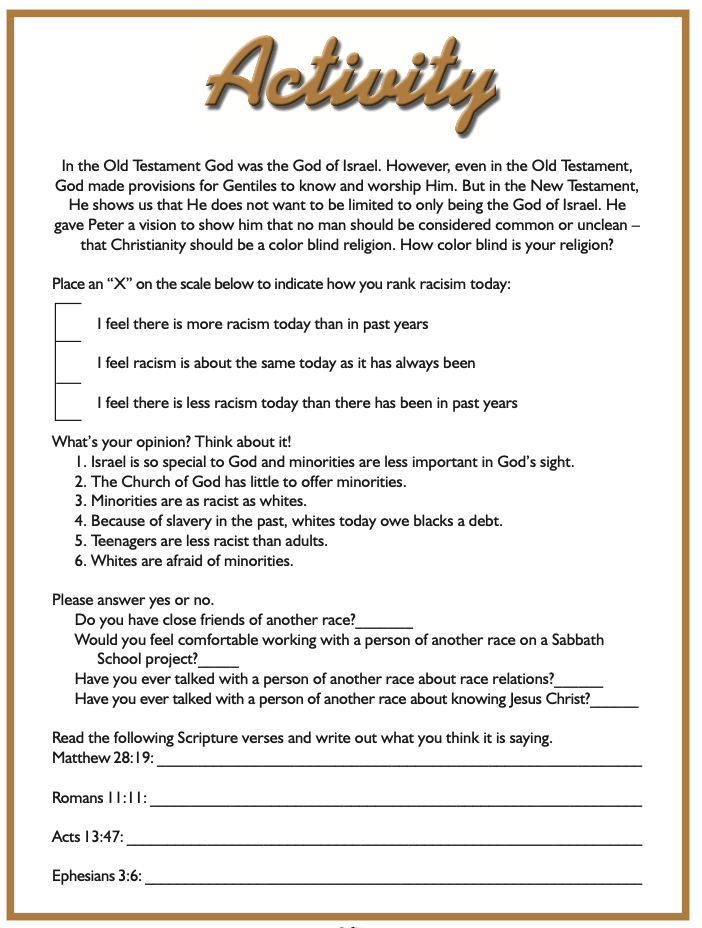
Discuss the activity in the students’ book. What was Peter to learn from the vision God gave him in Acts 10?
Now continue with the questions on that worksheet. What can we learn from the vision God gave Peter? Why do you think someone looks down on people of another race? It is because we like to think we are somehow more special to God than someone else. Is God big enough to love all races and to want them in His Kingdom?
Teacher-Directed Activity
Divide the class into partners. Have the partners take their chairs to different parts of the room and sit facing each other. Explain that they are to take turns explaining Peter’s vision in Acts 10:9-28 to each other. They are to explain how we know that this passage does not do away with the law of clean and unclean meats. Tell them that they can use their Bibles and their YEA book.
Song
“Thy Word” is on page 30 of The Group Songbook.
Closing Prayer
Have the students form a circle and join hands. Ask one of the students to thank God for having such wisdom and love for us that He saw to such details as showing us what is good for us to eat and what is not. Ask God that we might all learn the lesson from Peter’s vision that no man is common or unclean.
Printable Pages