YEA Lesson Library
Are the Holy Days Jewish?
About This Lesson
This lesson demonstrates the thread which runs through God’s Holy Days, indicating God’s plan for the salvation of mankind through Jesus Christ from the very beginning. The holy days are not simply Jewish festivals; they transcend Jewish history to present vital significance for all.
Scriptures
Genesis 1:14
Exodus 5:1
Leviticus 23:4
Deuteronomy 16:11-14
Nehemiah 8:1-18
Zechariah 14:16-19
Malachi 3:6
Acts 2:1-11
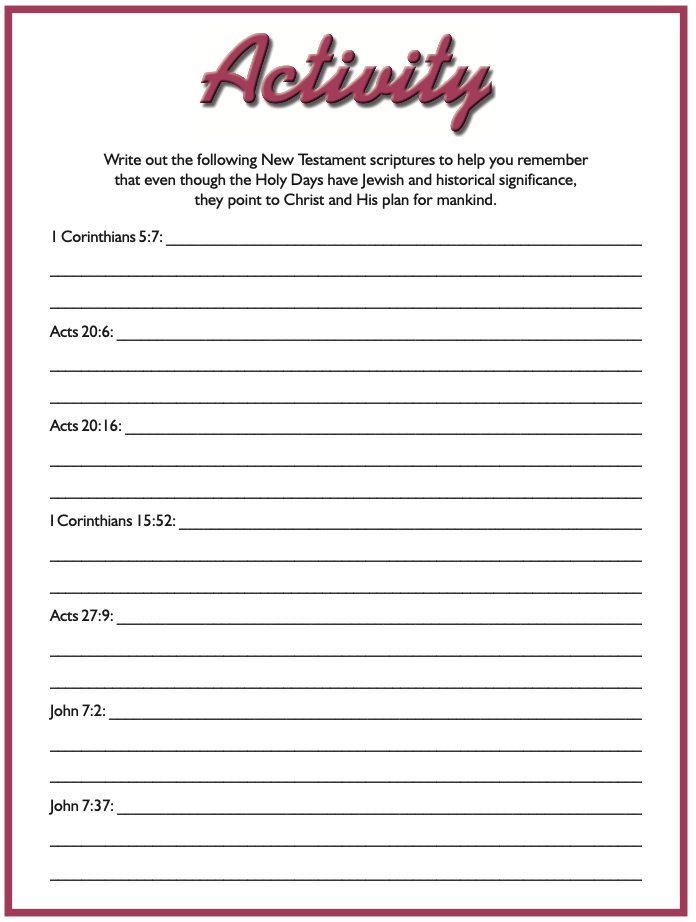
Acts 20:6, 16
James 1:17
Words to Know
THREAD - something that runs through the whole course of a thing connecting all of its parts
TRANSCENDING - to outdo or exceed in excellence
The Lesson
Most of Christianity celebrates Christmas and Easter every year. Here’s a challenge for you. See if you can find one scripture to substantiate New Testament Christians keeping Christmas and/or Easter. If New Testament Christians celebrated those days, wouldn’t you expect to find Bible references showing they did? The days that you will find mentioned in the Bible are Passover, the Days of Unleavened Bread, Pentecost, the Feast of Trumpets, the Feast of Tabernacles and the Last Great Day.
Aren’t all of these days just Old Testament celebrations? Aren’t they Jewish holidays? What about the New Testament, were these days celebrated after the resurrection of Christ? Luke records in Acts 20:6 that after the Days of Unleavened Bread, Paul boarded a ship with some fellows at Philippi and arrived in Troas five days later. From there, they continued on their journey. Paul decided not to stop at Ephesus this time because he was in a hurry to get to Jerusalem to celebrate Easter? No! To celebrate Pentecost. These verses show that after the death and resurrection of Christ the early church still celebrated the Passover and Pentecost. Why? Because these days have significance to Christians.
All of the Feast days are recorded in Leviticus 23. “These are my appointed feasts, the appointed feasts of the LORD, which you are to proclaim as sacred assemblies”(verse 1). When did these become appointed times? At Creation God divided the day from the night and said “let them be for signs, and for seasons”(Genesis 1:14). By following the translations of Leviticus, you will see they were for signs and feasts. This indicates that from the very beginning, God’s plan called for feast days.
Have you seen the movies Exodus and The Prince of Egypt? Charleston Heston played the part of Moses in Exodus. You may recall that he went to Pharaoh and said, “Let my people go.” But do you remember why Moses asked Pharaoh to let the Israelites go? It was so “they might hold a feast unto me in the wilderness.” One of God’s appointed times was approaching. This feast points squarely to the Passover. The Israelites were not allowed to go into the wilderness to keep the Passover, but they kept it in Egypt, to Pharaoh’s great regret.
There is reason to believe that even before this, God already had His appointed times. When Abraham took his son Isaac up to the mountain to sacrifice him to God, could this have been the Passover season?
God always had His “appointed times”and the occasions when God acted in history often took place on his “appointed times.” As a result of God’s action, the day took on the meaning of God’s action. The 14th day of the first month took on the meaning of the Passover because on that night, God passed over the houses of Israel and took all of the first born of Egypt. So for all of Israel, all of these appointed times took on names and customs that were related to important times in their history. They and the world forgot that there is a transcendent meaning to those days.
Some say these days only had application to the Jewish people. Is that right? From the very beginning these days had a “Jewish” or historical meaning, but more important, they pointed to the work and ministry of Christ. Like a chameleon, these days took on the color or meaning of their time or background. For a time they took on a “Jewish”or historical meaning, but all along they were pointing to something higher.
In 1 Corinthians 5:8 Paul wrote a letter to a Gentile church that was observing the Days of Unleavened Bread – they had put leavening out of their houses. Paul makes this unusual statement “For even Christ our Passover is sacrificed for us. Therefore, let us keep the feast, not with old leavening, but with the leavening of sincerity and truth. Jesus Christ is tied to the Passover. Paul urged them to keep the feast at a higher and different level. There is a transcending meaning to the Passover that reaches beyond the meaning of anything the Jews had known up until this time. Now it finds its meaning in the sacrifice of Christ.
There is an assumption that the 14th day of the first month became important because Israel was delivered from Egypt on this day. But what if Israel was delivered on this day because it was one of the “appointed times”of God from creation? The Passover did not become a Christian festival because Christ was crucified on that day. Christ died on that day because it was one of the appointed times of our Creator.
There is a thread that runs through the Bible and it is unbroken. This thread is the plan of God. From the beginning God had a plan and has consistently worked it down through the ages. Christmas and Easter don’t show God’s plan. His festival, His appointed times, contain an outline of that plan. The festival gives us a point where we can pick up that thread. Everything from creation, to God telling Abraham to sacrifice his only son, to the Passover and the death of Christ points to God’s plan to save mankind and make us His very own sons and daughters.
Teenagers have asked for a YEA lesson to help them understand why we celebrate “Jewish” holidays. But are the days we celebrate really “Jewish”? The days we celebrate and those mentioned in your Bible do have Jewish historical significance, but they are Christian in their meaning and application. The early church observed the same Holy Days that most Christians today dismiss. These days are not merely Jewish. Christ is to be found in each one of them. The Holy Days do have some Jewish and historical significance. But all of them point to Christ and His great plan for you and for me. These celebrations have vital significance to Christians.
God is constant. He doesn’t do one thing now and a thousand years from now change His entire plan. “For I am the Lord – I do not change” (Malachi 3:6). James 1:17 says that God does “not change like shifting shadows.”
Student Prayer
Almighty God and Father,
Thank you for your appointed times and for revealing to me that they do have Jewish and historical significance. But they also have transcendent meaning and point to Jesus Christ as our Lord and Savior. Increase my understanding of your Word and my appreciation for your appointed times.
It’s in Jesus Christ’s name that I pray.
Amen.
Daily Devotions
Sunday: Leviticus 23:4
Monday: Zechariah 14:16-19
Tuesday: Deuteronomy 16:11-14
Wednesday: Acts 2:1-11
Thursday: Nehemiah 8:1-8
Friday: Nehemiah 8:9-15
Saturday: Nehemiah 8:16-18
Objectives
At the end of this lesson, students will be able to:
1. Explain that the festivals were God’s appointed time from creation.
2. Discuss that down through history, God has picked the Holy Days to do significant thing on them.
3. Tell that the Holy Days have Jewish and historical significance, but they have meaning and application in Christ’s work and ministry.
Topics & Themes
Appointed Times
Christmas
Easter
Egypt
God’s Plan
Holidays, Christmas
Holidays, Easter
Holy Days
Jesus, Savior
Leavening
Passover
Paul
Pharaoh
Materials Needed
Bible, YEA students’ and teacher’s books, attendance and memory verse charts, songbook, cassette/CD, music player, newsprint pad, marker pens, butcher’s paper
How to Teach This Lesson
Begin the class by listing Passover, Days of Unleavened Bread, Pentecost, Trumpets, Atonement, Feast of Tabernacles and the Last Great Day on separate sheets of a newsprint pad. Tell the class that we’re going to play a game called “What Does This Day Make You Think About?” Explain that they can use the activity in their book for this lesson to get them started. Encourage every student to participate. They can give Scriptures, “meanings” of the day, explanations of the day, etc. Write a brief summary of what they say on the newsprint pad. Begin with:
Passover - Possible answers will be the original Passover, the Exodus, Abraham going to the mountain to offer Isaac as a sacrifice, the crucifixion of Christ, the means whereby individual’s sins can be forgiven, Christ as the Lamb of God that takes away the sins of the world, etc.
Days of Unleavened Bread - Possible answers could be for seven days leavening is a type of sin, putting leavening out of our houses, eating flat bread for seven days, Israel leaving Egypt in such a hurry that they didn’t have time for their bread to rise, a reminder to put Christ into our lives.
Pentecost - Possible answers could be: the Feast of first fruits, a harvest festival, count fifty, the Jubilee year, the day the Law was given and possibly the day of creation, the day the church was empowered with the Holy Spirit, Christ the First fruits, Christ as the Wave Sheaf, the converted at Christ’s return will be first fruits.
Trumpets - Possible answers could be: blowing of trumpets, the seventh trumpet, the return of Christ, the first resurrection of the dead, etc.
Atonement - Possible answers could be: fasting, two goats – one representing Christ and the other Azasel, the Temple ceremony, the Holy of Holies, communal forgiveness of sin, the year of debts being released – Jubilee year begins.
Feast of Tabernacles - Possible answers could be: Israel dwelling in booths when they came out of Egypt, the best Feast of the year, a time we celebrate for seven days, a time we can spend with friends, a time we leave our homes and live in temporary houses, that this life is only temporary and we look for God’s Kingdom, the Millennium, even the Egyptians will keep the Feast in the Millennium, the nations that don’t keep the Feast in the Millennium won’t get rain.
Last Great Day - Possible answers could be: the new heaven and the new earth, Christ saying there would be rivers of living waters, all things will be new, there will be no more tears, death, sorrow, God will live with man.
Now, attach each sheet of the newsprint, with a different festival on it to the wall. Ask: Which ones of these festivals have “Jewish” and historical significance? Which ones of these festivals points to the work and ministry of Christ?
Teacher-Directed Activity
Give each student a marker pen. Instruct the class to go to the butcher’s paper you’ve attached to the wall. They are to write a “Jewish/historical” significance and “work/ministry of Christ” under each of these festivals in the appropriate place. Explain that they can use the statements on the newsprint pad sheets and the activity in their book. Every festival should have one or more points showing the work and ministry of Christ. Now ask: Do you see any of the festivals of the Bible that do not point in some way to Christ? Do you feel the festivals we celebrate are Jewish or Christian? Why? Do you feel that Christians would learn more about Jesus Christ and God the Father and their plan for mankind if they would celebrate the festivals in the Bible? Why or why not?
Song
“I Will Celebrate” is on page 49 of The Group Songbook.
Closing Prayer
Ask one of the students to lead in prayer thanking God for His awesome plan shown through the Holy Days in the Bible and for the privilege of celebrating each one of them.
Printable Pages