YEA Lesson Library
Do Sinners God to Hell?
About This Lesson
This lesson surveys the scriptures which talk about hell, showing that none of them support the doctrine of eternal punishment in an ever-burning hell fire.
Scriptures
Job 11:8
Psalm 55:15
Proverbs 23:12-18
Amos 9:2
Jonah 2:2
Malachi 4:1
Matthew 5:22
Matthew 7:13-14
Matthew 8:11-12
Matthew 13:31-42
Acts 2:31
2 Thessalonians 1:7-12
James 3:6
2 Peter 2:4
Revelation 6:8
Revelation 20:13-15
Revelation 21:7-8
Revelation 21:8
Words to Know
THEOLOGICAL - pertaining to religious studies
GEHENNA - a deep east-to-west valley located about one thousand yards south of the Temple Mount
HADES - the abode of the dead
SHEOL - the abode of the dead
TARTAROS - The name of a subterranean region, regarded by the ancient Greeks as the abode of the wicked dead, where they suffer punishment for their evil deeds (Thayer’s Greek- English Lexicon).
INCINERATE - to cause to burn to ashes
The Lesson
One very hot August night in Mississippi, a red headed, red faced minister preached a sermon about how awful hell is for unrepentant sinners who have died. He vividly described how condemned sinners could find no relief from the flames of fire as they jumped from one hot coal to another in hell. Adulterers, thieves, wife beaters, child molesters, drug users, shoplifters, and gossips in his congregation became increasingly more restless.
Copious sweat poured from his brow that hot summer’s eve, for there was no air-conditioning in that church building. The preacher became more and more excited and his voice got louder and louder. His passion for those sinners in his audience drove him to draw detailed verbal images of an ever-burning hell fire.
As his sermon built to a climax he said, “Let’s lift the lid off of Hell, and see what Joe the drunkard, Two Gun Willie, Priscilla, the naughty lady some of you men have visited, and all of those other sinners are doing.” As he lifted the “lid off of hell,” he screamed at the top of his voice because of the suffering he supposedly saw. Doubtless, this had a powerful impact on those in that hot church building. But was this fact or fiction?
This is a true story. And it is the way many people envision hell to be. But is it what your Bible teaches? Will the God of the greatest mercy torture and torment sinners in hell fire for all eternity? What is the punishment for unrepentant sinners? If you die without repenting of your sins, are you doomed to eternal punishment in an ever burning hell fire? Is there a real hell fire? Is there justice with God? Is our Lord a merciful God? You owe it to yourself to know the truth of these matters.
“Hell” in theological usage is a place of punishment after death. Although there exists a bewilder- ing array of doctrines on hell, there are some broadly accepted elements. Hell is generally conceived as a place beneath the surface of the earth, for example. It is a place where the wicked are tormented by fire, suffering excruciating pain – both the pain of loss and pain of the senses. Somehow the fire causes pain but does not consume. It torments, but the usual relief caused by the destruction of nerves and tissue, passing out, or numbness, is denied the sufferer. How long does this go on? Since man is believed to have an immortal soul, his torment continues time without end, unremitting, for all eternity.
There are four words used in the Bible which are translated “Hell.” Those words are Gehenna, hades, sheol and tartaros. Gehenna was a specific location on the earth that is well known to all Jews. Psalm 55:15 tells us that the direction to hell is down. It is a deep place (Job 11:8), it is a place from which one can be delivered (Proverbs 23:14), it is a place one can dig into (Amos 9:2), Jonah even considers the belly of the whale to be a “hell” of sorts (Jonah 2:2).
In the broadest terms, sheol simply means “the abode of the dead.” Since most of the dead are buried, then hell, in the sense of sheol or hades, is well translated by the English word “grave.”
The Greek word tartaros is the name of a subterranean region, doleful and dark, regarded by the ancient Greeks as the abode of the wicked dead, where they suffer punishment for their evil deeds.”
Many teach that Jesus suffered the torture of flames in hell fire for three days and nights after He was crucified. They use Acts 2:31 to support their belief. “He seeing this before spake of the resurrection of Christ, that His soul was not left in hell (hades), neither His flesh did see corruption.” They read more into this Scripture than it says. It just says that Jesus was not left in the grave.” (For a complete explanation of each of these Scriptures and this subject call 1-888-BIBLE 44 for Ronald Dart’s free booklet “Is There Really a Hell Fire?” Excerpts from this booklet are included in this lesson.)
Not one New Testament reference has anything at all to say in support of the traditional doctrines of hell fire. This booklet will show you that eternal punishment in hell fire is likely derived, not from the Scriptures, not from the teachings of Jesus, but from Jewish traditions!
But the observant reader will notice that there is a Bible reference to a lake of fire. Could this be the kind of “hell” of which Jesus spoke? Absolutely! For indeed there is to come a time when a great sea of fire, such as lava, or molten rock, becomes the ultimate destruction of the wicked. But what happens to a human being when you cast him into a lake of molten fire? Obviously, he is incinerated. There is not one suggestion of even a lingering death, much less eternal punishing.
Well then, is there really a hell fire after all? Absolutely! At the very end of history, when every man has heard the Gospel and every man has had a chance to be saved, then everyone who “was not found written in the book of life was cast into the lake of fire” (Revelation 20:15).
There is justice with God! There is also virtually limitless mercy. To those who repent; to those who turn from their sins, receive Jesus Christ as personal Savior; as their Lord, who rules in their lives – as their ever-present High Priest, and their soon- coming KING, there is salvation! That means living forever – in the Kingdom of God – not being destroyed by a veritable sea of flames, which will render the wicked as ashes under the feet of the righteous (Malachi 4:1).
Student Prayer
Awesome and Merciful God,
Your plan is so wonderful! Show me how to live my life that it might be pleasing to you. I want you to be my High Priest and soon-coming King. I need your salvation.
In Jesus’ name I pray.
Amen.
Daily Devotions
Sunday: 2 Thessalonians 1:7-12
Monday: Matthew 7:13-14
Tuesday: Matthew 8:11-12
Wednesday: Matthew 13:31-42
Thursday: Matthew 5:22
Friday: Revelation 21:7-8
Saturday: Proverbs 23:12-18
Objectives
At the end of this lesson, students will be able to:
1. Give the definitions of the four Greek words used in the Bible for “hell.”
2. Explain that God is a merciful God and it is not His will that any perish.
3. Discuss that there is a lake of fire where sinners will be burned up.
Topics & Themes
Death
Eternal Life
God’s Mercy
Heaven/Hell
Immortal Soul
Jesus, Savior
Justice
Punishment
Repentance
Sin
Materials Needed
Bible, YEA students’ and teacher’s books, attendance and memory verse charts, newsprint pad, marker pen, cassette/CD, music player, slips of paper, Is There Really a Hell Fire? booklet
How to Teach This Lesson
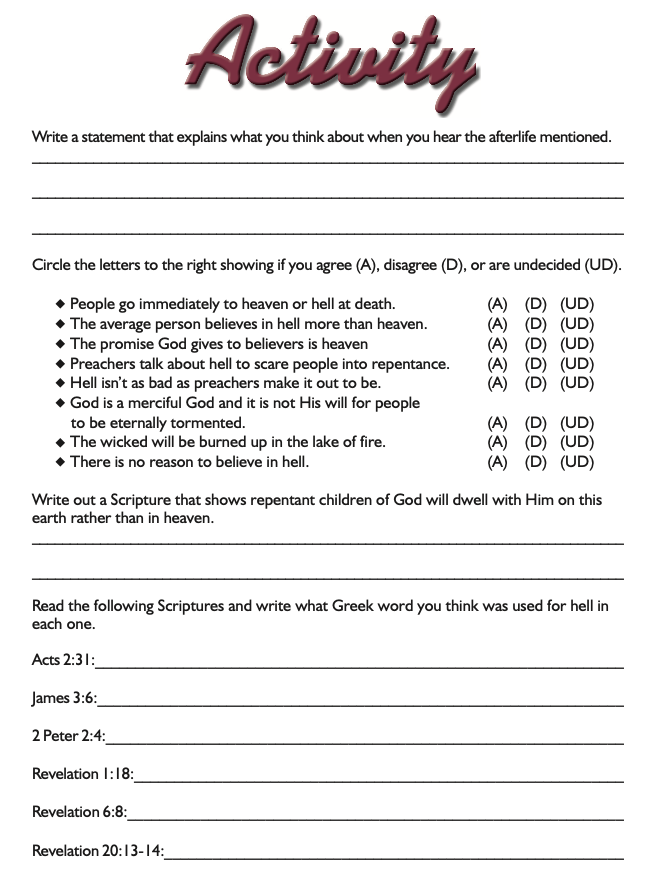
Before class, write the Scriptures in the third section of the activity in the students’ book on six different slips of paper. After opening the class with prayer, have the students draw one of the slips of paper with a Scripture on it. If there are more than six students, have them partner. If there are less, have them draw more than one slip of paper. Ask the students to turn to the activity in their book. Go over the first two sections of that activity and get the students’ answers. Let the students know that they will not be judged by the rightness or wrongness of their answers – you are wanting to hear their opinions. In the second section, get the students to raise their hands after each question showing how many agree, disagree, or are undecided. Keep score on the newsprint pad.
Start by asking for the person who has Acts 2:31 on his slip of paper to read the Scripture and tell what Greek word he thinks was used for hell.
Ask: How many agree with him? What was in this Scripture that made you select this Greek word for “hell.” Continue with the remainder of the Scriptures in the same manner.
Acts 2:31 - the Greek word is hades which simply means grave. Point out that Jesus was not tormented in hell fire for three days and three nights as some have suggested. The Scripture just says that Jesus was not left in the grave.
James 3:6 - the Greek word is Gehenna. Ask: What does Gehenna mean? It was a specific location, well known to all Jews, on the surface of the earth. Ask: Do you see anything here to tell us one way or the other about an eternal hell fire? If so, what?
2 Peter 2:4 - the Greek word is tartaros that is regarded by both Peter and the classical Greek writers as a place of darkness. Did you notice an inconsistency about it being a place of darkness and the traditional teachings of hell? What was it? Fire gives off light! Whose fate is discussed in this Scripture? This scripture is about the fate of fallen angels, not the fate of wicked men. Their fate is described by Jude as being “reserved in everlasting chains under darkness unto the judgment of the great day” (verse 6), and “wandering stars, to whom is reserved the blackness of darkness for ever” (verse 13). In no way does this Scripture establish the traditional hell fire doctrine.
Revelation 1:18 - the Greek word is hades. Ask: What does hades mean? It means the grave. Does Jesus have the power to unlock the graves, death and to release men in the resurrection? Do you see any support for the traditional doctrines of hell in this verse? If so, what?
Revelation 6:8 - The Greek word is again hades. Ask: In what way does this support the traditional teaching on an ever-burning hell fire? It doesn’t. This is a metaphor for describing wide-spread death. Death rides on a pale horse, and the grave follows him.
Revelation 20:13-14 - Ask one of the students to start reading in verse 11 and read through verse 14. The Greek word is hades. Ask: What inconsistency do you see in these verses with the traditional teaching of an ever-burning hell fire? “Hell” is required to deliver up its dead. So this rules out a place of permanent torment from which one cannot be delivered. Ultimately, both death and the abode of the dead are destroyed in a lake of fire.
If the wicked will not burn in hell fire through- out eternity what is their ultimate punishment? Death in the lake of fire.
Ask: How then do we know that there is justice with God? Ask one of the students to read Revelation 20:15. Ask: Who will be cast into the lake of fire? Ask one the students to read Revelation 21:8. List these on the board, and include those not found written in the book of life.
How do we know that the wicked aren’t tortured throughout all eternity? Ask one of the students to read Malachi 4:1. God is a merciful and a just God. The wicked will be burned up and be as ashes under the feet of the righteous.
Teacher-Directed Activity
Collect all of the strips of paper with the Scripture verses on them and have the students draw again. Have them partner and explain the verse they drew to their partner.
Song
“Be Not Afraid” is on page 86 of The Group Songbook.
Closing Prayer
Have the students form a circle and join hands. Ask for a volunteer to lead in prayer thanking God for understanding His justice and mercy. Ask that all of our names will be found written in the Book of Life.
Printable Pages