YEA Lesson Library
He Lives!
About This Lesson
This lesson delineates the timeline of Jesus’ death, time in the tomb, and resurrection.
Scriptures
Jonah 1:1-17
Matthew 12:38-40
Matthew 12:39-40
Matthew 27:51-52
Matthew 28:1-15
Mark 15:42 - 16:20
Luke 23:47-56
Luke 24:1-48
John 19:31-42
John 20:1-24
1 Corinthians 15:12-20
Words to Know
MORGUE - A place where dead bodies are kept.
EMBALM - A treatment of a dead body to preserve it.
CHRONOLOGY - The sequential order in which things occur.
The Lesson
The earth rumbled and shook. Rocks broke. Tombs opened and many godly dead men and women came back to life. At the very moment that Jesus died, the curtain in the Temple was torn in two from top to bottom. “Destruction of the outer veil would primarily symbolize the forth coming destruction of the temple, while the destruction of the inner veil would primarily symbolize open access to God” (The Expositor’s Bible Commentary, page 580). By now, the soldiers at the crucifixion were not only terrified, but convinced that Jesus was indeed the Son of God.
Women such as Mary Magdalene and Mary, the mother of James and Joseph, watched from a distance as prophecies were fulfilled before their eyes. These women were Galileans who often traveled with the disciples to care for Jesus’ needs out of their own resources.
According to the Scriptures, Jesus died on the Passover. And it was now late that afternoon. There was an urgency to get Jesus’ body down from the stake and in the grave before sundown because the Sabbath was approaching. Joseph of Arimathea, a very wealthy man, mustered his courage to ask Pilate for the body of Jesus. Pilate gave orders to the soldiers that the body be handed over to him. Then Joseph took the body off the stake, wrapped it in clean linen and rushed to place it in his own new rock-hewn tomb before sunset. This was late Wednesday and the Holy Day began at sunset (John 19:31). The chief priest and Pharisees asked Pilate to give orders to have Jesus’ grave closely guarded for three days. They remembered that Jesus had said, “After three days I shall rise again.” They wanted to make sure that no one stole Jesus’ body during those three days, so soldiers stood guard.
When the Sabbath, which was the First Day of Unleavened Bread, was over (Thursday, Mark 16:1), Mary Magdalene, Salome and Mary the mother of James purchased and prepared spices to embalm Jesus’ body (Friday). Then they rested on the weekly Sabbath (Luke 23:56). Very early Sunday morning they took the spices they had prepared to the tomb.
As they walked toward the tomb, they dis- cussed how they would roll the huge stone away from the entrance of the sepulcher where Jesus was buried. As they approached the burial site, they were very surprised to see the stone wasn’t there. An angel was sitting inside and all the linen cloths that Joseph wrapped Jesus in were there as well. But Jesus wasn’t anywhere to be found. This frightened the ladies. But there was an angel there. And the angel admonished them not to be frightened and said, “Jesus, which was crucified, is not here, He is risen. Go tell the disciples that He is risen. Go, and you will see Him.”
As two of the disciples left Jerusalem and went toward Emmaus, they talked about all the events that had happened in the last three days. Jesus appeared to them and walked along beside them, but they didn’t recognize Him. He said, “What are you talking about and why are you so sad?” Cleopas said, “You’re just a stranger in Jerusalem and don’t know everything that has happened.” Jesus asked, “What things?” They related details of Jesus being arrested by the chief priests and rulers, and how He was condemned to death and crucified. Besides, they said, “This is the third day since He was crucified and the women who visited the tomb this morning didn’t find Him there. Others went to His tomb after we told them He was missing and they didn’t find Him there either.” Jesus said, “Why are you so slow to believe what the prophets have said?” Their eyes were opened and they finally recognized Jesus. Then He vanished out of their sight.
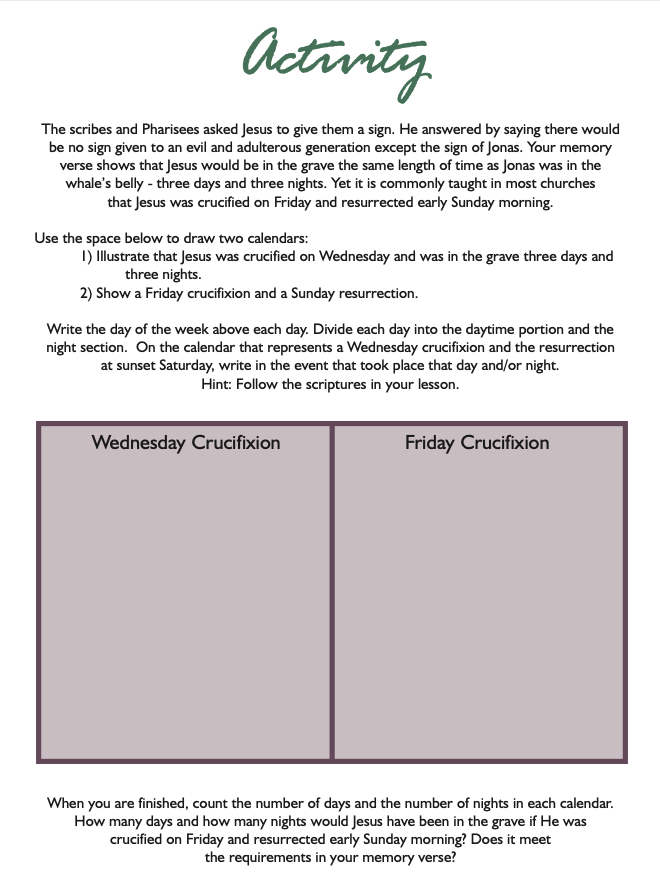
The chronology of these events is very important because it verifies that Jesus was in the grave three days and three nights. Jesus prophesied the length of time that He would be in the grave in Matthew 12:40. “Only an evil, faithless nation would ask for further proof; and none will be given except what happened to Jonah the prophet! For as Jonah was in the great fish for three days and three nights, so I, the Messiah, shall be in the heart of the earth three days and three nights. Jesus was very specific about the length of time He would be in the grave. A Friday crucifixion and Sunday morning resurrection is only half the time Jesus said that He would be “in the heart of the earth.”
But what does all of this mean to you? It means much more than just being able to prove to a friend that Jesus was not crucified on Friday. We are forgiven of our sins by the shed blood and death of Jesus Christ. “Without the shedding of blood there is no forgiveness of sins” (Hebrews 9:22b). But we are saved through His life (Romans 5:10). If Jesus had not come out of that tomb, you would have no hope of salvation. The wages of sin is death. Because you have sinned you would be condemned to die with no hope. But Jesus did come out of that tomb exactly when He said that he would, and He lives today!
He sits on the right hand of the Father as your intercessor. He’s there to plead your cause when you do sin. Think of the enormity of what Christ has done and is doing for you. Doesn’t He deserve the best you can give Him every day of your life?
Student Prayer
Most Gracious Father,
Thank you for the supreme sacrifice that your Son paid for my sins. Thank you also for resurrecting Him on the third day. It is through His life that I can have eternal life. Help me always to live a life worthy of that reward.
It’s in Jesus’ name I pray.
Amen.
Daily Devotions
Sunday: John 19:31, 20:1-14
Monday: 1 Corinthians 15:12-20
Tuesday: Mark 16:1-8
Wednesday: Luke 23:50-56
Thursday: Luke 24:1-12
Friday: Jonah 1:1-17
Saturday: Matthew 12:38-40
Objectives
At the end of this lesson, students will be able to:
1. Explain that the only sign that Jesus gave to this evil and adulterous generation was the length of time He would be in the grave.
2. Demonstrate that there are not three days and three nights from Friday sunset to Sunday morning.
3. Outline the events that took place from the time Jesus was crucified until He was resurrected.
4. Explain that we have no hope of eternal life unless Jesus was resurrected.
Topics & Themes
Angel
Days of Unleavened Bread
Emmaus
Eternal Life
Fulfillment of Prophecies
Jesus, God the Son
Jesus, Resurrection of
Joseph of Arimathea
Passover
Resurrection
Salvation
Spices
Temple
Three days/nights
Tomb
Materials Needed
Bible, YEA students’ and teacher’s books, attendance and memory verse chart, music player and music tape/CD, songbook, newsprint pad, marker pen, concordances and rewards
How to Teach This Lesson
Begin by telling this story. Philip and his friend were at the lake the day before graduation. He was depressed because he failed a course which would keep him from graduating from high school. Several beers were consumed while they were at the lake. When Philip drank he got mean and angry. His mother was home as he and his friends walked in. She immediately knew that Philip was legally drunk. She began questioning him about his drinking and he grabbed a gun. His friend tried to protect Philip’s mother, so Philip shot and injured him. Seeing his friend fall to the floor with blood gushing all over the breakfast room, even his inebriated mind became frightened. He pointed the gun to his head and blew his brains out right in front of his own mother. Philip was dead before the helicopter arrived to take his friend to the hospital and his body to the morgue. Two days later the funeral home chapel was filled with sobbing teenagers as Philip was eulogized and then put to rest.
Let’s assume that you had attended Philip’s funeral, then three days later Philip joined you and your groupies as you walked in the mall. As you walked, Philip even chimed in on your conversation. What kinds of thoughts would have gone through your mind. And how would you have felt?
Do you think you would have recognized Philip? Do you think Mary, Martha and the disciples were mentally prepared to see Jesus alive after His crucifixion? Why do you think Mary, Martha and the other ladies didn’t recognize Jesus after His resurrection? Why was Jesus able to disappear and then reappear?
In a hostile environment, Joseph of Arimathea, a very wealthy and devout man, went to Pilate and asked for Jesus’ body. At a time like this, could you have mustered the courage to ask Pilate for Jesus’ body, prepared it for burial and then placed it in your own tomb? Why or why not?
At noon the earth became dark as pitch and stayed that way for three hours. Then the earth began to rumble and shake underneath their feet. Rocks broke and tombs opened, and many godly dead men and women came back to life. What if you had been in a crowd of people and your friend, Philip came out of his grave. Do you think this would have made any difference as to how it impacted you? What feelings do you think the Roman soldiers, the High Priest and religious leaders felt with the events taking place, and the curtain in the Temple ripping in two?
Ask one of the students to read Hebrews 9:22 aloud. Say: What does this Scripture say? Jesus had to die and shed His blood or we would have no forgiveness of our sins. But why did He have to be resurrected? To give us eternal life. Ask one of the students to read aloud 1 Corinthians 15:12-20. Write on the pad: “Christ had to be resurrected in order that we too can be resurrected to eternal life.”
When did Mary and Martha purchase the spices to embalm Jesus’ body? After the Sabbath was over (Mark 16:1). Did they do this on Sunday? No, on Friday. How do you know? Luke 23:54-56 shows that after the “Sabbath” the ladies saw the sepulcher, prepared spices and rested on the Sabbath. Then how could there be two Sabbaths in a week? Because the First Day of Unleavened Bread is a Sabbath or High Day. How do you know that? John 19:31. Ask one of the students to read Luke 23:56 aloud. This says they prepared the spices and rested all day on the Sabbath. Is this a contradiction? No. Then how do you explain these three Scriptures?
Summary: Draw five adjoining boxes on the newsprint pad and divide each box into halves. Write “day” in small letters at the top and “night” in small letters at the bottom. Then above or beside the boxes write the days of the week, beginning with Wednesday. Ask the students to help as you write in the boxes the events that took place each day. Wednesday: “Passover, the preparation and crucifixion day.” Thursday: “First day of Unleavened Bread - High day or Sabbath.” Friday: “The women brought spices and prepared them.
Sabbath: “The women rested.” Sunday morning: “The women took their spices and went to the tomb. Jesus was not there.” On the pad write in big letters: “The third day He lives!”
Teacher-Directed Activity
Divide the class into two groups and give each group at least one concordance. Tell them to pretend that a friend has asked why they don’t believe Jesus was crucified on Friday and resurrected on Sunday. Give the two groups five minutes to find as many Scriptures as they can to prove their beliefs. The team that has the most Scriptures gets to present what they found and gets a small reward that you provide.
Song
“He’s Alive” is on page 70 of The Group Songbook.
Closing Prayer
Call on one of the students to lead in prayer and to thank God for the resurrection of Jesus.
Printable Pages