YEA Lesson Library
Jesus is Crucified
About This Lesson
This lesson about the crucifixion and death of Jesus Christ urges the student to respond by committing to repent and be baptized.
Scriptures
Deuteronomy 30:19-20
Matthew 27:26-66
Mark 15:1-39
Luke 23:1-56
John 3:14-17
John 18:28-40
John 19:1-38
Acts 2:36-39
Words to Know
SCEPTER - a highly ornamental rod or staff held by rulers on ceremonial occasions as a symbol of sovereignty.
The Lesson
The Israelites of Jesus’ time were looking earnestly for the Savior. They had been told that He would come and be their King and would fulfill the promises that had been given to their forefathers. Jesus did not fit their image of a King. He was not fighting for their freedom; He was not leading the revolt against the Romans in the way they expected. He was calling the Pharisees and Sadducees hypocrites; He was telling them that their way of worshiping God was misdirected. Rather than listening to His message, they became angry – extremely angry!
The entire council took Jesus over to the residence of Pilate, the Roman Governor, after He was arrested in the Garden of Gethsemane. They began to accuse Him. Pilate asked Him, “Are you the Messiah?” Jesus replied that he was. After that, He remained silent through many accusations against Him. Pilate knew that they looked on His teachings as a threat to their way of doing things.
While Jesus’ trial was taking place, Pilate’s wife sent him a message saying that she had a dream to leave Jesus alone. It was Pilate’s custom to release one prisoner during the Passover season. And Pilate’s wife was hoping that he would release Jesus. Jesus and Barabbas were the two prisoners being considered to be released that day. But in the meantime, the Jewish religious leaders persuaded the crowds to ask for the release of Barabbas, who was a notorious prisoner. So Pilate asked the crowd, “Which of these two shall I release to you?” The crowd shouted back, “Barabbas!” Then Pilate asked, “What shall I do with Jesus, your Messiah?” The crowd shouted, “Crucify Him!” Pilate demanded to know why, but the crowd kept shouting, “Crucify! Crucify!"
Riots were developing, and Pilate saw that he wasn’t getting anywhere. So he washed his hands in a bowl of water to show he wanted nothing more to do with the matter. The people said, “His blood be on us and on our children?” They stripped Jesus and put a scarlet robe on Him. Pilate laid open Jesus’ back with a leaded whip, and the soldiers made a crown from long thorns and forced it down on His head causing Him to bleed. They put a stick in His hands saying, “This is your scepter.” They knelt before Jesus and mocking said, “Hail, King of the Jews.” They spit on Him and beat Him on the head with sticks. When they finally tired of this sport, they took the robe off and put His clothes back on Him. Then they led Jesus to be crucified. Simon of Cyrene was coming in from the country, and they forced him to carry Jesus’ stake to Golgotha. Roman soldiers nailed Him to the stake and thrust the stake, with Jesus nailed to it, into a hole. He was suspended between heaven and earth to die.
While the soldiers watched Him die, they gambled for the clothes He wore. They put a sign above His head that said, “This is Jesus, the King of the Jews.” People passed by and shouted abusive remarks about Jesus. The Chief Priest and Jewish leaders also mocked Him. “He saved others,” they scoffed, “but he can’t save himself!” At noon the earth became dark as night. About three o’clock, Jesus shouted “Eli, Eli, lama sabachthani,” which means, “My God, my God, why have you forsaken me?” Even His Father turned His back on Jesus because He had to suffer the full penalty for our sins. Someone ran and dipped a sponge in vinegar, put it on a stick and held it up for Jesus to drink. When Jesus tasted it, He wouldn’t drink it. He cried out again, then He died. The curtain in the Temple, which secluded the Holy of Holies, split from top to bottom, and an earthquake shook the ground.
The Holy Day began at sunset, and the Jewish leaders didn’t want the victims to still be hanging there. So Pilate gave orders to the soldiers to break their legs to hasten their deaths and to finish this horrible process before the Feast day began at sunset. When they got to Jesus, they found that He was already dead. A soldier pierced His side with a sword and blood and water flowed out. This fulfilled the Scripture that said not one bone would be broken. There was even more to it than just fulfilling this Scripture. It was necessary for His blood to be shed for you to have forgiveness of your sins (Hebrews 9:22).
Jesus lived a perfect life. Yet, He died an excruciating criminal’s death. Why? John 3:14-17 says, “And as Moses in the wilderness lifted up the bronze image of a serpent on a pole, even so I must be lifted up upon a pole, so that anyone who believes in me will have eternal life. For God loved the world so much that he gave his only Son so that anyone who believes in him shall not perish but have eternal life. God did not send his son into the world to condemn it, but to save it” (TLB).
It’s all too easy to think how awful and cruel the Roman soldiers and Jewish leaders were who killed Jesus. Yes, they were, but what about you? Acts 2:36 and Acts 4:10 tell us that we too crucified Jesus. If you or I had been the only sinner on this earth, He would still have died for our sins. How can we ever make it right with our crucified and resurrected Savior? “Each one of you must turn from sin, return to God, and be baptized in the name of Jesus Christ for the forgiveness of your sins; then you also shall receive this gift, the Holy Spirit” (Acts 2:38 TLB). God gave His Son in order that you can be saved from the death you deserve because of your sins. But you must believe on Him; you must repent; and you must be baptized. “I call heaven and earth to witness against you that today I have set before you life or death, blessing or curse. Oh, that you would choose life; that you and your children might live! Choose to love the Lord your God and to obey him and to cling to him, for he is your life and the length of your days” (Deuteronomy 30:19-20 TLB).
Student Prayer
Gracious Father,
It’s very humbling to understand what Jesus went through because of the many times I’ve broken the Sabbath, disobeyed my parents, stolen from others, used your name in vain and fallen short of complete obedience. Please forgive me and set my feet in the right path. Help me to come to repentance and to be baptized in Jesus’ name.
It’s in His name that I pray.
Amen.
Daily Devotions
Sunday: John 18:28-40
Monday: Luke 23:1-31
Tuesday: Matthew 27:31-44
Wednesday: Matthew 27:45-52
Thursday: Matthew 27:62-66
Friday: Mark 15:1-39
Saturday: John 19:1-30
Objectives
At the end of this lesson, students will be able to:
1. Discuss the event that took place with Jesus’ trial and crucifixion.
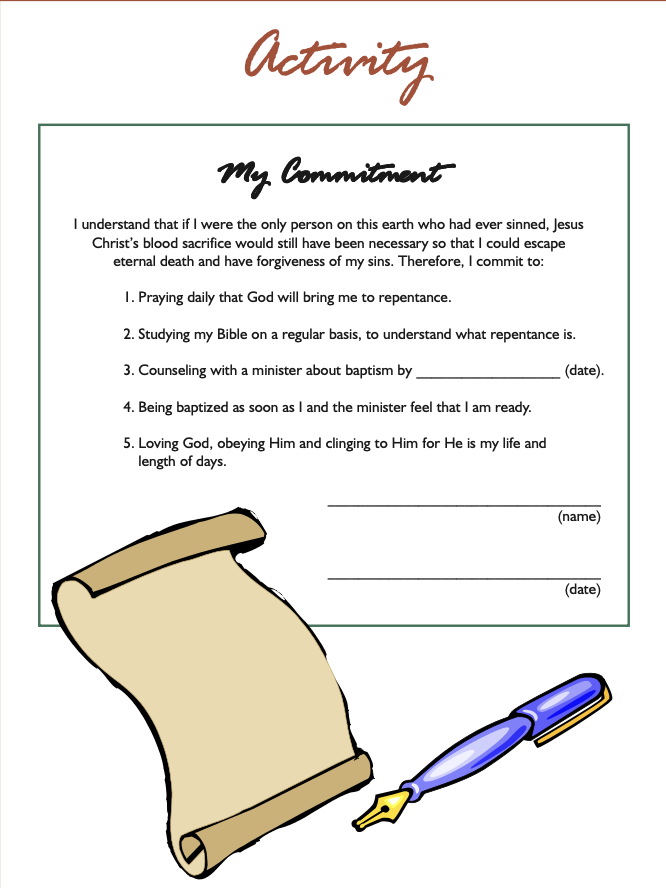
2. Make clear that Jesus’ blood sacrifice would have been necessary if they had been the only person who had ever sinned.
3. Explain the significance of Jesus’ blood being shed.
4. List the steps they must take to be saved.
Topics & Themes
Baptism
Fulfillment of Prophecy
Jesus, Crucifixion of
Jesus, Death of
Jesus, Messiah
Jesus, Savior
Jesus, Suffering of
Jesus Without Sin
Passover
Pilate
Repentance
Sin
Materials Needed
Bible, YEA students’ and teacher’s books, attendance and memory verse chart, music player and music CD/tape, songbook, newsprint pad and marker pen, props for the activity
How to Teach This Lesson
Start the class by saying: Let’s visualize the high drama in today’s lesson. It was late on that spring night when Jesus and His disciples took the Passover. All of them except Judas retreated to the Garden of Gethsemane where Jesus agonized in prayer. He asked His Father that if there was any way that you and I could have salvation without the excruciating suffering He was to go through the next day, let it be. But He came to grips with the situation and submitted His will to His Father’s. Then the chief captain of the Roman army, Jewish religious leaders and about 500 people streamed out of the East Gate of the Temple down the Kedron road to the garden with Judas. Jesus identified Himself to them and they all fell backwards to the ground. Judas kissed Jesus to ensure they knew exactly who He was. Peter quickly pulled out his sword and cut off the right ear of Malchus, the High Priest’s servant. Jesus put the man’s ear back on and restored it. The soldiers and religious leaders arrested Jesus and took Him to the High Priest’s residence where He was interrogated until the early hours of the morning.
By sequentially following the questions below, you will be better able to stay on track, meet the objectives and complete every section of this lesson.
How do you feel about all of these events? Why do you think Barabbas, a criminal, was let go instead of Jesus who was completely innocent? What were your feelings when Pilate gave in to the screams of the mob to crucify Jesus?
What do you think was the symbolism when Pilate washed his hands? He wanted nothing to do with the decision and did not want to be held accountable. Have you ever been more humiliated than Jesus was? Do you know of anyone who has been?
Why do you think Jesus went through all of this humiliation, suffering and even death yet put up no resistance when He was arrested? (John 3:16)
Not only did Jesus suffer pain and humiliation, even His Father turned His back on Him at His very darkest hour. Why? He alone had to bear the sins of the whole world. Ask one of the students to read Isaiah 53 aloud. Who else besides God the Father turned their back on Jesus? We too have turned our backs on Him. How do we turn our back on Him? By not believing Him and obeying Him.
As you studied the lesson, did you ever think how cruel and awful the Roman soldiers and Jewish leaders were who killed Jesus? How do your sins fit into this picture? Every one of us is as guilty as the Roman soldiers and Jewish leaders. Ask one of the students to read Acts 2:36, 4:10 aloud. Now have someone read Romans 6:23 and 3:23. Then all of us are under the death penalty. How do we get out from under it? Only through repentance. Ask one of the students to read aloud Acts 2:38.
How old do you think a person should be before he is baptized? As soon as he or she is old enough to recognize that he is a sinner and can come to repentance. What are the advantages of being baptized? You will receive the greatest gift you can have, the Holy Spirit. It is the Spirit of power. It gives you the power to resist sin, to overcome sin and to grow spiritually. It is the power to keep you faithful to God until He returns and you become a member of His family. How important is it that you make this commitment? It makes the difference between your having eternal life or eternal death. End the lesson by having one of the students read Deuteronomy 30:19-20 aloud.
Teacher-Directed Activity
Have the students select parts and act out this story. The scene could be at Pilate’s house or in the Garden of Gethsemane. Bring appropriate props such as sticks for torches, crown of thorns, sponge, etc.
Song
“Victory Chant” is on page 44 of The Group Songbook.
Closing Prayer
Ask one of the student to lead in prayer, asking God to help each one of us to fully grasp the significance of this lesson and to act accordingly.
Printable Pages