YEA Lesson Library
The Last Supper
About This Lesson
This lesson ties the Old Testament Passover with the New Testament Passover, then encourages the student to show the same humility Jesus did by planning a service project.
Scriptures
Exodus 12:1-14
Numbers 9:6-14
Matthew 26:20-30
Mark 14:12-26
Luke 22:7-20
John 13:1-38
1 Corinthians 11:23-34
1 Corinthians 11:28
Words to Know
PASSOVER - The original Passover celebrates the death angel passing over the first-born without killing them. Christians today celebrate it on the same night that Jesus kept His last Passover as a memorial to His death for our sins.
CULMINATION - The highest point
The Lesson
All across Egypt families wailed and cried with grief. Not an Egyptian family was spared from the death of its firstborn son the night of the first Passover. God had told Moses and Aaron that He would smite all the firstborn males in the land of Egypt, both man and beast. Judgment time had come upon Egypt for mistreating the Israelites and for not allowing them to leave Egypt to keep God’s feast. The night of the first Passover the death angel passed over the houses where the blood of a lamb was on the doorpost – their firstborn was saved from death. Where there was no blood on the doorpost, the firstborn male in every family, both human and animal, died that night.
That Passover was only a type of Jesus’ destiny. All of the lessons we have learned in this Life of Christ series are narratives leading to the culmination and climax of this most sobering occasion. Jesus was born as a human baby for this very purpose, to die for your sins.
Jesus knew that this particular Passover dinner was special. It meant that His death was near. It was His last night on earth before returning to His Father. Jesus knew that He would not be with His disciples for their next Passover meal; He knew that He would not be able to eat it again with them until He partakes of it with them in God’s Kingdom. He also knew that one of those eating this very special meal with them would be His betrayer. He loved His disciples very much and this was very disturbing. This Passover was a time of both great love and great agony.
As this Passover approached, Jesus talked with His disciples. “As you know, the Passover celebration begins in two days, and I shall be betrayed and crucified” (Matthew 26:2 TLB). Even while He was talking with His disciples, Jewish leaders were meeting at the house of Caiaphas, the High Priest, plotting to kill Jesus. They devised a plan to capture Him quietly. They knew that if they did it during the Passover celebration, riots could erupt.
While the Israelites were cleaning the leavening out of their houses, the disciples came to Jesus and asked where they would be keeping the Passover. Jesus instructed these men to go into the city and see this unnamed man and tell him that Jesus would be eating the Passover with His disciples at home. The men followed Jesus’ instructions.
After Jesus sat with His disciples and ate the Passover meal, He took off His robe and wrapped a towel around Him. He poured water into a basin and began to wash the feet of each man. Peter protested, “Master, you shouldn’t be washing our feet like this!” Jesus told Peter that he didn’t under- stand why He was doing this. “If I don’t wash your feet, you can’t be my partner” Jesus replied. Then Peter was anxious for Jesus to wash his feet. Jesus explained that He was setting an example. Since He had washed their feet, they ought to wash each other’s feet as well. “How true it is that a servant is not greater than his master. Nor is the messenger more important than the one who sends him. You know these things, now do them! That is the path of blessing” (John 13:16-17 TLB). Jesus was in great anguish of spirit and said, “One of you will betray me.” A chill came over the room as this statement tore the heart out of every man there. No one thought they would betray Jesus. Each one of them began to ask, “Is it I?” Jesus replied that it was the man He served first. Then Judas asked, “Am I the one?” Jesus answered in the affirmative. Satan entered into Judas and Jesus told him to hurry up and do it now.
As they were eating, Jesus took unleavened bread, blessed and broke it and gave the disciples a piece to eat. He said, “Take and eat, for this is my body.” Then He took the cup of wine, blessed and gave it to them as well. “This is my blood, sealing the New Covenant. It is poured out to forgive the sins of multitudes” (Matthew 26:27-28 TLB). They sang a hymn before going to the Mount of Olives.
This covenant renewal with Jesus, done by the taking of the bread and wine, is most important for Christians. For Jesus says, “With all the earnest- ness I possess I tell you this: Unless you eat the flesh of the Messiah and drink his blood, you cannot have eternal life within you. But anyone who does eat my flesh and drink my blood has eternal life, and I will raise him at the Last Day” (John 6:53-54). What does your Bible say about simply going through this ceremony when the heart is not right? “But let a man examine himself, and so let him eat of that bread, and drink of that cup. For he that eats and drinks unworthily, eats and drinks damnation to himself, not discerning the Lord’s body” (1 Corinthians 11:28-29). Self examination and repentance are very important before we take the Lord’s Supper.
The Passover is filled with history and significant meaning. It’s a time of love, a time of forgiveness, a time to examine ourselves and a time to renew our covenant with Jesus Christ. Our prayer as we remember the body and the blood of Christ each year should focus on Jesus Christ and the supreme sacrifice that He paid for our sins. We should remember His sadness at that special time. We should remember that Christ gave His life for our sins. We should resolve to live a life more pleasing in His sight. And we should remember the joy of His promises.
Student Prayer
Gracious Father,
Thank you for the supreme sacrifice that Jesus paid for my sins. At each successive Passover help me to come to deeper repentance and to walk even closer to my Savior Jesus Christ.
It’s in His name that I pray.
Amen.
Daily Devotions
Sunday: Exodus 12:1-14
Monday: John 13:12-26
Tuesday: Matthew 26:20-30
Wednesday: 1 Corinthians 11:23-34
Thursday: Numbers 9:6-14
Friday: Mark 14:12-26
Saturday: Luke 22:7-20
Objectives
At the end of this lesson, students will be able to:
1. Explain the order of the Passover service.
2. Discuss the meaning of the bread and wine.
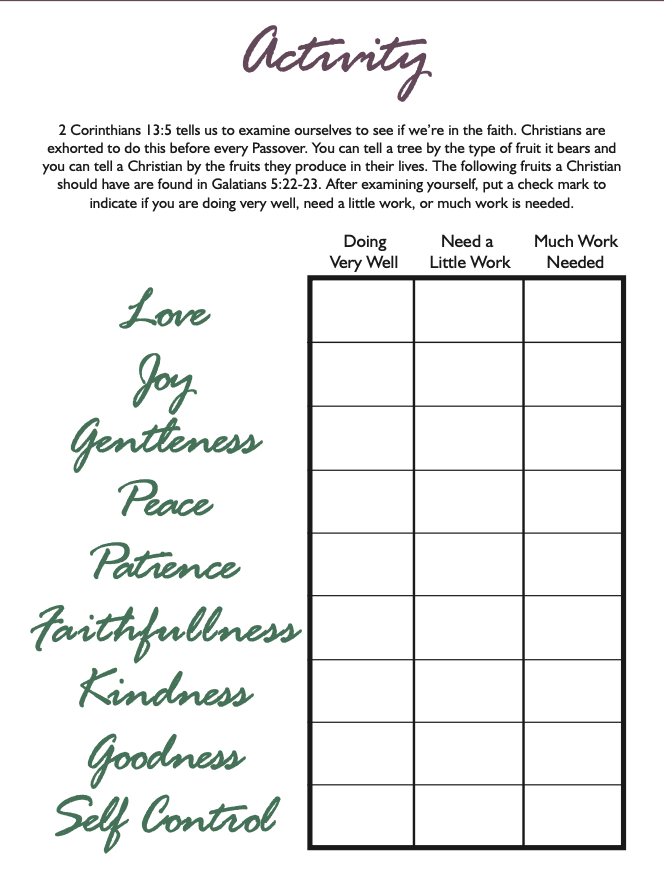
3. Examine their attitude and heart before partaking of the Passover.
4. Explain the connection between the death of the firstborn and Jesus Christ as our Passover.
Topics & Themes
Angel, Death
Betray
Blood
Bread and Wine
Covenant
Disciples
Judas
Peter
Egypt, Coming Out
Examination
Firstborn
Footwashing
Fruit of the Spirit
High Priest
Jesus, Crucifixion of
Jesus Sets Example
Judas
Lamb
Leavening
Passover
Peter
Plagues
Materials Needed
Bible, YEA students’ and teacher’s books, attendance and memory verse chart, songbook, music player and music tape/CD, newsprint pad, marker pens
How to Teach This Lesson
By sequentially asking the following questions you will more likely stay on track, meet the objectives and complete each portion of this lesson.
Who would like to describe the average Egyptian family the night of the first Passover? What correlation can you make between the blood on the doorpost and the crucifixion of Christ? The blood of a lamb they put on the doorpost saved lives, and the shed blood of the Lamb of God saves us from our sins. What message is common to both incidents? Deliverance.
Why do you think Peter didn’t want Jesus to wash his feet? He didn’t think he was worthy. How many of you have attended a Passover service? Did it, or would it bother you to have your feet washed? What significance is there in the foot washing service? Following Jesus’ example. What does the foot washing service symbolize? Humbly serving others. What types of things can you do to “wash each other’s feet?”
How would you feel if one of your best friends betrayed you? What if someone was looking for you to kill you, and your best friend told that person where you were? Do you think that you have a friend who would betray you for 30 pieces of silver? What amount would be enough for you to betray a friend?
What does the unleavened bread symbolize in the Passover service? Jesus’ broken body. Ask one of the students to read aloud 1 Corinthians 11:29-30. Why are some weak, sickly and even sleep or are dead? Because they do not recognize the importance of Jesus’ body being broken for our healing.
What does the wine symbolize? His blood. Ask one of the students to read Hebrews 9:22 aloud. Then, why did Jesus have to shed His life’s blood? There is no forgiveness of sin without the shedding of blood. Do you see a type of this in the first Passover? Yes. What is it? Without the shedding of blood there is no forgiveness of sin, and we would be under the death penalty. How do we go about renewing our covenant with Christ? Examine ourselves and repent of our sins.
Teacher-Directed Activity
Remind the students that the foot washing service at the Passover pictures humble service. Have the students decide on some service they can perform as a group within the next week. They should consider such things as helping a needy person in the church, cleaning the house or taking a meal to an elderly or sick church member or neighbor, painting an elderly person’s house, visiting the children’s wing of the hospital, working in a soup kitchen, helping with special Olympics, etc. Write ideas on the newsprint pad as the students come up with them. Since nursing homes are most often selected, think outside the box and come up with other ideas and try to make it personal, if possible. Delegate responsibilities to students. Get them to set deadlines and a time, make appointments, make a menu, if meals are being prepared, and decide who cooks what, etc.
Song
“One Bread, One Body” is on page 48 of The Group Songbook.
Closing Prayer
Ask one of the students to lead in prayer, asking God to help us to personally and fully understand the significance of the death of Christ and to forgive us for our part in it.
Printable Pages