YE5B.1 · Activity Page
2 Chronicles 7:13-22
Matthew 17:1-13
Matthew 19:29
Matthew 20:18-27
Matthew 23:1-12
Mark 9:1-9, 30-35
Mark 9:35
Mark 10:25-45
Luke 9:28-43
Luke 14:8-11
Luke 22:14-27
SACRIFICE - to give up something valued for the sake of something having a higher or more pressing claim.
TRANSFIGURATION - the supernatural and glorified change in the appearance of Jesus on the mountain.
Who do you think is a really great person? Would you say Albert Einstein? Or do you think Wolfgang Amadeus Mozart is really great? Maybe you would pick Tiger Woods for winning the Masters at such a young age. If you’re a girl, you might think Princess Diana or Marie Curie was really a great person.
What about U.S. Presidents? Which one would you say was the greatest? Would you say George Washington? How about Abraham Lincoln? Perhaps you would consider a more recent president such as Ronald Reagan, Jimmy Carter or Donald Trump. When President Clinton went to China for a state visit, who do you think considered himself to be the greatest, the President or Chairman Jiang, the Chinese leader?
Have you attained recognition or an award which you consider to be a great achievement?Have you made the honor roll? Have you been elected to be a cheerleader, captain of your football team, president of the student body, or first place in a music contest? Now these are noteworthy, commendable accomplishments. Did the recognition or award make you feel that you might just be greater than your friends? If so, you’re not alone with this kind of attitude.
A few months before Jesus was crucified, He took Peter, James, and John up on a mountain top. His face began to shine with glory and His clothes became dazzling white. Then Moses and Elijah appeared and began talking with Jesus. Just in case you don’t remember, Moses and Elijah had been dead for millenniums. This situation was so remark- able they didn’t have a clue as to what they should say. True to form, Peter replied impulsively, “We will make three shelters here, one for each of you. . . .” Even while Peter was still talking, a cloud blotted out the sun and covered them and a voice from the cloud said, “This is my beloved Son. Listen to him.”
Suddenly Moses and Elijah were gone and only Jesus remained with them. As they descended the mountain, Jesus asked His disciples not to tell anyone about what they had seen until after His resurrection. The purpose of Jesus’ transfiguration may have been to strengthen the disciples’ faith in Him being the Messiah. They would soon be facing very difficult times.
Jesus and His disciples left that area and traveled through Galilee where He tried to avoid a lot of publicity. He wanted very much to spend time teaching His disciples that He was the Messiah and that He was going to be betrayed, killed, and resurrected three days later. But the disciples didn’t understand what Jesus was talking about and were afraid to ask Him what He meant.
They all settled into a house in Capernaum that probably belonged to Peter and Andrew. Jesus wanted to know what the disciples had been arguing about. They were ashamed to answer Him because they had been arguing about – guess what – which one was the greatest! They had spent almost three and a half years studying with Jesus and were still concerned with status and self importance. They just didn’t get it. Rather than spending time contemplating who Jesus really was and His impending suffering and crucifixion, they were more concerned about the senseless argument of their own greatness.
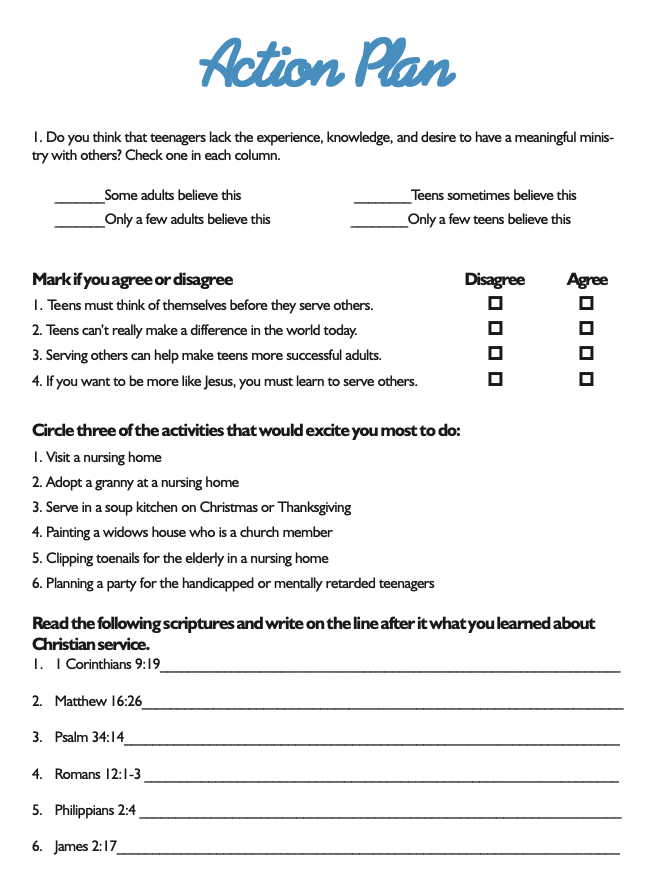
Are you any different from Peter, James, and John? Are you influenced by the culture of today? Do you have a real desire to be great? Is that desire wrong? What did Jesus say about it? He didn’t say it was wrong to want to be great. He just clarified what “the greatest” is.
Too often television, movies, teen magazines, and peer pressure encourage teens to be self- centered, grasping, and egotistical. Being the greatest is depicted as what you wear, how cool you look, what you own and other physical achievements. Jesus taught a complete reversal of the value system many of your peers may follow. He told His three disciples that, “Anyone wanting to be the greatest must be the least – the servant of all.” In other words, being the greatest has to do with what you do and how you treat others.
How do you get started being “the servant of all?” You may think that you’re not very talented or have little or no training. So what do you do? Learn a lesson from the birds. “Use what talents you possess, the woods would be very silent if no birds sang here except those that sang the best” (Henry Van Dyke).
Maybe being “the servant of all” just doesn’t fit your schedule. The kind of service Jesus was talking about requires sacrifice. Sacrifice means to give up something valued for the sake of something having a higher or more pressing claim. Giving up your time, a valued possession, will require sacrificing. So why should you do it?
When you visit a diabetic lady in a nursing home who has had both legs amputated and is almost blind, you brighten her day more than you’ll ever know. That is one day in her very boring and lonely life when she knows someone loves her and cares about her. You give her hope because she knows at least one person in the world cares enough to visit her.
What’s in it for you when you sacrifice your time to visit a person in a nursing home or do other good deeds for lonely people in need? Think how you will feel when they hold your hand and tell you how much your visit means to them. What’s it worth to see the tears of joy in a person’s eyes and to know your visit has provided this person with the best day they’ve had in months. It doesn’t take training or talent to do this. It takes caring. It takes giving up a little of your time and just a little bit of you.
Matthew 19:29 says, “Anyone who give up his home, brothers, sisters, fathers, mothers, wife, children, or property, to follow me, shall receive a hundred times as much in return, and shall have eternal life.” Jesus says your passport to gaining entry into His Kingdom is being willing to follow Him. Sometimes Jesus wants you to sacrifice your time and efforts in service to others - in His name. If you’re willing to follow Him wherever He leads, you’ll have an entire eternity full of rewards! Now that’s great stuff!
Our Father in Heaven,
Thank you for the lessons you taught the Apostles. Help me to see clearly how these lessons apply in my life. Help me to seek out people I can help and make their life better with kind deeds. Help me every day to make someone’s life better with the service I do.
In Jesus’ name I pray.
Amen.
Sunday: Matthew 20:18-27
Monday: Mark 10:25-45
Tuesday: Luke 22:14-27
Wednesday: Luke 9:36-43
Thursday: Matthew 23:1-12
Friday: Luke 14:8-11
Saturday: 2 Chronicles 7:13-22
Genesis 2:2-3
Exodus 16:1-27
Exodus 20:8-11
Exodus 31:13-18
Isaiah 56:2-7
Isaiah 58:13-14
Matthew 12:10-17
Mark 2:23-28
Luke 6:1-11
Luke 13:11-17
MENINGITIS - Inflammation of the thin membranes that cover the spinal cord and brain.
SHOWBREAD - Twelve loaves of bread which were placed on a table in the Temple. The loaves were replaced each Sabbath day.
FLOUT - to mock or scoff, treat with disdain.
Todd was brought up in a very strict religious home. His parents believed they should do what the Bible says. They taught their children to do the same. The restrictive life that Todd’s parents lived just wasn’t for him. There were certainly more attractive things to do than keep the Sabbath holy. He was embarrassed to tell his friends that he couldn’t go to the ball game, movie, or a dance on Friday night.
He yearned to be like his friends and was tired of being different. Graduation was approaching as Todd celebrated his 18th birthday. Shedding all of this religious stuff and being free at last seemed like heaven to Todd.
Todd conveniently forgot a saying his dad quoted so often, “Your companions are like the buttons on an elevator. They will either take you up or they will take you down.” The last thing Todd wanted to concentrate on was a Scripture his Mom had him memorize in the sixth grade, “Before every man there lies a wide and pleasant road that seems right but ends in death” (Proverbs 14:12).
One of Todd’s dreams was to become a computer whiz and make big bucks. Eighteen, and on his own, he started to college with his friends. At last he could do what they did. So he got a job working as many hours as his class load would allow. It was no problem working on the Sabbath now that he was out of his parent’s house. He burned the midnight oil seven days a week. After all, he was young and healthy, so he thought, and he could push it hard.
While working the late shift one Friday night, Todd’s head began to pound. His neck had never been so stiff. His skin was hot and feverish and he felt really sick. He got in bed about midnight and thought he’d sleep it off. But there was no such luck. His temperature climbed and he became delirious. His room- mate rushed him to the emergency room and learned that Todd had meningitis. Todd’s par- ents arrived to be at his bedside in the intensive care unit as his life hung in the balance.
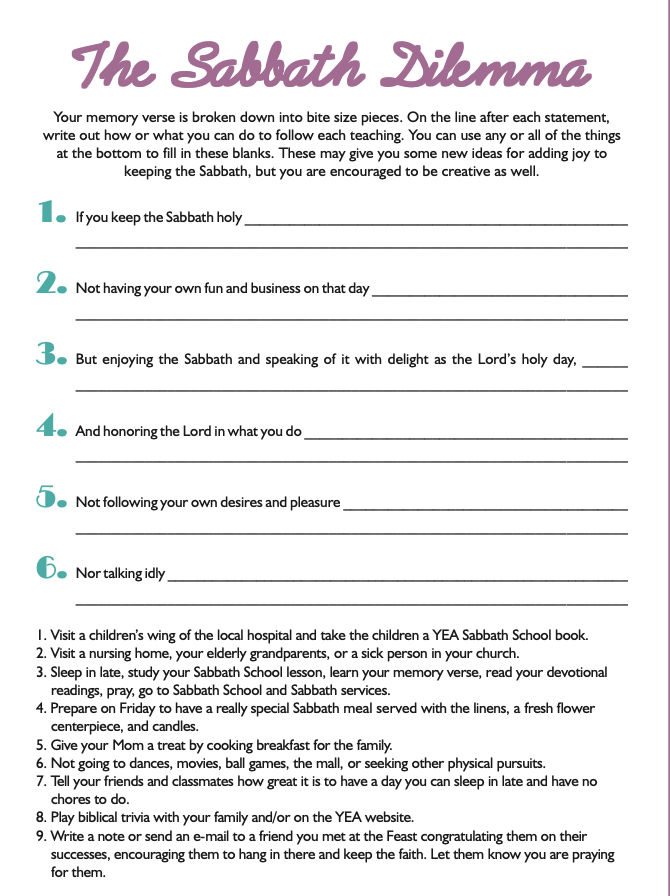
No, God’s not out there to get you every time you do something on the Sabbath that you shouldn’t. But that does not mean there are not laws at work. God designed your body to need a day of rest each week. One of the first things that happens to your body when you don’t get your rest is a weakening of your immune system. You become more susceptible to all of those bugs waiting to pounce on you. There is another side of the coin to consider when you run rough shod over God’s law: Can you expect to have the rewards God promises in you memory verse?
Then what can you do on the Sabbath that will be pleasing in God’s sight? Exodus 20:8-10 says, “Remember the Sabbath day by keeping it holy. Six days shall you labor and do all your work, but the seventh day is a Sabbath to the Lord your God. On it you shall not do any work, neither you, nor your son or daughter, nor your manservant or maidservant, nor your animals, nor the alien within your gates” (TNAB).
But Jesus plucked corn and healed people on the Sabbath, you might say. Yes, He did. Since He did those things on the Sabbath, did He break the Sabbath?
When the Pharisees accused Jesus of breaking the Sabbath, He explained that when King David and his men were hungry, they went into the Temple and ate the showbread, a special bread placed before God. Jesus pointed out that what David did was illegal. But He did not condemn David for taking care of human needs on the Sabbath.
On another Sabbath a man with a deformed hand was present at the synagogue, where Jesus was teaching. Even though the Pharisees were watching to see if Jesus would heal the man, He proceeded to do exactly that. Jesus answered their questions by asking questions. “Is it right to do good on the Sabbath day, or to do harm? To save life, or to destroy it?” Jesus is actually the Lord of the Sabbath day and He clearly shows that it is okay to do good on the Sabbath.
How does Todd’s situation differ from what Jesus did? Todd was not doing good to his own body by burning the candle at both ends. He had no intentions of keeping the Sabbath. Todd’s motives were not to do good, but to make the big bucks as soon as he could, regardless of the teachings of his parents and the Bible.
Keeping the Sabbath isn’t always easy, but it’s the way to please God. Can you expect God to look down on you with love, compassion and His blessings when you flout His law? God provides time for your body to rest every Sabbath day. He sets aside a special day for you to spend additional time with Him. The way may be difficult at times, but God promises that in the end, He will remember to bless you.
Most wonderful and gracious Heavenly Father,
In all of your wisdom you have given us the Sabbath as a most needed day of rest. Help us to keep it holy and to do good on the Sabbath as Jesus did.
In Jesus’ name we ask these things.
Amen.
Sunday: Genesis 2:2-3
Monday: Exodus 16:1-27
Tuesday: Exodus 31:13-18
Wednesday: Isaiah 56:2-7
Thursday: Mark 2:23-28
Friday: Matthew 12:10-17
Saturday: Luke 13:11-17
Exodus 20:1-17
Deuteronomy 5:6-21
Psalm 19:7
Jeremiah 31:33
Matthew 5:17-48
Romans 2:12-23
Romans 6:23
Galatians 3:10-29
1 Timothy 1:6-11
ABOLISH - to do away with.
PLANKTON - organisms occurring in a body of water; primarily microscopic algae and protozoa.
If you have studied physics then you know all about the law of gravity. You know that without gravity you could lay a book on a table and it wouldn’t stay there. The book would float in the air. Of course the table wouldn’t stay on the floor either. Gravity is necessary! It’s in the nature of things. In other words God designed it to be that way because it is good for human beings. Without gravity, water wouldn’t stay in the ocean.
Think about it, where would we be without the oceans? Did you know that islands, such as the British Isles, get a significant amount of the oxygen people living in England, Ireland and Scotland breathe every day from plankton in the ocean? If there were no water in the oceans, there would be no plankton, and of course there would not be enough oxygen to support life for Great Britain’s population.
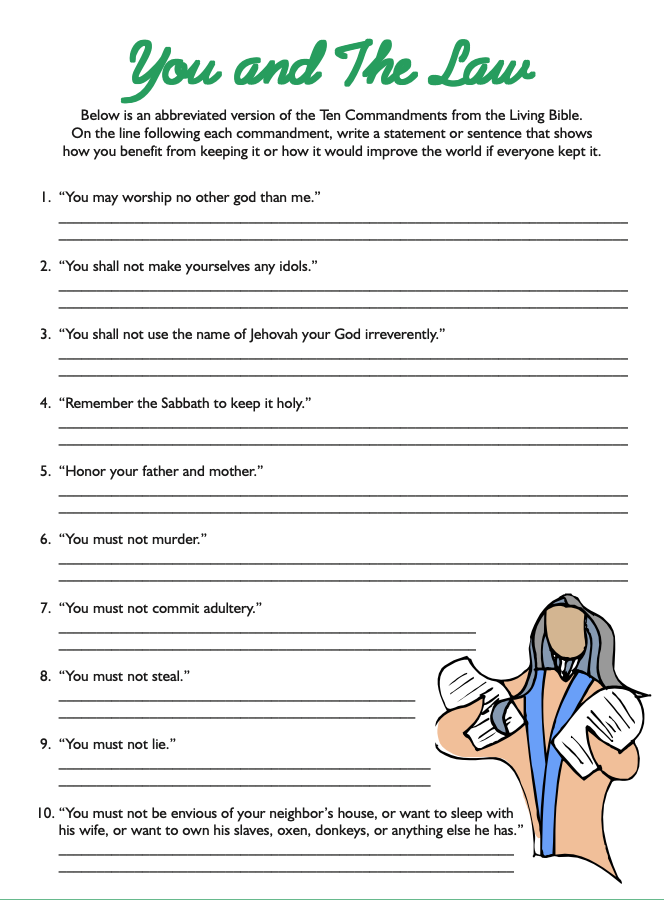
What about the law of God or the Ten Commandments? Are the Ten Commandments an arbitrary set of rules imposed by God on mankind to deprive us of things we would really like to do? Did it add to God’s stature to call Moses up to the mountain and give him the Ten Commandments? Do you somehow make God bigger or greater when you keep the Ten Commandments? Were the Ten Commandments nonexistent before God wrote them with His own finger on two tables of stone? What about Adam and Eve? Was there no law for them to obey? Did they have no idea what was right and what was wrong for them to do?
Has anyone ever told you that the Ten Commandments were done away when Jesus was crucified? Have you been told that the Law of God was nailed to the cross? What does Jesus say about this? And what does He have to say about You and The Law?
A crowd of people followed Jesus and His disciples as He went up into the mountain. He began to teach these people the Beatitudes. Then He proceeded to help them understand the purpose of the law. He reminded the people, “Do not murder, and anyone who murders will be subject to judgment.’ But I tell you that anyone who is angry with his brother will be subject to judgment. Again, anyone who says to his brother, ‘Raca’ is answerable to the Sanhedrin. But anyone who says, ‘You fool!’ will be in danger of the fire of hell.’” (Matthew 5:21,22 NIV Study Bible for Kids).
Did you notice that Jesus didn’t say that it is wrong to take a life under any circumstance? Under the law, civil governments are allowed to take the life of a person who commits certain crimes. Jesus is saying that the root of murder is anger, and anger is murderous in principle. Now notice what Jesus said, “anyone who is angry with his brother will be subject to judgment.” It’s obvious that Jesus didn’t change the law and give us permission to break the sixth commandment. Rather, He extended the application to include being angry with your brother.
Listen to what Jesus said next. “If you start to make an offering to God and remember that your brother has something against you, leave your gift in front of the altar and make amends with your brother. Then you can come and make your offering.” We are more likely to remember when we have something against others than when we have done something to offend others. But we cannot truly worship God when our relationship is not right with our brother.
Jesus brings up the seventh commandment, “Thou shalt not commit adultery.” Again, He took it further than the literal command. He said, “I tell you that anyone who looks at a woman lustfully has already committed adultery with her in his heart.”
Did you notice that Jesus said that if you have the wrong kinds of thoughts about someone you are not married to, you have broken the seventh commandment. Jesus didn’t do away with the seventh commandment, He shows that the intent of your heart can break this commandment and made it to even include wrong thoughts.
Why is sex outside of marriage so wrong? God wants you to be pure and He doesn’t want you to steal something that rightfully belongs to another. The sexual relationship is the sole right of one man and one woman who are married to each other. Any other sexual activity, including fooling around as a teenager, is stealing from that beautiful relationship. It’s destructive to all parties, including the children of those people who cheat and are cheated. Everyone involved suffers when a home is broken because of adultery.
What about the fourth commandment? We learned in the last lesson that the Sabbath was not abolished when Jesus was crucified. “Do not think that I have come to abolish the Law or the Prophets. I have not come to abolish them but to fulfill them. I tell you the truth, until heaven and earth disappear, not the smallest letter, not the least stroke of a pen, will by any means disappear from the Law until everything is accomplished” (Matthew 5:17). Why? It is because God’s law is eternal! It’s because it is for your good to keep the Law. The Law shows you how to stay out of trouble and live a joyful life.
The only things nailed to the stake were Jesus and a sign that said, “King of the Jews.” The Law wasn’t given because God wanted to impose a harsh set of rules on us. Just like the law of gravity, it is beneficial and necessary for mankind. It’s in the nature of things. The Law defines sin and shows us how to stay out of trouble and be genuinely happy. The Law shows you how to have the right kind of relationship with God and your fellow man. Keeping the Law is the way to become a winner!
Great Father,
Thank you for such a holy, just and good law that caused Moses’ face to shine when he received it. Help me to have a proper respect and appreciation for your Law and to keep even the intent. Help it always to be a lamp unto my feet to keep me out of trouble. I want to be a winner.
In Jesus’ name I pray.
Amen.
Sunday: Exodus 20:1-17
Monday: Deuteronomy 5:6-21
Tuesday: Jeremiah 31:33
Wednesday: Psalm 19:7
Thursday: Romans 2:12-23
Friday: Galatians 3:10-29
Saturday: 1 Timothy 1:6-11
Psalm 36:1-12
Matthew 6:1-13
Matthew 6:16-21
Matthew 18:1-5
Luke 12:1-9
Luke 12:2-3
Luke 18:9-14
Romans 12:1-8
Philippians 2:1-5
1 Peter 5:5-11
HYPOCRITE - a stage actor or one who plays a part; one pretending to be something or someone he is not.
HUMILITY - having a modest opinion of one’s own importance or rank; meekness.
PRETENTIOUS - making an exaggerated outward show.
Eric was a Thespian and really enjoyed acting. He had just tried out for state competition and anxiously awaited the results. His secret dream was to go to Austin and enter the Texas Interscholastic League competition. Getting the part to play Uncle Stanley in George Washington Slept Here should ensure he would be going to Austin.
Finally, the drama teacher came out and made the announcement that Eric would indeed play Uncle Stanley. Staying after school each afternoon was well worth it because all of those people would be there watching him perform. Learning the lines for Uncle Stanley came easy for Eric. He learned to get himself in character, to think like Uncle Stanley, to talk like Uncle Stanley, and to act like Uncle Stanley. Play acting was not only fun, it was hot stuff for Eric.
The curtains went up and Eric proudly played the part of Uncle Stanley. He acted the part well and was proud of his performance. The applause was deafening as the people came to their feet almost in unison. The thrill of a lifetime came with that standing “O.” He knew George Washington Slept Here had it in the bag. Man, that was big stuff! But when the play was over, the awards were passed out and the applause was gone, the costume and all of the dramatic trappings were gone as well. Eric was just Eric again.
Play acting isn’t just something students do in school plays or actors and actresses do before the cameras in Hollywood. We all perform from time to time. We thrive when people applaud or compliment us. But how long does the applause last? How much lasting good does it really do us?
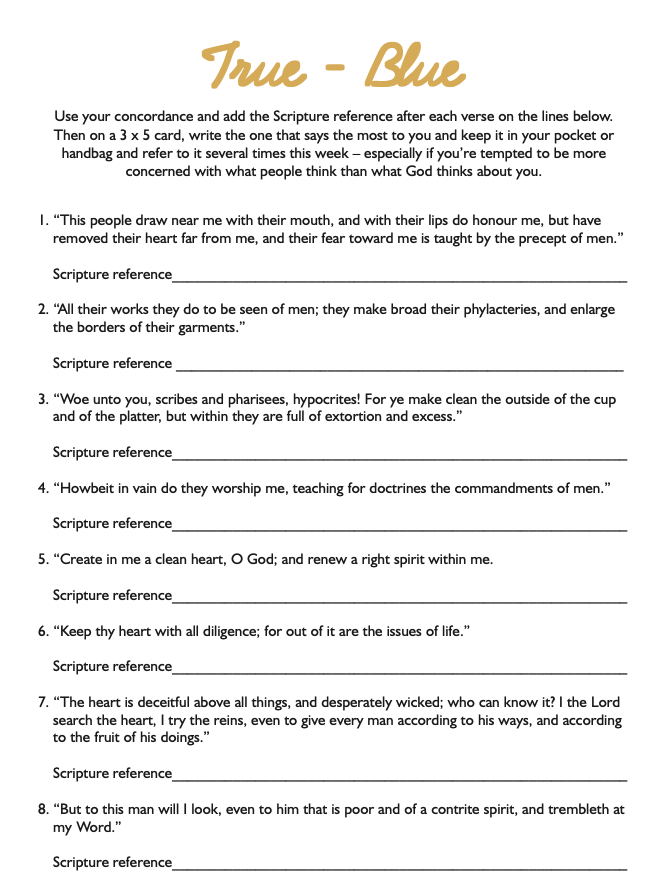
The word “Hypocrite” means stage actor or one who plays a part. In Jesus’ day performers wore masks to conceal their true identity while playing their part. Jesus challenges us to not live our lives for the praise of our peers, but to be genuine. Acting religious doesn’t gain you any brownie points with God. The message comes through loud and clear in Jesus’ teachings that our good deeds, religious life and worship of Him should be genuine and not just putting on a show. God looks on the intent of the heart.
He says if you do your good deeds for the public to admire you, you will lose the reward from your Father in heaven. “When you give a gift to a beggar, don’t shout about it as the hypocrites do – blowing trumpets in the synagogues and streets to call attention to their act of charity! I tell you in all earnestness, they have received all the reward they will ever get. But when you do a kindness to someone, do it secretly – don’t tell your left hand what your right hand is doing. And your Father who knows all secrets will reward you” (Matthew 6:2-4 TLB).
What does Jesus have to say about other religious acts such as prayer? He again warns us not to be like the hypocrites who pray long public prayers so that everyone can see them praying and hear their beautifully worded prayers. Prayer is a very private thing between you and God. It’s a time when you can talk over all of your secrets with Him and you can trust Him not to tell a soul.
His instructions are to go in your room and shut your door. He wants you to be yourself and not be pretentious. Just as Eric was Eric again after the costume came off, God wants no acting or pretense. He doesn’t even want you to repeat the same prayer over and over again. He wants you to say what’s in your heart and on your mind. After all, He already knows your thoughts, so you might just as well tell Him.
Jesus says, here is a model for you to follow. “Our Father in heaven, we honor your holy name. We ask that your kingdom will come now. May your will be done here on earth, just as it is in heaven. Give us our food again today, as usual, and forgive us our sins, just as we have forgiven those who have sinned against us. Don’t bring us into temptation, but deliver us from the Evil One. Amen” (Matthew 6:9-13 TLB).
One of the greatest temptations we all have is to want respect, applause, admiration and approval of our peers. Jesus tells us that if we live our lives and do our deeds as a show for them, then that is the only reward we will have. It will last just about as long as Eric’s standing ovation and it’s all over. But when you live your life to please Jesus and Jesus alone, He’ll ensure you’ll have a much greater reward that will last throughout all eternity.
Gracious Father,
You know my heart so there is no need for me to pretend I am something that I am not. Help me to do my good works to please you and not for the praise or admiration of my peers. Please forgive me of the many times I have done this.
I pray all of this in Jesus’ holy and righteous name.
Amen.
Sunday: Matthew 6:16-21
Monday: Luke 18:9-14
Tuesday: Romans 12:1-8
Wednesday: Philippians 2:1-5
Thursday: 1 Peter 5:5-11
Friday: Matthew 18:1-5
Saturday: Psalm 36:1-12
Leviticus 27:30-34
Numbers 18:24-32
Deuteronomy 14:22-29
Deuteronomy 26:12-19
Nehemiah 10:37-39
Malachi 3:8-12
Malachi 3:10
Matthew 6:19-24
Mark 12:41-44
Luke 12:13-15
Hebrews 7:1-12
TITHE - A tenth part of your increase
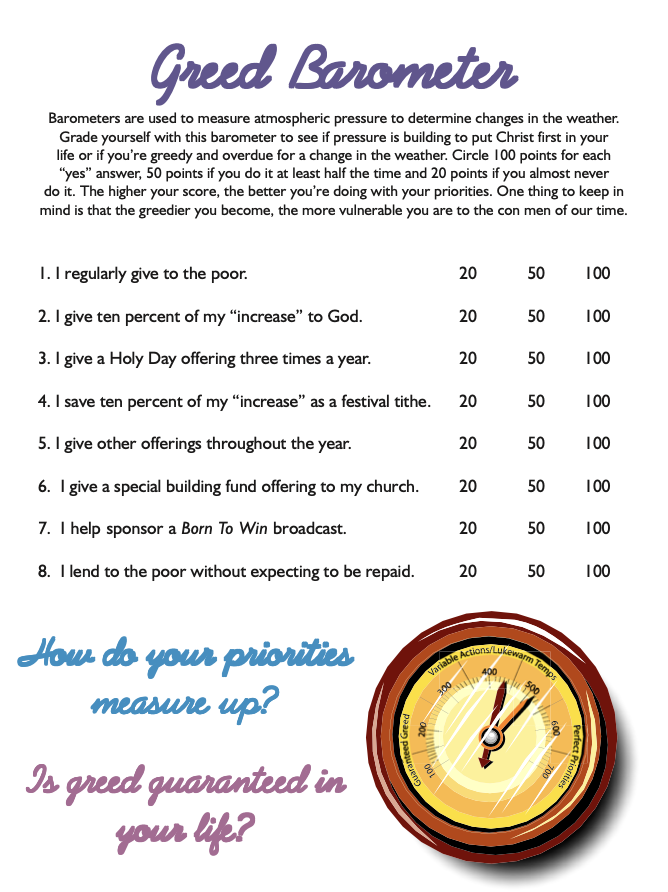
How would you like to be rich, not just a millionaire, but really, really rich like Donald Trump, Ted Turner or Bill Gates? You might say you’d be happy just winning the lottery. But what would you do with all that money?
Now take a minute and pretend you’ve just come into a few million dollars. What’s the first thing you would do? Would you go buy the most expensive Lexus with all the gold trim on it? Or does your taste run more to one of those sleek Mercedes sports coupes? You may feel those cars are for older people, you just want a brand new Corvette with every extra feature available. Would you go on a long shopping spree buying really neat expensive clothes? Where would you begin spending all that money? If you had enough money to buy everything you want, would you feel that you are really a winner?
Did you know that Jesus probably talked more about money than love, sin, heaven, hell or His return to this earth? Do you think that was because He wanted to have a lot of this world’s goods? Why do you think He kept returning to the subject of money?
Thirteen trumpet-shaped treasury boxes were in the court of the Temple. Both men and women were permitted in this area. Some came frequently to put their tithes into the boxes. The rich often came into this court and gave large sums of money. Then one day a poor widow came in and dropped two pennies into one of the boxes. This was such a remarkable event that Jesus called His disciples together and told them that she had given more than all of the rich men put together. Why? Because she gave the very last penny she had. Jesus was so impressed with this generous act of faith and worship that this incident is included in the Bible for all of us to read.
Does Jesus require that you give your last penny to Him? To answer that question it is important to understand whose penny it really is. “For all the animals of the field and forest are mine! The cattle on a thousand hills! And all the birds upon the mountains! If I were hungry, I would not mention it to you – for all the world is mine, and everything in it” (Psalm 50:10-11 TLB).
But you might say that it’s your hard work that has produced the money in your pocket. Oh now really? “Always remember that it is the Lord your God who gives you power to become rich, and He does it to fulfill his promise to your ancestors” (Deuteronomy 8:18). That kind of leaves you feeling naked before God, doesn’t it? Well, you’re not alone. Job said, “Naked I came from my mother’s womb, and naked I will depart. The Lord gave and the Lord has taken away; may the name of the Lord be praised.” To sum up those three scriptures, God owns everything. He gives you power to produce wealth and He can even take it away. Does this mean God gets to keep the last penny in your pocket?
Malachi 3:8-10 sheds more light on the subject. “Will a man rob God? Surely not! And yet you have robbed me. What do you mean? When did we ever rob you? You have robbed me of the tithes and offerings due to me. And so the awesome curse of God is cursing you, for your whole nation has been robbing me. Bring all the tithes into the storehouse so that there will be food enough in my Temple” (TLB). God wants back ten percent of everything He puts in your trust, otherwise you’re a robber with the awesome curse of God. Then what if you give God back ten percent of everything He gives you, what’s in it for you? “I will open up the windows of heaven for you and pour out a blessing so great you won’t have room enough to take it in!” God knows that teenagers like a challenge and He gives you one. He says, “Try it! Let me prove it to you!” (Malachi 3:10-11 TLB). God not only leaves you with ninety percent of what you take in, He promises a great rate of return on the ten percent you give back to Him.
Now back to the question. Why do you think Jesus spent so much time talking about money? He summed it up by saying “Where your treasure is there your heart will be also.” Wealth is not evil in itself. Abraham, David, Solomon and Job were all very wealthy men. But we get in trouble when money becomes a god to us. God won’t settle for second place in our live. He wants to occupy first place in your life! For God to occupy first place in your life means He gets the first tenth of your increase (Leviticus 27:26) not what is left over.
But can you trust God if you put Him in first place in your financial planning? King David said, “I was young and now I am old, yet I have never seen the righteous forsaken or their children begging for bread. They are always generous and lend freely; their children will be blessed” (Psalm 37:25-26 NIV).
Holy Father,
You are so generous to give us everything we have. You give us our daily bread, the money we have, and even the power to get wealth. We owe everything to you, the Giver of every good and perfect gift. Help me put you first in my life.
In Jesus’ name.
Amen.
Sunday: Leviticus 27:30-34
Monday: Deuteronomy 14:22-29
Tuesday: Malachi 3:8-12
Wednesday: Deuteronomy 26:12-19
Thursday: Numbers 18:24-32
Friday: Hebrews 7:1-12
Saturday: Nehemiah 10:37-39
Leviticus 19:9-18
Deuteronomy 1:12-17
Deuteronomy 16:18-22
Matthew 7:1-3
Matthew 7:12
Luke 6:36-42
John 4:5-42
Acts 10:34-48
James 2:12-17
QUIP - a clever or witty remark; sharp, sarcastic remark
ALABASTER - a finely granular variety of gypsum, often white and translucent, used for ornamental objects such as lamps and figurines
CAJOLE - to persuade with flattery
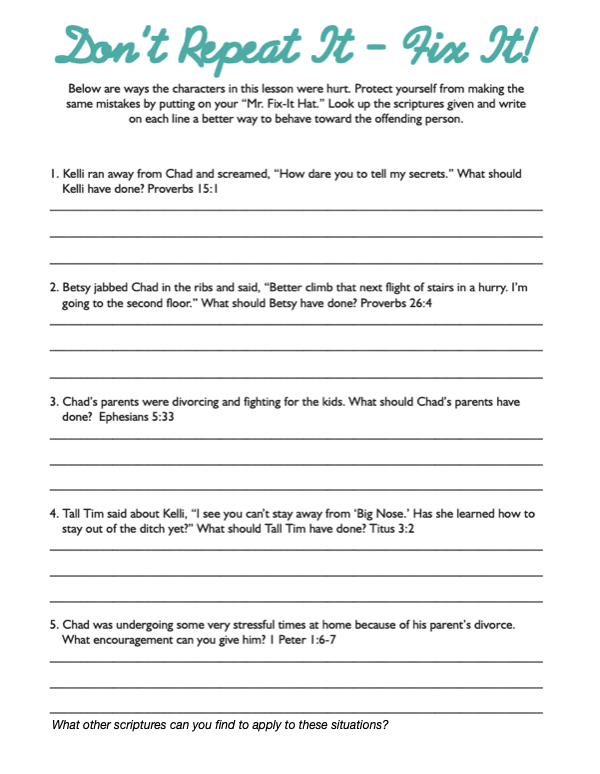
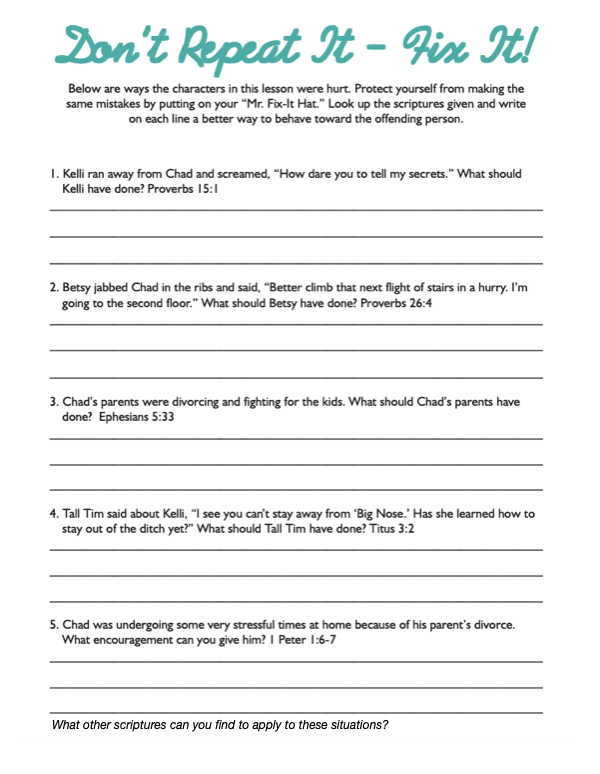
Chad’s parents are divorcing. The custody battle for him and his little brother grew nastier by the day. Kelli was the only person who could take Chad’s mind off his parents’ unrelenting fight. He and Kelli lingered in the school cafeteria after finishing their lunch. The need for approval and some kind of reassurance almost overwhelmed Chad. So he got the courage to ask Kelli what she liked about him. Kelli didn’t hesitate to let him know that she liked the way he made her laugh. Chad had cultivated a good sense of humor and had prided himself on being a comedian. His quips and retorts kept Kelli in stitches.
They made their way down the hall of the first floor as Tall Tim approached. “Gonna slam dunk a bunch of balls tonight, Tim?” Chad asked. “Yeah man,” Tall Tim replied. “I see you can’t stay away from ‘Big Nose.’ Has she learned how to stay out of the ditch yet?” Ever since Chad had been dating Kelli, he and Tim had a private joke about her generous nose.
Tears began to flow as Kelli quickly turned on her heels and began running in the opposite direction. “How dare you tell my secrets,” she screamed back at Chad. He was the only person she had told about running into a ditch, and he promised faithfully never to tell a soul. Learning that Chad had been calling her “Big Nose” to his friends added insult to injury and was more than she could take.
This was the last thing Chad wanted or needed. He was depressed more than ever now. He’d messed up badly and Kelli was gone. He wandered around in a daze toward his one o’clock class. “Fat Betsy,” as he called her to Kelli, jabbed him in the ribs. “Better climb that next flight of stairs in a hurry, smart guy. I’m going to the second floor.” So. . . Kelli had told Betsy what he had said about her being so fat that she’d come through the second floor of the school building. Okay, so Kelli didn’t keep his secret either. Then how can she think she’s better than I am, Chad thought?
It’s interesting how the tongue weighs such a small amount, but how few people are able to control it. Have you ever wondered why? In this short story we’ve seen several people who hurt others because they didn’t control their tongue. But what’s at the root of this hurtful behavior? They judged by appearances and without mercy.
One day Simon, a Pharisee, invited Jesus to dinner. A sinful woman came and brought an alabaster jar of expensive, good smelling perfume. She knelt weeping while she washed Jesus’ feet with her tears. Her long hair fell over her shoulder and she used her silky strands to dry Jesus’ feet. Simon was critical of what he saw. “How can you let this sinful woman even touch you, let alone wash your feet with her tears?” He asked.
Jesus answered with this story. “‘A man loaned money to two people – $5,000 to one and $500 to the other. But neither of them could pay him back, so he kindly forgave them both, letting them keep the money! Which do you suppose loved him most after that?’ ‘I suppose the one who had owed him the most,’ Simon answered” ( TLB). He turned toward the woman and told Simon that he hadn’t even given Him water to wash His feet. But the sinful woman washed His feet with her tears and wiped them with her hair. She kissed His feet and put perfume on them. Jesus said her many sins were forgiven because she loved much.
What Simon did by focusing on the woman’s sin rather than his own judgmental heart is not uncommon. Chad focused on Betsy being fat and Kelli’s big nose. Kelli was angry because Chad had broken his promise, yet she had done the same thing. Kelli had higher expectations of Chad than she had for herself. It’s so much easier to focus on the faults of others rather than our own weak- nesses. It’s much easier to correct our siblings or friends than to make a course correction in ourselves. It’s easier to place heavier expectations on others than what we place on ourselves.
What does your memory verse say? Others will treat you as you treat them. Have you felt that someone has done you dirty? Have you been misjudged? Then look at your track record, what does it tell you? It seems so hard for us to treat others the way we want to be treated – especially those whom we view to be a threat or inferior to us.
The woman who washed Jesus’ feet with her tears was not as righteous as He was, she was a sinner. Jesus is our example to follow. He wants us to treat others with the same respect, the same courtesy, the same mercy that we would like for them to use when they think and act toward us. This even includes our enemies.
Often we don’t know what kind of problems other people have on their plate. Just like the lady who washed Jesus’ feet, Chad had made some mistakes too. But they both needed love, approval and acceptance.
One reason God hates divorce is because of what it does to the children in the family. Doubt- less, Chad’s quips and retorts were hurtful. But Kelli and Betsy were given the opportunity to show mercy as Jesus did to the woman. But did they? How often do we act more like Simon than like Jesus?
To overcome our weaknesses, we must first admit that we don’t treat friends or enemies the way we would like to be treated. Second, we must ask God in fervent prayer for His forgiveness and strength to be more merciful. Third, we must change our behavior. If we ask and don’t do anything, we are asking amiss as it says in James 4:3.
Dear Father,
Thank you for your patience, mercy and love, It’s so easy to set higher standards for others than I have for myself. I know that if I judge without mercy I will be judged without mercy. Please help me to show mercy to others.
In Jesus’ name I pray.
Amen.
Sunday: Luke 6:36-42
Monday: John 4:5-42
Tuesday: Acts 10:34-48
Wednesday: James 2:12-17
Thursday: Deuteronomy 1:12-17
Friday: Deuteronomy 16:18-22
Saturday: Leviticus 19:9-18
Genesis 18:23-32
Matthew 6:9-13
Luke 11:5-10
Luke 11:10
Luke 18:1-8
John 17:1-26
Romans 12:9-21
Ephesians 6:18-20
Colossians 4:1-3
1 Thes. 5:11-18
PERSISTENCE - the act of continuing a course of action in spite of opposition or criticism.
DELIMITER - a character of space indicating the beginning or end (usually of a piece of computer data).
In 1940, Wilma Rudolph was the 20th of 22 children to be born in her family. She was born with polio and suffered serious bouts of pneumonia and scarlet fever. Polio left her in a leg brace until she, in faith, removed it when she was eleven years old.
Having been born with a disability didn’t stop Wilma – she was determined and persistent. At 13 she got involved with basketball and track at school. It didn’t take long before Wilma was running and winning races. As a sophomore in high school, she participated in the Olympic Games in Melbourne, Australia. But she lost the 200 meter race. Wilma didn’t give up. She became more determined than ever.
After entering Tennessee State she became a member of Ed Temple’s “Tigerbelles” track team. In 1960, she set a world record for the 200 meter dash during the Olympic trials. Then in the Olympic games in Rome, she became the first American woman to win three gold medals in the 100 meter dash, the 200 meter dash and the 400 meter relay. Wilma worked her way through school and later became a coach. Her autobiography was a best-seller, and in 1977 it became a television movie, starring Cicely Tyson.
As an African-American child with a terrible disability, the odds were certainly against Wilma ever attaining such achievements and honor. But the thing she had in her favor was the determination to hang in there regardless of any snags or handicaps.
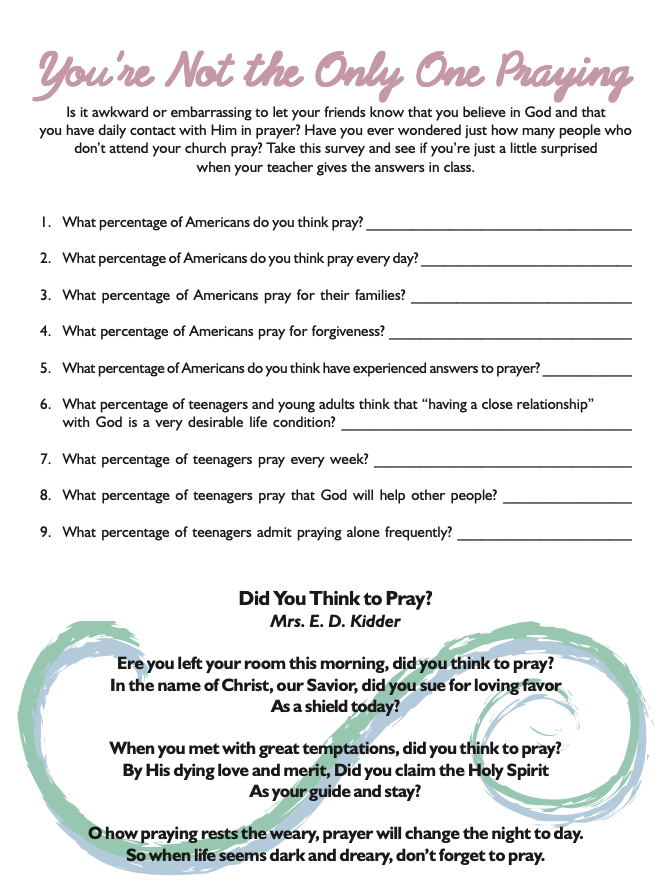
You already know that high achievements and honor require persistence and determination. If we let such things as disabilities or hardship deter us, we’ll probably be mediocre at best. But have you ever thought that getting answers to your prayers can require the same kind of persistence and determination? Jesus told His disciples a story of a widow who had been harmed by a man and wanted justice. Unfortunately, she had to deal with a godless judge. Think of the excuses she could have made. She could have easily said, “I’m a poor widow lady in a society where women are considered second class citizens. I’m afraid of the man who harmed me and this godless, harsh judge.” But she didn’t fall prey to the “victim” trap. Even though the judge totally ignored her at first, she kept coming back again and again.
Eventually her persistence got on the judge’s nerves. He said, “I fear neither God nor man, but this woman bothers me. I’m going to see that she gets justice, for she is wearing me out with her constant coming!” Jesus went on to say that if an evil judge can be worn down by the persistence of a widow lady, don’t you think a merciful God will surely give justice to His people who plead with Him day and night? Jesus assured them that our Father will answer us quickly.
The principle of persistence is so important that Jesus told another story. Let’s suppose you need to borrow some loaves of bread so you go to a friend’s house at midnight. You shout up to him that a friend has just come for a visit and you don’t have food for him. Your neighbor might shout back at you, “Don’t ask me to get up. The door is locked for the night and we’re all in bed. I can’t help you this time.” Jesus said even though he won’t get up and give you the bread, because you’re a friend, he’ll do it if you’re persistent enough. The same thing is true with prayer. He said, “I will do whatever you ask in my name” John 14:14 (NIV).
Jesus is not teaching that the only requirement for answered prayer is to nag Him. James 4:3 says, “You do not have, because you do not ask God. When you ask, you do not receive, because you ask with wrong motives, that you may spend what you get on your pleasures” (NIVSB). James 5:16 helps us get a more complete picture of what is required before we can expect our prayers to be answered. “The effectual fervent prayer of a righteous man avails much.” So what does it mean if we feel we’re asking for something in prayer the proper way and in the proper frame of mind and we still don’t get what we ask? This is often the source of real problems for growing Christians. Should you think God is like the Easter Bunny or Santa Claus? How can you believe in Him if He doesn’t do what He said He will do?
Remember, God doesn’t measure time the way human beings measure it. To Him a day is the same as a thousand years and a thousand years is the same as one day. We measure time based upon the sun and the moon – which He created. He doesn’t have those same delimiters. He can answer your prayers when He deems it is best for you. As you pray, one of the most important things to keep in mind is to ask that God’s will be done. Sometimes it’s necessary for God to delay or deny a heartfelt request because He knows what is really best for you. He knows the future and His plans for you. But stay with it in prayer until you know it is not God’s will for you to have what you have requested.
Awesome God,
You are so wonderful, yet you care so much about me that you hear my prayers when my heart is right with you. You know what is best for me. Grant me the faith to trust you and the persistence not to give up easily with the requests I bring to you.
In Jesus’ name I pray.
Amen.
Sunday: Genesis 18:23-32
Monday: Ephesians 6:18-20
Tuesday: Luke 18:1-8
Wednesday: Colossians 4:1-3
Thursday: John 17:1-26
Friday: 1 Thessalonians 5:11-18
Saturday: Romans 12:9-21
Matthew 7:12
Matthew 10:37-42
Matthew 25:31-40
Luke 6:27-45
1 Corinthians 13:1-13
Ephesians 4:17-32
Colossians 3:12-17
James 1:19-27
2 Peter 1:3-7
IGNEOUS - produced under conditions involving intense heat, as rocks crystallized from molten magma or of volcanic origin.
CONDUCTOR - serves as a channel or medium.
In 1980 gold sold for $850 an ounce. That’s a lot of money for a very small amount of a yellow lustrous metal. But it’s a rare metal that is pleasing and workable. It does not tarnish or corrode. It’s also a good conductor of electricity. Like many other elements, gold is widespread in small amounts in all igneous rocks.
Fortune seekers rushed to Sutter’s Mill, California in 1848 to discover gold. According to the Encyclopaedia Britannica, “Frontier camps and towns, ruled by grass-roots democracy, grew rapidly, and died as quickly once the gold supply was depleted.”
Down through history people have been fascinated with this precious metal – even Israel of old. While Moses was up on Mount Sinai receiving the law, the Israelites asked for a god they could see. So Aaron had them take off their gold earrings for him to mold their jewelry into a golden idol shaped like a calf.
The years between 70 BC and 18 AD were called the Golden Age because of literary achievements during those years. The Gold Coast is a section of the Guinea Coast of Africa. A gold cup is given to the winner of a motorboat competition in the United States. There’s the Golden Gate Bridge in California. And there’s the Golden Gloves amateur boxing competition. Bracelets, necklaces, rings, watches and other fine jewelry are made of gold. Even the cups and furniture in Solomon’s Temple were made of gold. This expensive metal plays an important part in our culture and society.
“All the Gold’s in California” was a popular song a few years back. But that’s really not true because there is gold in the code of conduct – The Golden Rule. Just as gold excels all other metals, this rule of conduct exceeds all other codes of conduct. What does it say? “So in everything, do to others what you would have them do to you, for this sums up the Law and the Prophets” (Matthew 7:12 TLB). How can this greatest code of conduct make a difference in your life and the lives of others? Let our Savior tell you.
Crowds of people came from Jerusalem, and from all over Judea as far north as the seacoast of Tyre and Sidon. Jesus told them, “Love your enemies. Do good to those who hate you. Pray for the happiness of those who curse you; implore God’s blessing on those who hurt you.
“If someone slaps you on one cheek, let him slap the other too! If someone demands your coat, give him your shirt besides. Give what you have to anyone who asks you for it; and when things are taken away from you, don’t worry about getting them back. Treat others as you want them to treat you.
“Do you think you deserve credit for merely loving those who love you? Even the godless do that! And if you do good only to those who do you good – is that so wonderful? Even sinners do that much! And if you lend money only to those who can repay you, what good is that? Even the most wicked will lend to their own kind for full return!” (Luke 6:27-34 TLB).
Does this mean that you are to pray for people who curse you and ask God to bless them? Are you required to lend to people who will never pay you back? What would the world be like if all of us did this? Can you imagine a world where everyone spoke well of each other? Fighting would stop. Grudges would drop by the wayside. There would be forgiveness and broken relationships would be mended. Love would blossom everywhere.
We tend to think of God as we are. Jesus says you should try to show as much compassion as His Father does. He’s gracious, loving and forgiving. He’s not small minded and selfish. He sees the big picture and knows the results of forgiveness. He didn’t give us a cheap code of conduct, it’s made of pure gold excelling all others. The Christian walk requires you to be a good conductor of love as gold is a good conductor of electricity. A Christian must be pleasing and workable and not tarnished or corroded by ill treatment or bad attitudes of others. A Christian who will do this is as rare as gold. The person who will follow this code of conduct will be very precious in God’s sight! These are Christ like actions, for He is kind to the unthankful and to those who are truly wicked.
What’s in it for you if you take the heat, pray God’s blessings upon your enemies, turn the other cheek, and don’t expect friends or enemies to repay you for what you do for them? Luke 6:47 promises, “All those who come and listen and obey me are like a man who builds a house on a strong foundation laid upon the underlying rock. When the floodwaters rise and break against the house, it stands firm, for it is strongly built” (TLB). Does that sound like the Christian who believes and obeys God will have protection when things get rough? What kinds of floodwaters could rise and break in your world?
Our world is becoming more unsafe daily. Gun violence, cybersecurity threats, carjackings and theft, and other violent crimes are on the rise. Life hasn’t been very sure and comfortable many areas in the U.S. and around the world. In times like this don’t you want to find favor in God’s eyes? Don’t you want your house to stand firm?
God is looking for 24-karat gold character. He promises if you will give, “you will get! Your gift will return to you in full and overflowing measure, pressed down, shaken together to make room for more, and running over. Whatever measure you use to give – large or small – will be used to mea- sure what is given back to you” (Luke 6:38 TLB). WOW! What a promise to never forget! The Golden Rule truly excels all other codes of conduct. If you follow The Golden Rule, you’ll be worth more than $850 an ounce in God’s sight bringing a lustrous precious metal to those around you. Will it be easy? Probably not. But is it worth it to follow this code of conduct? Absolutely!
Almighty God,
Thank you for giving us The Golden Rule which is a code of conduct that excels all others. It’s awesome what you have in store for those who are willing to turn the other cheek and give to their enemies without expecting to be repaid. Keep my mind firmly focused on you and your promised reward.
It’s in Jesus’ name I pray.
Amen.
Sunday: 1 Corinthians 13:1-13
Monday: 2 Peter 1:3-7
Tuesday: Ephesians 4:17-32
Wednesday: Colossians 3:12-17
Thursday: James 1:19-27
Friday: Matthew 10:37-42
Saturday: Matthew 25:31-40

Deuteronomy 8:1-6 Psalm 5:8-12
Proverbs 13:15
Isaiah 59:1-2
Matthew 4:1-4
Matthew 7:13
Matthew 7:13-21
Luke 13:24-30
1 Corinthians 4:1-21
Revelation 21:7, 10-11
Revelation 22:15-21
ELITE - the choice or best of a group or class.
LAMPOON - a harsh satire directed against an individual or institution.
Zig Ziglar told a story about John Johnson’s humble beginning. He was the great grandson of slaves and born in a shotgun tin-roofed house. He was a shy, bowlegged lad who wore homemade clothes. His classmates made fun of him. Yet he went from living in a tin-roofed house to living next door to Bob Hope and became one of the four hundred wealthiest men in America.
Becoming one of the wealthy elite may seem easy to many. But remember, Mr. Johnson wasn’t born with a silver spoon in his mouth. He didn’t inherit millions to make it possible that Bob Hope would be his next door neighbor, nor put him on the list of America’s wealthiest people. John Johnson’s road to success was difficult and hard. But Mr. Johnson had to play the cards in his life that were labeled opportunity.
Opportunity knocks for you and the sky’s the limit. Who your parents are and where you started are not the important factors. You can go from where you are to anywhere you want to go, not just geographically. But there is a price to pay for achievement. The road will be narrow and rocky and there will be hills and valleys. Reaching your desired destination will be hard.
John Johnson followed certain laws or principles that led to his financial success. God gave laws, which if you will apply them in your life, will make you a winner as well. But can you be famous, rich, successful and respected on your job, and yet not be a true winner? Do you have to be rich to be a winner? Is God more concerned with your personal life being happy and your spiritual life being successful than with you bank account? Since Mr. Johnson’s road to financial success wasn’t a bed of roses, will your road to spiritual success be narrow and hard as well? Is it worth it?
One day as the crowds gathered on the hillside, Jesus sat down and taught the people how to be winners. He told them there are two gates, two roads, two crowds, two destinations. The wide gate is spacious and accommodating to peer pressures. Forget about keeping the Sabbath and playing ball on Friday night, it says. Sex just this one time won’t matter. Foul language is okay if your parents don’t hear it. Cheating on exams or your time card at work is all right because everyone does it. The path through the wide gate is oh so attractive. But it is the highway to destruction and the way to missing out on God’s Kingdom.
The narrow gate is restrictive. To go through it requires discipline. The trip through the narrow gate does not permit you to do things Jesus doesn’t allow. It’s not the way to win a popularity contest with your peers. Just like John Johnson’s case, your classmates may taunt, jeer, tease, or lampoon you. So why should you want to chart your course through the narrow gate? Won’t you miss out on so many things? Yes you will. But what will you gain in comparison?
The road through the wide gate gives certain physical thrills, but they are temporary and not without consequences. Many of the consequences are immediate and some are not. Breaking the Sabbath to play in a ball game may ensure your team wins. What if you have premarital sex and don’t get AIDS or another sexually transmitted disease, and the girl doesn’t end up pregnant? Were there no consequences? How about your foul language if your parents didn’t hear, did God hear? Maybe you cheated on an exam and made an “A,” were you really better off? But what do these infractions of God’s law do to your relationship with God? What temporary and lasting impact do they have on you as a person?
“Listen now! The Lord isn’t too weak to save you. And he isn’t getting deaf! He can hear you when you call! But the trouble is that your sins have cut you off from God. Because of sin he has turned his face away from you and will not listen anymore” (Isaiah 59:1,2). How important is it for God to hear you when you pray? Do you want Him opening doors for you to be admitted into the right college, to getting a great job, or finding a wonderful marriage partner? These are things you may not be able to do for yourself. What if you’re really in trouble? If you’ve had an accident and your life is hanging in the balance, would you want God to hear your prayers?
Even though the wide gate your peers may want you to enter seems exciting and fun, it leads to pain today and death tomorrow. “The way of the transgressor is hard” (Proverbs 13:15). It leads to guilt, sexually transmitted diseases, unwanted pregnancies, fights, jail terms, misery, and eventually death. It doesn’t just lead to physical death, but eternal death. “But cowards who turn back from following me, and those who are unfaithful to me, and the corrupt, and murderers, and the immoral, and those conversing with demons, and idol worshipers and all liars – their doom is in the Lake that burns with fire and sulphur. This is the second Death” (Revelation 21:8 TLB). So there’s more at stake than your physical life.
But the good news is that the rewards are wonderful for those who enter the narrow gate and live the disciplined life. “But everyone who conquers will inherit all these blessings, and I will be his God and he will be my son . . . I watched that wondrous city, the holy Jerusalem, descending out of the skies from God. It was filled with the glory of God. And flashed and glowed like a precious gem, crystal clear like jasper” (Revelation 21:7, 10-11 TLB).
John Johnson was dealt a set of cards labeled opportunity. He lived the disciplined life and followed the law which led to wealth and the opportunity to be Bob Hope’s neighbor. You are also being dealt a set of cards labeled opportunity. Even the sky is no limit for you. But you must follow God’s law and the principles Jesus Christ laid out for you to be a winner. The path is narrow, but the rewards are worth it!
Thank you, God, for the awesome plan you have for me. It far surpasses the temporary pleasures of sin. Help me each day to stay focused on the reward you have for me if I will enter the narrow gate and live the disciplined life. Give me your help in following you even when my peers tempt me not to.
In Jesus’ name I pray.
Amen.
Sunday: Luke 13:24-30
Monday: Matthew 7:13-21
Tuesday: Revelation 22:15-21
Wednesday: Matthew 4:1-4
Thursday: Deuteronomy 8:1-6
Friday: Psalm 5:8-12
Saturday: 1 Corinthians 4:1-21
Deuteronomy 6:1-9
Psalm 1:1-6
Psalm 119:33-48
Matthew 18:1-14
Mark 9:41-50
Mark 9:42
Luke 14:25-33
2 Corinthians 10:4-7
Hebrews 4:1-13
Jude 1:17-25
PROMISCUOUS - having numerous sexual partners on a casual basis.
EXEMPLIFY - to show or illustrate by example.
Thirteen year-old Cody had the greatest admiration for Amanda, her 19 year-old sister. In her eyes, Amanda could do no wrong. Her older sister was the best looking girl in her school. She was active in her church’s youth program. She read her Bible and prayed every day. If Amanda thought it was cool to read the Bible and pray, so did Cody. So she habitually followed her big sister’s example.
Amanda was cheerleader for three years and won all the beauty contests. The report cards she brought home were always worthy of praise. Being an honor student gave Amanda a distinct advantage for college admission. This meant that she could pick the college of her choice, and she was almost certain to be accepted.
The University of Kansas was far enough from home, yet close enough that Amanda could afford an airline ticket home. It offered an excellent communications program which was a major determining factor for her college selection. UK gladly accepted Amanda for the fall term. Her bags were packed and she could hardly wait for the adventuresome college life.
Late nights, keg parties, and shacking up were common place on campus. Amanda’s beauty made her one of the most desirable freshman. She lived on campus the first year and dated most of the best-looking fellows. Guys could hardly wait to get their hands on her.
Being a virgin seemed to have a stigma attached to it. Even her best friends often ridiculed her for here “Puritan ways.” Hating the ridicule, along with so many anxious guys pressuring her, soon led to her losing the stigma that virginity carried with it.
As Amanda returned to the UK for her sophomore year, she moved in with her boyfriend, Brett, without parental approval. After all, two could live cheaper than one and everyone was doing it. Cody learned about Amanda’s loose lifestyle and was deeply hurt at first. But the hurt seemed to diminish as Cody reasoned her way around to thinking that maybe what Amanda was doing was cool.
Amanda’s example made it all too easy for Cody to become promiscuous on dates. It wasn’t just one fellow that she slept with. She went all the way with every good looking stud on two legs. Shortly after Amanda graduated from college, Cody developed a high fever and swollen lymph glands. When the blood tests’ results came back, the doctor called Cody’s mom and dad into his office to inform them that Cody had AIDS.
Have you ever deeply considered that someone may be watching your every move? Perhaps you have been told that “you need to be good because God is watching you.” But what about your sister, brother, friend or cousin? Are they watching you as well? Can your actions make a difference on an impressionable young mind? Could they secretly admire you for standing up to your religious convictions? When you relent and go to a ball game or a dance on the Sabbath, will it have an impact on more people than you have considered? What about the type of dress you wear? Would you really want to be dressed like Britney Spears when Christ returns? The consequences of your actions could be good or bad, depending on your deeds or behavior.
Jesus points out that we have a responsibility to others for our actions. “But if any of you cause one of these little ones who trusts in me to lose his faith, it would be better for you to have a rock tied to your neck and be thrown into the sea. Woe upon the world for all its evils. Temptation to do wrong is inevitable, but woe to the man who does the tempting. So if your hand or foot causes you to sin, cut if off and throw it away,” Jesus is not advocating self-mutilation. He is teaching the seriousness of the responsibility your example carries.
In the past nine lessons, we’ve talked about your attitude, your actions, and your words. Today’s lesson stresses the importance of your responsibility. Careless behavior takes its toll on you, but it doesn’t stop there. What you do can have far reaching consequences as it did with Cody contracting AIDS. But what is also at stake here is your eternal life!
We can fall into the same trap that the Pharisees and Sadducees did. They had placed more emphasis on their traditions and the literal interpretation of the Judaic Law than their example. We may pride ourselves on keeping the Sabbath, but there may be other areas of our lives that we need to look at closely.
Jesus is telling you in today’s lesson that you need to take your responsibility seriously. If you’re following Jesus Christ’s example, you are a walking example of high morals, service, good relationships, and God’s love and mercy. If we don’t exemplify Jesus Christ in all of our behavior, we may be causing someone to stumble. In short, He is telling us that we must walk the talk – our actions must match our words.
And they must match the Bible teachings. When God measures a man, He puts the tape around the heart instead of the head. If we are not walking the talk, we may be causing a friend or sibling who is watching our actions or listening to our words to stumble. If your actions do not match your words, those who admire you will lose respect for you and will stop following your words. They could turn away from God before they ever learn the basics of Christianity.
This is a heavy responsibility. God has given you gifts and talents. He expects you to learn to use them wisely and to be an example of His way of truth, love, and mercy.
The most valuable gift you can give another person is a good example. Someone like Cody is watching you and imitating your way of life. Will you be proud of your example? Will someone stumble because of you? Do your actions match your words? Do you Walk the Talk?
Dear Father,
You’ve given me an awesome responsibility to set the right example. Give me your help each day to walk the talk. Help me never to cause anyone to stumble. I want to be a light to others and help them learn your wonderful way of life.
It’s in Jesus’ name I pray.
Amen.
Sunday: Deuteronomy 6:1-9
Monday: Psalm 119:33-48
Tuesday: 2 Corinthians 10:4-7
Wednesday: Luke 14:25-33
Thursday: Psalm 1:1-6
Friday: Hebrews 4:1-13
Saturday: Jude 1:17-25