YEA Lesson Library
Would You Touch Him?
About This Lesson
Using the healing of the women who touched his garment and the resurrection of Jairus’ daughter, this lesson teaches about the importance of having a relationship with God so that we can go to Him for help when we’re suffering.
Scriptures
Leviticus 15:25-27
2 Kings 20:1-21
Ecclesiastes 9:11
Matthew 9:2-8
Matthew 9:18-22
Mark 5:21-34
Luke 5:18-26
Luke 8:43-48
Romans 8:35-36
Romans 8:35-39
Words to Know
CHEMOTHERAPY- the administration of chemical drugs given usually for cancer
HEMORRHAGE - the escape of large amounts of blood; heavy bleeding
The Lesson
Kevin was a runner and one of the most popular kids in his high school. As he tried to beat his latest record on the track that day, he was aware of severe recurring pain in his leg. The doctors recommended surgery to correct a problem in his back. But as he healed from surgery, the pain didn’t go away. The doctor ordered a CAT
scan. The bad news showed his leg was full of cancer.
The next step was chemotherapy. These treatments cost Kevin his hair. This wasn’t easy for a teenager to deal with. As Kevin suffered and struggled with hope of being well someday, he became painfully aware of what all of us have to deal with – life is only temporary. Pain and suffering are very real. His situation worsened until the pain was unbearable. Kevin slipped into a coma. His pulse weakened and the family gathered around his bed as he drew his last breath.
Kevin was young and before the pain set in, life looked great. He, like most high school kids thought cancer and death were things older people dealt with. He felt immune to this happening to him. But Ecclesiastes 9:11 tells us time and chance happen to all men. Even teenagers are not immune to cancer or a fatal disease.
It’s been five years since Kevin died of cancer. His family and friends had a long, hard grieving period and still miss him. But God’s Word assures us that nothing can separate us from God’s love (Romans 8:35-36). Kevin won’t be left in the grave – someday God will resurrect him.
Jairus, who was a leader of the local synagogue, had a daughter who was at the point of death. He fell down before Jesus pleading with Him to heal his little daughter. Jesus started towards Jairus’ home and a crowd of people followed.
In that crowd was a woman who had suffered twelve years with a hemorrhage. She had gone to many doctors and like Kevin, they were not able to heal her. This type of bleeding usually produces anemia. But her weakened condition didn’t take away her faith that Jesus could heal her. As a matter of fact, she had faith that if she could only touch Jesus’ garment she would be healed. She probably felt it would be wrong to touch Jesus’ person because her bleeding made her ceremonially unclean (Leviticus 15:25-27).
This woman slowly made her way through the crowd toward Jesus. As she got close to Him, she reached out her hand and touched the edge of His cloak. Upon touching it, she immediately felt a sensation within her body. Her bleeding had stopped! Think how joyful and excited she must have felt.
However, this excitement was abruptly interrupted. Suddenly Jesus stopped walking, turned to the crowd and asked, “Who touched my clothes?” As if her healing wasn’t amazing enough, Jesus’ awareness of what had just occurred was even more mind boggling. Even His disciples were puzzled by His question. With a crowd so large pressing against Him, how could Jesus ask such a thing? But Jesus’ eyes continued to scan across the crowd. He knew what had just occurred for He felt some of God’s power leaving Him. Overwhelmed and afraid, the woman knew that she could not ignore Jesus’ question. Her conscience wouldn’t allow it. After all, she was the one Jesus was looking for!
The woman made her way to Jesus and fell at His feet, trembling with fear. Then in the presence of all the people, she explained why she had touched Him and how she had been instantly healed. Then Jesus called her “daughter” – the only place in the gospels where Jesus addressed a woman by that word. He made it clear that her faith had healed her not only physically, but spiritually as well. He told her to, “Go in peace.” The peace He was speaking of comes only through a complete relationship with God.
Jairus’ daughter died before Jesus got to her. So an even greater miracle was performed by Jesus when He went to Jairus’ home with Peter, James and John. He raised her from the dead. One of the lessons we can learn from this study is that Jesus cares about you. He’s the first place we should go to when we have sicknesses or troubles. He has all power and all compassion.
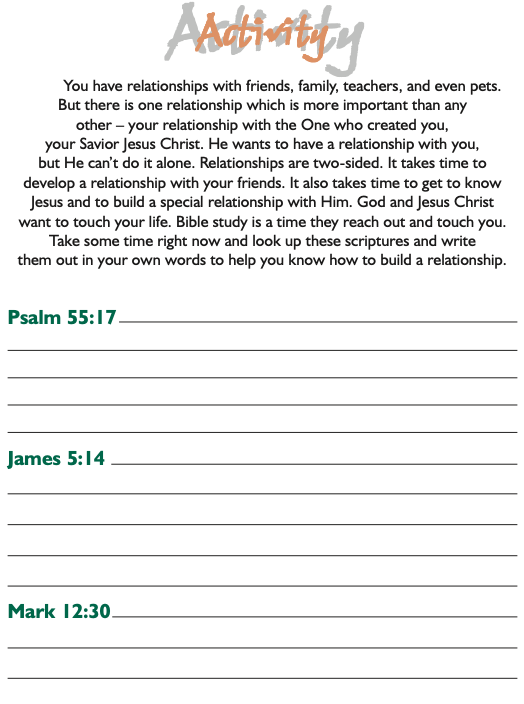
God may not relieve your pain as fast as He healed the woman who touched Him. But He loves you and cares about you personally. He wants a close relationship with you. That close relationship can only come when you obey Him and have daily contact with Him in prayer and Bible study. He wants you to reach out to Him. He wants you to touch Him so that He can touch your life. He will never leave your side.
Student Prayer
Dear Father,
You are such an awesome God! Your miracles are most encouraging to me. Through them I can learn how much you love me and that you will never leave my side. Help me always to have a very close and personal relationship with you.
In Jesus’ name.
Amen.
Daily Devotions
Sunday - Matthew 9:18-22
Monday - Leviticus 15:25-27
Tuesday - Mark 5:22-25
Wednesday - 2 Kings 20:1-21
Thursday - Luke 8:43-48
Friday - Luke 5:18-26
Saturday - Matthew 9:2-8
Objectives
At the end of this lesson, students will be able to:
1. Explain that time and chance happen to all men and life is temporary even for teens.
2. Discuss that real peace can only come from a close relationship with God and what that relationship consists of.
3. Talk about the importance of first going to a compassionate and all powerful God when we are sick and in trouble.
Topics & Themes
Death
Faith
God’s Omnipotence
Jairus
Jesus, His Miracles
Healing
Resurrection
Obedience
Pain
Prayer
Relationship with God
Resurrection
Temporary
Materials Needed
Bible, YEA students and teacher’s books, attendance and memory verse charts, songbooks, CD and music player
How to Teach This Lesson
By sequentially following the questions laid out below, you will be better equipped to complete every section, stay on track and meet the objectives of this lesson.
Teens rarely reflect on their mortality. They can drive fast and reckless, but somehow they think death won’t touch them. Begin the class by asking each student to relate his or her stories about teens who have died or friends or relatives who have had cancer. Ask them to tell about the impact this had on their family and how they reacted to it.
How did it affect their relationship with God and their family? Ask one of the students to read Mark 5:21-24. Why do you think Jairus thought Jesus could heal his daughter. Is it easier for Jesus to heal a common cold than to heal someone with cancer or a person who is at the point of death? Why or why not?
Ask another student to read Mark 5:25-32. In a crowd such as this, how many people do think might have touched Jesus’ garment? Do you think the woman thought she could be healed without Jesus knowing it? Probably. How do you think she felt when she got caught in the act? She seemed afraid and humbled because she fell to the ground in front of Jesus, yet she was completely honest.
How did Jesus show His love and compassion to this woman? Her healing remained and He called her “daughter” an intimate term that He didn’t use anywhere else in the New Testament.
When you are ill, do you find it difficult to trust that Jesus will heal you? Why or why not?
Since Jesus made it clear that the woman’s faith had healed, not only her hemorrhaging, but she had been healed spiritually, what impact do you think that had on her life?
Can time and chance happen to you the same as it did to Kevin? What would change in your life if you learned you had terminal cancer? I would try to have a closer relationship with God.
Would things that didn’t seem so important suddenly become more important and things that are now important become lower on your list of priorities? What things do you think would suddenly become more important? A good relationship with God, family and friends. Sabbath School, keeping the Sabbath, obeying God, repentance and baptism would be of greater importance as well.
What are the elements of a close relationship with God? Knowing God through Bible study and prayer. Living the Christian life.
What can you do to build a better relationship with Jesus?
Just because you’re healthy today, does that promise you that you’ll never have cancer as Kevin did? No. How would it change the way you live your life? I would try to please and obey God better. Since we’ve learned that time and chance happen to all men, why should we please and obey God in the same way as we would if we had terminal cancer?
Teacher-Directed Activity
Have the students gather in the center of the room. Divide them into two groups. Tell them that you’re going to have your own talk show today. Half of the class will be the audience and the other half are celebrities who make up the panel. All of the panel has a common denominator – they have all been betrayed. Assign each panelist the job of selecting a pretend name and a story of betrayal. In the meantime, the audience is to compile a list of very difficult questions to ask the panelists. These could include “What happened to you?” “How did you feel about it?” “What aspect of this betrayal was the most difficult for you?” “How did this affect your relationship with the person who betrayed you?” The teacher can act as the talk show host. Each member of the panel should be introduced before the audience begins to ask their questions. After the talk show is over, ask, 1) What elements were common in virtually every story? 2) Which of these stories was similar to a betrayal you have experienced? 3) Do you fully trust anyone to never betray you? 4) Did the compassion God showed to the woman who was bleeding and Jairus’ daughter have any affect on your trust in God?
Song
“I Exalt Thee” is on page 39 of The Group Songbook.
Closing Prayer
Have the students form a circle and join hands as a volunteer leads in prayer. Suggest that he thank God for being concerned with human needs. Ask that God will help them to have a close relationship with Him, their family and friends.
Printable Pages