YEA Lesson Library
Worship God in Truth
About This Lesson
This lesson teaches why Christians should not celebrate Easter.
Scriptures
Exodus 23:13
Joshua 23:7
1 Kings 11:1-11
Ezekiel 8:13-18
John 4:23
Words to Know
SIGNIFICANT - very important, noteworthy
PREPARATION DAY - the day before a Sabbath or holy day, used to prepare for the Sabbath
PAGAN- having to do with worship of gods other than the one true God
CELEBRATE- to do something special to mark an event or day
The Lesson
"Hey, Dad," Andy asked, "why do some people celebrate Easter?" Andy and his dad were changing the oil in the lawn mower and sharpening the blade.
"Well, some people celebrate Easter because they truly believe that's when Jesus rose from the dead," Mr. Willis replied.
"Do we believe that?" Andy asked.
"No," his dad said, "and l'll tell you why. We believe that Jesus died at the end of the day on Wednesday that year, just before sunset, just before the first Day of Unleavened Bread.”
"Okay," Andy said, "and since Jesus was in the tomb for three days and three nights .
"Right. Let's count it out," M.r Willis said. "Wednesday night is one night. Thursday is one day.”
"Thursday night is two nights," Andy continued. "Friday is two days. Friday night is three nights. Saturday is three days." Andy held up his hands with three fingers showing on each hand. "That's three days and three nights!”
"And we end up at Saturday night,” Mr. Willis said, "not Sunday morning.”
"Okay," Andy said, "but why do some people think it was Sunday?”
His dad sighed. "There are lots of reasons. Some have been taught that, so that's what they believe. Some have never heard anything different. Some don’t know about the holy days, so they think the preparation day that Jesus died on was the day to prepare for the Sabbath, instead of the First Day of Unleavened Bread. Some are comfortable with what they do and don’t see a need to change. Some don’t think the day is important. They believe the celebration of the event is what is really significant."
"What's the deal with the Easter bunny and eggs and chocolate candies?" Andy asked.
"That's all part of the pagan stuff that goes with Easter," Mr. Willis told Andy.
"What do you mean?" Andy asked. "What does pagan mean?"
"Pagan means what was done to worship other gods ,"Mr. Willis explained. "Do you remember how God told His people not to do what the nations around them did? God didn't want them to worship Him in those ways. They were pagan.”
"What is bad about them?" Andy asked.
"It looks like fun, doesn't it?" Andy's dad smiled."That's one of the bad parts of the pagan things. Sometimes they look really good. Like Easter eggs and Easter egg hunts. That's just fun for the kids, right?”
"It does look like fun," Andy agreed.
"But Easter eggs don't come from rabbits. Easter eggs and rabbits were part of the worship of pagan gods," Mr. Willis told Andy.
"And God said not to worship Him with pagan things," Andy said.
"Because it's not true? “
"Right," his dad agreed. "Truth is very important to God. Easter isn't when Jesus rose from the dead. And Easter eggs don't come from rabbits. And rabbits and eggs don't have anything to do with worshiping God."
"So what do I tell my friends when they ask what I'm doing for Easter?" Andy asked.
"You could start by telling them that you don't celebrate Easter because you don't believe Jesus rose from the dead that morning," his dad said. "Then if they ask you more questions, you can give them more. "
"And if they aren't really interested," Andy said, "I'd just let it drop.”
"Right," Mr. Willis said, "you want to give them as much as they will think about, but you don't want to drive them away with too much information.”
"Okay. Thanks, Dad," Andy said. "I just have one more question.”
"What's that, son?" Mr. Willis asked.
"Are we ready to mow this lawn?"
"You bet!" Dad answered.
Student Prayer
Dear Heavenly Father,
Thank you for your holy days. I love to celebrate them. Thank you for showing me the truth and why I shouldn’t keep Easter.
In Jesus' name I pray.
Amen.
Daily Devotions
Sunday - John 4:23
Monday - Ezekiel 8:13-18
Tuesday- Exodus 23:13
Wednesday- Joshua 23:7
Thursday- 1Kings 11:1-3
Friday- 1Kings 11:4-6
Saturday - 1Kings 11:7-11
Objectives
At the end of this lesson, students will be able to:
1. Give three reasons why Christians should not celebrate Easter.
Topics & Themes
Choices
Easter
Holidays, Easter
Jesus, Resurrection of
Pagan Traditions
Materials Needed
Bible, YEA Students' and Teacher's books, attendance and memory verse charts, stars, songbook, CD and player, poster board cut into 1l" ×17" pieces for each student, self-sticking foam letters, stickers, stamps, markers, glitter, glue, puppet
Preparation
There's a difficult line to walk in teaching this lesson: Giving reasons why we do not celebrate Easter while teaching children not to denigrate those who do. Sometimes it helps just to be aware of this goal.
For some children, finding all the foam letters for the activity during class time is a daunting task. You may wish to supply the letters for each child. Then they'll simply have to put them in the correct order to form the memory verse.
How to Teach This Lesson
After opening the class with prayer, begin the lesson below.
Teacher: We're talking about Easter today.
Puppet: Oh good! I love Eastern things — the Atlantic Ocean and the Statue of Liberty. If you get really far Eastern, there are snow monkeys inJapan.
Teacher: No, we're not talking about a direction, eastern; we're talking about a day that some people celebrate called Easter.
Puppet: Oh! Easter. Okay, Easter. But I don't know anything about Easter. How am I going to be able to do any talking? I don't know anything about Easter. Do you know anything about Easter, children? Can you help me out? l'm not going to be able to talk at all. I don't know anything about Easter. And why are you so quiet today?I'm not going to be able to talk and the kids are quiet.
Teacher: Shhhhhh! (To the puppet, puppet puts hands over mouth. Waits for the children.)
Teacher: Let's start with rabbits and eggs.
Puppet: Why are we talking about rabbits and eggs now? I thought we were going to talk about Easter?
Teacher: (Give the puppet a quelling “teacher" look.) How many of you believe there is such a thing as an Easter bunny?
Puppet: I think there's an Easter bunny. Don't we get to see him every Easter?
Teacher: You may have seen a poster of an Easter bunny in a store somewhere, but you've never seen a real, live Easter bunny. It doesn't exist. There is no such thing.
Puppet: How did they get a poster of it then?
Teacher: It's just someone's imagination. And, if you look closely, you'll see that the Easter bunny is different from store to store.
Puppet: But if there's no Easter bunny, why do people say there is an Easter bunny?
Teacher: It's part of Easter. He's supposed to lay eggs. Sometimes they are chocolate and sometimes they are plastic with candy inside.
Puppet: Yum! I like chocolate and candy. The Easter bunny sounds pretty good to me. Are you sure it's not real?
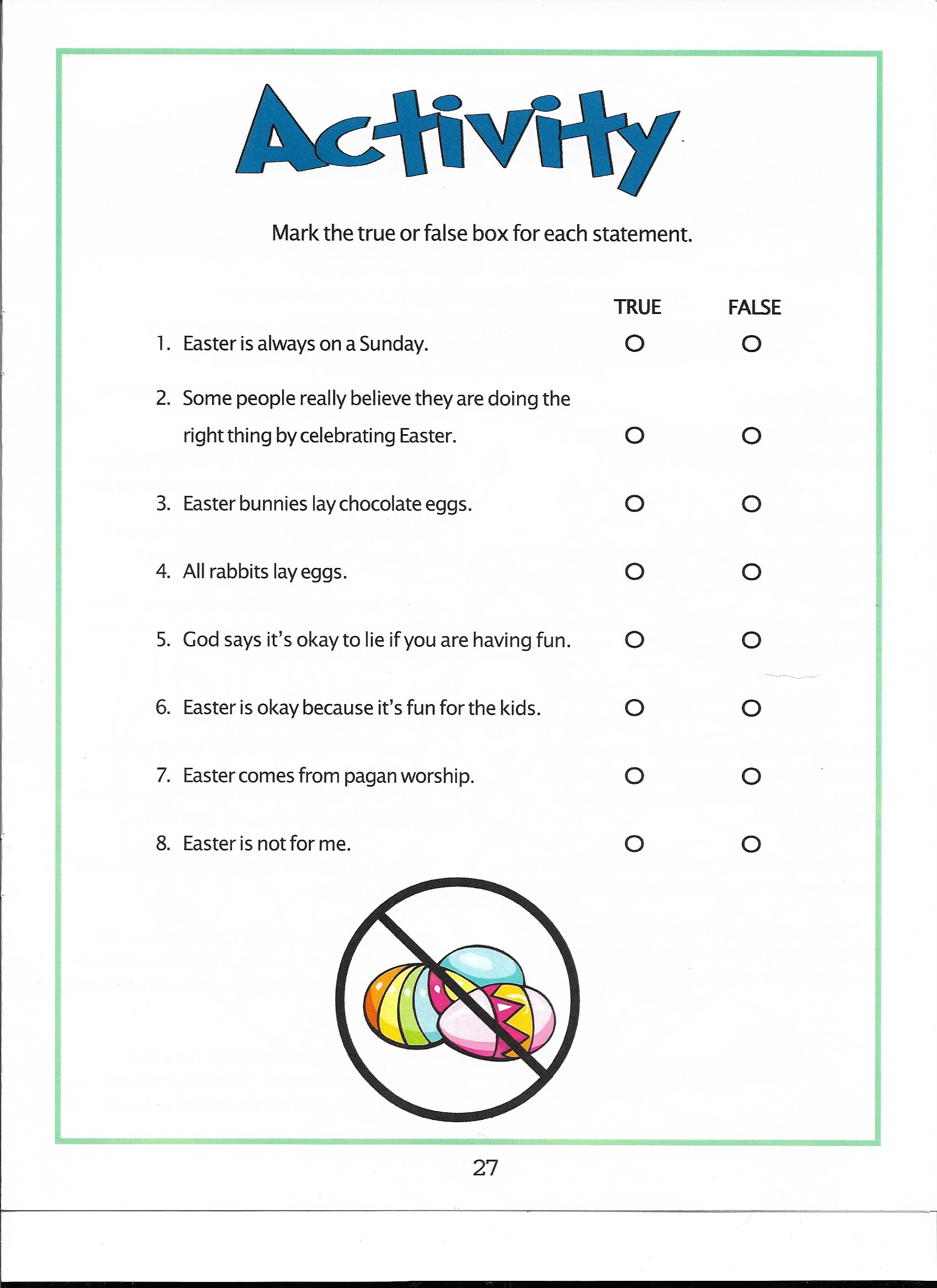
Teacher: It's not real. And rabbits don't lay eggs. But most people think children will have the same response our puppet did. People say they keep the Easter bunny in their Easter celebration for the kids. The kids need t o have fun.
Puppet: But it's a lie. That doesn't make sense! Parents are always telling you, "Don't lie. Tell the truth." Are parents really lying to their kids?
Teacher: If they're telling them the Easter bunny laid eggs for an Easter egg hunt, they’re not telling the truth. And if they tell their children the Easter bunny is real, they are not telling the truth.
Puppet: Is that why people celebrate Easter?
Teacher: No, that's just one part of Easter that is not true. The other part of Easter that is not true is what they believe about Jesus.
Puppet: People lie about Jesus? Uh-oh. That's bad.
Teacher: I think some people don't know they are lying. They are just doing what they've been told is right. They have been told that Jesus died onFriday, was three days and three nights in the tomb, and rose on Easter Sunday morning.
Puppet: Wait a minute! Did you say three days and three nights?
Teacher: Yes! Jesus said that He would only be dead for three days and three nights.
Puppet: But there are not three days and three nights in Friday and Sunday! Even if you count Friday afternoon and early Sunday as days, there are not three nights!
Teacher: You're right. But some people say that doesn't matter. It's more important to celebrate Jesus' resurrection from the dead.
Puppet: Is that the important thing?
Teacher: We're talking about the Son of God! We're talking about Him coming back to life from the dead and ascending to God's throne. This is so important! It's the only way any of us have a chance to live with God in His Kingdom! I believe the details are important!
Puppet: I think tails are important, too, especially if you're a monkey.
Teacher: Not tails, details. I believe that all the pieces of a celebration are important. Some people may truly want to worship God on Easter. But it's not a good choice for me because I believe the truth that is in the Bible.
Puppet: God doesn't like lies, either.
Teacher: Easter isn’t the best choice to worship God, especially when you have something better.
Puppet: Something better?
Teacher: You bet. God's holy days and the Sabbath are the best choices for worshiping God.
Review Questions
1. Why isn't Easter for you?
2. How should you treat people who do celebrate Easter?
3. What do you have that is a better choice for worshiping God?
Teacher-Directed Activity
Have students use foam letters to write the memory verse on an 11" x 17" piece of poster board. When the memory verse is completed, decorate with markers, stickers, stamps, glitter, etc.
REACH Activity
1. Do a sword drill with the daily devotionals. Depending on how many children you are involved, you can either have them compete against each other to see who can get to the scripture first or you can have a child time himself (or herself) and try to better his time each successive scripture.
2. Sing: From Kids Classics Collection, “The B-I-B-L-E” on page 18 and “I Am a C-H-R-I-S-T-I-A-N” on page 52;
From the CEM Hymnal, “Christ the Lord is Risen Today” on page 7;
From The Group Songbook, “Open Our Eyes” on page 50.
3. Song Application. Choose one of the songs from REACH Activity #2. How does it relate to the non-observance of Easter? One way you can depict this is to divide a piece of notebook paper vertically in the middle. One the left side, write the song lyrics. On the right side, make notes about how it applies to not keeping Easter. Include scripture references, if applicable.
4. Venn Diagram. Use a Venn Diagram to display what the Passover and Wave Sheaf Day have in common with Easter. Here are some suggested words to place in the correct part of the Venn Diagram: spring, Jesus’ death, Jesus’ resurrection, Easter eggs, Easter bunny, celebration, God’s holy day, pagan festival, truth, lie, three days/three nights, Friday crucifixion/Sunday resurrection, unleavened bread, hot cross buns. Once you have placed all of the words in the correct space, talk about this with your family. Then recopy your Venn Diagram onto a poster board. Use your neatest handwriting with easy-to-read lettering. Add scriptures, if applicable.
5. But it’s fun! One of the arguments that people use for celebrating Easter is that it’s fun for the kids. Think about this reasoning! In your Bible notebook, write down three reasons why this is a terrible reason to celebrate Easter.
6. Essay. In your Bible notebook, write the answer to this question: Why isn’t Easter for you? (Question from the teacher’s edition, Review Questions section).
7. Giving an answer. In 1 Peter 3:15, we are told to be ready to give an answer to anyone who would ask us about the hope we have in Jesus. Many people who celebrate Easter believe that their hope is based on Jesus’ resurrection. How would you agree with what they believe? How would you disagree? How would you give an answer to someone who asks you about your belief in the resurrection of Jesus Christ and yet your non-observance of Easter? The second part of the verse says that we are to give an answer with gentleness and respect. Consider what you might say to someone and what scriptures you would use to back up your belief. Discuss this with your family and then role play the situation.
8. Giving an Answer, Part 2. After doing REACH Activity #7, write a dialog between two people. One person celebrates Easter and asks the other person why they don’t celebrate Easter. They also want to know why the second person celebrates Passover. They might assume the second person is Jewish. Keep this in your Bible notebook.
9. Calendar Count. On an 11 x 18 piece of paper, draw a chart of five boxes. Label them Wednesday, Thursday, Friday, Saturday, Sunday. With a green pen (Green for “go!”), label the following:
Wednesday - Passover Day, Jesus’ crucifixion, Jesus’ death in the afternoon and burial before sunset;
Thursday - First Day of Unleavened Bread;
Friday - Preparation Day for the Sabbath, women bought spiced and prepared them; Saturday - Sabbath; at the end of the sabbath (sundown), Jesus’ resurrection, wave sheaf cut and prepared all night;
Sunday morning - Jesus’ ascension to the Father, wave sheaf offering at the Temple
Then number the days and nights that Jesus was dead (in the tomb).
With a red pen (Red for “stop!”), label the following (Easter is based on this timing):
Friday - crucifixion
Sunday morning - resurrection (Jesus coming out of the tomb)
Number the days and nights that Jesus was dead (in the tomb).
10. Three days/three nights. Jesus said the only sign that he would give would be the sign of Jonah. (Matthew 12:40) Based on REACH Activity #9, does Matthew 12:40 support the celebration of Easter? Why or why not? Write about this in your Bible notebook.
11. He Understands Essay. Sometimes people will excuse their celebration of Easter, saying that God knows their heart. In other words, they are telling you that they don’t want to obey God, but God knows that they are basically a good person and so He won’t be upset about their disobedience. Is that the way it works? Let’s consider it in human terms: Your mom and dad tell you not to do something. They don’t like that particular action and it doesn’t honor them. But you decide to do it anyway. What will their response be? Will they accept your statement that they should know your heart and give you a pass on your disobedience? If they don’t apply a consequence to your disobedience, why would you ever obey them? Our God is a God of justice. There is a penalty that is required for sin - the transgression of His law. When God says not to do something, that’s a law or commandment. If you decide to disobey, you are going to suffer consequences. After you have thought about this subject, write your thoughts in an essay to share with your family.
12. Flow Chart. Create a flow chart about whether you should celebrate Easter. Start with a title, for example: Making a Decision About Celebrating Easter. Then set up your questions in the flow chart. You can use questions like: Are the origins of Easter pagan? If yes, then ask the question: Does it please God to celebrate pagan festivals? If no, then ask the question, does it honor God? Next, give the choices of answers to “Does it please God to celebrate pagan festivals?” If yes, direct the person to read any of the passages which clearly say that God doesn’t want us to celebrate pagan festivals. If no, direct the person not to celebrate Easter. Next, give the choices of answers to the question, “Does it honor God?” If yes, ask “Does it honor God to celebrate something that is not true?” If no, direct the person not to celebrate Easter. Then answer the question “Does it honor God to celebrate something that is not true?” If yes, direct the person to read the scripture in John 14:6 telling us that Jesus is the Way and the Truth and the Life. He doesn’t have anything to do with untrue/false celebrations. Direct the person not to celebrate Easter. If no, direct the person not to celebrate Easter. Add any of your own questions to the flow chart. Share with your family.
Song
"Everybody Ought to Know" is on page 1 of Kids Classics Collection.
Closing Prayer
Lead the children in prayer asking God to show them the way He wants to be worshiped. Thank God for the gift of His Son, His holy days, andHis love.
Printable Pages