YEA Lesson Library
Add or Subtract
About This Lesson
This lesson teaches that Easter is not a holiday that God’s people should celebrate; God’s people should celebrate God’s Holy Days.
Scriptures
Exodus 20:3
Exodus 23:13
Numbers 33:52
Deuteronomy 4:2
Deuteronomy 12:29-32
Deuteronomy 12:32
1 Kings 11:1-11
Jeremiah 7:18-23
Ezekiel 8:13-18
Revelation 17:1-2
Revelation 22:18
Words to Know
WORSHIP - to show honor and re- spect in a sacred way
CELEBRATE - to commemorate a day with ceremony and festivities
CONFUSE - to be unclear or fail to distinguish between
PLAGUES - a widespread disease where a lot of people die
The Lesson
A long, long time ago there was a goddess named Easter. In the spring of the year, about the time of the Passover, a feast was celebrated to this goddess. It was a joyous day of celebrations and games. Before the sun came up on Sunday morning, the people would meet outside and face the rising sun to praise Easter, their goddess. The celebration included finding colored eggs which were hidden in the grass, around trees and in other hiding places. The children especially enjoyed this game. This happened many years before Jesus was ever born. Then rabbits were added to this celebration.
Some years Easter and the Passover season were at the same time. A lot of people thought it was fun to celebrate Easter with colored eggs and bunny rabbits. People became confused and did the wrong thing.
We shouldn’t say bad things about people because they celebrate Easter. Some people celebrate Easter because they think Jesus was raised from the dead on that day. Do you remember what day Jesus was raised from the dead? The Bible tells us that Jesus was raised from the dead “Late on the Sabbath, as it began to dawn toward the first day of the week” (Matthew 28:1 NASB). Did you notice that Jesus wasn’t raised from the dead on Easter Sunday morning?
God has told us how to worship Him. He has given us Holy Days to celebrate, but Easter is not one of them. It is not a day that God commands us to remember or keep. It is a day celebrated to a goddess named Easter. Do you remember what the first commandment says? It says, “Do not put any god in place of me” (Exodus 20:3 NIrV Kid’s Devotional Bible). God says we should not bow down to another god or worship it. Easter is another god or goddess that God says we are not to worship.
God tells us to Celebrate the Passover and the Days of Unleavened Bread. We do not please God if we add to or take away from what He has said, “Don’t add to what I’m commanding you. Don’t subtract from it either. Instead, obey the commands of the LORD your God that I’m giving you (Deuteronomy 4:2 NIrV Kid’s Devotional Bible). God was very serious about this. He tells us in Revelation 22:18, “I am warning everyone who hears the words of the prophecy of this book. If you add anything to them, God will add to you the plagues told about in this book. If you take any words away from this book of prophecy, God will take away from you your share in the tree of life. He will also take away your place in the Holy City. This book tells about these things” (NIrV Kid’s Devotional Bible).
In the spring of every year we remember the Passover and we Celebrate the Feast of Unleavened Bread. We eat unleavened bread for seven days because God says we should. He does not want us to con- fuse these celebrations with Easter, colored eggs and bunny rabbits. God wants us to worship Him the way that He tells us to. God says, “Do not follow the practices of other nations” (Jeremiah 10:2). “Don’t ask questions about their gods. Don’t say, ‘How do these nations serve their gods? We’ll do it in the same way.’ You must not worship the LORD your God the way they worship their gods” (Deuteronomy 12:30 NIrV Kid’s Devotional Bible).
The Passover is a night for which we can be very thankful. God gave the Israelites their freedom on that night. Jesus Christ gave us forgiveness for our sins on the Passover. We can rejoice in the Days of Unleavened Bread because Jesus loves us so much. He wants to give us what is best for us. He wants to live His life in us. God’s feast days are great! Let’s not be confused.
Student Prayer
Dear Heavenly Father, Thank you for showing us how to worship you. Thank you for creating everything so it makes sense. Help me to always worship you in the right way. In Jesus’ name. Amen.
Daily Devotions
Sunday - 1 Kings 11:1-11
Monday - Ezekiel 8:13-18
Tuesday - Jeremiah 7:18-20
Wednesday - Exodus 23:13
Thursday - Numbers 33:52
Friday - Revelation 17:1-2
Saturday - Jeremiah 7:21-23
Objectives
At the end of this lesson, students will be able to:
1. State that God must be worshiped in the manner He desires.
2. Explain that Easter was a goddess.
3. Recite the first commandment.
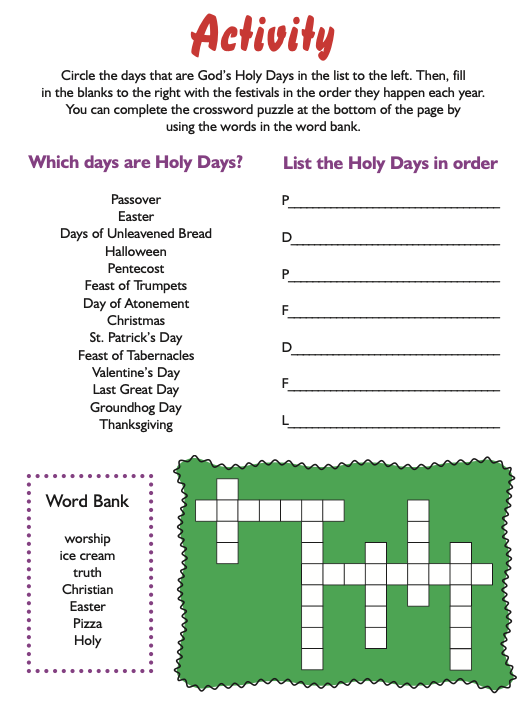
4. Recite the Holy Days of God.
5. Distinguish between God’s Holy Days and holidays that God does not command.
Topics & Themes
Easter
Holidays, Easter
Holy Days, Passover
Jesus, His Miracles
Resurrection
Pagan Traditions
Passover
Ten Commandments
No Other Gods
Worship God
Materials Needed
Bible, YEA students and teacher’s books, two boxes, gift wrapping paper, broken glass, marker pen, songbook, CD/cassette tape and music player, attendance and memory verse charts, stars
Preparation
For a teacher to be adequately prepared to teach this class he or she needs to have an understanding of how Easter preceded the resurrection of Christ (see “People got confused”) with many of the same customs used in its celebration today. In 8 B.C., four years before Christ’s birth, the Germanic people, offered sacrifices to the goddess of spring on the evening before the first Sunday after March 21st. The egg was regarded as the emblem of germinating life of early spring. On Sunday morning they gathered again before dawn. Everyone would face the East – toward the rising sun – praising their goddess. This was a joyous day with games. One game was to find colored eggs which were hidden in the grass, around trees and in other hiding places. Children especially enjoyed these games. (see the Encyclopaedia of Religion and Ethics, vol. 2, p. 34 and the Westminster Dictionary of the Bible, John D. Davis, p. 145). The ancient Persians presented each other with colored eggs when they kept the festival of the solar new year in March (see Chamber’s Encyclopaedia, article, “Easter”).
“The recognized religion, however, is only a part of folk belief, which is impregnated with concepts from earlier times. The decorated Easter egg, for example, is an evolution of the egg as an ancient symbol of renewed life,. . . There are many survivals from local pagan cults, particularly of motifs associated with life, fertility, and protection. . .” (Encyclopaedia Britannica, Macropaedia Knowledge in Depth, volume 7, page 475.)
How to Teach This Lesson
Goddess named Easter - Begin the class by talking about children at school having Easter egg hunts. Ask: Why do you think they are doing this? Do you think this is right? Explain that a long, long time ago there was a goddess named Ishtar and we pronounce her name Easter in English. Tell that this celebration took place many, many years before Jesus was ever born.
Easter Customs - Discuss how eggs were colored, hidden and hunted in celebration to the goddess of heaven as she was called. They baked cakes, much like the “hot cross” buns that are in bakery shops today about Easter time (Jeremiah 7:18). God said that made Him very angry. Do you know why it made Him angry?
People got confused - The Passover season is also in the spring of the year. It always precedes Easter (see Preparation), but the celebrations are close together. Explain that the people had a lot of fun coloring eggs, hiding them and finding them. This was a big celebration. Even though some of them believed in Christ, they didn’t want to stop celebrating to the Queen of Heaven. So they began to think it would be okay for them to still celebrate in the same way and think it was worshiping Christ.
Why God was angry - “The children go out and gather wood. The fathers light the fire. The women mix the dough. They make flat cakes of bread for the goddess who is called the Queen of Heaven. They pour out drink offerings to other gods. That makes me very angry” Jeremiah 7:18 (NIrV Kid’s Devotional Bible). Do you remember what the first commandment says? God forbids us to put another god in His place. He is the one and only true God. All other gods are worthless and we shouldn’t do anything to worship them.
God wants us to celebrate - God has given us many wonderful and right days to celebrate. Can you name them? Discuss how we remember Jesus’ death to pay for our sins at the Passover. We Celebrate the Days of Unleavened Bread in the spring because God says for us to do this. He wants us to remember that Jesus is the Bread of Life. When we eat unleavened bread it helps us to remember to put Jesus first in our lives.
Don’t condemn those who celebrate Easter - Explain to your class that people who celebrate Easter don’t understand that it is wrong to do it. We should never say bad things about them. They keep Easter to celebrate Jesus’ resurrection.
We must worship God as He tells us to - Discuss how God does not want us to add to or subtract from what He says for us to do in the Bible. This is a very serious thing and God will not like it if we do. This will make Him very angry. He wants us to worship Him in Spirit and in truth. This means that we try to do exactly what He wants us to do.
Teacher-Directed Activity
Before class wrap two boxes that are the same size. On one write “Handle with Care” and have some broken glass in it. Put both boxes on a table before you in class. Ask the students what does “Handle with Care” mean on the first box? What would happen if we drop the box? It could break and be completely ruined. Drop the box and let them hear the broken glass.
This other box has no sign on it to let us know how to handle it. Let’s pretend that an explosive such as dynamite is inside. What kind of warning would you put on the outside?
Since we don’t know what is inside this box, we don’t really know what kind of label to put on it. We have to open it to see. The same thing is true with the Bible. We have to open it and read it to find out what is true.
REACH Activity
1. Do a sword drill with the Daily Devotional Scriptures. Read the Scripture reference to the child. Then start the timer. When the child has found the verse, stop the timer. Read the verse and talk about how it relates to the lesson. Challenge the child to see how quickly he/she can find each of the verses in the Bible.
2. What do you know about Easter? In your Bible notebook, list the things that people usually do on Easter. You may also wish to list the things that are traditional to eat. Once you’ve listed everything you can think of, go to your mom and ask her to help you add to the list. Then go to your dad and ask for his help. The next thing to do is to look at each item and figure out whether it’s a good thing or a bad thing (i.e something that would not please God). If you think it wouldn’t please God, why do you think that. Make sure to write down the reasons why you think Easter isn’t pleasing to God.
3. Make three posters out of 11 x 17 paper. One should have a 🚫. Another can have “No Easter Allowed.” The third could have “Easter Prohibited Here” or “Rabbits Don’t Lay Eggs; What Other Lies Does Easter Promote” or “No Bunnies Here” (my favorite because it sounds like “nobody’s here”). Add sketches of Easter eggs, rabbits, or Easter baskets. Use your favorite color tools to make them really stand out. Display them in your room or an appropriate place in your home. Ask permission from your sabbath school teacher to display them at church.
4. Is Easter really about the resurrection of Jesus Christ? Talk with your mom and dad about scriptures that say Jesus was raised from the dead at the end of the Sabbath. When does the day end, according to God? When the sun sets. With your parents’ help, make a calendar/timeline of the events surrounding Jesus’ death and resurrection in the year that He died. Tuesday evening: Passover meal with disciples in the upper room. Then Jesus went to the Garden of Gethsemane. Early Wednesday morning, Jesus was arrested. He was nailed to the cross. He died Wednesday afternoon. They had to hurry to get his body into the tomb before sunset because Thursday was the first Day of Unleavened Bread, one of God’s Holy Days. Friday was preparation day for the sabbath. The women bought spices. They rested on the Sabbath. At the end of the Sabbath, Jesus was resurrected. (If you have filled in the events on your calendar, you can count the three days and three nights that Jesus said He would be in the tomb.) He told the women not to hold on to Him because He had not yet ascended to the Father. The next time He saw them, He had because He told them to touch Him. He had been accepted by the Father as the First of the firstfruits, on the Wave Offering Day which began when the sun went down Saturday night.
5. Make a True/False quiz based on your lesson. Be sure to make a key with the answers. Then give it to your mom or dad to take. Grade the quiz when they finish.
6. Sing:
A. From Kids Classics Collection: “Thy Word Have I Hid in My Heart” on pg. 75, “I Am A C-H-R-I-S-T-I-A-N” on pg. 52, and “The B-I-B-L-E” on pg. 18.
B. From The Group Songbook: “”Thy Word” on pg. 30, “Create in Me a Clean Heart” on pg. 36, “Open Our Eyes” on pg. 50.
C. From the CEM Hymnal: “Give Of Your Best to the Master” on pg. 147, “I Love to Tell the Story” on pg. 80, “Let Others See Jesus in You” on pg. 178, “Yield Not to Temptation” on pg. 149.
7. Choose one of the songs from the list. Write a paragraph in your Bible notebook about why it would be a good song to sing to refute the celebration of Easter.
8. Choose one of the verses from your daily devotions. Write the scripture in your Bible notebook. Then explain how the verse you chose relates to not celebrating Easter.
9. Sometimes when we take a stand against celebrating Easter, people think that we don’t love God and that we don’t believe Jesus was resurrected from the dead. Then, because we celebrate Passover and the Days of Unleavened Bread, they think we’re Jewish. You can’t force your beliefs on anyone else, but you should be able to defend why you do the things you do. Read 1 Peter 3:15. Then write a paragraph in your Bible notebook defending why you don’t celebrate Easter and why you do celebrate God’s holy days.
10. Write a poem about loving God and following His commandments to stay away from pagan practices. Once you are satisfied with the flow, copy it onto a nice piece of drawing paper. Add a decorative border to the paper and color with your favorite coloring tools. Then display in your room. This will be a good reminder when someone tries to pressure you to do something that you know won’t please God.
11. Write your memory verse on a piece of black construction paper. Either use a white crayon or write chalk. Then put addition and subtraction problems around your memory verse for decoration. Glue on a border of brown or tan construction paper strips. Display on your refrigerator. Remember to practice your memory verse three times every day this week.
12. Make a side-by-side drawing by folding a piece of paper in half and putting a line where the crease is. On one side, draw a picture of children looking for Easter eggs. On the other side, draw a child reading the Bible, singing songs of praise to God, or having fun with their friends during the Days of Unleavened Bread. Put a caption across the bottom like “What do you think would be more pleasing to God?”
Song
“I Am A C-H-R-I-S-T-I-A-N” is on page 42 of the Kids Classics Collection.
Closing Prayer
Lead the children in prayer thanking God for wonderful Holy Days that we can celebrate. Tell Him that we want to always worship Him as He has shown us in the Bible.
Printable Pages