YEA Lesson Library
Two Goats
About This Lesson
This lesson teaches the importance of observing the Day of Atonement.
Scriptures
Leviticus 16:1-4
Leviticus 16:15-18
Leviticus 23:26-32
Leviticus 23:27
Romans 5:6-11
Hebrews 9:11-12
Hebrews 10:1-6
1 John 2:2
Words to Know
ATONEMENT - the covering of sins
FAST - to go without eating food. Health and age should be considered
PUNISHMENT - consequence for doing something wrong
SCAPEGOAT - A goat on whose head the High Priest put the sins of all the people. Then it was sent into the wilderness
The Lesson
Can you remember the last time you did something you shouldn’t have done? Were you punished for it? If your par-ents didn’t know about it, then you probably weren’t punished. You may clearly remember the last time you were punished for doing wrong. Why do your parents punish you when you do the wrong things? They want you to be safe and happy. They want you to grow up to be a good person. Your Mom and Dad want you to know right from wrong. They don’t punish you because they hate you. They love you and want the very best for you. That’s why they pull you on their lap and tell you that they love you after they punish you.
If you don’t have an older brother, imagine that you do. Wouldn’t you love your brother a lot? Now think about something you did that you should not have done. Mom and Dad know about it. And you know you will be punished. What if your older brother knows that you are very sorry that you did this bad thing. What if your older brother tells your parents that he will take the punishment for you? That would never happen would it?
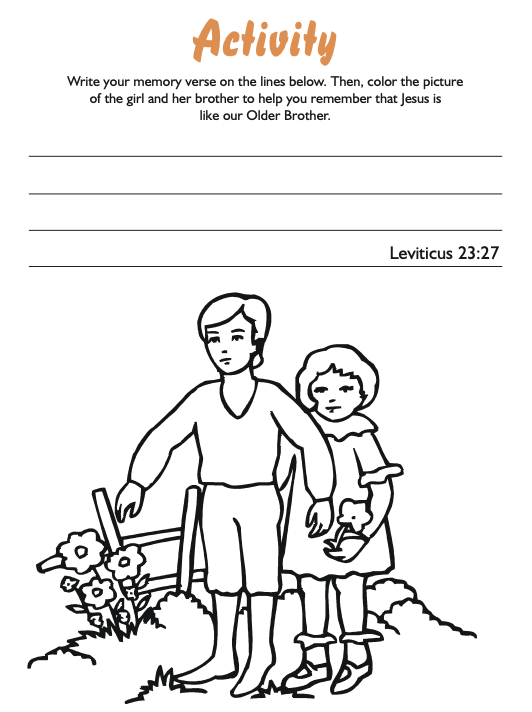
Yes, it could and it did. Jesus is our Older Brother. This is the reason Jesus was born as a baby and lived on this earth. He came to give His life for all the bad things you have done. When we do something we shouldn’t, Jesus is there to take our punishment for us. But He will only take your punishment if you are truly sorry. We can’t just be sorry that we got caught. We have to be so sorry that we’ll never do it again. When we are that sorry, God gives us a way out of the punishment. God, our Heavenly Father, loves us so much that He gave all of us His Son, Jesus.
This is what the Day of Atonement is all about. Do you remember that during Passover we talked about the lamb that stands for Jesus Christ? On the Day of Atonement there is a goat that stands for Jesus as well.
A special service was done by the High Priest in the Temple on the Day of Atonement. It was like a play on a stage. This play told the story of how bad sin is and how Jesus forgives all of us. Everything in this play had to be done exactly as God said. The priest had to wear special clothes. Two goats played a part in this play. One stood for Jesus and the other was a scapegoat.
The Holy of Holies was a room in the Temple. The Ark of the Covenant was in this room. It was beautifully covered in pure gold. The Ten Commandments were in it. No one could ever go in that room except the High Priest. If they did, they would die. This was the only day in the year that the High Priest could go into the Holy of Holies. He went there so his sins and the sins of all of Israel would be forgiven.
God wants us to remember every year how bad our sins are. We don’t eat food or drink anything that day. That’s very hard for some people to do. But we do it because we love God and we want to do what He says. We know that we have done a lot of wrong things during the year. On the Day of Atonement, we need to pray and tell God how sorry we are for our sins. God is ready to forgive us, and we can be very thankful for that. The Day of Atonement is a very important day to each child of God.
Student Prayer
Dear Father, Thank you for the Day of Atonement. Help me to remember what you have done for me. In Jesus’ name I pray, Amen.
Daily Devotions
Sunday - Leviticus 16:1-4
Monday - Leviticus 16:15-18
Tuesday - Leviticus 23:27-32
Wednesday - Romans 5:6-11
Thursday - Hebrews 9:11-12
Friday - Hebrews 10:1-6
Saturday - 1 John 2:2
Objectives
At the end of this lesson, students will be able to:
1. Give a simple meaning of the Day of Atonement; that God gives us a way out of punishment for our sins.
2. Explain why we fast.
3. Define what fasting is.
4. Tell why we keep this day.
Topics & Themes
Day of Atonement
Fasting
Forgiveness
Goats
God’s love
High Priest
Holy of Holies
Jesus, Older Brother
Jesus, Savior
Prayer
Punishment
Reconciliation
Repentance
Sin
Materials Needed
Bible, YEA students and teacher’s books, yarn, liquid starch, glue, waxed paper, copies of the sheep, crayons, songbook, CD/cassette tape, music player, attendance and memory verse charts, stars
Preparation
Because the Holy Days are intricately woven together, you may want to refer back to the Passover in this lesson. Keep in mind as you teach this lesson that the Passover pictures our personal forgiveness for sin and the Day of Atonement was a collective, community forgiveness for sin. Atonement was made for the entire community of Israel. The Jubilee year began on the Day of Atonement. Not only was the entire community out of debt spiritually through the sacrifice of Jesus Christ, but it was debt free physically every fiftieth year. Thus, to the Israelites, the day of Atonement was observed solemnly, but with reverent joy in being cleansed and released from debt.
Some parents may encourage or give their children the option of fasting on this day. Be cognizant of how fasting and the emphasis on Christ’s death may affect the children. Don’t minimize what Christ has done; do emphasize the love that God the Father and Jesus Christ have for each of us.
How to Teach This Lesson
This is an extremely important day and one children should not grow up dreading. This Holy Day has a very beautiful meaning you should try to convey to your students. Prepare in advance and allow the significance of the day to mature in your subconscious mind. Pray that God will help you present it in such way that students will have a positive attitude about this day.
Punishment for doing wrong - Ask: Have you ever done something bad for which you were never punished? Who would like to tell us about the last time you were punished for doing wrong? Why do you think your Mom or Dad punish you when you do something wrong?
What if a brother took your punishment? Ask: How many of you have a brother? If you did something really bad and your Mom and Dad said you can’t watch television, nor ride your bike for a week, do you think your brother would take the punishment for you? Who can you think of that might be your Older Brother? Do you know that Jesus loves you so much that He was willing to take the punishment for your sins, the bad things you have done? Does anyone know how He did this? (By dying for your sins.) Why do you think He did that for you? (He loves you so much.)
The meaning of the Day of Atonement - Explain that the Passover shows us that Christ died for our personal sins. On the Day of Atonement God has a plan to forgive Israel, our home town and our whole coun- try for their sins. It’s also a very happy day because Jesus loves us so much that He is like a good Older Brother who took our punishment for us. We can be very happy for such a wonderful thing!
The Day of Atonement ceremony - Ask: How many of you have been to see a play at school? How many of you have been in a play? Explain that on the Day of Atonement the High Priest did something that was like a play in the Temple. This play had to be done exactly as God commanded. God said there were to be two goats in this “play.” One goat was chosen to represent Jesus. It had to die for our sins. Then the other goat played the part of the scapegoat. It remained alive. The High Priest laid all of the people’s sins on its head. It was sent into the wilderness as a goat that carried all of Israel’s sins away.
Why do we keep the Day of Atonement? God wants us to remember every year how bad our sins are. It’s a very serious day. We don’t eat food or drink anything that day. We do it because we love God and we want to do what He says.
Review Questions
1. When do we observe the Day of Atonement?
2. Why do we observe this day?
3. What does it mean to fast?
4. What does “atonement” mean?
5. Who makes atonement for us?
6. Why does Christ make atonement for us?
Teacher-Directed Activity
Enlarge and make enough copies of the sheep for each child to have one. Each child should tape a sheet of waxed paper over their sheep. Have them dip a long piece of yarn in liquid starch, arrange it and glue it within the sheep form. Each strand should touch another - until the entire sheep is filled with yarn strands. Write each child’s name on his waxed paper. Let it dry until the next Sabbath. Before class next week, remove the sheep from the waxed paper and glue a magnetic strip to the back of each one. Next week have the children add black felt eyes and ears before they take their sheep home to put on the refrigerator.
REACH Activity
1. In your Bible notebook, add to your list of God’s Holy Days (chart or paragraph) begun during the Days of Unleavened Bread.
2. Find the Concentration game (Holy Days, Passover, and Sabbath) you made during the spring holy days. Play it with a younger sibling or friend.
3. Do a sword drill with the Daily Devotional Scriptures. Read the Scripture reference to the child. Then start the timer. When the child has found the verse, stop the timer. Read the verse and talk about how it relates to the lesson. Challenge the child to see how quickly he/she can find each of the verses in the Bible.
4. Write an acrostic poem from the word A-T-O-N-E-M-E-N-T. (Each letter of a word begins a line of the poem; i.e. in a “P-R-O-M-I-S-E” acrostic poem, a word beginning with “P” starts the first line. A word beginning with “R” start the second line; “O” the third line, etc.) Share with your sabbath class.
5. If you have a bow and arrow (or a dart gun), spend a few minutes trying to hit the center of a target. Sin means to miss the mark. What does that means? Well, God has told us what He wants us to do. When we don’t do it, it’s like the arrow or the dart missing the target. Draw a bow and arrow and target in your Bible notebook. Write down “Sin = missing the mark” so that you will remember.
6. Leviticus 25:8-12 tells about the year of Jubilee. Read these scriptures with your parents. Write large bubble letter “50” in your Bible notebook.
7. If you have hurt someone’s feelings or done something you shouldn’t have, make a card to give to them to apologize and tell them you are sorry.
8. Freedom is valuable. Many countries have their own Independence Day. What are they celebrating? On the Day of Atonement, we celebrate our freedom from sin. God also made this day the day when the land sabbaths and the jubilees were declared. On a day when God’s people were spiritually freed from their sin debt, they were also freed from their monetary debts to each other. So why are we so serious on the Day of Atonement? We realize that it’s only God’s mercy that sets us free. We cannot do it on our own. So we humble ourselves before Him, usually by fasting. Write a note in your Bible notebook about being free on the Day of Atonement.
9. Thank God for providing His Son to reconcile us to Himself.
10. Find a drawing of God’s temple. Make a copy of it to put in your Bible notebook. Label the Holy of Holies. Make a note that the high priest was only allowed into this part of the temple one day each year: the Day of Atonement.
11. Using the lyrics from one of the songs, make a bookmark. Decorate it with stickers, ink stamps, paper shapes, or your favorite decorating tools. Add color. Give it to someone to lift their spirits.
12. Sing:
A. From the CEM Hymnal: “Victory in Jesus” on pg. 188, “Redeemed” on pg. 117, “To God Be the Glory” on pg 26, and “Revive Us Again” on pg. 21.
B. From Kids Classics Collection: “Jesus Loves Me” on pg. 6, “I Will Sing of the Mercies of the Lord Forever” on pg. 17, and “God is So Good” on pg. 87.
C. From The Group Songbook: “All Day Song” on pg. 84, “Change My Heart, Oh God” on pg. 53, “Create in Me a Clean Heart” on pg. 36, “This is the Day” on pg. 35, and “Humble Thyself in the Sight of the Lord” on pg. 38.
13. Tear a piece of paper. Experiment with ways to put it back together like it was. You can try bandages, tape, glue, paper, first aid kit, needle, thread, patch, cloth. Will any of these “fix” the tear? Yes. Which ones? Will any of them make it impossible for you to see that a tear happened in the first place? Write in your Bible notebook how sin always leaves scars, even if God forgives us. Our goal should be to never sin, but when we do, we go to God, tell Him we’re sorry and that we’ll never do that particular thing again.
14. Make naked eggs by putting a raw egg in a jar with one cup of vinegar. Make sure the egg is covered with vinegar. Let the egg soak in the vinegar overnight. The vinegar will dissolve the egg shell. The next morning, you will have an egg without a shell. Usually we can’t see inside an egg, just like we can’t see into someone’s heart. But God sees into our heart - just like we can now see past the egg shell because it’s not there. He knows our thoughts. He knows when we’ve told a lie or broken one of His commandments. He knows when we’ve sinned. He sees right into our hearts. On the Day of Atonement, we humbly come before God (as a community of believers) and recognize that He has made a way for us all to be forgiven through the sacrifice of Jesus Christ. Do this experiment with the egg, then write about it in your Bible notebook. Then take the egg outside to see how well it bounces. We don’t like to be without our shell; we don’t like others to see inside us. But our hearts are all naked before God.
15. For this experiment, you’ll need a dry erase board, dry erase markers, permanent markers, and a dry erase board eraser. Write “sin” on your dry erase board with a permanent marker. Try to erase it. Can you? No. Uh Oh. This is like sin in our lives. Jesus covers our sin. Use the dry erase marker to completely color over the permanent marker “sin.” Then use the dry erase board eraser to wipe it away. Jesus’ death pays the penalty for our sin. God says that He takes it away as far as the east is from the west. Write about this experiment in your Bible notebook.
Song
“Jesus Loves Me” is on page 6 of the Kids Classics Collection. This could be practiced to sing in Sabbath Services.
Closing Prayer
Lead the students in a prayer thanking Christ for being our atonement.
Printable Pages