YEA Lesson Library
Let My People Go
About This Lesson
This lesson teaches the links between the Old Testament Passover and why we celebrate Passover today.
Scriptures
Exodus 4:13-16
Exodus 8:1-4
Exodus 9:13
Exodus 11:10
Exodus 12:1-14
Numbers 9:1-5
Matthew 26:2
Mark 14:1
Luke 22:7
John 13:1-5
Words to Know
ISRAELITES - children, grandchildren, great grandchildren, etc. of Jacob’s sons
PLAGUE - many bad things that happened, including diseases that killed many people
FIRSTBORN - the first child born
SIGN - something that stands for some- thing else
The Lesson
Many schools have a mascot, like a lion or bear. Almost all schools have school colors. School colors are a sign. They tell you something. You know who goes to your school just by the colors students wear to a ball game.
God uses signs too. One of the most serious signs in the whole Bible has to do with a feast we call the Passover.
A long time ago, God’s people, the Israelites, lived in Egypt. The Israelites were Pharaoh’s slaves. Pharaoh, the ruler of Egypt, was very mean to God’s people. He beat them and worked them very hard. God didn’t like this. He wanted Pharaoh to put a stop this. And He was ready to put an end to Israel’s slavery.
Even though Moses was an Israelite, Pharaoh’s daughter adopted him. So Moses was raised in the royal palace in Egypt. God spoke to Moses. He wanted Moses to go to Pharaoh and tell him to “Let my people go.” Moses didn’t want to go rescue the Israelites from Pharaoh. He told God that he was not a good speaker. But God told Moses to “Go anyway and do as I tell you. Your brother, Aaron, can speak to Pharaoh for you. I want him to tell Pharaoh to let my people go to the desert and worship me. I will be with you and tell you what to say.”
Moses went to Pharaoh and told him to “let my people go.” Pharaoh didn’t like this, and he made the Israelites work even harder. So God sent one plague after another. But Pharaoh kept saying “no” to Moses. Then God turned the water in the river into blood and all the fish died. Pharaoh still said “no” to Moses.
Seven days passed and God sent frogs. Frogs were all over the place. They were in people’s bedrooms, and even in their beds. Frogs jumped out of the ovens and their bread pans. Yuck! Every place they looked they saw frogs.
All of these frogs didn’t change Pharaoh’s mind. He wasn’t going to let God’s people go. So God sent plagues of gnats, flies, hail and locusts. Can you imagine having so many gnats and flies around your face that you can’t breathe without getting them in your nose?
Pharaoh still wouldn’t change his mind and let the Israelites go worship God. So God plagued their animals. The people had painful boils on their skin. Ouch! Pharaoh was so stubborn that he still said “no” to Moses. So God really got tough with Pharaoh.
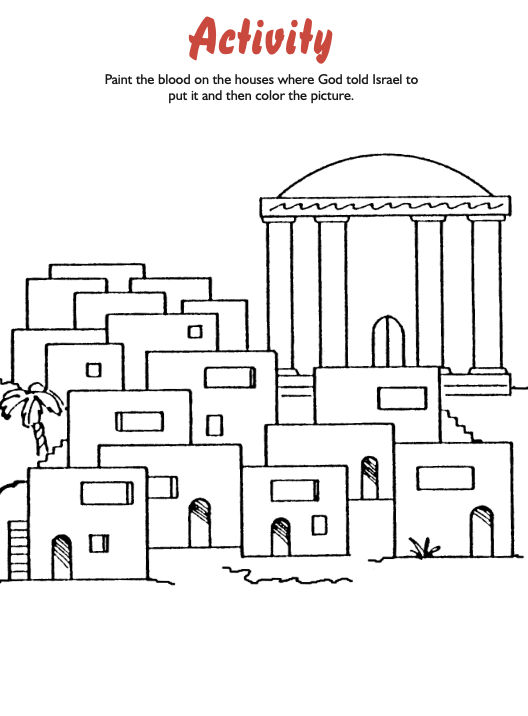
God told the Israelites to kill a lamb. He said they were to put the blood of the lamb they killed on the sides of their doorway and above the door. He would send a death angel to see if they had done this. If the Israelites or the Egyptians didn’t obey God and do this, their firstborn child would die. Even their first born animals would die. If they obeyed God and put the blood on the doorway and above the door, the death angel would pass over their house and no one would die. This was very, very serious!
Once a year we celebrate this night. It is called the Passover, because the death angel passed over the houses of those who obeyed God.
Just as school colors or a mascot is a sign to tell you where someone goes to school, the blood of the lamb on the door of their houses was a sign to the death angel. This sign told the death angel that the people in that house obeyed God and these people’s lives would be saved. The lamb they killed was also a sign. It was a sign that Jesus Christ is the Lamb of God. The lamb’s blood was a sign of Jesus’ blood that was shed for our sins. The night the death angel passed over the children of Israel, a lamb had to be killed. On the night of the first Passover, the blood of the lamb saved everyone who obeyed God. Many years later Jesus was killed on the Passover. His blood was shed to save us from our sins. If we obey Jesus Christ and do what He says, His blood can save us too.
The Passover was very important to the Israelites because Pharaoh let them go. They were no longer slaves. The Israelites were free! We celebrate the Passover today because it is very important to us too. Jesus Christ can make us free from our sins.
Student Prayer
Dear Heavenly Father, Thank you for caring so much about your people that you saved them from Pharaoh. Thank you for giving us your Son, Jesus, to save us. Help us to always be willing to follow you. In Jesus’ name. Amen
Daily Devotions
Sunday - Exodus 12:1-10
Monday - Exodus 12:11-14
Tuesday - Numbers 9:1-5
Wednesday - Matthew 26:2
Thursday - Mark 14:1
Friday - Luke 22:7
Saturday - John 13:1-5
Objectives
At the end of this lesson, students will be able to:
1. State that a sign stands for something else.
2. Identify Moses and Pharaoh as two people God used.
3. Explain how the lamb saved the people from the death angel.
4. State that we celebrate the Passover because God told us to.
5. Tell that the Passover was important to the Israelites and it’s important to us.
Topics & Themes
Aaron
Blood
Death angel
Egypt
Firstborn
Israelites
Jesus, Lamb of God
Jesus, Savior
Lamb
Moses
Obedience
Passover
Pharaoh
Plagues
Sin
Slaves
Worship God
Materials Needed
Bible, students and teacher’s YEA books, attendance and memory verse charts, stars, poster, magazines, construction paper, glue sticks, marker pen, tape, songbook, CD/cassette tape and music player
Preparation
Prior to class cut out pictures from magazines that are symbols or signs. These can include such things as stop signs, tele- phone symbols, handicap signs, or a sign for a railroad crossing. Make a list of symbols or signs on poster board that God uses in the Bible. The following are some you could list:
The Sabbath = a sign between God and His people
The Sign of Jonah = three days and three nights that he was in the whale’s belly
Unleavened Bread = without sin.
Arrive early enough to set up the room with the chairs in a semicircle and tape the poster you have prepared to the wall low enough for the students to reach. As the students arrive, greet them warmly. Listen to each child recite their memory verse and give them another star to put by their name on that chart.
How to Teach This Lesson
SIGNS - Start a conversation about signs. Ask for the children to give their school colors or a mascot. Ask: Can you tell which school someone goes to by their mascot or school color? Have someone read the signs on the poster and what they mean. Ask the class to name as many signs as they can think of. Add these to the poster.
MOSES - Ask: When you read your lesson, did you think of Moses being a prince? Can anyone tell us what made him a prince? Prince Andrew of England will probably someday be a king. Some princes become kings and some don’t, but Moses lived in the palace. Why do you think God told Moses to go tell Pharaoh to let His people go? Moses didn’t want to do this because he didn’t like giving speeches. So God said his brother, Aaron could go with him to Pharaoh and do the talking for him.
ISRAEL AS SLAVES - Can anyone tell us who the Israelites were? A long, long time ago Abraham had a son named Isaac. Isaac had a son and his name was Jacob. Jacob had twelve sons. These sons were called Israelites. The Israelites were God’s chosen people – they were very special to Him.
PHARAOH AND THE PLAGUES – Talk about how Moses and Aaron tried to get Pharaoh to let the Israelites go so they could keep a feast, but he was stubborn and wouldn’t let them go. God sent one plague after another trying to change Pharaohs mind. The Egyptian people suffered because of Pharaoh being stubborn. The plagues got worse and worse. Finally God sent the death angel to kill the firstborn of everyone that did not obey Him by putting the blood over their door and on the posts.
PASSOVER- The Passover is an extremely important concept for children to under- stand, yet it’s not an easy one for primaries. Death can be scary to young children. Be sensitive to their reactions. Stress that God saved His people. Even though we don’t like to think of lambs being killed, the fact is that they died so the Israelites could live. Focus on the fact that God saved His people, that He mercifully gave the children of Israel a way to escape the plague of the firstborn being killed.
Review Questions
1. Who was the ruler of Egypt?
2. Who did God send to go to pharaoh and tell him to let His people go?
3. What did the people have to put over their door and on the posts.
4. What was that night called?
5. Why do we celebrate the Passover.
6. What is the Passover Lamb a sign for?
Teacher-Directed Activity
Have some signs cut out of magazines prior to class for the students to select. Also have them cut out as many pictures of signs that they can find in the magazines you bring. These signs or symbols can be from everyday life and signs in the Bible. Have them glue a collection of signs to a piece of construction paper and write what the sign says to them: stop sign says stop, no crossing sign says you can’t cross the street at that place, “Do Not Disturb” says the person doesn’t want to be bothered, unleavened bread means without sin, etc.
REACH Activity
1. Create a miniature set. Use red tempera paint to “paint” the door post and lintels of the house. Retell the story of the Passover using the set.
Find a piece of cardboard about two feet square. Build a three-sided house in the middle from another piece of cardboard. You’ll want the fourth side open so you can work inside the house during the retelling of the story. Cut windows in the house before you attach the house to the bottom cardboard. Paint the inside of the house before you assemble the roof. Lay twigs and small sticks over the walls of the house to make the roof. Make a mixture of mud and dried grass that you can lightly smear over the twigs to make the roof more realistic. Paint the landscape then glue pebbles down for the pathway to the house. (Using craft glue makes construction easier because it dries faster than normal school glue.) Make proportional people out of card stock, using a marker to draw faces, hair, clothes, etc.
2. Do a sword drill with the Daily Devotional Scriptures.
More information: Read the Scripture reference to the child. Then start the timer. When the child has found the verse, stop the timer. Read the verse and talk about how it relates to the lesson. Challenge the child to see how quickly he/she can find each of the verses in the Bible.
3. Copy a map of Egypt. Using a Bible atlas, label Goshen, Rameses, Memphis, Succoth, the Nile River, the Red Sea, and the Mediterranean Sea. Be sure to include a compass rose to indicate directions. Color with crayons or colored pencils and display during the Days of Unleavened Bread.
4. Make a mobile of the ten plagues recorded in Exodus chapters 7 - 11. Copy the outline of Egypt on heavy cardstock ten times to make 3 x 3 shapes for a mobile. Write one plague on each Egypt card. Color the cards and hang in a prominent location.
More Information: Cut out the shapes desired for reinforcing the lesson (i.e., cloud shapes, Bible shapes, Egypt outline).Use heavy cardstock for the shapes.Using a single hole punch, punch a hole in the center of the top of the shape. Thread different lengths of yarn, string, or fishing line through the different shapes. This will allow the shapes to dangle at different levels. (When writing the words from a memory verse on the clouds, put the first words on the clouds which dangle at a higher level.) Tie the tops of the strings onto a hanger. Spread them out along the hanger so the hanger is balanced. To display the mobile, the hook on the top of the hanger can be twisted perpendicular to the rest of the hanger in order to hang the finished mobile over a curtain rod.
5. Make a comic strip of the Ten Plagues - one plague for each square. Or make a comic strip drawing of Moses confronting Pharaoh, Pharaoh’s refusal to let God’s people go, the tenth plague, Pharaoh commanding they leave, and the people leaving. Use your favorite coloring tools to complete the project.
6. On a large piece of drawing paper, draw the Hebrew people leaving Egypt with all of their belongings, their animals, and their kneading troughs. Write the memory verse across the bottom of the drawing as a caption. Add color to complete the project.
7. Sing these songs:
A. From the CEM hymnal: “He is Able to Deliver Thee” on pg. 72; “Nothing But the Blood” on pg. 114; “Go to Dark Gethsemane” on pg. 109; and “When I See the Blood” on pg. 116.
B. From Kids Classics Collection: “I’m in the Lord’s Army” on pg. 33 and “I Will Sing of the Mercies of the Lord Forever” on pg. 17.
C. From The Group Songbook: “El Shaddai” on pg. 82 and “I Have Decided to Follow Jesus” on pg. 60.
8. Using the lyrics from “He Is Able to Deliver Thee”, make a greeting card to send to someone in your church who is ill or experiencing trouble, to encourage them.
9. Using 20 index cards, write one plague on each card. Then write the numbers 1 - 10 on the rest of the cards. Use them to play concentration.
10. Students can choose five parts of the story and create a picture sequence on 11 x 17 paper that they can use to tell the story to family or friends. Use any type of color tool.
11. Write a letter. Pretend you are an Egyptian child living during the time of the Exodus. Write to a relative telling them about the events leading up to the Passover: the plagues, Moses’ demand to let the Hebrews go to worship God, and Pharaoh’s refusal. Tell about life with frogs, gnats, locust, and hail. Use the Bible to keep the plagues in order.
12. Draw a picture of the houses which had the blood of the lamb painted on the doorposts and lintels. Write 1 Corinthians 5:7 across the bottom of the drawing as a caption. Use your favorite color tool to finish the project.
13. Read Exodus 5:1-5. Write a paragraph explaining why Pharaoh didn’t want to let the Israelites go to worship God.
14. God still rescues His people today. Ask your parents to tell you about a time when God rescued them from a bad situation or how God rescued them from slavery to sin.
15. There are several types in the Exodus story. With help from an older sibling or your parents, make a chart showing the symbolism and what it points to. Use these to get started:
Slaves in Egypt Slaves to sin
powerless to save themselves powerless to save ourselves
Passover lamb ??
Pharaoh ??
Egypt ??
Blood ??
16. Read Leviticus 23:4-5. When is the Passover? Why do we celebrate it today? Write these answers in your Bible notebook.
17. Imagine that you are living in Egypt as an Israelite child during the time of the Exodus. Why would you want God to rescue you from Egypt? How would you feel once He did? Write a thank you note to God for rescuing you from Egypt.
Song
“I Will Sing of the Mercies of the Lord Forever” is on page 17 of the Kids Classics Collection.
Closing Prayer
Lead in prayer thanking God for saving His chosen people; and because we are very special to Him, He can save us as well.
Printable Pages