YEA Lesson Library
Remember This Night
About This Lesson
This lesson explains the events of the first Passover and how it connects to the student and Jesus Christ, our Passover.
Scriptures
Exodus 11:1-10
Exodus 12:1-50
Exodus 12:14
Numbers 9:2-3
Deuteronomy 16:1-8
1 Chronicles 16:12-14
Psalm 27:5
Psalm 34:17-19
Words to Know
BITTER HERBS- plants with a bitter taste
FRIENDSHIP BRACELET - bracelet made out of sting, given to a friend
PUNISHMENT - harsh treatment because of something you have done
UNLEAVENED - not having anything to make it rise
The Lesson
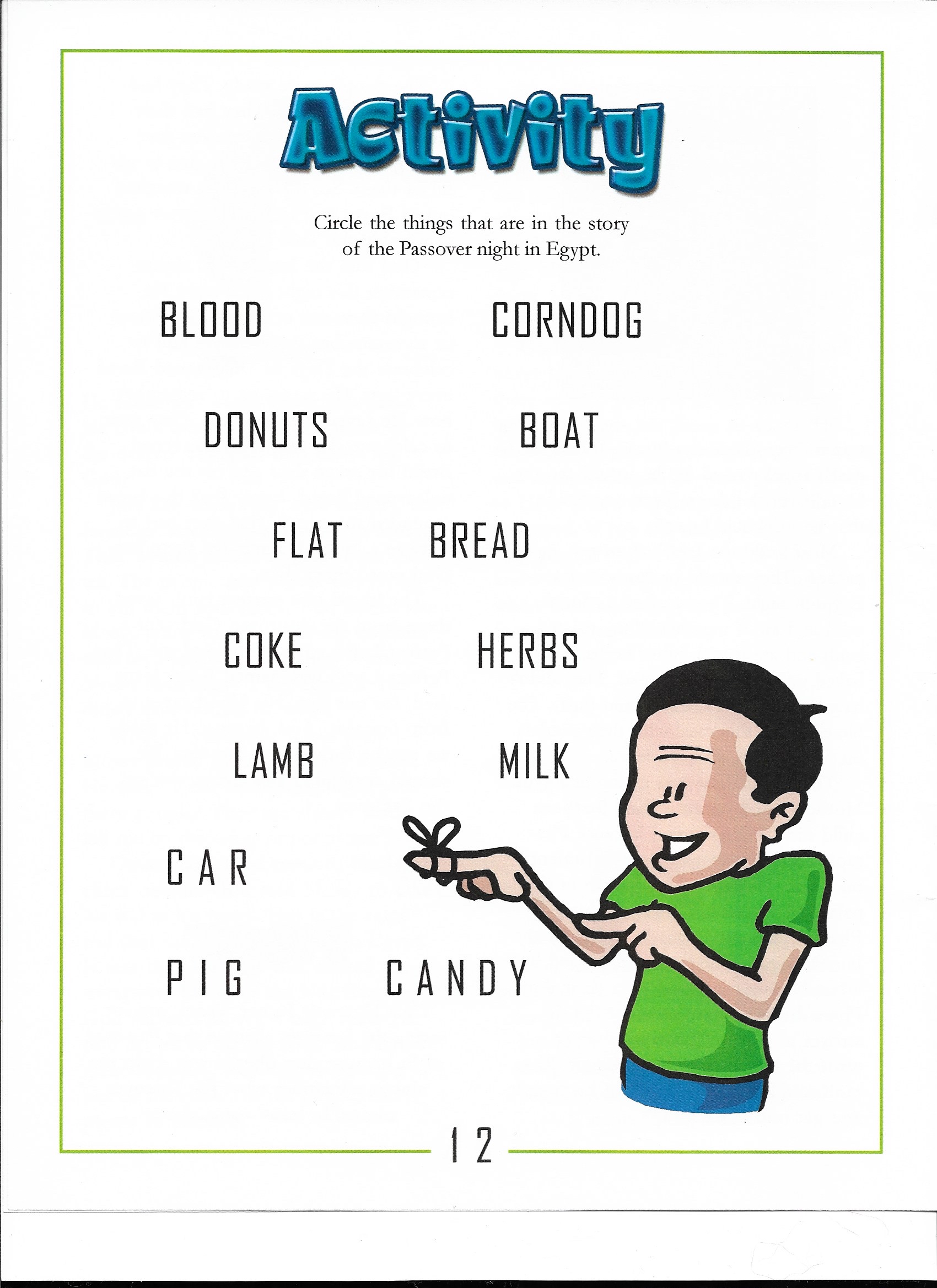
Paula went to school one day. She had a red string tied around her finger. Her friend, Cathy, said it matched her sweater. Cathy thought the string was like a friendship bracelet. She wanted one, too. Paula's teacher asked why she had a string on her finger. Paula said it was to help her remember something important. Paula's teacher asked what she was supposed to remember. But, Paula couldn't remember what the string was for. The string didn't do much good.
Today's lesson is about some days that God wants you to remember. But, you don't have to tie a string around your finger to remember. God set aside a special time and a feast to help you remember these days. They are called the Passover and the Days of Unleavened Bread.
Pharaoh wouldn't let the Israelites go into the desert to worship Him. God told Moses to give Pharaoh a warning. Moses said that something terrible was going to happen. God would send His destroyer into Egypt. The destroyer would kill the firstborn child in every family that didn't have blood on the door post of their house.
God would protect His people from the destroyer. Moses told the Israelites to kill a perfect lamb. He said, "Put some of the lamb's blood above and on the sides of your door." All the family was to stay inside the house. When the death angel passed by, he would see the blood over the door. Everyone inside that house would be safe.
Moses told the Israelites to get packed. They should be ready to leave Egypt at night. They cooked a special meal and ate it together. They roasted a lamb and ate it with bitter herbs. They baked unleavened, flat bread. They didn't have time to let it rise high and fluffy. The Israelites ate this meal with their sandals on. They were ready to leave.
That night there was crying in Egypt. Mothers cried because their firstborn child died. Fathers cried because Pharaoh brought this terrible punishment on them. There was even death in the palace of Pharaoh. Don't you think Pharaoh was sorry that he didn't let the Israelites go? The destroyer passed by when he saw the blood over their door. Pharaoh knew that God sent the destroyer to Egypt. This made him want the Israelites to leave Egypt. Pharaoh told Moses to take all of his people and get out!
The people were ready. They had their clothes packed. They had their sandals on. The Egyptians even gave them gold and silver jewelry just to get rid of them. So, the Israelites marched out of Egypt that night. They were going to worship the True God.
God told the Israelites to always remember this night - the night He brought them out of Egypt. God wants us to remember the Passover and to celebrate the Days of Unleavened Bread every year. He wants us to remember how He saved the Israelites. They were to celebrate the feast of Unleavened Bread for seven days and eat the flat, unleavened bread. Every year this bread reminded the people that they had to leave in a hurry. It reminded them how God saved them alive.
The blood of a perfect lamb saved them from the destroyer. God sent a Perfect Lamb to save you and me. That Perfect Lamb was named Jesus. Jesus died for our sins. His blood saves us from our sins. And, because He died, we can be forgiven of our sins. We should remember this every year on the Passover.
Student Prayer
Dear Heavenly Father,
Thank you for saving the Israelites alive on that Passover
night because they obeyed you. Help me always remember what the Passover means.
In Jesus' name.
Amen.
Daily Devotions
Sunday - Psalm 27:5
Monday - Psalm 34:17-19
Tuesday - Deuteronomy 16:2-3
Wednesday - 1 Chronicles 16:12-14
Thursday - Exodus 12:23-24
Friday - Exodus 12:26-27
Saturday - Numbers 9:2-3
Objectives
At the end of this lesson, the children will be able to:
1. Identify Passover as the night God's destroyer passed over the Israelite doors with blood on them.
2. Explain that the people ate flat, unleavened bread because they had to leave in a hurry.
3. State that Jesus is God's Perfect Lamb.
4. Tell that God wants us to remember and celebrate the Passover every year.
Topics & Themes
Angel, Death
Blood
Egypt, Coming Out
Jesus, Lamb of God
Lamb
Passover
Pharaoh
Unleavened Bread
Materials Needed
Bible, YEA Students' and Teacher's books, attendance and memory verse charts, songbook, stickers, music player and CD or cassette, large calendar, marker
Preparation
Children in the early elementary ages are beginning to reason more deeply and ask questions that reflect this growth. How you handle their questions can help guide them through the process of coming to know God in a more personal way. Encourage participation in discussions that will help reveal how well they understand what is being taught. The questions and input of your students can also benefit other students who may be confused.
You will need a one-year calendar with large boxes for the days of the week.
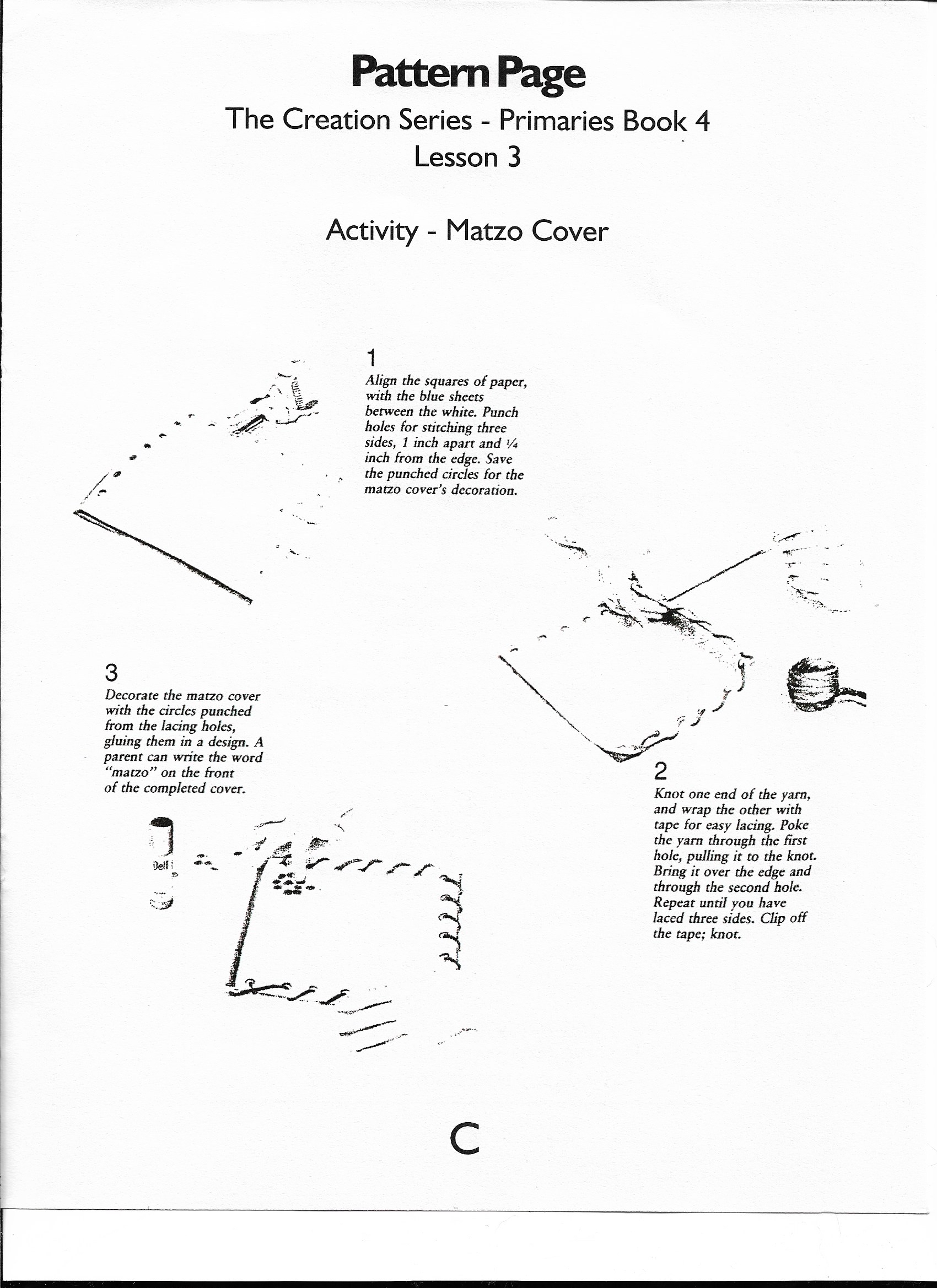
Before you come to class, cut enough 7-inch squares of blue construction paper, and white paper for each child to have two of each. Align the squares with the blue sheets between the white. Punch holes for stitching I inch apart and 1/4 inch from the edge around 3 sides of the sheets. Loop a 36-inch length of blue yarn and tie through the first hole. Wrap a piece of tape around the other end of the yarn for easy lacing.
How to Teach This Lesson
Everyone has a special day that you would like your friends and family to remember. Ask: Who can tell me what that is? Everyone here has a birthday. (Give each child a star or sticker. Ask them to find their birthday on the calendar, write their name and put a star in that box.This calendar can be hung in your class to remind you to send birthday cards.) Ask: Can you think of any other ways to help you remember a special day?
Today's lesson is about special days that God wants us to remember. These days are when God saved His people from the destroyer and when they left Egypt in a hurry. They are called the Passover and the Days of Unleavened Bread.
Ask: If you want to be safe while riding in your car, what should you do? You should always wear a seat belt.The seat belt protects you in case of an accident. What would you wear to keep you safe while riding in a boat? (Life jacket.) Why? What do you have on your door to keep you safe from someone you don't want inside? (Lock.)
God was sending His destroyer into the land of Egypt. The destroyer was going to kill the firstborn child in every Egyptian family because Pharaoh wouldn't obey God. Ask: What did God tell Pharaoh to do?
The Israelites were God’s special people. In today’s lesson, Moses told the Israelites to do something to their door to keep them safe. They didn’t put a special lock on the door. What Moses told the people to do probably sounded strange to them. They were to kill a lamb. But, not just any lamb. Ask: What was special about this lamb? (Perfect) Then they were to put some of the lamb’s blood above and on the sides of their door. Ask: When the destroyer saw the blood over the door, what would he do? That is why we call this night “Passover.”
God wanted His people to be ready to leave Egypt. Ask: What were some things they did to get ready? (They asked the Egyptians for silver, gold and clothing, ate a special meal, and put on their sandals.) The people had to be ready to go, so they didn't have time for their bread to rise high and fluffy. They ate flat, unleavened bread.
When the destroyer passed through Egypt, the firstborn in every family - people and animals died. Mothers and fathers were crying. Even Pharaoh's firstborn son died. God gave Pharaoh many chances to obey Him. He even warned Pharaoh that something terrible would happen if he didn't let the people go. But Pharaoh was stubborn.
Ask: What did Pharaoh do after Passover night? (He sent Moses and the Israelites away.)
God made a way for people to be saved from the destroyer. He loves people and wants good things for them. The people who obeyed were safe.
God tells us that we should remember this night because it shows how God saved the Israelites. We celebrate the days of Unleavened Bread by eating unleavened, flat bread, just like the Israelites ate.
God loves you so much that He sent His own Perfect Lamb to save you. That Lamb’s name is Jesus. Jesus never did anything bad. Just as the Passover lamb had to be perfect, Jesus was perfect. Many years later He died on the Passover so that we can be forgiven of the bad things we do. And because He died and came back to life again, we can live forever in God's Kingdom. Every time we celebrate the Passover, we should remember this!
Review Questions
The questions are included in the body of this lesson.
Teacher-Directed Activity
Give each child two 7 inch squares of blue construction paper and two white squares. Align the holes and lace the yarn through one hole, bringing it over the edge and through each consecutive hole. Clip off tape and knot the yarn. (See pattern page for a diagram.) Have the children write the date of this year's Passover on the outside of the matzo cover. Give each child a piece of matzo to place inside the cover to remind them that flat bread is eaten at the Passover and during the days of Unleavened Bread.
REACH Activity
Materials Needed: tempera paint, paint brushes, clay, package of colorful construction paper, string, glue, tape, Kids Classics Collection songbook and/or CDs, Bible, YEA book, Bible notebook, black permanent marker, watercolor paints, 11 x 17 drawing paper, pencils, markers, colored pencils, crayons, scissors, ruler, index cards, CEM Hymnal, Bible dictionary, concordance, access to encyclopedia or the Internet, Bible encyclopedia, Bible map or Bible atlas, dictionary, letter beads, bracelet materials, butcher paper, magnetic letters
1. To review YEA Lesson 2, name a plague from the lesson. Then tell as much as you can remember about the plague in 30 seconds. Go on to the next student who will pick up where the previous student left off. Continue until the plagues have been reviewed.
2. How did you remember the plagues during the review on Lesson 2? Discuss different ways to remember things we do not want to forget, for example making a note and sticking it on the bathroom mirror. In your Bible notebook write about a time that you wanted to remember something very important, but forgot. Then write about a time you remembered something you did not want to forget. What was different about the time you remembered and the time you forgot?
3. Pharaoh still would not let the Israelite people go from Egypt. Moses was very angry. How would you feel if you were Moses going back and forth to Pharaoh and asking him to let the people go? What do you think Moses would write in his journal after meeting with Pharaoh so many times?
4. Moses had a message from God to the Israelites, find and kill a perfect lamb, then put the blood on the doorpost of every home. What would happen if they did not obey God’s directions? Discuss Moses’ message with your family. (This can be a very delicate subject for young children, especially if they are firstborns.)
5. God is our Protector. Can you remember a time that He protected you and your family from a bad situation, for example a storm? Draw a picture of how God protected you. Put the title “God is our Protector” on your drawing. Share with family or Sabbath School class.
6. Using butcher paper, design and create a mural of what the Israelites did the night of the Passover. Use construction paper to make cut outs for the people, animals, and homes, and then glue them to the paper. Use the mural to retell the lesson, and then store away for sharing on the next observance of Passover.
7. Why should you remember the night of Passover? Why should you celebrate the Feast of Unleavened Bread? Write and perform a play of this YEA lesson. Invite family and friends.
8. Practice the verse with magnetic letters until memorized.
9. Make an index card for the tenth plague.
10. Make an index card for the memory verse for this week.
11. Add the tenth plague to the plague mobile.
12. Add the forecast for the tenth plague to the weather forecasting book.
13. Draw a closed hand, with only the first finger up. Draw a string around that finger. Write the memory verse on the hand.
14. Do a sword drill with the Daily Devotionals for this week.
NOTE: Sword drill: Use the Daily Devotional Scriptures to have a sword drill. Read the Scripture reference to the child. Then start the timer. When the child has found the verse, stop the timer. Read the verse and talk about how it relates to the lesson. Challenge the child to see how quickly he/ she can find each of the verses in the Bible.
15. Each day, write how the Daily Devotional ties in with the YEA lesson.
16. How does this YEA lesson make you feel? Write about it in your Bible notebook.
17. Practice putting the plagues in order.
18. Make a bracelet. Find letter beads for your name and enough to spell Jesus twice. Put Jesus’ name before and after your name as you string the beads on the bracelet. Just as you are— your name is—surrounded by Jesus on the bracelet, God surrounded His people with the blood of the lamb to protect them from the death angel. Similarly, Jesus’ blood covers your sins and protects those who call Him Savior today.
19. Sing: “Through the Love of God, Our Savior” on page 122 of the CEM Hymnal.
Culminating or On-going Activities
1. Create a newspaper or newsletter with headlines from each of the YEA lessons, or write your own. Each reporter should have their own story to write. Use pictures with each story. Make copies for each family member or Sabbath School student.
2. Design one mural for these ten lessons. Additions are made after each lesson. Hang the mural when completed. Invite others to your Exodus mural.
3. Ask students to create a game from the YEA lessons on the plagues. Provide simple materials and supplies. Students share and teach the games to each other. Store games in ziplock bags or small boxes.
4. Set up the classroom as a news station. Create call letters for your news station, for example BNN - Bible News Network or BNS - Bible News Station. Invite family and friends to hear the newscast of what happened during these ten YEA lessons. Divide the newscast into several parts: headline news, eyewitness/man on the street segment, weather report, sports, and the strange and unusual. Have someone videotape the newscast for the class to watch at a later date.
5. Write a thank you note to your Sabbath School teacher and/or your parents, telling them which lesson you liked best in On The Move and why.
Song
“I Will Sing of the Mercies of the Lord Forever” is on page 17 of Kids Classics Collection.
Closing Prayer
Lead the children in prayer, thanking God for saving the Israelites on Passover night. Thank God that He sent Jesus, our Passover Lamb, to forgive us of our sins so that we can be saved. Ask that the children might remember this every Passover.
Printable Pages