YEA Lesson Library
More Troubles
About This Lesson
Using Pharaoh’s unbelief and disobedience as an example of what not to do, this lesson teaches that there are serious consequences to disobedience.
Scriptures
Exodus 9:1-35
Exodus 10:1-29
Exodus 11:9
Exodus 18:11
Deuteronomy 11:26-28
Psalm 9:7-10
Psalm 19:9-11
Psalm 34:6-9
Psalm 138:6-7
2 Thessalonians 1:5-7
Words to Know
CROPS - plants that grow and are harvested
HAIL - balls of ice that fall from the clouds
The Lesson
Mrs. Thompson told her class, "Tomorrow we will have a spelling test. Don't forget to study your words." Alex picked up his spelling book. He put it into his backpack. The bell rang and everyone headed for the door.
Alex met Tommy after school. They walked home together. On the way, the boys stopped to pet a friendly puppy. Alex set his backpack on the ground. He almost forgot to pick it up and take it home. Tommy reminded him of the spelling test.
Mom was cooking when Alex came into the kitchen. She told Alex to get started doing his homework. But, Alex stopped in the living room. His little sister was watching cartoons. So, Alex sat down and watched with her.
After supper, Daddy asked Alex if he had done his homework. Alex said, "I just have to study for a spelling test.” Daddy told Alex to go to his room and study. But, Alex had a new video game. He started playing the game instead of studying.
It was time for bed. Daddy came in to tuck Alex in. "Are you ready for your spelling test?” Daddy asked. Alex said, "I think so." But, Alex wasn't telling the truth. He hadn't even looked at his spelling words.
The next morning Mrs. Thompson told the class to take out a sheet of paper. She began to call out the spelling words. Alex was in trouble. He didn’t do what Mrs. Thompson told him. He didn't study. He didn't do what Tommy reminded him - he didn't study. He didn't do what Mom told him - he didn’t study. And, he didn't do what Daddy told him - he didn't study. Whose fault is it that Alex failed his spelling test?
It is always best to obey your teachers and your parents. But most important, you should obey God. Pharaoh would soon learn this lesson.
God sent Moses and Aaron to warn Pharaoh what would happen if he didn't let the Israelites go to worship Him. They told Pharaoh that God would make their animals very sick. But, Pharaoh didn't listen. So the Egyptians' animals got sick. Cows got sick. Sheep got sick. Camels got sick. Horses and donkeys got sick. Many of the animals even died.
Then Moses warned Pharaoh that God would send sores to the Egyptians and their animals. Moses threw a handful of dust into the air. The dust spread out all over Egypt. And, when the dust landed on people or animals it caused sores all over their bodies. But Pharaoh was still stubborn - he wouldn't let the people go.
Moses told Pharaoh that God would send hail to Egypt. Big balls of ice would fall from the sky. They would beat their crops down to the ground. They would break trees. They would fall on the people and animals, hurting them. Pharaoh wouldn't listen. So God sent the hail. He even sent thunder and fire with the hail. But the hail didn't fall on God’s people, the Israelites.
Pharaoh saw that he was in trouble. He told Moses to ask God to stop the hail. He said he would let the Israelites go. But Pharaoh lied. When the hail stopped, Pharaoh changed his mind. So, God sent millions, and millions of grasshoppers to Egypt. There were so many grasshoppers that the sky was black with them. The grasshoppers ate the leaves off all the trees and bushes. They ate all the plants in the gardens. It was terrible!
Again, Pharaoh promised to let the people go. But again, he lied. So, God made all of Egypt dark - for three whole days and nights! It was so dark that people couldn't see anything. But the Israelites had light. Pharaoh said he would let the people go this time. But, Moses knew he was lying.
God gave Pharaoh nine chances to listen and obey Him. Moses warned Pharaoh what would happen if he didn’t obey. But, Pharaoh was like Alex. He wouldn't obey. And like Alex, Pharaoh got into trouble. It is always best to do what God tells you. He wants us to obey Him. He has good things for those who obey - like the Israelites. But, when you don't obey, bad things can happen.
Student Prayer
Dear Heavenly Father,
You wanted Pharaoh to obey vou. You sent Moses to warn him about what would happen if he didn't. Help me do what your Word tells me. Help me obey your commands.
In Jesus' name I pray.
Amen.
Daily Devotions
Sunday - Exodus 11:9
Monday - Psalm 138:6-7
Tuesday - Psalm 34:6-7
Wednesday - Psalm 9:7-10
Thursday - Psalm 19:9-11
Friday - Deuteronomy 11:26-28
Saturday - 2 Thessalonians 1:5-7
Objectives
At the end of this lesson, the children will be able to:
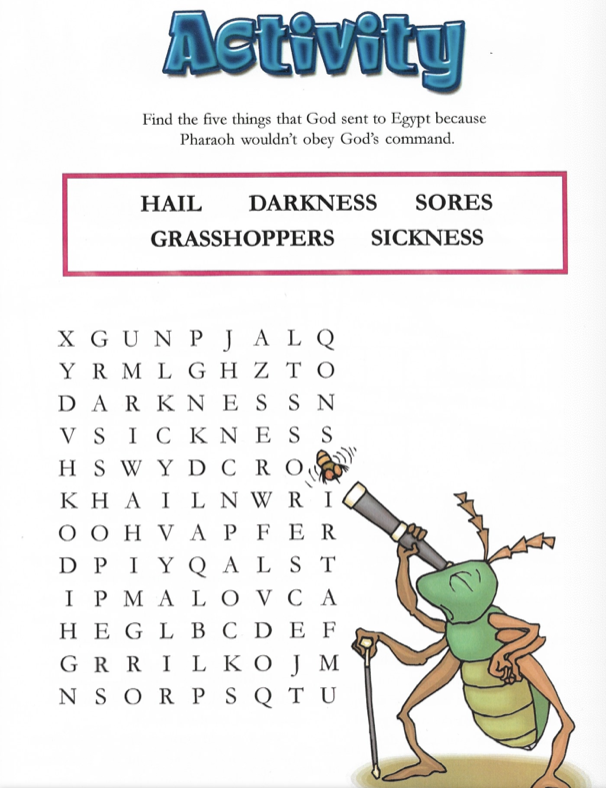
1. Name these five plagues that were sent on Egypt because Pharaoh wouldn't obey.
2. Tell that when you don't obey it leads to trouble.
3. State that it is always best to obey God.
Topics & Themes
Consequences of Sin
Egypt
God’s Judgment
God’s Omnipotence
God’s Omniscience
Moses
Obedience
Pharaoh
Plagues
Materials Needed
Bible, YEA Students' and Teacher's books, attendance and memory verse charts, songbook, stickers, music player and CD or cassette, 3x5 cards
Preparation
Games can help reinforce the objective of your lesson, or drive home an important point. They are also useful tools to help children improve moral and social values. Don't hesitate to make learning fun!
Before you come to class, make a set of 10 cards (add more for larger class) by writing each of the following situations on one side of a3×5 card: I) Mom tells you to put your toys away. 2) Daddy says it's time for bed. 3) Teacher tells you to study your spelling words. 4) Traffic light says "Don't walk." 5) Babysitter says not to watch the scary movie. 6) Mom tells you to stay with her in the mall. 7) Your older brother tells you not to mess with his motorcycle. 8) Bible tells you not to steal. 9) Principal says to walk outside the building during fire drill. 10) Weather man says a storm is coming - take cover.
How to Teach This Lesson
Ask the children to tell of times when they disobeyed their parents, teacher or other authority figure, and what happened as a result. Point out that sometimes you may think you got by with disobeying, but that God sees every- thing we do. Sometimes we suffer the natural consequences of disobeying, like Alex not studying and failing his test. Other times we might be punished, such as being grounded for disobeying your parents. It is always best to obey when God tells you to do something.
Use the "Obey vs Disobey" cards to let the children think of their own solutions to the situations posed. Each child can draw a card and give his or her solution. Ask the rest of the class to decide whether the student's solution was "Obey" or “Disobey."
Fifth Plague - Moses and Aaron warned Pharaoh that if he didn't let the people go, all their animals would get very sick. Pharaoh refused to obey. So, the Egyptians’ cows, sheep, horses, camels, and donkeys got a terrible disease. Many of them even died.
Sixth Plague - God told Moses that He would send painful sores on the Egyptians and their animals if Pharaoh wouldn’t let the people go. Pharaoh said, “No!” So Moses took a handful of dust and threw it into the air. The dust spread all over Egypt. And everywhere the dust landed, the people or animals had painful sores all over their bodies. The Israelites didn’t have the sores. But, Pharaoh still was stubborn.
Seventh Plague - Moses told Pharaoh that God would send hail to the land of Egypt. Big balls of ice fell from the sky. The hail fell on the crops and beat them to the ground. It fell on people and animals, hurting them. It broke tree branches and made holes in the roofs. There was even fire and thunder with the hail. This time Pharaoh saw he was in trouble. He asked Moses to pray and ask God to make the hail stop. Then he would let the people go. Ask: Do you think he meant it? When the hail stopped, Pharaoh changed his mind.
Eighth Plague - The next thing God sent to Egypt ate every leaf off of every tree! Big grasshoppers came flying into Egypt. It looked like a huge black cloud. The grasshoppers landed on everything green.They ate all the plants. Soon there would be no food left. So again, Pharaoh promised to let the people go. Ask: Do you think he was serious this time?
Ninth Plague - Moses knew that Pharaoh wouldn't let them go. God told Moses to stretch his hand toward heaven. When he did, all of Egypt got very dark for three days and nights. It was so dark that people couldn't see to go outside. But, God's people had light.
God gave Pharaoh nine chances to obey. But, Pharaoh thought he was more important and stronger than God. God had to send all these bad things to show Pharaoh that He was greater than Pharaoh or any man. It is always best to obey the things God commands us to do. Our next lesson tells what finally made Pharaoh pay attention and let God’s people go.
Review Questions
In the last two lessons, we have seen nine plagues that God sent to Egypt because Pharaoh wouldn’t do what God said. Ask the children to name all nine.
Teacher-Directed Activity
Play a game of "Mother, May I." Line the children up against one wall. Give each child simple directions, like "Take two giant steps," "Take four baby steps," or "Hop on your right foot." They must answer, "Mother, may I?" before they follow the instructions. Failure to do so results in going back to the starting line. The first child to make it successfully across the room wins.
REACH Activity
Materials Needed: tempera paint, paint brushes, clay, package of colorful construction paper, string, glue, tape, Kids Classics Collection songbook and/or CDs, Bible, YEA book, Bible notebook, black permanent marker, watercolor paints, 11 x 17 drawing paper, pencils, markers, colored pencils, crayons, scissors, ruler, index cards, CEM Hymnal, Bible dictionary, concordance, access to encyclopedia or the Internet, Bible encyclopedia, Bible map or Bible atlas, dictionary, candle for each family member, matches
1. To review YEA Lesson 1, use a scrap piece of paper and choose three colors from your color tools that remind you of the three plagues you read about in the lesson. Use one color tool at a time to draw a picture of the plague that each color represents. Example: if you chose red to remind you of the plague of blood, then draw a picture of a “red” Nile River.
2. Make index cards (as you did for Lesson 1) for the fifth through ninth plagues.
First card: front side—Fifth plague; back side—sickness on Egyptians’ animals
b. Second card: front side—6th plague; back side—boils on Egyptians and their animals
c. Third card: front side—7th plague; back side—hail
d. Fourth card: front side—8th plague; back side—locusts throughout Egypt
e. Fifth card: front side—9th plague, back side— three days of darkness
3. Make another index card for the memory verse. The front side has the first half of the memory verse; the back side has the second half.
4. Use the cards to put the events (plagues) in order and to practice the memory verse.
5. Read Exodus 9:1-10:29. Then role play it.
6. Pretend you are Moses. Write a journal entry for the events and Moses’ reaction.
7. Continue the weather forecasting book based on the plagues of Egypt. For example, for the plague of grasshoppers, write the forecast for heavy clouds of grasshoppers. Illustrate. Do plagues five through nine, one page for each plague.
8. Continue the mobile of the plagues of Egypt. Hang a different object from a hanger depicting each plague, i.e. a piece of black paper for three days of darkness.
NOTE: Making a Mobile: Cut out the shapes desired for reinforcing the lesson (i.e., the plagues of Egypt). Use heavy card stock for the shapes. Using a single hole punch, punch a hole in the center of the top of the shape. Thread different lengths of yarn, string, or fishing line through the differ- ent shapes. This will allow the shapes to dangle at different levels. Tie the tops of the strings onto a hanger. Spread them out along the hanger so the hanger is balanced. To display the mobile, the hook on the top of the hanger can be twisted perpendicular to the rest of the hanger in order to hang the finished mobile over a curtain rod.
9. What did the Lord keep asking Moses to say to Pharaoh? In your opinion, why didn’t Pharaoh listen to Moses? Discuss.
10. Do you always listen and obey your parents? Think of a time when you were disobedient and write about it in your Bible notebook.
11. The plague on the livestock did not affect the Israelites' animals. Horizontally fold a piece of 81/2 x 11 paper in half. On one side draw the Egyptians’ livestock during the plague and the Israelites’ livestock on the other side. Write a caption or sentence underneath each picture that tells what you learned about this plague. Share with family or Sabbath School class.
12. Choose one type of livestock animal to research and study. Use encyclopedias and other nonfiction books to find your information. Write the information in your Bible notebook to use later.
13. On card stock draw two outlines of the animal you researched (See R.E.A.C.H. #12). One outline will be the front of your animal book. The other outline will be the back of the book. Set aside for Animal Shape book (R.E.A.C.H. #14).
14. Animal Shape book: From the information in your Bible notebook, write and make a book about the animal you researched. Decide how many pages will be in your book. Then trace one of the card stock animal outlines on lined paper to write your book on. When all pages are completed trace animal outlines on unlined paper and draw pictures of the animal to go with all or some pages of the book. Finally, put all pages together and staple on the left edge to make a book. Share with family or Sabbath School class.
15. Read Exodus 9:8-12. Use a dictionary or encyclopedia to find out more about boils. Discuss how the people must have felt when they were covered with boils.
16. How is hail formed? Look it up in an encyclopedia or on the Internet. Hail can damage people, roofs, cars, and plants. Interview family or friends who have experienced hail storms. Write about the interview(s) in your Bible notebook.
17. During the hail storm, flax and barley crops were destroyed, but two other crops were not. Which were not? Read Exodus 9:32 to find the answer.
18. Pharaoh told Moses that he would let the Israelite people go, but he changed his mind. Why do you think he decided that they had to stay in Egypt? Discuss with family or Sabbath School class.
19. Go outside and look around at everything that grows. Then go inside, open closets, and drawers. Imagine if everywhere you went and everywhere you looked there were locusts, or grasshoppers! Write a song about this plague using the tune to “Jesus Loves Me.” Teach the song to family and friends.
20. The plague of darkness lasted for three days and three nights, but only for the Egyptians. How would you feel as an Israelite watching the darkness happen to the Egyptians, but not you? Write and explain your answer in your Bible notebook. Share if you would like with family and Sabbath School class.
21. At dinner or another family meal, set the table with one candle for each member of the family. Before the meal and blessing have each member light their candle and share why they would have rather been an Israelite than an Egyptian.
22. Sing: “He Is Able To Deliver Thee” on page 72 of the CEM Hymnal; “This is My Father’s World” is on page 150 of the CEM Hymnal; Remember, even though the plagues hit Egypt, God protected His people where they lived in the land of Goshen.
Culminating or On-going Activities
1. Create a newspaper or newsletter with headlines from each of the YEA lessons, or write your own. Each reporter should have their own story to write. Use pictures with each story. Make copies for each family member or Sabbath School student.
2. Design one mural for these ten lessons. Additions are made after each lesson. Hang the mural when completed. Invite others to your Exodus mural.
3. Ask students to create a game from the YEA lessons on the plagues. Provide simple materials and supplies. Students share and teach the games to each other. Store games in ziplock bags or small boxes.
4. Set up the classroom as a news station. Create call letters for your news station, for example BNN - Bible News Network or BNS - Bible News Station. Invite family and friends to hear the newscast of what happened during these ten YEA lessons. Divide the newscast into several parts: headline news, eyewitness/man on the street segment, weather report, sports, and the strange and unusual. Have someone videotape the newscast for the class to watch at a later date.
5. Write a thank you note to your Sabbath School teacher and/or your parents, telling them which lesson you liked best in On The Move and why.
Song
"O Be Careful Little Eyes" is on page 39 of Kids Classics Collection.
Closing Prayer
Lead the children in prayer, asking God to help the children learn to obey their moms and dads, teachers, and others in authority, but most of all, to obey God.
Printable Pages