YEA Lesson Library
Scratch and Sniff
About This Lesson
Using Pharaoh’s unbelief and disobedience as an example of what not to do, this lesson teaches the student to obey God with a willing heart.
Scriptures
Exodus 7:1-25
Exodus 8:1-32
2 Chronicles 30:8
Psalm 86:9-10
Psalm 91:1-2
Proverbs 8:32-33
Proverbs 28:14
Ephesians 2:2
James 1:25
Words to Know
MAGICIAN - a person who performs magic tricks
MIRACLE - a wonderful thing that only God can do
The Lesson
God chose Moses to lead His people out of Egypt. God sent Moses and his brother, Aaron to tell Pharaoh, "Let my people go!" But, Pharaoh was a stubborn man. He wouldn't obey God. So, God had to show Pharaoh that He meant business. He would show Pharaoh that He was a powerful God.
God sent Moses and Aaron to Pharaoh. He told Aaron to throw his rod down in front of Pharaoh. When he did, the rod turned into a snake! Pharaoh thought it was magic. So, he had his magicians do the same thing. Snakes were everywhere. Then Aaron's snake ate all the other snakes. This was not just a trick - it was a miracle! But Pharaoh wouldn't believe.
Pharaoh was still stubborn. So, God told Moses to meet Pharaoh at the Nile River. As a baby, Moses was hidden in the river in a basket. Now God would show Pharaoh another miracle.
God wanted Pharaoh to know that He was God. He told Aaron to hold out his rod. He held it over the Nile River - the river turned to blood. He held the rod over the lakes and ponds. They turned to blood, too. Even water in jars and buckets turned to blood. There was no water for people to drink. Then the fish in the river died. What a stinky mess! But Pharaoh still thought it was a trick. He wouldn't believe in God.
How would you like to wake up with frogs in your bed? That is what happened in Egypt. God sent frogs to show Pharaoh that He was God. There were frogs in the beds. Frogs were in their clothes. Frogs were in the ovens and on their dishes. Everywhere people walked there were frogs. Squish, squish! Oh, it was a slimy, stinky mess. And the people were hopping mad!
Pharaoh wanted all the frogs gone. He told Moses to ask God to get rid of them. He said, "Then I will let your people go." But when the frogs were gone, Pharaoh wouldn't let the people go. He was still stubborn.
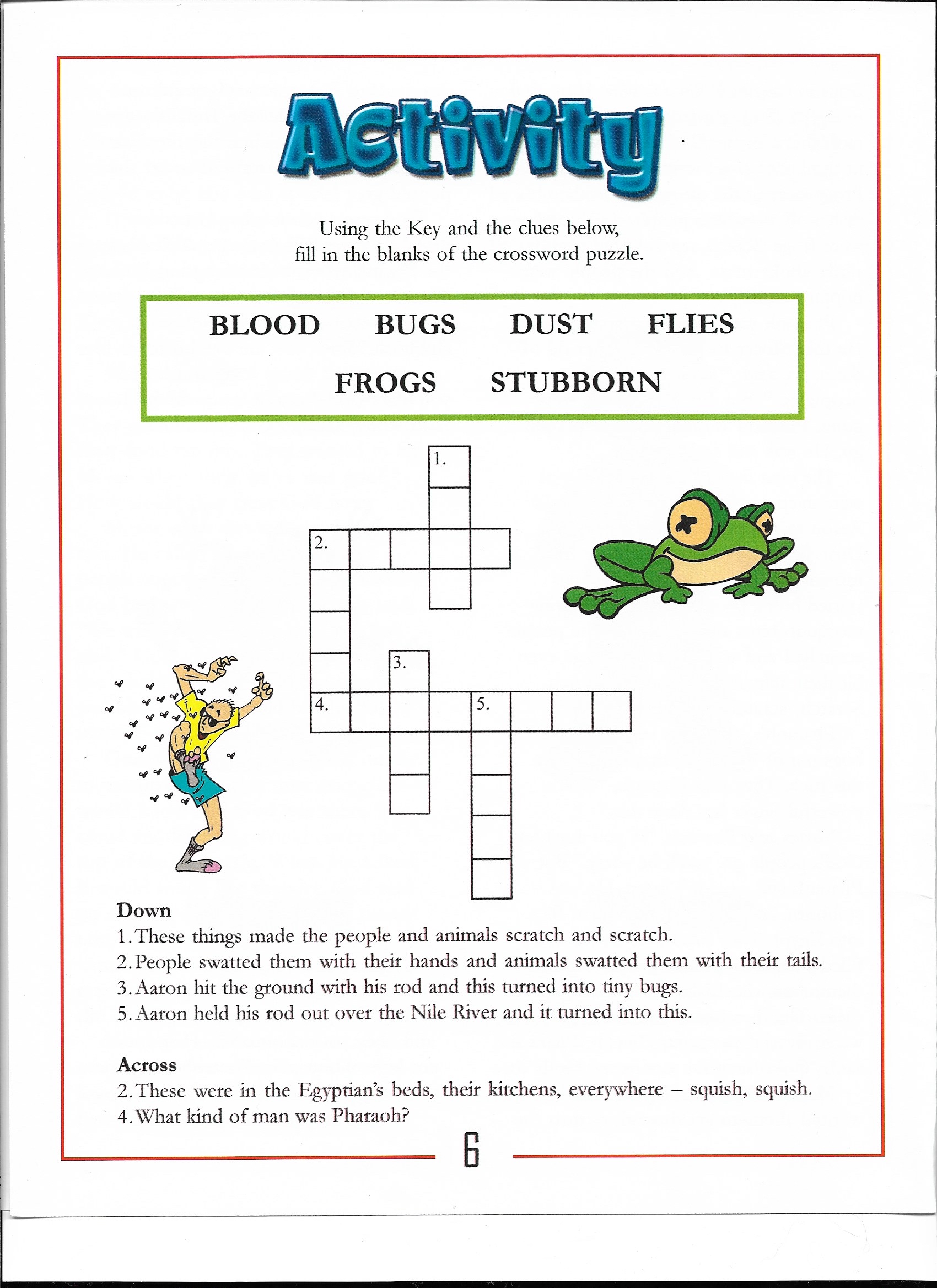
The next things God sent to Egypt were even worse than frogs. God told Aaron to strike his rod on the ground. Dust flew everywhere. Then the dust turned into tiny little bugs. The bugs started biting people. It was like having mosquito bites all over them. The people scratched and scratched. The bugs even bit their animals and made them itch. Scratch, scratch, scratch! Pharaoh's magicians tried to make bugs out of dust. But, they couldn't do this trick. They told Pharaoh, "God's powerful finger has done this."
Moses told Pharaoh, "If you don't let God's people go, you'll be sorry." But Pharaoh still wouldn't listen. He was stubborn. So, God sent millions of flies into Egypt. They filled the houses. They filled Pharaoh's palace. People swatted them. Animals swished their tails at them. The flies ruined the food. They were all over everything. Finally, Pharaoh said, "Go, offer your sacrifice to God."
Moses told Pharaoh that God wanted them to go three days into the desert. But, Pharaoh was a stubborn man. He wouldn't let the Israelites go very far away. And when the flies had gone away, Pharaoh refused to let the people go.
God wants you to obey His commands. Because Pharaoh wouldn't obey, the Egyptians were scratching bug bites. They were holding their noses from the stinky messes. But still Pharaoh was stubborn. When you are stubborn, sometimes bad things happen to make you obey God. Learn a lesson from Pharaoh - obey God!
Student Prayer
Dear Heavenly Father,
There is nothing too hard for you. You want us to listen to and obey your commands. Help me to not be stubborn, like Pharaoh. Help me to obey you the first time, with a willing heart.
In Jesus' name.
Amen.
Daily Devotions
Sunday - Psalm 86:9-10
Monday - Ephesians 2:2
Tuesday - Exodus 7:4
Wednesday - Proverbs 8:32-33
Thursday - James 1:25
Friday - 2 Chronicles 30:8
Saturday - Psalm 91:1-2
Objectives
At the end of this lesson, the children will be able to:
1. Name the first four plagues sent on Egypt.
2. Explain that Pharaoh was stubborn, he wouldn’t let the people go worship God.
3. State that it is always best to obey God instead of being stubborn.
Topics & Themes
Aaron
Egypt
God’s Judgment
God’s Omnipotence
Miracle
Moses
Obedience
Pharaoh
Plagues
Materials Needed
Bible, YEA Students' and Teacher's books, attendance and memory verse charts, stickers, music player and CD or cassette, songbook, green cardstock or construction paper, wiggle eyes, glue, small plastic frogs, rice, broom handle or long stick
Preparation
Handwork projects can be more than just fun. They are wonderful tools that enhance your lesson. Handwork is different from craft activities. These projects are designed to be more teacher-guided. They are structured so that they can later be used to review the lesson or to share the specific message of the lesson with their family.
Make sure your supplies are in order, including clean-up items. Make a sample project before class so that you understand how to put it together.Then demonstrate the assembly in a step-by-step manner as the children follow your directions.
Before you come to class, cut green construction paper or cardstock into 6 x 10 inches rectangles (one for each child).
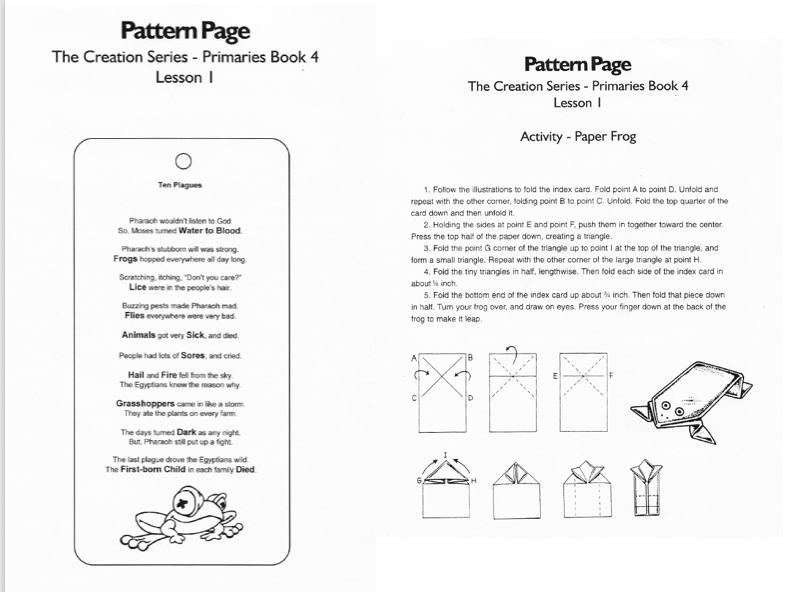
In addition to the weekly memory verses, assign the ten plagues for the children to memorize. Make copies of the bookmark on the pattern page to aid in memorization. They are to be recited in ten weeks at the end of this unit. A small award should be given to those who have memorized all ten.
How to Teach This Lesson
Divide the children into two groups. At the indicated time, group one will say, "Let my people go," group two will say, “No!”
God chose Moses to lead His people out of Egypt. God sent Moses and his brother, Aaron, to tell Pharaoh (Group one, "Let my people go"). But Pharaoh was a stubborn man. He wouldn't obey God. (Group two, "No!") So, God had to show Pharaoh that He meant business. He would show Pharaoh that He was a powerful God.
Proof of Power - God sent Moses and Aaron to Pharaoh to demonstrate His power. God told Aaron to throw down his rod (Throw the stick on the floor). When he did, Aaron's rod turned into a snake. Pharaoh's magicians thought it was magic. They did the same thing. Snakes were everywhere. But then, Aaron's snake ate all the other snakes. Ask: Do you think this was a trick? It was a miracle! God was showing His power.
First Plague - The Nile River was needed in Egypt. It was the source of drinking water for both man and animals. It was the laundry and the place where they bathed. It was worshiped. It was also the place where Moses’ mother had hidden him in a basket when he was a baby. Moses’ life was spared as Pharaoh’s daughter drew him out of the river. But most importantly, it was the place where Pharaoh had commanded all newborn Hebrew boy babies to be thrown so they would die. Because Pharaoh used the Nile to kill the Hebrew newborn sons, it is possible God chose to use it for the first plague when Pharaoh refused to obey Him.
As Moses and Aaron stood before Pharaoh, Moses said, (Group one - “Let my people go.”), and Pharaoh said, (Group two - “No!”). This time God’s miracle took place at the Nile River. God told Aaron to hold his rod out over the river. (Hold your rod out.) All the water in the river turned to blood. Ask: What do you think happened to the fish and animals that lived in the river? Dead fish floated to shore. They piled up and began to stink. Ask: Have you ever smelled dead fish? Yuck! Would you like to live in Egypt around such a stinky mess?
Second plague - Ask: What would you do if you awakened in the morning and frogs were hopping all over your bed? When you threw back the covers and stepped on the floor, squish! Hopping, slippery frogs were everywhere. Would you like to eat out of a plate that had a big fat frog sitting on it? Moses and Aaron met again with Pharaoh. Moses said, (Group one) and Pharaoh said, (Group two). What a stubborn man he was! This time God sent frogs to Egypt. They came up out of the rivers and ponds. (Put plastic frogs on the floor and furniture.) They hopped into houses, jumped on the tables, got in the cupboards on the dishes, in the beds, even on their clothes. Frogs were everywhere! The people couldn't even walk without stepping on frogs - squish, squish!
Pharaoh's magicians did their magic- more frogs! But, the magicians couldn't make the frogs go away. Pharaoh was angry; he wanted the frogs gone. He asked Moses to get rid of them; then he would let the people go. Ask: Do you think he meant what he said?
Third & Fourth Plagues- Pharaoh's stubborn heart wouldn't let the people go. This time God sent something very tiny, but it caused all kinds of problems. He told Aaron to strike the ground with his rod (Hit the floor). Dust flew everywhere. Then the dust turned into tiny bugs. They jumped on the people and animals. (Sprinkle rice in the children's hair.) They started biting them. Everyone was scratching. It was like they had mosquito bites all over them! But still Pharaoh said, (Group two, “No!”). So God sent flies!
Flies were in all the houses. They were in the palace. They were on the food. Ask: Would you like to eat a hamburger that had flies all over it? People swatted flies. Animals swished their tails at them. But the flies wouldn’t go away. The magicians couldn’t make bugs out of dust or make flies. They said, “God’s powerful finger has done this.”
This time Pharaoh told Moses, “Go, offer your sacrifice to God.” Ask: But do you think Pharaoh would really let them go? (Group two)
God wants us to obey Him. When we don’t do what He tells us, sometimes bad things happen to make us want to obey. Ask: What lesson can you learn from Pharaoh? (Obey God!)
Review Questions
1. What was the first miracle that Moses and Aaron did?
2. What happened to the water in the Nile River when Pharaoh wouldn’t obey?
3. Why was there such a stinky mess?
4. What got n the beds, cupboards, and all over Egypt? Hint - squish, squish!
5. How did the dust cause people to itch and scratch?
6. What did God send that had the Egyptians and animals swatting?
7. Were Moses and Aaron using magic?
Teacher-Directed Activity
Give each child a sheet of green paper. Step-by-step have them fold the paper into a "frog." (See diagram on pattern page.) Glue on wiggle eyes. If time allows, have frog races by pressing finger down at the back of the frog to make it leap.
REACH Activity
Materials Needed: tempera paint, paint brushes, clay, package of colorful construction paper, string, glue, tape, Kids Classics Collection songbook and/or CDs, Bible, YEA book, Bible notebook, black permanent marker, watercolor paints, 11 x 17 drawing paper, pencils, markers, colored pencils, crayons, scissors, ruler, index cards, CEM Hymnal, Bible dictionary, concordance, access to encyclopedia or the Internet, Bible encyclopedia, Bible map or Bible atlas, dictionary, cardboard, frogs, frog cutouts
1. Moses’ and Aaron’s rods were also called staffs. What is a “staff”? What does it look like and what is its purpose? Use Bible reference books to find answers and then write about it in your Bible notebook. Share the information with your Sabbath School class or family.
2. Draw the outline of a staff or rod on a brown piece of cardboard and then cut it out. Write the memory verse on it with glitter glue. Practice the verse until memorized.
3. Have you ever seen a picture or map of the Nile River? Use Bible maps and encyclopedias to see the Nile River for yourself. Write at least three facts about the Nile River in your Bible notebook.
4. Use a Bible dictionary to find the definition of “plague.” Write the definition in your Bible notebook.
5. Make index cards for the miracle with Moses’ rod and the first four plagues.
a. On the front side of an index card, write “Moses threw his rod down and it became a snake.” On the back side, write “Pharaoh’s magicians did the same thing, but Moses’ snake ate their snakes.”
b. Second card: front side—First plague; back side—water turned to blood everywhere.
c. Third card: front side—2nd plague; back side—frogs everywhere, bathtubs, beds, kneading troughs
d. Fourth card: front side—3rd plague; back side—gnats from the dust
e. Fifth card: front side—4th plague; back side—flies, but only on Egyptians, not on Hebrews
6. Make another index card for the memory verse. The front side has the first half of the memory verse; the back side has the second half.
7. Use the cards to put the events (plagues) in order and to practice the memory verse.
8. Read Exodus 7:12-9:7. Then role play it.
9. Pretend you are Moses. Write a journal entry for the events and Moses’ reaction.
10. Start a weather forecasting book based on the plagues of Egypt. For example, the first page would be the flood of blood in the Nile and across all of Egypt. Illustrate. Do the first four plagues, one page for each plague.
11. Start a mobile of the plagues of Egypt. Hang a different object from a hanger depicting each plague, i.e. a section of a red river for the first plague, a frog for the second plague, etc.
NOTE: Making a Mobile: Cut out the shapes desired for reinforcing the lesson (i.e., the plagues of Egypt). Use heavy card stock for the shapes. Using a single hole punch, punch a hole in the center of the top of the shape. Thread different lengths of yarn, string, or fishing line through the differ- ent shapes. This will allow the shapes to dangle at different levels. Tie the tops of the strings onto a hanger. Spread them out along the hanger so the hanger is balanced. To display the mobile, the hook on the top of the hanger can be twisted perpendicular to the rest of the hanger in order to hang the finished mobile over a curtain rod.
12. Parents want their children to learn to obey them when they are asked to do chores. For example, to clean their rooms and throw away the trash. But children don’t always do what they are told. Remember, when you obey your parents, you are also obeying God. (Read the Fifth Commandment.) Moses and Aaron obeyed God and went to Pharaoh with specific directions. Write Exodus 7:20a in your Bible notebook.
13. Write the rest of Exodus 7:20 on the top of a piece of 81/2 x 11 piece of construction paper. Next, draw what the Nile River looked like during the plague of blood. Add details that were in the YEA lesson and related Scriptures. At the bottom of the paper, label this picture as the first plague.
14. For the plague of frogs: with adult supervision, try to get real frogs to touch and observe. Research and share frog facts. Trace and cut out frog shapes, then write a frog fact on each and tape the frog facts all over your bedroom or classroom. How would you feel having your living and sleeping space invaded by frogs? Discuss with a friend or family member what would be so bad or great about having frogs everywhere.
15. The plague of gnats or lice affected people and animals. How do you think the people took care of their bites? What do you do when you get a mosquito bite? What makes it stop itching and feel better? What do you think gnats or lice look like? Look up gnats or lice in an encyclopedia. Draw a picture and write three facts in your Bible notebook.
16. If you have ever been on a picnic, you know how flies can bite. How could the people eat with flies everywhere? What would you do about eating and sleeping with those flies all around? Talk about it with your Sabbath School class or family.
17. The memory verse includes two very important words: respect and stubborn. Use a dictionary to find their meanings, and then write them in your Bible notebook.
18. Sing: “Have Thine Own Way, Lord!” on page 97 of the CEM Hymnal; “God of Our Fathers, Whose Almighty Hand” on page 11 of the CEM Hymnal.
Culminating or On-going Activities
1. Create a newspaper or newsletter with headlines from each of the YEA lessons, or write your own. Each reporter should have their own story to write. Use pictures with each story. Make copies for each family member or Sabbath School student.
2. Design one mural for these ten lessons. Additions are made after each lesson.. Hang the mural when completed. Invite others to your Exodus mural.
3. Ask students to create a game from the YEA lessons on the plagues. Provide simple materials and supplies. Students share and teach the games to each other. Store games in ziplock bags or small boxes.
4. Set up the classroom as a news station. Create call letters for your news station, for example BNN - Bible News Network or BNS - Bible News Station. Invite family and friends to hear the newscast of what happened during these ten YEA lessons. Divide the newscast into several parts: headline news, eyewitness/man on the street segment, weather report, sports, and the strange and unusual. Have someone videotape the newscast for the class to watch at a later date.
5. Write a thank you note to your Sabbath School teacher and/or your parents, telling them which lesson you liked best in On The Move and why.
Song
“My God is So Big” is on page 14 of Kids Classics Collection.
Closing Prayer
Lead the children in prayer, asking God to teach them to always obey what He tells them, the first time.
Printable Pages