YEA Lesson Library
Let My People Go
About This Lesson
This lesson teaches that everyone must obey God - from Moses and Pharaoh to all of us today!
Scriptures
Exodus 5:1
Exodus 5:1-23
Exodus 6:1-30
Exodus 7:1-13
1 Chronicles 16:23-29
Psalm 33:12
Psalm 95:7-8
Isaiah 45:5-6
Mark 12:29-30
Acts 5:29
Words to Know
MIGHTY - strong
PHARAOH - the king of Egypt
RULER - the one in charge
STATUES - carvings of wood or stone
The Lesson
When your teacher tells you to do something, do you listen and obey? When your mom tells you to clean your room, do you do what she says? Or when your daddy says it's time for bed, do you listen to him? It is important that you learn to obey. Sometimes even grown-ups have to obey. Daddy has to obey his boss at work. Mommy has to obey traffic laws. And, we all must learn to obey God. We must do what He tells us in His Word.
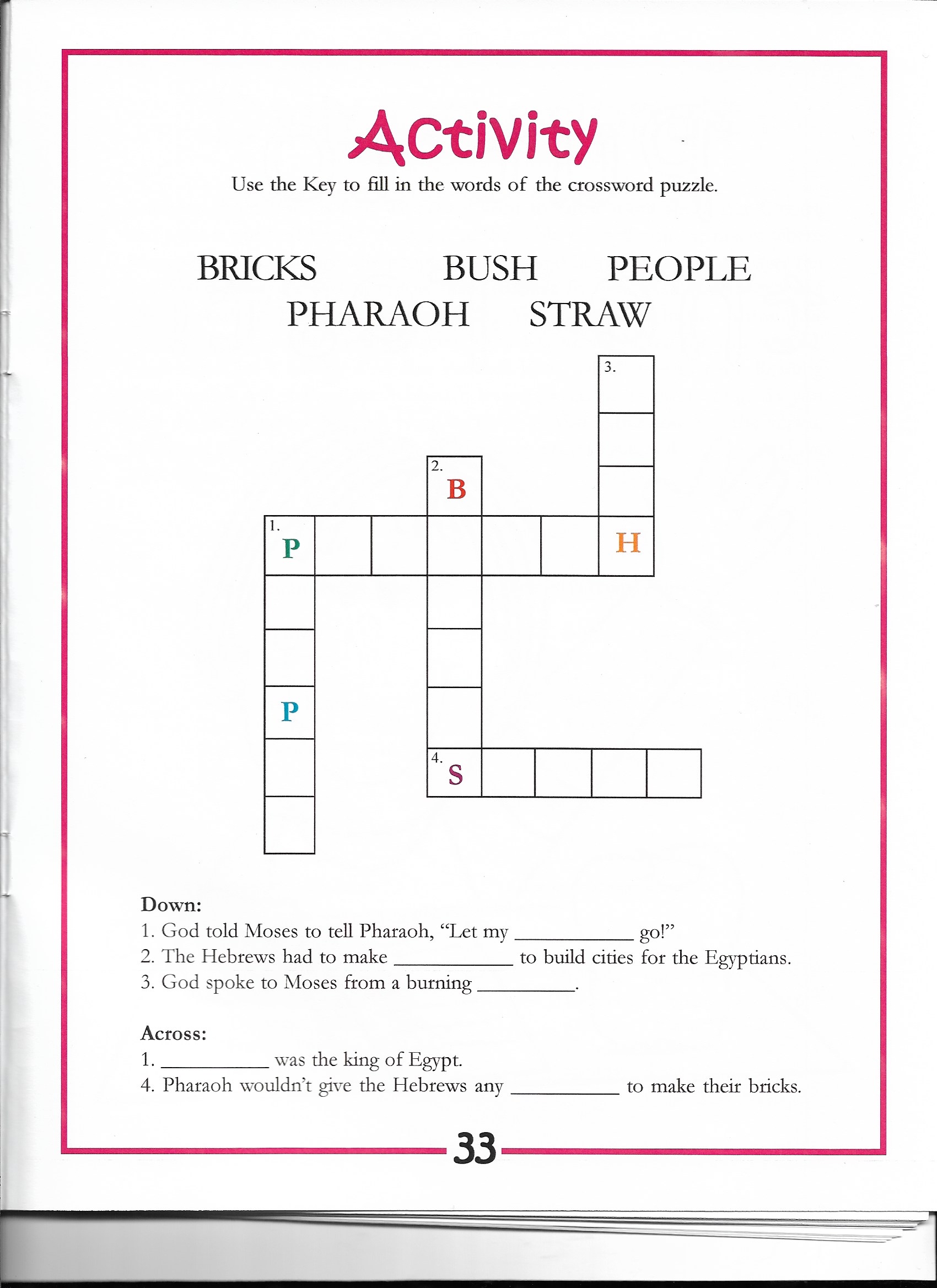
One day God spoke to Moses in the desert. He spoke through a bush that was burning. God gave Moses a job to do. He told Moses to go and speak to Pharaoh, the king. God said, "Tell him to Let My People Go?” God wanted the Israelites to be free to go into the desert. There they would hold a feast unto God.
Remember, the Israelites worked for the Egyptians. They made bricks and built big cities with them. Pharaoh didn't want to lose his workers. If he let the Israelites go, who would make the bricks?
A king is a very important man. Not everyone was allowed to talk to him. Wouldn’t you be afraid if you had to talk to a king? It would be like talking to our president. Moses was afraid, but he obeyed God. He told Pharaoh what God said.
Pharaoh was angry with Moses. He asked, "Who is this God that I should listen to Him?" The Egyptians didn't worship the true God. They worshiped and prayed to statues. Pharaoh was the king. He didn't like anyone, not even God, telling him what to do. He said he wouldn't let the people go to worship their God.
Pharaoh wanted to keep the Israelites busy. He made it harder for them to make bricks. They needed dirt and water to make mud. Then they would add straw to help hold the bricks together. Pharaoh said, "Don't give them any more straw. Let them find their own." They even had to make more bricks than before. Now the people would have to work longer. There would be no time for worshiping God.
The Israelite people were very tired. They were mad at Moses. They said that he had brought this trouble to them. I wonder why they were not mad at Pharaoh?
Moses prayed to the Lord. He thought God had made a mistake. He said that Pharaoh wouldn't listen to him. But God still wanted Moses to tell Pharaoh to "Let My People Go!" Then Moses tried to get out of his job. He said that he didn't speak very well. Sometimes it is hard to do what God says. God said He would help Moses. He said to take his brother, Aaron, to speak for him.
Moses and Aaron went again to Pharaoh. They said what God had told them, "Let My People Go!" But Pharaoh refused to listen. He only got more angry.
Our God made the earth and the sky. He made everything in them. He is great and mighty. He is the ruler over everything. Next to God, Pharaoh was very weak and small. God could squash him like a bug! It is dangerous to get mad and not obey God. There could be trouble. Pharaoh had better be careful!
Student Prayer
Dear Heavenly Father,
You are so strong and mighty, no one is as great as you. You made everything and you know everything. Help me to listen and obey what you tell me.
In Jesus’ name.
Amen.
Daily Devotions
Sunday - Acts 5:29
Monday - Isaiah 45:5-6
Tuesday - Psalm 95:7-8
Wednesday - Psalm 33:12
Thursday - 1 Chronicles 16:25, 29
Friday - Mark 12:29-30
Saturday - Exodus 5:2-3
Objectives
At the end of this lesson, the children will be able to:
1. Tell Moses' excuse for not wanting to go speak to Pharaoh.
2. Explain why Pharaoh refused to listen to what Moses had to say.
3. State that sometimes it is hard to do what God wants us to do.
4. Tell that we should all obey God because of who He is and because we love Him.
Topics & Themes
Aaron
Burning Bush
Consequences of Sin
Creator
Fear
God’s Omnipotence
Loving God
Moses
Obedience
Pharaoh
Slavery
Worship God
Materials Needed
Bible, YEA students' and teacher's books, attendance and memory verse chart, stars, music player, cassette tape or CD, plastic containers, dirt, pitchers of water, newspapers, hay, straw or grass clippings, old shirts to protect clothing, towels for clean-up, construction paper, tape, aluminum baking tins (about 3" × 6"), awards
Preparation
Obedience at any age can be difficult. We have our own thoughts and ideas and choose them rather than obedience to God. Children are no exception. Children make the choice to obey many times a day, at home, in school, and on the playground. Even when they do not want to obey, they can choose to obey out of love. Emphasizing obedience as an act of love is beneficial. It takes the focus off their desires (what do I want) and places it on others (how can I please).
Before the children arrive, tape two large construction paper circles to the floor, about three feet apart. Write on one circle “Going My Way” and on the other “Obeying.”
Before you come to class, cover the table or floor with newspapers. Fill plastic containers (about 18" × 10" × 4") half full of dirt. You will need one container per each four students. Each group will also need a pitcher of water. Cut hay, straw or dry grass clippings into pieces about 1" long. Each group will need about 1 cup.
How to Teach This Lesson
Begin this lesson with an obedience test. Give the following scenarios and ask for volunteers to go to one of the circles and answer the question.
I. Your mother says, "Stay on the driveway. Don't ride your bike away." tI would be fun to cross the street. What will you do? (Have the child go to one of the circles.) Ask them to explain what could happen if they obey; fi they disobey?
2. Your teacher says, "Come inside now. Recess is over." You want to stay and have a turn on the swing. What will you do? (Go to circle.) What might happen if you obey; if you disobey?
3. Daddy says, "Your friends are here. Please share your toys." You want to play with your new truck. What will you do? (Go to circle.) If you don’t obey and share, what could happen? What will happen if you obey?
4. Grandma says, “Please go to bed. It’s time to get some rest.” You’d rather stay up and watch the rest of the movie. What will you do? (Go to circle.) What might happen if you stay up to watch the movie? What might happen if you obey Grandma?
God’s Call, Moses’ Answer - God wanted Moses to do something very important - what was it? How did God speak to Moses? Moses gave God an excuse as to why he couldn’t do the job - what was his excuse? How did God solve this problem? Explain that sometimes serving God is not easy. Even though Moses may have been afraid, he obeyed God.
God Said . . . - Moses and Aaron stood before Pharaoh and told him, “God said, ‘Let My People Go!’” Pharaoh was an important man. He didn’t like anyone telling him what to do - not even God! Ask: What question did Pharaoh ask Moses? Why did he ask such a question; didn’t everyone know why God was?
Make the Bricks - Pharaoh thought the Israelites had too much time on their hands. He ordered them to make more bricks. Ask: What did they need to make the bricks? What did he tell the taskmasters to stop giving them? This made the Israelites’ work even harder. They got mad at Moses. They thought he brought this new trouble on them.
God Repeats The Command - Because of Pharaoh's refusal, and the anger of the people, Moses prayed to God. Again God sent them to Pharaoh with the message, "Let My People Go!" Ask: How did Pharaoh respond - did he do what God told him?
Who Should Obey? - God has given us many commands in His Word, the Bible. Ask: Can you name some of God's commands? Write their answers on a chalkboard or newsprint pad. If you don't like God's commands, should you argue with Him or tell Him you don't have to listen? God created the earth and
sky and everything in them. He is the Almighty God, ruler over everything. We should obey God because of who He is. But, we should also obey Him because we love Him and want to please Him. There are consequences for disobeying God, just like there are consequences for disobeying your parents. Pharaoh was walking on dangerous ground when he refused to obey God.
Review Questions
Questions are used throughout the lesson.
Teacher-Directed Activity
Give each child an old shirt to wear to protect their clothing. Have a plastic container of dirt for every four students. Allow one child in each group to slowly pour in water, and another child to add straw pieces, while the other two mix the ingredients with their hands until it is the consistency of thick mud. Give each child a small aluminum baking tin and have them fill their tin about half full of the mud mixture. Tell them that the Israelites let their bricks bake in the hot sun until dry. (You will need to bake their bricks in a warm oven overnight, or until dry.) Remove the bricks from the baking pans.
Memory Work for book:
Have the students recite Psalm 23. Provide a reward for their hard work!
REACH Activity
Materials needed: tempera paint, paint brushes, package of colorful construction paper, string, glue, tape, Kids Classics Collection songbook and/or CDs, Bible, YEA book, Bible notebook, black permanent marker, watercolor paints, 11 x 17 drawing paper, card stock, pencils, markers, colored pencils, crayons, scissors, ruler, index cards, CEM Hymnal, Bible dictionary, concordance, access to encyclopedia or the Internet, Bible encyclopedia, Bible map or Bible atlas, dictionary, empty oatmeal container or coffee can, poster or poster paper, dirt, straw
Bible notebook: A spiral bound notebook will be used as a Bible notebook. This is a good place to write and keep all of the writing activities.
1. Using an empty oatmeal container or coffee can, make up a rhythm to go with the memory verse.
2. Memory verse practice: two students practice the verse together. One says the first line. The other student says the second line. They take turns until the verse is memorized.
3. Use 14 index cards. Write one word of the memory verse on each card (plus one card for the Scripture reference). On poster paper or a poster, arrange the cards like bricks for building— but with the words in the correct order so that the memory verse can be read.
4. Use dirt, water, and straw to make bricks. Does it work? Why or why not? Write what happened in your Bible notebook. Show the bricks to your Sabbath School class or family.
5. Ask your family who they must listen to at home, work, and at school. Discuss why listening to that person is important. God wants you to listen to Him, too. Use your Bible to find something special to read today. Tell your family about it and what you learned.
6. Use your Bible and concordance to find at least two Scriptures each for the words “listen” and “obey.” Write them in your Bible notebook. Then write two sentences using each of the words. Share with Sabbath School class or family.
7. Moses told God that he didn’t speak very well. Use your Bible and concordance to find out why. Write the information in your Bible notebook. Share with Sabbath School class or family.
8. Moses decided he would obey God. What did God tell Moses to say to Pharaoh? Do you remember who Moses’ people were? Read back in your YEA lessons to find the name of his people. Then write in your Bible notebook why God wanted the people to be let go.
9. Read Exodus 5:1 to 7:13. Then role play Pharaoh and Moses.
10. Draw a picture of the confrontation between Moses and Pharaoh. Write the memory verse across the bottom of the page.
11. Imagine that you are an Israelite who is working harder than ever because of what Moses told Pharaoh. Ask someone to help you role play what you would say to Moses.
12. 1 Peter 1:12 indicates that the angels are very interested in God’s plan for man. Pretend you are an angel watching when Pharaoh says no to Moses. Knowing that God sent Moses, what do you think the angel’s reaction would have been? Write about it.
13. Do a sword drill with the Daily Devotionals for this week. Write the one verse that is your favorite when you are finished.
Note: Sword drill: Use the Daily Devotional Scriptures to have a sword drill. Read the Scripture reference to the child. Then start the timer. When the child has found the verse, stop the timer. Read the verse and talk about how it relates to the lesson. Challenge the child to see how quickly he/ she can find each of the verses in the Bible.
14. Sing: “O Be Careful Little Eyes” on page 39 of Kids Classics Collection. Apply this song to Pharaoh. For example, think about how he wasn’t careful about what he saw; he saw the murder of the baby boys because he ordered it.
15. Sing: “Thy Perfect Will Be Done” on page 199 in the CEM Hymnal.
16. Students should be ready to recite Psalm 23.
17. Memory work activity for book: To help with the memorization of Psalm 23, give each student 13 4 x 6 cards. On one side of the card the student should write one phrase of each verse. For instance, one card will have: The Lord is my shepherd; I shall not want. The next card would have: He makes me lie down in green pastures. The third card would be: He leads me beside still waters. Continue with each phrase of the psalm. On the other side of the card the student should draw a picture that will help them remember that phrase. Since the students will be expected to recite Psalm 23, the cards should be made after YEA Lesson 1. After each of the subsequent lessons, the student should practice the psalm until memorized. Provide a reward for their hard work!
Culminating Book Activities
1. Ask students to choose one word from each memory verse and use it in a sentence related to the YEA lesson.
2. To go with the Put to the Test theme of this YEA book, ask students to identify who was put to a test in each of the lessons. Can they tell you what kind of test the person experienced and how they “passed the test”?
3. Ask students to write down at least one question from each lesson. Have them trade papers and see if they can “pass the test” the other student wrote.
4. Test anxiety affects many students and adults. The older primaries may mention this during the ten week unit. Listen to their concerns and offer help if you can. If not, be sure to share the child’s anxiety with a parent. There are many resources to find help for the student.
Song
“My God Is So Big” is on page 14 of Kids Classics Collection.
Closing Prayer
Lead the children in prayer, acknowledging God’s greatness and asking Him to help them obey God’s commands.
Printable Pages