YEA Lesson Library
Reward for Service
About This Lesson
This lesson uses Joseph’s story as an example for the student to emulate: despite adversity, Joseph continued to faithfully do what was right and was eventually rewarded.
Scriptures
Genesis 41:15-16
Genesis 41:33-57
Psalm 3:5-6
Psalm 37:18-19
Proverbs 1:7
Proverbs 11:26-28
Proverbs 13:21
Proverbs 17:2
Matthew 6:26
Words to Know
ALLOWANCE - money given by parents, often for doing chores
CHARIOT - horse-drawn, two-wheeled cart
CONCESSION STAND - a booth where food and drinks are sold
FAMINE - a severe shortage of food
FELLOW-PRISONERS - someone also in prison with Joseph
The Lesson
Patrick and his family were spending the day at the beach. He and his sister were building sand castles. Patrick walked down the beach looking for sticks for their castle. He would use them to make flag poles. Half hidden in some grass, he saw something black. Patrick picked it up and found it was a wallet - and there was money inside! “What should I do?” Patrick wondered. He decided to take the wallet to the concession stand.
Patrick gave the wallet to the girl in the concession stand. He told her where he found it. Just then, a man came up very excited. He asked if anyone had turned in a black wallet. The girl told the man that Patrick had found it. The man was very happy. He said Patrick had done a very good thing. Then he opened his wallet and handed Patrick a five-dollar reward!
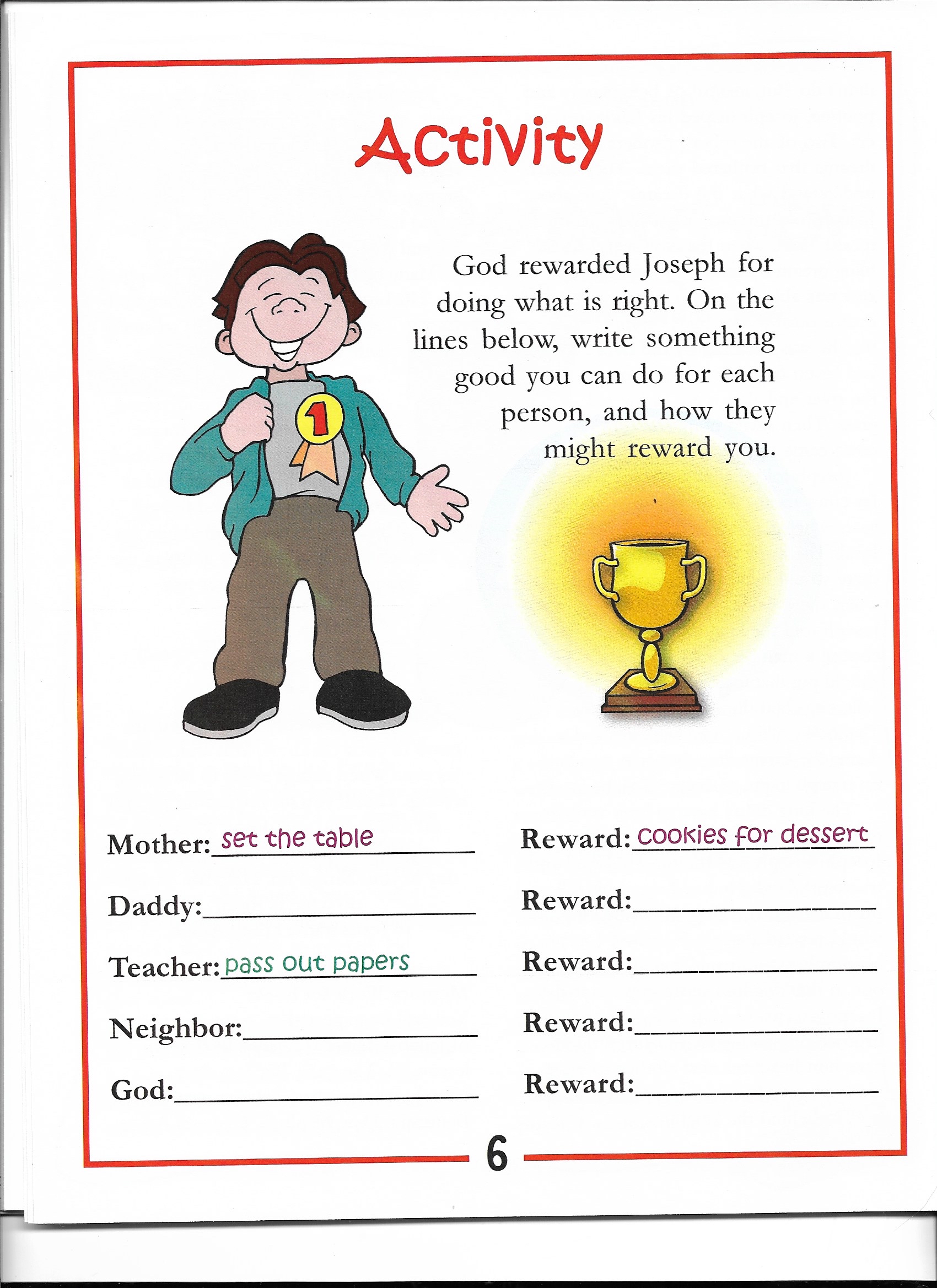
Have you ever received a reward for doing something good? Have you ever found something that was lost and returned it to its owner? What did the owner do? Do you ever help your mom or dad clean the house or yard? Do they reward you with an allowance? We should not do good things just to receive a reward. But, rewards are surely nice to receive!
Joseph had been thrown in prison for something he didn't do. But, instead of being angry and pouting, Joseph helped his fellow-prisoners. Two of the other prisoners had dreams that bothered them. They didn't understand what the dreams were about. Joseph told the men what their dreams meant. And, when the king had a troubling dream he sent for Joseph. Joseph also was able to tell the king what his dream meant. The king dreamed that he was standing by the river and seven fat cows came up out of the river and they were eating tall grass. Then seven bony and thin cows came up.
Joseph told the king that the seven fat cows meant there would be seven years when there would be plenty of food. The bony and thin cows meant there would be seven ears of famine when there would be little food. Joseph told the king that he should choose a man he could trust. He should put that man in charge of collecting food during the good years. The food could be stored in barns and used during the famine time. But, who was honest enough to put in charge of al the food?
The king didn't have to look very far to find his man. He knew he could trust Joseph. Joseph was honest. He loved and trusted in God. He had helped his fellow-prisoners and the king. Now the king would reward Joseph. He made Joseph his number one man! There would be no one in the kingdom more important than Joseph except the king. The king took off his own ring and gave it to Joseph. He gave him beautiful new clothes to went He even gave him his own chariot to ride in right behind the king!
Joseph worked hard during the good years. Everyone had plenty to eat. Their gardens grew lots of grain and other vegetables. Joseph told the people to bring part of their harvest to him. He stored it in barns. Soon his barns were full and running over!
Many bad things happened in Joseph's life. His brothers were jealous of him and sold him as a slave. His master’s wife lied about Joseph and he was sent to prison. He helped his fellow-prisoners understand their dreams. But they forgot about Joseph. With all these bad things, Joseph didn't get mad at God. He still loved and trusted Him. And, God rewarded him for his service. But, God was going to use Joseph in an even greater way.
Memory Work for book:
You will be expected to recite Psalm 23.
Student Prayer
Dear Heavenly Father,
You are good to your children. You watch over us even when things seem to be going wrong. Thank you for rewarding Joseph for loving you and doing what was right. You will reward me someday in your Kingdom. Help me always do what is right.
In Jesus name I pray.
Amen.
Daily Devotions
Sunday - Proverbs 3:5-6
Monday - Proverbs 1:7
Tuesday - Proverbs 17:2
Wednesday - Matthew 6:26
Thursday - Psalm 37:18-19
Friday - Genesis 41:15-16
Saturday - Proverbs 11:26-28
Objectives
At the end of this lesson, the children will be able to:
1. State that God rewards faithful good behavior.
2. Tell how Joseph was finally rewarded for doing what was right.
3. Explain that sometimes we must wait for our reward.
4. Tell what reward God has planned for those who are faithful in obeying Him.
Topics & Themes
Adversity
Authority
Faithful
Famine
God’s Kingdom
God’s Plan
Helping Others
Joseph
Rewards
Trusting God
Wait on God
Wisdom
Materials Needed
Bible, YEA students' and teacher's books, music player, cassette tape or CD, attendance and memory verse chart, stars, poster board pieces, safety pins, colored markers or crayons, tape, good behavior awards
Preparation
First through third graders do not yet think of God in terms of His attributes like loving, holy, eternal and so forth. They think of God in terms of what He does. They are self-centered, and therefore are interested in what God can do for them. God gives them their food, He made the sky and animals, He supplies their needs.
With the right kind of modeling, these children can learn to share and do things for others. Praise them for good behavior. Children respond to specific praise and will continue doing the things that elicit praise. Praise in itself can be a precious reward to a child. "Let us consider how we can stir up one another to love. Let us help one another to do good works" (Hebrews 10:24, NIrV).
Make or purchase ribbons, buttons, certificates or trophies from a novelty or teacher's supply store to be awarded for good behavior.
How to Teach This Lesson
Begin the class by showing the children the awards you will give to the students who exhibit good behavior. Explain that they should not talk out of turn, they should do what they are told, and they should help one another. Tel them that God has rewards for those who obey His commands and do things that please Him.
Be Patient - During a big part of Joseph’s life it looked like only bad things were happening to him. Ask for volunteers to play the parts of Joseph and his brothers. Put a colorful shirt or jacket on "Joseph." Tel the "brothers" to act out how they felt when they saw Joseph in his new coat. Ask: Were they happy for Joseph? Did they like him? What did Joseph's brothers do to him?
Joseph was sold to be a slave - Ask: Was this a good thing? Then his master’s wife lied about Joseph. Ask: What happened to him then? (Thrown in prison) Ask: Did Joseph get mad at God and quit serving Him? Joseph was even willing to help two fellow prisoners by explaining what their dreams meant. Ask: Was Joseph rewarded for doing this good deed? What did the fellow prisoner do? (Forgot about Joseph) Joseph had to wait a long time before he was finally rewarded for doing what was good.
Pharaoh’s Dreams - The king began having dreams that bothered him. He asked all his smartest men if they could tell him about his dreams. Not one of them could help the king. Then the king’s butler remembered how Joseph had helped him. And God helped Joseph understand the dreams. Ask: What did the seven fat cows stand for? (Seven good years) What did the seven bony, thin cows stand for? (Seven years of famine)
Joseph’s reward - Joseph told the king that he should prepare for the years of famine. He should set someone trustworthy in charge of collecting food during the good years. Ask: Who do you think would be the best person for such an important job? Pharaoh knew he could trust Joseph because he served and loved God. The king gave Joseph beautiful new clothes and a ring off of his own hand. He made Joseph the second most important man in the kingdom.
Our Reward - Read Matthew 5:11-12 from a kids’ or modern translation. Joseph was faithful to God and served Him even during the bad times. He is our example. God has promised to bless us, even when it seem like everything is going wrong. Jesus was crucified for sins He didn’t commit. He is also our example. He even prayed for those who mistreated Him. Jesus knew that He had a home waiting with His Father in Heaven. There everything would be right and good. God has also promised a reward for you and me if we will faithfully do what He has commanded. He is preparing a home for us in His Kingdom. There everything will be right and good. We will live with Jesus and our Heavenly Father forever! This is the best reward anyone could ever have!
Good Behavior Awards - At the end of the class time, Pass out the good behavior awards to students who have been helpful, obedient and attentive.
Review Questions
(Other review questions are included in the body of the lesson.)
1. How did the king reward Joseph for helping him understand his dreams?
2. Do we always receive our rewards right away?
3. What reward does God have for those who faithfully obey His commands?
Teacher-Directed Activity
Give each child a piece of poster board. Have them cut out a design, such as a circle, star, oval, etc. With colored markers, allow them to design their own award (best parent, good brother, favorite dad, etc.). Tape a safety pin to the back so the award can be worn. Tell them to award these for something special.
Memory Work for Book:
Have the students memorize Psalm 23.
REACH Activity
Materials needed: tempera paint, paint brushes, package of colorful construction paper, string, glue, tape, Kids Classics Collection songbook and/or CDs, Bible, YEA book, Bible notebook, black permanent marker, watercolor paints, 11 x 17 drawing paper, card stock, pencils, markers, colored pencils, crayons, scissors, ruler, index cards, CEM Hymnal, Bible dictionary, concordance, access to encyclopedia or the Internet, Bible encyclopedia, Bible map or Bible atlas, dictionary, blue (or other color) ribbon, magnet
Bible notebook: A spiral bound notebook will be used as a Bible notebook. This is a good place to write and keep all of the writing activities.
1. Draw: Divide a piece of drawing paper in half. On one side, draw Pharaoh’s first dream. On the other side, draw his second dream. (Read Genesis 41:25-57 for the whole story.) Be sure to write a caption for each drawing.
2. Draw: Divide a piece of drawing paper in half. On one side, draw a picture to represent the first half of the memory verse. On the other side, draw a picture to represent the second half of the memory verse. Write each half on the corresponding side.
3. On construction paper or card stock, write the memory verse in the shape of a blue ribbon. Or glue a blue (or other color) ribbon to the paper. Write the memory verse around or on the ribbon. Glue a magnet to the back and hang it where it can be seen. Practice the verse until it is memorized.
4. Draw: Divide a piece of drawing paper into four sections. Draw the events of the lesson in each section: 1) Pharaoh dreaming, 2) Joseph interpreting the dreams for Pharaoh, 3) Joseph in charge of all of Egypt (under only Pharaoh), 4) People bringing food to Joseph to store. Write captions under each section to tell the action.
5. Create a comic strip of Joseph, the people bringing their harvest to him, and the barns. Remember to include “bubbles” for dialogue. Share the comic strip with the Sabbath School class or your family.
6. In your Bible notebook, write a different ending to Patrick’s story in the YEA lesson. What would have happened if Patrick hadn’t turned in the wallet? How would he have explained having the extra money to his parents? How would he have felt? Then compare the two stories and write how you feel. What will you do if you find something?
7. Write the names of Jacob’s (Israel’s) 12 sons in your Bible notebook.
8. What do you think is a good reward? Does it depend on what you had to do to earn the reward? Explain your answer in your Bible notebook.
9. Think of a reason that you would give someone a reward. What kind of reward would you give? Explain why you would give a reward and describe what it would be. Write your answer in your Bible notebook.
10. Make a list of things that you like as rewards: going to the playground, a special meal, one-on-one time with Mom and/or Dad, a new pencil, etc. Keep your list in your Bible notebook. The next time your parents want to reward you for doing the right thing, you’ll be prepared to let them know what you like.
11. Sing: “Do Lord” on page 72 of Kids Classics Collection and “Count Your Blessings” on page 44 of the CEM Hymnal.
12. Joseph was in prison for something that he didn’t do. If you have been punished for something you didn’t do, you may have felt angry, frustrated, or confused. With your family, use your Bible and concordance to find a prayer that will help you with these feelings. Remember that God wants you to pray and talk to Him about what you are going through. He will always be there for you. Discuss and pray about this topic with your family.
13. Even though Joseph was in prison for something he didn’t do, he was able to serve or help others. He didn’t sit around and cry or pout. When others needed help, he gave it. “Servant” is a word for someone who serves or helps others. Do you know anyone who likes to serve or help others? Make them a card and thank them for being a good servant.
14. Use your Bible and concordance to find two Scriptures each for “serve” and “servant.” Write them in your Bible notebook. Explain the meaning for each Scripture to family.
15. Joseph was given the King’s ring, beautiful clothes to wear, and his own chariot. Draw a picture that shows the King giving these things to Joseph. Think about what the ring might have looked like, as well as the clothes and the chariot. Share your picture by retelling the YEA lesson.
16. Joseph has gone through some difficult times. Write a letter telling Joseph what you think about his life so far. Imagine you are really going to mail the letter. Create a design on the letter paper and envelope, including the stamp. Share your letter with the Sabbath School class or your family.
17. Memory work activity for book: To help with the memorization of Psalm 23, give each student 13 4 x 6 cards. On one side of the card the student should write one phrase of each verse. For instance, one card will have: The Lord is my shepherd; I shall not want. The next card would have: He makes me lie down in green pastures. The third card would be: He leads me beside still waters. Continue with each phrase of the psalm. On the other side of the card the student should draw a picture that will help them remember that phrase. Since the students will be expected to recite Psalm 23, the cards should be made after YEA Lesson 1. After each of the subsequent lessons, the student should practice the psalm until memorized. Provide a reward for their hard work!
Song
“I Will Sing of the Mercies of the Lord Forever” is on page 17 of Kids Classics Collection.
Closing Prayer
Lead the class in prayer, thanking God for His goodness. Ask Him to help the children do what is right, and acknowledge the rewards that await us in God’s Kingdom.
Printable Pages