YEA Lesson Library
Exciting Evidence
About This Lesson
This lesson cites the witnesses who saw Jesus alive again after His crucifixion.
Scriptures
Mark 16:9-14
Luke 24:13-43
John 20:1- 21:14
Acts 1:3
Acts 3:15
Acts 13:31
1 Corinthians 15:5-11
Words to Know
EVIDENCE - a sign that proves something to be true
MOAT - a deep ditch filled with water
The Lesson
Paula, Connie, and Larry worked hard building a sand castle. They built it far from the water. They didn’t want the waves to wash it away. It was a big sand castle. They made towers. They put little paper flags on top. They even made a wall around it. They were very proud of what they had made.
Daddy came to the door of the cabin. He called the children to eat lunch. They didn’t want to leave their sand castle. But, Daddy said that they could go back after they ate. They wanted to build a moat around the castle. They saved their popsicle sticks to make a neat bridge.
After lunch they ran to the beach. But, something had happened. There was nothing left of the sand castle but a pile of sand. “What happened?” asked Connie. There looked around, but no one was in sight.
Connie ran to tell Daddy what had happened. She was almost in tears. Larry was angry. He said he would like to find who messed up their sand castle. They would be sorry!
Daddy looked at the pile of sand. “Who would do such a thing?” asked Paula. Daddy thought he knew what happened. He told the children to look around for evidence. Daddy said they should look for clues.
The children looked at the sand. It was dry. The waves didn’t mess up their castle. No one else was on the beach. Larry pointed to footprints in the sand. They were animal prints, not people prints. “I’ve got it! I know who did it.” Larry called, “Here, Chase.” Their dog Chase came running, wagging his tail. Chase was guilty. They had evidence to prove it!
Jesus had been crucified. He came back to life. But some people still didn’t believe. Some thought His body had been stolen. Others were afraid to believe. They might be killed too. Jesus gave them evidence so they would believe.
Mary came back to the tomb. She was crying. She thought someone had taken Jesus’ body away. Mary heard a voice behind her. She thought it was the gardener. Jesus called her by name. Mary knew it was Jesus. She wanted to hug Him. But, Jesus said He had not yet gone to His Father.
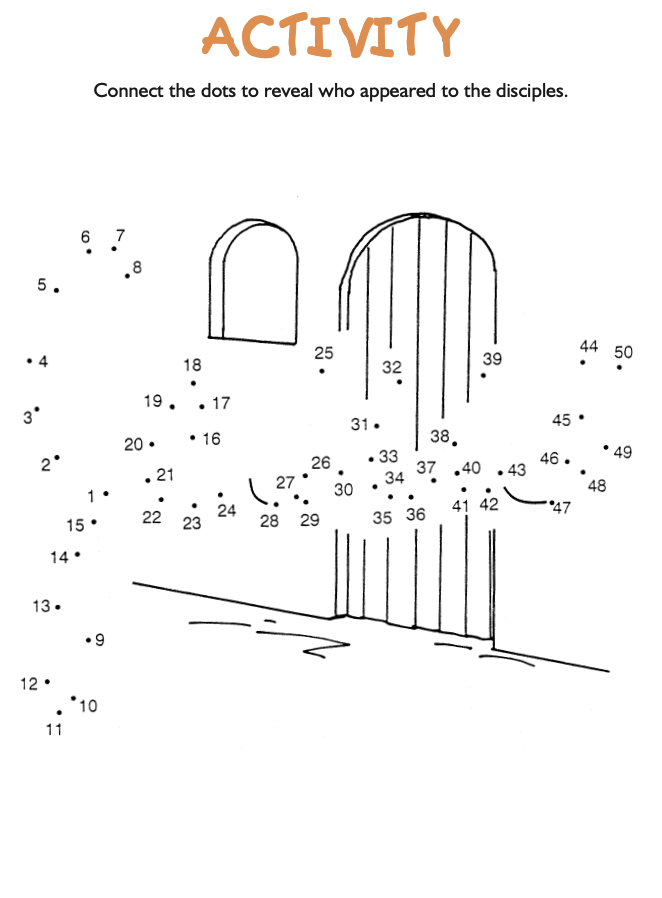
That same day, the disciples were meeting in a room. The door was locked. Suddenly, Jesus was in the room with them. They were all surprised. Jesus showed them His hands and feet. The disciples saw where the nails had been. This was really Jesus. The evidence proved it!
Thomas was one of Jesus’ disciples. He was not in the room when Jesus came. Jesus met with the disciples again. This time Thomas was there. Jesus showed His hands and feet to Thomas. He told him to touch the place where the soldier had stabbed Him.
Peter and some other disciples had gone back to fishing. Jesus met them on the beach. He ate bread and fish with them. He talked to two other disciples as they walked down the road. Another time Jesus met with over five hundred people. They all saw Jesus with their own eyes. They had evidence that He was really alive. They had proof that Jesus did what He said He would do – He came back to life!
Student Prayer
Dear Heavenly Father, Thank you for giving us proof that Jesus is alive again. Everyone who saw Jesus saw the exciting evidence. Thank you for giving us the Bible that tells us all of these things. In Jesus’ name. Amen.
Daily Devotions
Sunday: Mark 16:9
Monday: Mark 16:12
Tuesday: Mark 16:14
Wednesday: Luke 24:35-36
Thursday: Acts 3:15
Friday: Acts 13:31
Saturday: John 21:1
Objectives
At the end of this lesson, students will be able to:
1. Give the reason that Jesus appeared to so many people.
2. List at least three people who saw Jesus after His resurrection.
3. State what the evidence proved.
4. Recite their memory verse.
Topics & Themes
Disciples
Fish, Fishing
Jesus, Ascension of
Jesus, Crucifixion of
Mary
Peter
Resurrection
Thomas
Tomb
Witnesses
Materials Needed
Bible, YEA Students’ and Teacher’s books, six paper lunch bags, tape or stapler, rocks, cloth, dry leaves, keys, nails, slice of bread, rake, picture of a hand, fishing rod or net, attendance and memory verse charts, stickers or stars, songbook, CD or tape, music player
Preparation
It has been said that a meal is not complete without dessert. This is somewhat true of an effective lesson. If you have a good beginning (introduction or attention step) and a meaningful ending, your lesson has a better chance of being remembered. A meaningful conclusion should be planned as carefully as the beginning and body of the lesson.
Study carefully the objectives of your lesson. Emphasize these objectives as you teach the body of your lesson. Reinforce these objectives and answer any questions during your conclusion. Apply the Bible teachings to the everyday activities of your students. And, review the objectives and their application during the activity part of your lesson. Remember, that each portion of your lesson has been designed to drive home these objectives, and to teach the children to live according to God’s directions.
Before you come to class, place the following items around your classroom: a stone, rake, key, picture of a hand, and a fishing rod or net. Make a magnifying glass out of poster board, or bring a large magnifying glass to class to help you find and examine the evidence.
Place each of the following items into paper lunch bags and staple or tape the bags closed: a few rocks, a piece of cloth, dried leaves, key, nails and a slice of bread. Number the bags from one to six.
How to Teach This Lesson
Today you are going to be detectives. You will use your magnifying glass to look for clues or evidence. Since the children have read their lesson at home, they should be familiar with the term. But, in case there are some who may not have read the lesson, explain that evidence is a sign or clue that proves something is true. You are looking for evidence that proves that Jesus did what He said He would do.
Lead the children around the room until you “find” the stone. Seat the children on the floor and tell them that you will examine the evidence. This is just a small stone. Ask: After Jesus was placed in the tomb, what was placed in front of the door? It was not a small stone, it was a very large stone. It took several men to roll the stone in front of the door. But after three days and nights something happened to that stone. What did the women find when they came to the tomb on the first day of the week? The stone had been rolled away. This was evidence that something had happened.
Lead the children once again around the room until you “find” the rake. Seat the children and examine the rake. Mary was very upset when she found the tomb empty. She thought someone had stolen Jesus’ body. Ask: When she heard a voice speaking her name, who did she think it was? Whose voice was really speaking to Mary? Mary heard with her own ears and saw with her own eyes. It wasn’t the gardener, but Jesus who talked to her at the tomb. She had evidence that Jesus wasn’t dead!
The next item in your search is the key. Ask the children to find the key and be seated. As you examine the key, tell the children that it is a door key. Ask: Who was in a room with the door locked? Why did they lock the door? The disciples were afraid for their own lives. Ask: Who appeared in the room with the disciples? What evidence did Jesus show them to prove who He was?
Lead the children to the picture of the hand. As the children are seated, tell them that someone was not in the locked room that night. Ask: Which of the disciples was not there? When Jesus met Thomas, He told Thomas to do something. What did Jesus tell Thomas to do with his hand? Thomas said he would not believe unless he could touch the nail prints in Jesus’ hands and feet, and the place in His side where the soldier stabbed Jesus. Thomas had his evidence that this was really Jesus!
The last item is a fishing rod or net. As the children “find” this item, seat them again. Some of Jesus’ disciples went back to their job of fishing after Jesus died. Jesus went to the seashore and ate bread and fish with them. Ask: Can a dead person eat fish? The disciples had evidence that Jesus was no longer dead – He was alive again!
Jesus appeared to many people after He came out of the tomb. They saw Him with their own eyes. Some ate with Jesus. Thomas even touched Him. They all could prove that Jesus really did come back alive again.
Review Questions
Pretend you are in a court room. The teacher or assistant can be the judge. (Pound the gavel and call the court to order.) The following questions should be asked to prove that Jesus really rose again:
1. Why do you think Jesus showed Himself to so many people after His resurrection?
2. How do we know that Jesus’ body was not taken away? Who saw Him at the tomb?
3. Jesus’ disciples were meeting in a room with the door locked. How did Jesus prove to them that He was alive?
4. Thomas was not in the room when Jesus appeared. How did Jesus prove to Thomas that He was Jesus and that He was alive again?
5. Jesus proved that He was alive to Peter by doing what?
6. What did all of this evidence prove?
Teacher-Directed Activity
On a chalkboard or newsprint pad, write the numbers from one to six. Have the children sit in a circle on the floor. One at a time, pass the numbered bags around the circle. Allow each child a few seconds to feel the bag, then pass it to the next child. When each child has examined the bag, ask what they think was in the bag. Write their answer on a chalkboard or newsprint pad next to the corresponding number. After all six bags have been passed around, and their contents recorded, open the bags and show the children what was actually in the bags. Explain that they have just examined the evidence.
REACH Activity
Special Materials: craft or popsicle sticks, foam letters (plastic letters or tile letters as in Scrabble), dictionary
1. Make a story cube: Kids can draw pictures which show the “exciting evidence“ that Jesus has risen from the dead and is alive again. A cube is a six-sided figure. The YEA lesson has the “evidence” to complete the cube. Two examples of evidence can be drawn in combination on one side, leaving one side to be used for a title, if needed.
More Information: A Story Cube: On an 11 x 17 inch sheet of construction paper stick four 3-inch square post-it notes lengthwise. Then stick another post-it note at the top and at the bottom of the square that is second from the end. Cut around the post-it notes, but not between them. Fold between each post-it note to make a cube then remove the post-it notes. Write one event or sentence on each square of the cube. Tape the edges where the squares meet. Roll the story cube and talk about the sequence of events. If you don’t have post-it notes, you can draw 3-inch squares, but the post-it notes may make it easier.
2. Tell children to write a song to the tune of “He’s got the Whole World in His Hands,” which tells about the “exciting evidence” of Jesus.
3. Have kids use craft or Popsicle sticks, construction paper, glue or tape, scissors, and markers or crayons to create face stick puppets. Cut out four circles from the construction paper. With the crayons or markers, draw a face which shows fear/afraid, one that shows crying, one that shows surprise, and one that shows excitement. Glue or tape the faces to the craft or Popsicle sticks. Let them tell the YEA lesson story about Jesus to a friend or family member. As they get to the part of the story where someone was afraid, crying, surprised, or excited, they are to use the face stick puppets.
4. Encourage children to practice the memory verse. If you have foam letters or letter tiles, similar to those found in the game of Scrabble, they can use them to spell out their memory verse. Then have them practice saying it aloud to a friend or family member.
5. Sing “Down in My Heart” on page 69 of Kids Classics Collection. Ask: Why do you have the “love of Jesus in your heart”?
6. Kids should add this lesson to the timeline.
7. Children can make a list in their Bible notebook of the people who saw Jesus alive after His resurrection, using the YEA lesson to help them.
8. Ask: What wonderful words can you add to your Bible notebook this week? Have them add those words to their notebooks. Sing: “Wonderful Words of Life” on page 43 of the CEM Hymnal.
9. Ask: Has anyone tried to play a trick on you to make you believe that you saw something that you didn’t see? How do you know that Jesus is really alive?
10. Using the list of people who saw Jesus after His resurrection, help children do a mock trial. Each person on the list is an important witness to Jesus’ resurrection. Have each character tell what they saw that proves He was who He said He was. They can use their YEA lesson to get started. Then they should have their parents help them add more.
11. Seeing is believing. Ask: Who wouldn’t believe Jesus was alive again unless he actually put his hands in Jesus’ side and saw the wounds in Jesus’ hands and feet? Can you think of a time when you wouldn’t believe something until you saw it?
12. Have kids make eyeglasses out of construction paper. Draw them fairly large. Then they should write this week’s memory verse on the glass part of the glasses. This will help them remember that many people saw Jesus alive again!
13. Ask: What is “evidence”? Have them look it up in the dictionary and write the definition in their Bible notebook.
14. Romans 1:20 gives evidence that God is real. Ask: What is this evidence?
Song
“Isn’t He Wonderful” is on page 42 of the Kids Classics Collection.
Closing Prayer
Ask one of the children if they would like to lead in prayer, thanking God for the evidence that proves Jesus rose from the dead like He said He would.
Printable Pages