YEA Lesson Library
Alive Again!
About This Lesson
This lesson teaches about the resurrection of Jesus after three days and three nights in the tomb.
Scriptures
Matthew 20:18-19
Matthew 28:1-15
Mark 9:31
Mark 16:1-8
Luke 24:1-12
Luke 24:5
Acts 4:10
1 Corinthians 6:14
1 Corinthians 15:20
Words to Know
CEMETERY - a place to bury the dead
CRUCIFIED - nailed to a stake and left to die
TOMB - a grave
The Lesson
Do you like scary ghost stories? This is the best non-ghost story ever heard!
What happens at a funeral? When a person dies, his body is put in a casket. Everyone is sad – some are crying. A minister reads from the Bible and prays. He may say some good things about the person who died.
After the funeral, you go to the cemetery. Men carry the casket to the grave. The minister again reads the Bible and prays. The casket will be put in the ground. Everyone knows that person is really dead.
How would you feel if you saw that person again three days later? He is walking and talking. He even talks with you. Someone might just scream, “It’s a ghost!”
This is what happened three days after Jesus was killed and put in the tomb. The Sabbath was over. Mary and two others were going to Jesus’ grave. They brought spices to wrap Jesus’ body for burial. The women saw Jesus die. They saw men put nails in His hands and feet. They cried when Jesus took His last breath. They saw Him put in the tomb. They even saw the huge stone put in front of the door. They were sad their friend Jesus was dead.
The women were in for a big surprise! They got to the tomb. The huge stone had been moved. The women were afraid. They peeked inside the tomb. It was dark and empty! What happened to the Savior? Where was Jesus’ body?
The women heard a voice speaking to them. Who could it be? It was an angel. His clothes were white and shining. He told them not to be afraid. He asked the women a strange question. “Why do you look for the living among the dead?” They were looking for Jesus. He was dead – they had seen Him crucified. They had come to wrap His body for burial.
The angel had some good news. He said Jesus was not there. Jesus didn’t need the tomb any more. You see, God brought Him back to life. Jesus was Alive Again! He could walk. He could talk with His friends. He was alive!
This is not a ghost story. This was a miracle! Jesus told His followers He had to die. He also said He would come back. They didn’t understand. Now the angel said Jesus was Alive Again! This was wonderful news! This is the best non-ghost story you’ve ever heard.
How would you feel if this happened to you? Mary and her friends were surprised and excited. They could hardly believe what they saw. They ran to tell the disciples what the angel said. Jesus was Alive Again!
Student Prayer
Dear Heavenly Father, How thankful we are that Jesus didn’t stay in the tomb. You brought Him back to life. And, because He died and is alive again, we can have this same hope. Someday we will see Him and live forever with you and Jesus. Thank you! In Jesus’ name. Amen
Daily Devotions
Sunday: 1 Corinthians 6:14
Monday: 1 Corinthians 15:20
Tuesday: Mark 16:5-6
Wednesday: Matthew 20:18-19
Thursday: Luke 24:7
Friday: Mark 9:31
Saturday: Acts 4:10
Objectives
At the end of the lesson, students will be able to:
1. Give the reason the women were going to the tomb.
2. State the first thing they saw different about Jesus’ tomb.
3. Tell who the women saw at the tomb.
4. Give the reason why Jesus was not in the tomb.
5. Recite their memory verse.
Topics & Themes
Angel
Eternal Life
Mary
Resurrection
Sabbath
Spices
Three days/nights
Tomb
Materials Needed
Bible, YEA Students’ and Teacher’s books, butcher’s paper, crayons, picture of caterpillar and butterfly, tree branch, peanut in shell, newspaper strips, Elmer’s glue, water and gray paint, attendance and memory verse charts, stickers or stars, songbook, CD or tape, music player
Preparation
In order to instill in our children the desire to return again and again to Sabbath School, and to introduce them to Jesus as a real friend, it is imperative that you make your lessons exciting. The people in your Bible were real people. They had the same emotions, fears and problems that we all have. Help the children relate to them by pointing out the similarities or differences. Discuss things like clothing, houses, customs, etc.
You can ascertain how well your students understand the lesson by asking questions. But, a more fun and creative way would be to allow the children to paint or draw the events of the story. For today’s lesson you will need a long strip of butcher’s paper placed on a wall. Be sure to hang it low enough for the students to reach. If you use paints, you will want to put paper on the floor to protect it from spatters. Supply each student with an old shirt to protect their clothing.
Allow the children to participate in teaching today’s lesson by drawing the key elements as you tell teach the lesson about Jesus being alive again. Assign each student a section of the paper, or they can work together in pairs or small groups. Have the student or group draw as you tell the story and ask questions.
Before you come to class make a cocoon. Cut a branch from a tree or bush. Carefully break open a peanut shell and remove the nuts and put the shell back together. Attach the empty shell to the branch by wrapping it with strips of newspaper that have been softened in a mixture of half Elmer’s glue and half water. After the cocoon dries, paint it gray.
How to Teach This Lesson
Use the cocoon as an object lesson to teach the resurrection. Show the children your cocoon. You may want to find a picture of a caterpillar and butterfly for the children to see.
Explain that at a certain time of year the caterpillar will completely wrap itself in layers and form a cocoon. (Show your cocoon) The cocoon is not colorful like the caterpillar. It looks like a gray lump on the branch. It looks dead.
But if you watch the cocoon for a few days or a week, something wonderful happens. The cocoon will begin to move. It will open, and out will come a beautiful butterfly! While it was inside the cocoon, the caterpillar changed into a butterfly. It is no longer limited to walking on branches – it can fly! Look inside the cocoon. (Cut open your cocoon) It is empty. The caterpillar is gone.
When Jesus came to earth, He walked here with men. He ate with them. He talked to them. He taught them. But, one day He was put to death. They placed His body into a tomb, sort of like the cocoon. Jesus was in the tomb for three days and nights. But, then something wonderful happened. The stone was rolled away and Jesus came out – alive again! He was now free to rise up to heaven to be with His Heavenly Father, much like the butterfly who could fly away!
Scene 1: Three women walking down the road
Mary and two other women were walking down a road together. They were carrying something. Ask: What did these women have in their hands? What were they going to do with these spices? As they walked along they looked very sad. Ask: Why do you think the women looked so sad? What happened to Jesus that made them so sad?
Scene 2: The tomb
The women were going to Jesus’ tomb. In Bible times people were sometimes placed in caves to be buried, instead of in the ground. Ask: What does a cave look like? After Jesus died, one of His friends let the disciples place Jesus’ body in a cave that belonged to his family. Ask: After they placed Jesus in the tomb, or cave, what did they place in front of the door? It was a huge stone that took many men to move. They rolled the stone in front of the door so no one could get in or out.
Scene 3: The tomb with the stone rolled away and the angel standing there
When the women came to the tomb, something surprised them. Ask: What did the women see? That huge stone was rolled away. How did the women feel? Were they happy? Were they sad? Were they afraid? The women were afraid at first because they didn’t know who had moved the stone. But, when they looked inside they were afraid of something else. Ask: What did they see when they looked inside the tomb? How did the tomb look inside? There was someone at the tomb waiting for the women. Ask: Who was there? The angel had good news for the women. What did he tell them?
Scene 4: Women running
The women could hardly believe their eyes and ears. They were so happy to hear that Jesus was alive again. They were excited. Ask: What did they do after the angel told them the good news? They wanted others to know the good news.
We can all be happy about the good news the angel had for the women. Jesus died and came back to life again. He promised that we could have life forever with Him if we believe and obey God’s word.
Review Questions
Go to scene 1 of the time line and ask the questions again.
1. What were the women carrying?
2. Why do they look so sad?
3. Where were the women going?
4. What was placed in front of the door?
5. What did the women find when they got to the tomb?
6. Who was waiting for them there?
7. What did the angel tell the women?
8. What did the women do when they left the tomb?
Teacher-Directed Activity
Today the activity has been combined with the telling of the story.
REACH Activity
Special Materials: sand, cookie sheet, Bible dictionary or encyclopedia, empty paper towel rolls, string, metal clothes hanger, tempera paint, paint brushes
1. Put sand on a cookie sheet or another flat surface and let kids write their memory verse with their finger in the sand.
2. Ask: Do you know what a “stake” is? It is not a kind of meat! In this lesson, the word stake has to do with what Jesus was nailed to by the soldiers. If you have a Bible dictionary or encyclopedia, have children look up “stake.” Ask: Do you see how it is a different shape than a “cross”?
3. Tell students to write the word “miracle” in the middle of a piece of paper. Now they can add the word “wonderful” by connecting the letter “l” in wonderful to the one in miracle. Have them continue adding and connecting the following words: alive, tomb, stone, surprise, Savior, Jesus, and angel. Then have them tell someone how all of these words are connected to the lesson.
4. Make a pattern of a stone—about 4 inches in diameter—large enough for the YEA lesson Scriptures to be written on one side (or type the Scriptures and glue them to the stone). Cut out 16 stones for each person. Beginning with “The Sabbath was over,” kids should write each of the following on a stone: Mary and two others were going to Jesus’ grave; the women were there when the soldiers killed Jesus; they cried when Jesus took His last breath; they saw the disciples place His body in the tomb; they watched the huge stone being rolled in front of the opening; their friend Jesus was dead; but when the women got to the tomb, they were in for a surprise; the huge stone had been rolled away from the opening; they walked up to the opening and peeked inside; it was dark inside; the tomb was empty; the angel said that Jesus was not there; God had brought Him back to life; Jesus was alive again; what wonderful news! Now on the other side of each stone, write one of these letters and the exclamation point: This was a miracle! When the events are sequenced correctly and the stones are turned over, a hidden message is revealed: This was a miracle!
5. Jesus told His followers (12 disciples) that He was going to die, but also that He would be alive again. (Devotional reading: Matthew 20:18.) What He told them really did happen! Jesus was always honest or told the truth. We can always count on Jesus to be an honest Friend. Sing: “What a Friend We Have in Jesus” on page 66 of the CEM Hymnal.
6. Read Luke 24:1-8. These verses tell us the story of Jesus coming alive again. Each of the four Gospels (the good news told by Matthew, Mark, Luke, and John) tells the story of Jesus being dead and coming back to life. Luke 24:8 says they remembered His words. This is very important for us today, too. We must always remember His Wonderful Words of Life! Have kids memorize these wonderful words: “On the third day He will be raised to life!” (Matthew 20:19b).
7. Mary and her friend were surprised and excited to know that Jesus was alive again. There are many exciting things that we can learn about Jesus. Ask: What have you learned about Jesus? Tell children to make a list and/or talk to their parent/teacher about what they have learned about Jesus. Then they can write/say a prayer thanking God again for sending His Son, Jesus, to die for us and that He came to life again.
8. Students should add this lesson to the timeline.
9. Sing “Wonderful Words of Life” on page 43 of the CEM Hymnal. Some of the best possible words are “Jesus Lives!” Have students add these words, and any other important words about Jesus’ resurrection, to their Bible notebook.
10. Tell kids to draw the women carrying spices to the tomb. They can write a caption under the drawing telling how sad the women would have felt.
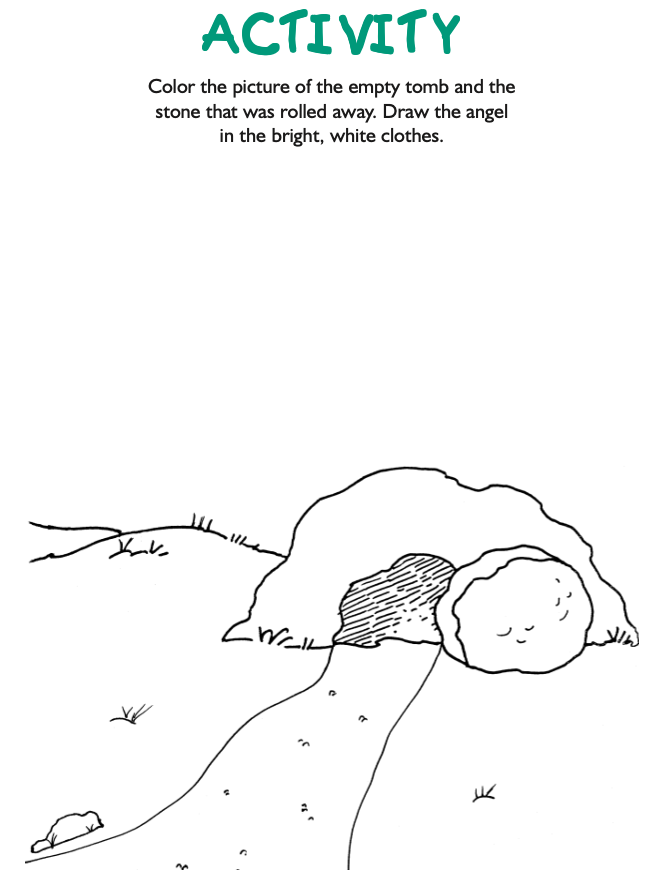
11. Have children draw the women finding the empty tomb and hearing the message from the angel that Jesus is alive, then write a caption under their drawing telling how surprised and happy the women felt.
12. When things seem really bad, it is important to remember to trust God. Have a child read Romans 8:28 in a modern or youth translation.
13 Ask: Have you ever had a pet, a family member, or friend die? It makes you very sad. Tell them to write three sentences telling how they would feel if the pet or person came back to life.
14. Have kids write a poem using their YEA lesson to help them put the details of Jesus’ resurrection in the poem.
15. Let students make a mobile using four empty paper towel rolls: 1) Punch a hole into the end of each roll and tie a string to the roll. Then tie the other end of the string to a metal clothes hanger which has been bent into a square shape. (Adult should help them do this.) 2) Paint each roll with tempera paint. 3) When the paint dries, use a permanent marker to write “He Lives!”on each roll. They should hang the mobile where they can see it every day.
Song
“Alive, Alive” is on page 55 of the Kids Classics Collection.
Closing Prayer
Teacher leads the children in prayer, thanking God for the resurrection, and for the promise of our future resurrection.
Printable Pages