YEA Lesson Library
A Serving Savior
About This Lesson
Using Jesus’ example of washing His disciples’ feet, this lesson teaches the importance of serving others.
Scriptures
Psalm 51:1-2
John 12:26
John 13:1-7, 34-35
Galatians 5:13
Hebrews 12:28
James 1:14-26
James 4:6
1 Peter 5:5
1 John 4:11
Words to Know
SERVANT - someone who meets the needs to another, a helper
SANDALS - an openwork shoe, made of a sole and straps
KNELT - rested on bended knee
EXAMPLE - a model or pattern
The Lesson
Adam sat on the porch. He had his baseball. He had his mitt and a bat. Adam was waiting for his friends to come and play ball. The phone rang. Adam heard Mom talking to someone. “Yes,” she said, “I’ll send him right over.” Adam asked who was on the phone. Maybe Steve and Billy wanted him to meet at their house. He picked up his bat and mitt.
Mom came outside and sat in her chair. She said, “That was Mrs. Smith. She needs some help picking her apples.” Mom said Adam would be glad to help.
Adam dropped his bat and mitt. “Why do I have to go?” He asked. “My friends are coming to play ball.” Adam wasn’t very happy.
Mom said Mrs. Smith was very old. Adam could play ball any day. The apples needed to be picked today. “Mrs. Smith needs help,” Mom said. Adam asked if he had to go. Mom “No, I won’t make you go.” But she said it would be a good thing for him to help. He could be a servant, like Jesus.
Steve and Billy came running into the yard. They were ready to play ball. Adam said he had something very important to do first. He asked them to help. They would all be servants, like Jesus. All three boys went to help Mrs. Smith pick apples.
Long, long ago there were no cars. There were no trains, buses, or airplanes. Jesus and His disciples walked everywhere they went. They had walked the long dusty road to Jerusalem. They were going to celebrate Passover. They wore sandals on their feet. Their feet were hot and dirty. Most people had a pan of water to wash their guests’ feet.
After they ate supper, Jesus picked up a towel. “What is He going to do?” the disciples wondered. Jesus tied the towel around Him like an apron. He picked up the pan of water. Jesus knelt in front of one of the disciples. Jesus started washing his feet. He went from one disciple to another and washed their feet.
When Jesus got to Peter, Peter said this was not a job for their Savior. He was God’s Son. He was their Teacher. Someone else should wash their feet. But, no one else wanted such a job. They thought they were too important. This was a job for a servant!
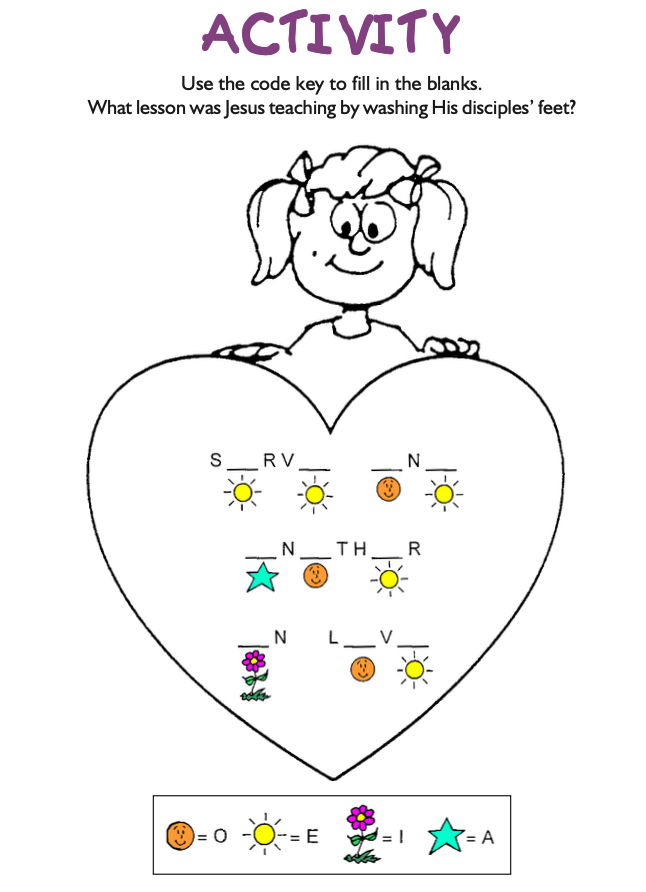
Jesus was teaching His disciples a lesson. We are never too important to do kind things for one another. Serving or helping someone else is a good thing to do. Jesus said we should do as He did. We should all serve one another.
Are there things boys and girls can do to serve? Adam, in our story, helped someone who was older. Can you help Grandma carry her groceries? Can you take her dog for a walk? Maybe you could carry out your neighbor’s trash. What are some ways you could help your mom? Can you do something to help your teacher? When you help someone, you are serving in love.
Student Prayer
Dear Heavenly Father, I thank you that your Son, Jesus, was willing to serve. Help me think of ways that I can be a helper and serve others. I want to follow Jesus’ example. In His name. Amen.
Daily Devotions
Sunday: James 4:6
Monday: 1 Peter 5:5
Tuesday: Hebrews 12:28
Wednesday: Psalm 51:1-2
Thursday: John 13:4-5
Friday: 1 John 4:11
Saturday: John 12:26
Objectives
1. At the end of this lesson, students will be able to:
2. Tell that a servant is someone who helps another.
3. Give reasons why Jesus washed His disciples feet.
4. State that serving or helping others is a good thing to do.
5. Think of ways that they can serve others.
6. Recite their memory verse.
Topics & Themes
Disciples
Footwashing
Helping Others
Humility
Jerusalem
Jesus, Servant
Jesus Sets Example
Kindness
Passover
Peter
Materials Needed
Bible, YEA Students’ and Teacher’s books, baseball and bat, towel, shallow pan for paint, pan for warm water, bulletin board paper, tempera paint, dishwashing liquid, magazine pictures of children in various activities, glue and sheet of plastic for the floor, attendance and memory verse charts, songbook, CD or tape, music player
Preparation
In years past, if a child did not learn, the tendency was to excuse it by saying, “He is lazy. She doesn’t care. He has problems at home.” etc. “We must realize, however, that the teacher’s responsibility is not simply to transmit information, then dodge behind one of these pat reasons if a child doesn’t learn. The teacher’s responsibility continues until the child has learned” (Basic Principles of Effective Teaching, by June Crabtree). Remember that the test of learning is whether a change has been affected because of your teaching. Many times that change takes place in the heart and mind of the teacher as well as the child.
The key word in today’s lesson is serving. The goal of the lesson is to teach your children how they can be serving, and that serving pleases God. Helping them to think of specific ways to perform acts of service, and observing them as they interact with other students, will help you determine whether true learning has taken place.
Before you come to class, have your room set up and ready for the activity. Cut a length of bulletin board paper long enough for all of your students to make their footprints. Place a sheet of plastic on the floor at one end of the paper (a large garbage bag will do). Place the pan of warm water on the plastic. Mix 1⁄2 cup of light colored tempera paint with a few drops of dish-washing liquid and pour a thin layer into a shallow pan. Place the paint pan at the opposite end of the paper. Place a chair and towel at the end next to the pan of water.
Cut out pictures of children doing “helping things” from magazines. Trace and cut out footprints and number them from one to eight to be used in the review.
How to Teach This Lesson
This might be a good lesson to introduce “role playing” to your children. Choose three children to play the role of Adam, Steve and Billy. (If your class has more girls than boys, assign them girls names) The teacher can play the role of Mother. Begin with “Mother” sitting in a chair and “Adam” seated on the floor with a ball and bat. The other two children can be off to the side.
Set the stage for the role play by reviewing the story in the student’s book. Ask the child playing Adam: What do you think you would do if your mother said she would not make you go help Mrs. Smith? Would you go play ball with Steve and Billy? Would you whine and say it isn’t fair? (Have the child act out his or her response.)
Have “Billy” and “Steve” come running up to where “Adam” is seated. “Mother” tells them about Mrs. Smith’s phone call and her need of help. Say: Wouldn’t you boys (or girls) like to help Mrs. Smith? You could be a servant, like Jesus. Ask “Billy” and “Steve:”How would you answer Adam’s mother? Would you tell her you would rather play ball? Would you say you don’t even know Mrs. Smith? Would you say picking apples might be fun? (Allow the children to come up with their own reply.)
Walking was the main method of transportation in Jesus’ day. They didn’t have tennis shoes or hiking boots. Everyone wore sandals. When they walked on the dusty roads their feet would get hot and dusty. When they entered someone’s home, the hostess usually provided a pan of water to cool and cleanse her guest’s tired feet. Washing and drying the feet was usually done by a servant.
Remind the children of how Mary poured the perfumed ointment on Jesus’ feet in lesson two, and then dried His feet with her own hair. She was showing Jesus that she loved Him. Now ask: Why do you think people usually had water to wash their guest’s feet? It was to show kindness.
Jesus and His disciples had gone to Jerusalem to celebrate the Passover. The meal was now over. No one had bothered to provide a pan of water to refresh their feet. No one wanted to do the dirty job of washing. The disciples were busy arguing about who was the most important.
Jesus saw opportunities for teaching in every situation, and this was no different. In order to teach His disciples that they were called to serve, Jesus took a basin of water and a towel and began to wash their feet. In doing so, Jesus was showing them that even He, the Son of God, had come to serve (John 13:14-16). They had been called to help meet the needs of others. Jesus, our Lord and Master washed the disciples feet as an example for us to follow. During the Passover service we wash one another’s feet to show that we are to humbly serve others.
When Jesus gave His life by dying for our sins, He was meeting our needs and serving. He is right now sitting at the right hand of His Father in heaven talking to God about our needs here on earth. Jesus did many miracles to help and meet the needs of others. Ask: Can you think of some- thing Jesus did to serve or help someone else? You may need to prime the pump by giving examples, like: feeding the five thousand, healing the sick, raising the dead, etc. (Allow time for the children to think of some of Jesus miracles.) Ask: Would you be willing to give up your play time in order to help or serve someone else? In their activity time they will be able to choose some things that they can do to serve.
Review Questions
To make the review both fun and beneficial, trace and cut out eight footprints and number them from one to eight, to correspond with the question numbers. Place the footprints on the table, number side down. One at a time, allow each child to pick a footprint. Ask the child the question that corresponds to the number on the footprint.
1. Why were Jesus’ and the disciples’ feet hot and dusty?
2. Why had they come to Jerusalem?
3. What did Jesus do after they had finished eating the Passover meal?
4. Why was Jesus the one who washed their feet?
5. Why do we wash one another’s feet at the Passover service?
6. What lesson did Jesus want to teach His disciples?
7. Are there things that boys and girls can do to serve?
8. Can you name something that you can do to help or serve someone?
Teacher-Directed Activity
Have the children remove their shoes and socks and form a line by the chair at the end of the paper on the floor. Lead the first child by the hand to the pan of paint. One at a time, have each student step into the paint. While holding his hand, have the children make footprints on the paper, walking to where the pan of water and chair are. Seat the child in the chair, placing his feet into the pan of water. The next child in line helps wash his feet and dry them with the towel. Then that child goes to the paint pan, repeating the action, until all children have footprints on the paper, and have helped wash and dry feet.
Allow the children to pick a picture from the table of something they can do to serve someone else, and glue that picture by one of their footprints.
REACH Activity
Special Materials: magazine pictures of people helping one another, dictionary
1. Jesus is called our Savior. The penalty for sin is death. Jesus died to save us from the penalty of sin. That is why He is called our Savior. We only have one Savior: Jesus. Have kids write a prayer of thanks to God for sending us His Son Jesus who saves us.
2. Jesus’ disciples were surprised and a bit confused when Jesus began to wash their feet. Ask: Has anyone ever surprised you with something unexpected or unplanned? How did you feel? When Jesus washed the disciples’ feet He was doing the job of a servant. That is why He is called A Serving Savior. Tell children to follow Jesus’ example and serve someone today out of love and kindness. They should plan it to be a surprise, and then describe how everyone felt afterwards.
3. Kids can write a thank you note to someone who served them out of kindness and love, including the YEA lesson’s memory verse.
4. Let students create a collage of pictures from magazines to show people serving one another.
5. Tell children to make an acrostic poem for S-E-R-V-A-N-T using words from the YEA lesson or memory verse.
6. Lessons 3 and 4 describe what happens at the Passover for baptized members of God’s family. Have kids ask a family member to explain how they feel on that special evening.
7. Jesus loves little children. Read Mark 10:13-16. Then, sing “Jesus Loves the Little Children” on page 56 of Kids Classics Collection.
8. Students should add this lesson to the timeline.
9. Read Matthew 26. Jesus said that He gave us an example. Ask: What was that example? What example does Jesus want us to follow?
10. Trace children’s feet on a piece of construction paper. Have them write five things on the feet that they can do to serve their family, then cut out the feet. Tell them to tape the feet to their closet door. They can take the feet down when they have done all five things at least once.
11. Sing “Wonderful Words of Life” on page 43 of the CEM Hymnal. “Sweetly echoes the gospel call” is one of the lines. Ask: Does this make you think of how you can serve others? Let kids list five things they can do to be a light and share God’s love to their neighbors. Then they can add these wonderful words to their Bible notebook.
12. Tell children to look up the word “serve” in a dictionary and write down what it means.
13. Have students write a prayer to God asking Him to show them how to serve.
14. Ask: Can you name five things your parents do each day to serve the family, even when you know they’d rather do something else? (Go to work, clean the toilet, etc.)
Song
“Jesus Wants Me For A Sunbeam” is on page 21 of the Kids Classics Collection.
Closing Prayer
Dear Jesus, Thank you for washing the disciples’ feet. Thank you for teaching me how to be a servant. Help me to be willing to do things to help and serve others. In Jesus’ name. Amen.
Printable Pages