YEA Lesson Library
No Excuses!
About This Lesson
This lesson uses the parable of the talents to teach the importance of living our lives in service to God.
Scriptures
1 Samuel 15:24
Psalm 100:2
Isaiah 55:10-11 Matthew 25:14-30
Luke 12:43
Acts 5:29
Romans 5:19
Romans 6:17-18
1 Peter 2:3
Words to Know
CRADLE - a small baby bed
HAMPER - a large covered basket
TALENT - a large amount of money
The Lesson
Brenda and Brian were twins. They had the same color eyes and hair. They usually dressed alike. They both liked the same things to eat. They both loved to play soccer. They were alike in many ways.
One thing was very different about Brenda and Brian. Brian’s room was always messy. He didn’t put anything away – unless Mom made him. His toys were scattered around on the floor. His clothes were in a pile. Books were on the desk, on the floor, and even under his bed. When it was time to get ready for school, Brian could never find what he needed.
Brenda was very neat. She put her dolls in a cradle at night. She always put her books away on the shelf. Brenda hung her clean clothes in her closet. She put her dirty clothes in the hamper. She was always the first one dressed and ready for school.
Mrs. Cooper was Brian’s and Brenda’s teacher. On Friday she gave the class a homework assignment. The children had books with pictures of leaves. The kids were to find real leaves like the ones in the book. Brian went home and tossed his book on his desk. He was in a hurry to go out and play. Brenda started looking for her leaves right away. By sunset she already had five leaves.
On Sunday, Brenda reminded Brian of the assignment. Brian searched and searched for his book. He finally found it behind his desk. But, it was too late to go outside.
Monday morning Mrs. Cooper asked for the leaves. Brenda had collected twenty leaves! Some children had ten, and some had 15. Mrs. Cooper asked Brian for his leaves. He tried to make excuses. Mrs. Cooper gave Brenda an “A.” She was rewarded for faithfulness and hard work. Brian received a failing grade. He didn’t do what he was supposed to.
Jesus used a parable to teach us to be faithful and do what we are told. A landowner was going on a trip. He told his servants to take care of his things. He gave the first servant five talents. This was a lot of money. It was more than the man earned in a year! He gave the second servant two talents. And, to the third servant he gave one talent. He expected the servants to use the money wisely.
The landowner came home to check on his money. The first servant took good care of the money. He used it to earn twice as much money! The landowner rewarded the servant by putting him in charge of many things.
The second servant also used his money wisely. He had twice as much as when he started. The landowner was very happy. He rewarded this servant also.
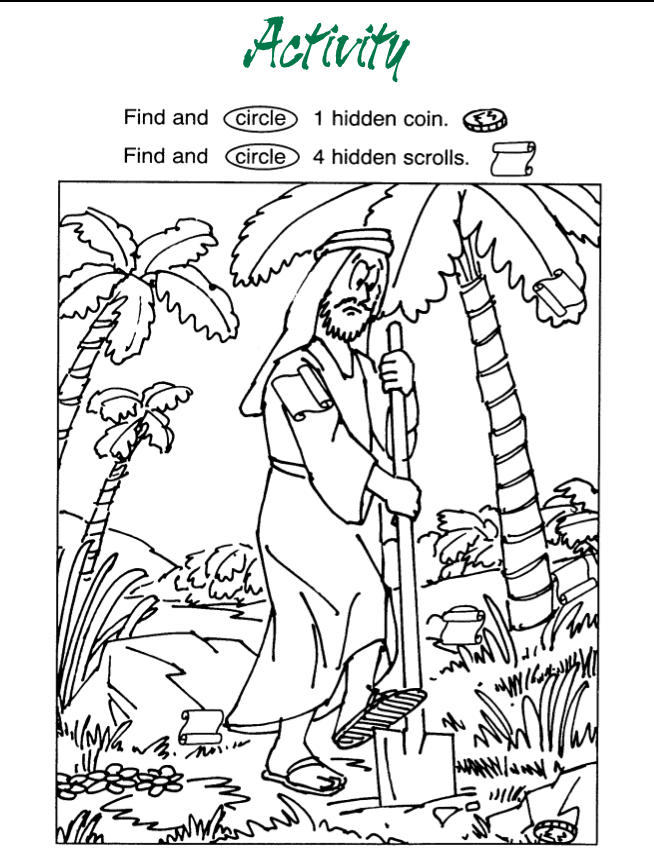
But, the third servant wasn’t so wise. He dug a hole in the ground and hid his money. He still had the money. But he didn’t do what the landowner wanted him to do. The landowner said he was lazy. He took the money from him. He gave it to the servant who had been wise.
Do you do what your mom and dad tell you? They don’t want excuses. God wants us to do what He tells us in His Word. He wants us to love each other. He tells us to read and memorize His Word. You should obey your parents and keep the Sabbath holy. The landowner rewarded the wise servants. If you gladly obey God, He will reward you, too.
Student Prayer
Dear Heavenly Father, Thank you for using parables to teach me how I should live. Help me to learn to do what you tell me to do. I want to learn to obey you gladly because I love you. In Jesus’ name I pray. Amen.
Daily Devotions
Sunday - Luke 12:43
Monday - 1 Peter 2:3
Tuesday - Acts 5:29
Wednesday - Romans 6:17-18
Thursday - Romans 5:19
Friday - 1 Samuel 15:24
Saturday - Isaiah 55:10-11
Objectives
At the end of this lesson, students will be able to:
1. Define what a parable is.
2. Tell what is meant by a “talent” in today’s lesson.
3. Give the reason why Jesus took the third servant’s talent and gave it to the first servant.
4. Recite their memory verse.
Topics & Themes
Bible Study
Loving God
Loving Others
Obedience
Parable of the Talents
Sabbath
Materials Needed
Bible, YEA students and teacher’s books, tan construction paper, double stick tape (or flocked paper), flannelgraph board, vinyl material, hole punch, yarn, masking tape, candy “coins,” attendance and memory verse chart, stars, songbook, music player and CD/cassette
Preparation
A flannelgraph is a helpful medium for telling Bible stories or object lessons. (A flannelgraph board can be purchased from your local Christian bookstore, or one can be made by covering a 24 x 18" sheet of card- board with flannel.) Children learn better when material is presented through more than one sense. Hearing the story and seeing it is better – and more interesting – than just hearing it. There will also be opportunities for tactile learning if you allow the children to handle the figures. Using flannelgraph for this lesson will also allow your primaries to make use of their math skills.
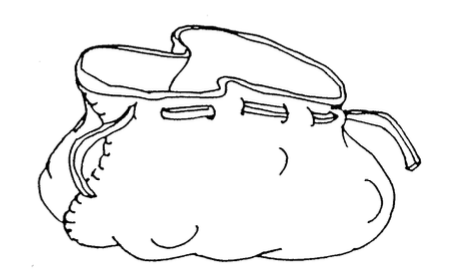
Enlarge and photocopy the “bag” pattern onto tan construction paper (making 15 bags) and cut them out. Place a small strip of double stick tape on the back of each one (or glue a strip of flocked paper or sandpaper to the back).
Trace a circle the size of a paper plate onto vinyl material (can be purchased at a fabric store) making enough circles for each child in your class to have one. Cut out the circles. With a hole punch, punch holes around the perimeter of each circle about one inch from the edge, leaving one inch between the holes.
Cut enough yarn into 24" pieces for each child to have one. Wrap a small piece of masking tape on each end of the yarn to make it easier to thread through the holes.
Purchase enough candy “coins” for each child in your class to have five.
How to Teach This Lesson
As you begin telling this story, explain that the word “talent” refers to an amount of money. Authorities differ on the specific amount, but it was probably what a man would earn for working an entire year. When the landowner entrusted his servants with the talents, he was entrusting them with a great deal of money.
On the left side of your flannel board, place the “bags” that the landowner originally gave to each servant (five to the first, two to the second, and one to the third) grouping them in descending order. As your story progresses, ask several students to place the “bags” that the servants “earned” on the right-hand side of the flannel board (opposite the original bags). Allow the children to count the bags as they are placed on the board. Finally, have the children count the total that each servant had to present to his master.
Ask the children how the landowner felt when he returned and asked each servant how he took care of his money. Was he happy or sad? What did the landowner do for each servant?
Ask: How do your parents feel when you obey them? Do they ever reward you? Does anyone receive an allowance for cleaning your room or for helping out around the house? Ask: But, what happens when you don’t obey? Do you ever have privileges taken away?
God wants us to obey Him, just like your parents want you to obey. He doesn’t want any excuses for not obeying. Ask: Can you think of some things that God has told you to do? How will God reward you for obeying?
Review Questions
1. What do we call the stories that Jesus used to help people understand His teaching?
2. How many talents did Jesus give the first servant? The second? The third?
3. What did Jesus do for the first two servants?
4. What did the third servant do with his master’s money?
5. What did Jesus do to the servant who made excuses for not obeying?
Teacher-Directed Activity
Give each child a vinyl circle and a piece of yarn. Show the children how to “sew” the yarn in and out through the holes around the circle, ending in the hole next to where they began. With the ends of the yarn on the outside, pull to gather the fabric, forming a pouch. As the children think of things God has told them to do, and how they can obey God, give them each five candy “coins” to place in their money pouch. This will remind them of the “talents” that were given to the servants.
REACH Activity
Special Materials Needed:
Metal-looking buttons, poster, ruler, index cards, sticky clips or wall putty
Activities:
1. Role play Matthew 25:14-30. Take turns playing different roles. Then talk about how it felt to play each role.
2. Add this week’s hidden treasure to your treasure chest.(Treasure suggestion: Having a heart willing to serve God.) Finish decorating the chest with metal-looking buttons.
3. Draw the sequence of events of Matthew 25:14-30. Either use several sheets of paper, or draw smaller pictures in 4-inch square boxes that can be taped together into a long strip. Use your pictures to retell the parable to your family.
4. Sing: A. “Jesus Bids Us Shine” on page 37 of Kids Classics Collection. B. “Work, for the Night is Coming” on page 158 of the CEM Hymnal. C. “This Little Light of Mine” on page 49 of Kids Classics Collection. D. “A Child of the King” on page 137 of the CEM Hymnal. Before you sing, read the words. Talk about how they relate to the YEA lesson. Are we shining for Jesus if we don’t use the talents He has given us?
5. Do a sword drill with this week’s Daily Devotionals.
More Information: Use the Daily Devotional Scriptures to have a sword drill. Read the Scripture reference to the child. Then start the timer. When the child has found the verse, stop the timer. Read the verse and talk about how it relates to the lesson. Challenge the child to see how quickly he/she can find each of the verses in the Bible.
6. Make a list of jobs your parents have asked you to be responsible for. Do you always do your jobs? Do you have to be reminded? What keeps you from doing your jobs? What kind of excuses have you given your parents when the job has not been done? Put a checkmark next to the ones you do without having to be reminded. For which jobs do you need to show more responsibility? Write a goal to faithfully finish your jobs this week.
7. Materials: posterboard, pencil, color tools, ruler, sticky clips, index cards. Using the list in your Bible notebook, make a job chart on poster board. Write this title at the top: “You have done well, good and faithful servant!” (Matthew 25:23). Below the title, write the days of the week horizontally across the board. Along the left side, vertically, write the jobs. Use a ruler to make rows and columns for the days of the week and the jobs. The chart will look like a grid. Put a sticky clip on the chart for each job on day of the week the job needs to be completed. Multiply the number of jobs times the number of days the job is to be done. If the job of sweeping has to done each day of the week except the Sabbath, then six happy cards are needed. Make happy/smiley cards and sad face cards by cutting 3x5 index cards in half. Draw happy and sad faces. When the job is completed put a happy face card in the sticky clip. If the job is not completed put a sad face card in the sticky clip. The goal is to have a full happy face chart. Next week start over again. Talk to parents about a possible reward each week for jobs fully completed.
8. The meaning of the word “talent” can mean the ability to do something very well. Some people have a beautiful singing voice; others have a talent for playing a musical instrument well. All talents are gifts from God. He wants us to use them to serve and honor Him. What talent do you have? Ask your family about the talents God has given you and them. Write your family’s talents in your Bible notebook.
9. Remember, God wants you to use your talent in some way to serve Him. Are you using your talent? If you aren’t sure what talent He has blessed you with, pray and ask God to help you know it so that you can be a good and faithful servant. Write the prayer in your Bible notebook. You do not have to share the prayer.
10. The reward for being a good and faithful servant is living with Jesus in the Kingdom of God. Use your Bible and concordance to read the Ten Commandments. Obeying His commandments is one way we can serve God. Draw or trace a stone tablet on ten plain 4x6 index cards. Write a commandment on each card. On the other side of the card write the number of the commandment. Practice learning the commandments by shuffling them and then putting them back in the right order. Don’t look at the number on the back of the card until you are finished. Then turn the cards over so that you can check to see if you have them in the correct order. Practice until they are memorized.
11. Make a word search puzzle with at least ten words from the YEA lesson. Give it to a friend to solve.
12. Perform a puppet show about the YEA lesson. Puppets can be made from socks or craft sticks. Invite family and friends.
13. Who wrote “A Child of the King?” Find out more about this song written by Harriet E. Buell. Write the information in your Bible notebook. Share with family and friends.
14. Draw or trace the outline of a shovel on a piece of construction paper. Cut out the shovel. Write the memory verse on the shovel. Practice the verse until it is memorized.
Song
“Jesus in the Morning” is on page 89 of the Kids Classics Collection.
Closing Prayer
Ask if one of the students would lead in prayer, asking God to help them obey gladly, without making excuses for not obeying.
Printable Pages