YEA Lesson Library
Growing Pains
About This Lesson
Using the parable of the Sower and the Seeds, this lesson teaches the importance of hearing and obeying God’s word and sharing the gospel.
Scriptures
Psalm 126:5-6
Isaiah 55:10
Matthew 13:1-23
Matthew 28:18-20
Mark 4:11
Luke 8:4-15
Luke 13:18-19
John 15:5
2 Corinthians 9:6
Ephesians 3:17-18
2 Peter 1:3-4
Words to Know
PARABLE - a simple story with a moral or lesson
SOWER - someone who plants seeds
The Lesson
Mandy loved summer vacation. One of her favorite things was to go to the library. She loved to look at all the new books. She liked to read her favorite books over and over again. But, the best part of the library was story reading time. Mrs. Clark made the stories come alive!
Jesus was the best storyteller ever! His stories were about things people knew. He told about farming and taking care of sheep. People loved to sit and listen to Jesus tell a story. He called His stories parables. Parables always had a special lesson. Today’s parable is about a sower.
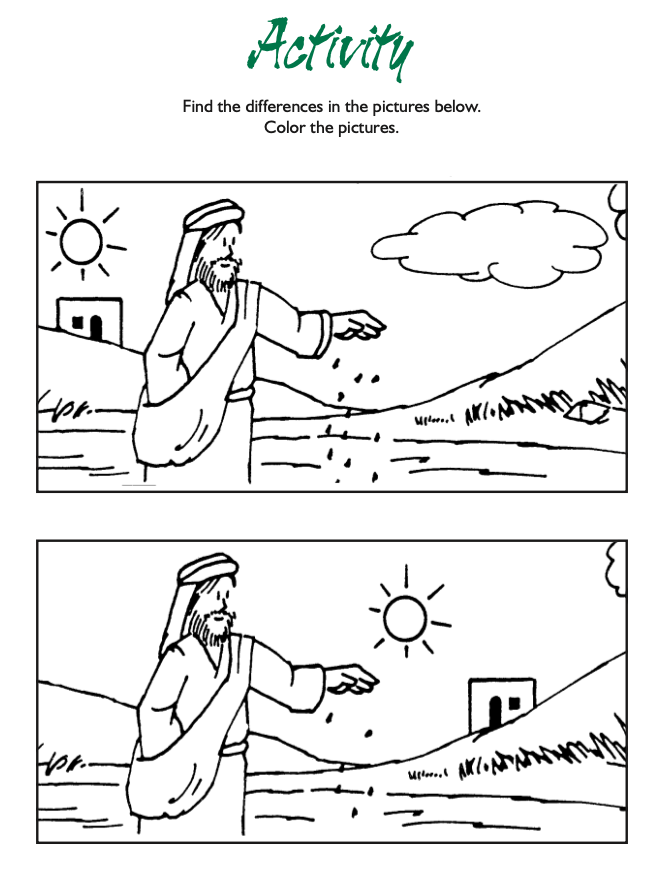
Early one morning, a farmer went out to plant some seeds. He carried a cloth bag around his neck. The bag was full of seeds. The farmer took a handful of seeds and threw them. He scattered the seeds as far as he could. Soon seeds were spread over the whole garden.
But, some of the seeds went outside the garden. They fell on the hard road. Do you think these seeds will grow? The ground on the road was too hard for the seeds. Birds saw them lying on the road. They ate the seeds for dinner. Other seeds were crushed as people walked on them.
Some of the farmer’s seeds fell into a pile of rocks. They sprouted and grew. But, the sun beat down on them. Soon they dried up. There was no moist soil to feed and water them.
Something else grew along with the good seeds. What grows in gar- dens that a farmer doesn’t want? Weeds! The weeds were so thick they choked the good plants. The good plants died.
The poor farmer worked hard to make his garden grow. Finally some of his seeds grew into tall and healthy plants. He picked 100 times more than he planted!
Jesus wanted people to know about God’s Kingdom. He said the seeds were like God’s message. Satan likes to confuse people who hear God’s message. Satan is like the birds who picked up the seeds. Those seeds never had a chance to grow. Satan doesn’t want God’s message to grow in our hearts. He doesn’t want us to understand the Bible or grow to love God.
Some people hear God’s message and believe it for a while. But, they quit believing God is good when trouble comes. They are like the seeds that fell on the rocks. We need God’s Word to grow strong and healthy.
Weeds choked some of the seeds. Some people let their problems choke them. They get too busy to have time for God. They don’t read God’s Word. They never grow into healthy Christians.
Are you like the seeds that grew? Do you hear God’s Word and believe Him? Do you read His Word and grow? Do you obey God’s commandments and love Him? If you do these things you will grow.
Jesus’ disciples were like the farmer sowing seeds. Boys and girls can be like the farmer. How can you tell others about Jesus? When you do this you are sowing good seeds.
Student Prayer
Dear Heavenly Father, Thank you for this wonderful story about the farmer and the seeds. Help me to be busy sowing good seeds as I tell my friends about you. In Jesus’ name I pray. Amen.
Daily Devotions
Sunday - Psalm 126:5-6
Monday - Isaiah 55:10
Tuesday - 2 Corinthians 9:6
Wednesday - Luke 13:18-19
Thursday - 2 Peter 1:3-4
Friday - Ephesians 3:17-18
Saturday - John 15:5
Objectives
At the end of this lesson, students will be able to:
1. Explain what a parable is.
2. Tell why Jesus often used stories in His teaching.
3. List the different places the farmer’s seeds fell and what happened to them.
4. Explain that the seeds were like God’s Word.
5. Recite their memory verse.
Topics & Themes
Belief (Faith)
God’s Kingdom
Great Commission
Jesus, His Ministry
Jesus, Listen to
Loving God
Obedience
Parable of the Seeds
Sharing the Gospel
Materials Needed
Bible, YEA Students and teacher’s books, chalkboard and chalk or newsprint and marker pen, visual aid (see preparation) or flannelgraph, styrofoam cups, potting soil, seeds and pitcher of water, songbook, CD/cassette tape, music player, attendance and memory verse charts, and stars
Preparation
The story of the sower should be taught by using visual aids. You can find a flannelgraph or pictures at your local Christian bookstore. When using a flannel board or pictures, be sure that you have them at the children’s eye-level. If the children are seated on the floor or in low chairs, you may want to seat yourself on their level, holding the flannel board or pictures in your lap.
Or, you can make your own hands-on visual. Begin with a shallow box or container about 9x12" in size. Place a layer of soil in the bottom of the box. In one corner of the box place several rocks. Along one edge of the box make a “path” of hard soil. (You can make plaster out of flour and water with some soil mixed in. Pour the mixture along the path and allow it to dry to harden.) “Plant” some small weeds in your soil.
For the Activity, place about 1 1⁄2” of potting soil in styrofoam cups (one cup for each child). These will be used for children to plant their seeds. You will also need water.
How to Teach This Lesson
To help the children comprehend this lesson, put yourself into their kind of thinking. Jesus, the master at storytelling, used this method as He taught the people in parables. A parable has been described as “an earthly story with a heavenly meaning.” Jesus often chose a parable to teach His followers godly principles, or about God’s character. He began with something with which the people were familiar and, step by step, proceeded to the “heavenly meaning.”
Some of the children in your class may never have seen seeds planted. Use your visual aid to teach this lesson. For a seed to grow healthy and strong it must have good soil, water and sunlight. Allow them to feel the soil and sow the seeds. Explain that if their seeds fell on the hard, dry “path”, birds would easily be able to see them and eat them. If their seeds fell where the rocks are piled up, there would not be enough soil for their roots to grow. Explain that weeds grow faster than good plants. Weeds use up all the nourishment and water from the soil and choke out the good plants.
When Jesus’ disciples asked Him what this story meant, Jesus told them that they could understand the meaning of these parables, because they tell a great deal about the Kingdom of God. But there are people who hear these parables and don’t understand them.
Jesus explained that the seed is God’s message to us. The hard path where some of the seed fell illustrates that some seeds fell on hard hearts. Seeds must have fertile soil in which to grow. When the seeds fell on the hard path, they could not send down their roots and were visible. The devil comes along and steals the Words away. “The stony ground represents those who enjoy listening to sermons, but somehow the message never really gets through to them and doesn’t take root and grow. They know the message is true, and sort of believe for a while; but when the hot winds of persecution blow, they lose interest. The seed among the thorns represents those who listen and believe God’s words but whose faith after- wards is choked out by worry and riches and the responsibilities and pleasures of life. And so they are never able to help anyone else to believe the Good news” (Luke 8:13-13 TLB). Explain that Christ must be more important to us than money or doing fun things.
Christ used the “good soil” to represent honest, good-hearted people who would listen to God’s word and obey them. The harvest is converted, good-hearted people who tell others about Christ. It is for this reason that we are told to “Go into all the world and preach the gospel to every creature” (Matthew 28:19). Not everyone who hears the gospel message will accept it, but we can give thanks for everyone who does.
Ask the children to think of ways that they can help sow the seeds of God’s Word. Make a list on a piece of news print or chalkboard to help the children remember.
Review Questions
1. Why did Jesus use parables when He taught people?
2. In today’s story, what were the different places the farmer’s seeds fell?
3. What did Jesus tell His disciples that the seeds were like?
4. Who wants to steal God’s Word away before it has a chance to grow, like the birds who ate the seeds on the hard path?
5. Will everyone who hears God’s Word believe it?
Teacher-Directed Activity
Give each child a styrofoam cup with potting soil in the bottom, and 2 or 3 fast growing seeds or beans. Tell them that they will be planting seeds and watching them grow. Have the children make a shallow hole in the soil and place their seeds into the hole. Cover the seeds lightly with soil and sprinkle with water (do not soak the soil). Instruct them to take their seeds home and place them on a window ledge so that they can get plenty of sunlight. Remind them to water their plants when the soil feels dry. They may want to bring their plants back to class after they have sprouted to show the other children.
REACH Activity
Special Materials Needed:
Card stock, seeds, sequins, rocks, potting soil, brick, weeds, a healthy plant or two, blank book, poster, yogurt cup, camera, tape recorder and tape, sticker, seed package, craft stick
Activities:
1. Sing: A. “Thy Word Have I Hid in My Heart” on page 75 of Kids Classics Collection.
B. “Bringing in the Sheaves” on page 35 of the CEM Hymnal.
C. “Thy Word is Like a Garden, Lord” on page 184 of the CEM Hymnal.
Read the words before you sing. Talk about how they relate to the YEA lesson and to you personally.
2. Divide a piece of paper into four sections. In each section, draw and color a picture from Matthew 13:1-23. Label each section.
3. Make a seed collection. On a piece of cardstock, glue a variety of seeds. Under each seed, label what kind it is. Across the bottom of the seed collection write, “The one who sowed the good seed is the Son of Man” (Matthew 13:37).
4. Read about the four different kinds of soil again in the YEA Life of Christ Series Book Three, Lesson 9. What kind of soil are you? What is the condition of your heart? Are you ready to hear God’s word and apply it in your life? Are you too busy with doing things and having things? Are you too worried about life to trust God? Do you understand what God tries to teach you? Think about how much you want God’s word to live in you. Then say a prayer to ask God for His help in becoming good soil—if that’s what you want.
5. Role play Matthew 13:3-8. Talk about the different kinds of soil the seed is sown into.
6. Do a sword drill with this week’s Daily Devotionals.
More Information: Use the Daily Devotional Scriptures to have a sword drill. Read the Scripture reference to the child. Then start the timer. When the child has found the verse, stop the timer. Read the verse and talk about how it relates to the lesson. Challenge the child to see how quickly he/she can find each of the verses in the Bible.
7. Add this week’s hidden treasure to your treasure chest.(Treasure suggestion: Having a fertile heart for God’s word.) Glue sequins to the chest.
8. Ask: Have you ever planted any seeds? Did the seeds sprout and grow into a plant? Do you know anyone who grows plants of any kind? Share and discuss what they know about planting and growing.
9. Materials: seeds, rocks, potting soil, brick, weeds, and a healthy plant or two. Place these on the table. Ask: Do you know what these objects have in common? Let them share ideas briefly. Then let the child(ren) use the materials to tell the parable.
10. How do you think the farmer felt as he kept spreading seed that wouldn’t grow? How do you think he felt when the seeds took root and started to grow? Write your answers in your Bible notebook. Share with family and friends.
11. Create a picture book of the YEA lesson. Design a cover and write a new title for the story. Each page of the book will have a picture and one or two sentences about the lesson. On the back cover write a paragraph about yourself. Include a picture of yourself, too. Put the covers and pages together like a book. Share the book with someone.
12. Design a poster showing how “good” seed (people) keeps growing. Look back at the YEA lesson for poster ideas and then come up with some of your own. Hang your poster where it can be seen each day. It will remind you of how to keep growing in God’s word.
13. In your Bible notebook make a list of at least five ways that you can tell others about God. This week choose one of the ways from your list and sow some good seeds.
14. Use a yogurt cup and the potting soil to start seedlings. Let students choose which seed they want to plant. Write their names on the cups before planting seed. Students keep track of plant growth in their Bible notebook. (They can write and/or draw pictures of the growth.) Students should share their experiences with other students, family, and friends. Ask them how they did as sowers of seed. What would they do differently? (Water more or less? Give it more light? Fertilize it more or less?)
15. Do you know anyone who has a garden? Interview them. Write the questions in your Bible notebook before you visit them. Take along a tape player if possible to record the interview. If not, write the answers in the Bible notebook. Take a picture of them in their garden. Share the interview with family and friends.
16. Use your Bible and concordance to find out more about gardens in Bible times. Draw pictures to go with the information you write in your Bible notebook. Share with family and friends.
17. Write the memory verse on a sticker and tape it to any kind of seed package. Tape the package to a craft stick and stick it in a cup filled with soil. Practice the verse until memorized.
Note: The “How to Teach This Lesson” section of the YEA Parent and Teacher’s Guide is excellent. If this activity is not going to be done during Sabbath class, be sure the children are able to do it at home. They will love it.
Song
“Everybody Ought To Know” is on page 11 of the Kids Classics Collection.
Closing Prayer
You might ask if one of the older children would like to lead in prayer, asking God to help them all to be busy “sowing” the seeds of God’s Word.
Printable Pages