YEA Lesson Library
Up a Tree!
About This Lesson
Using the story of Zacchaeus, this lesson teaches that God can use anyone who is willing to tell others about Him.
Scriptures
Matthew 20:28
Luke 19:1-10
Luke 19:10
John 12:32-33
John 12:47
Acts 4:10-12
Galatians 1:3-4
1 Timothy 1:14-15
Words to Know
INSIGNIFICANT - unimportant, having no special purpose
TAX-COLLECTOR - person who collects money for the government
SCOLD - to find fault
CONFESS - admit to doing
The Lesson
A small tree stood along a busy roadside. It wasn’t a big tree. It wasn’t a fruit tree. There was nothing very special about the tree. It was just a small green tree.
Many other trees were along the road. There were tall cedar trees. Their wood could make strong houses. Fruit trees grew good things to eat. Some trees had beautiful flowers. Some had long, shady branches. Next to all the other trees, the small tree felt even smaller.
One day the small green tree was feeling bad. He wished he was tall like the cedar tree. He wished he could shade people from the sun. “I wish I was good for something,” thought the small green tree.
“Tweet, tweet,” said a little bird. She had a nest in the top of the small tree. “Thank you for lending me your branches.” The mother sparrow was sitting on her nest and eggs. The small tree hadn’t even noticed.
Now the little tree was happy. He felt useful. New life would come in his branches. Baby birds would hatch from those eggs. He thought of them flying from branch to branch. God was using the small green tree.
A sycamore tree is a small tree. It has a short trunk and its branches are low to the ground. Our lesson tells about an important job God had for this small tree.
Zacchaeus was a tax-collector. He went up and down the road to Jericho. Most tax-collectors were not very honest. So, the people of Jericho didn’t like Zacchaeus very much.
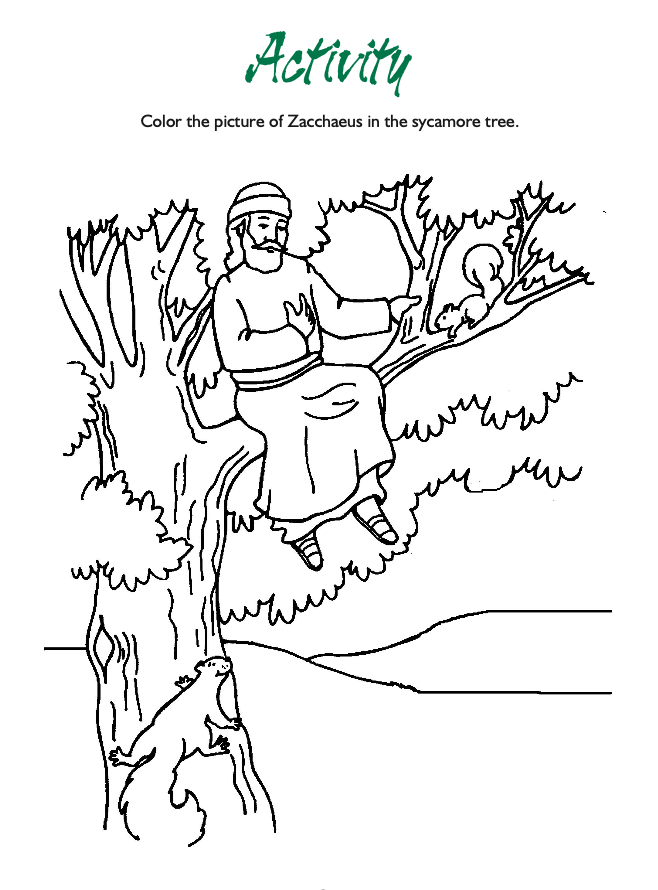
One day Zacchaeus saw lots of people coming down the Jericho road. He heard that Jesus was coming. He had heard good things about Jesus. Zacchaeus wanted to see Him. But, Zacchaeus was a very short little man. He couldn’t see over the other people’s heads. He tried to push through the crowd. He ran this way and that to find a place to see. Finally, Zacchaeus saw the sycamore tree. “That will be the perfect place to see Jesus,” thought Zacchaeus. He ran ahead of the people. He climbed up the short trunk. He found a branch where he could sit and watch.
Lots of people walked down the road. They came to the tree. Jesus
stopped. What would He do? Jesus looked up in the tree. He saw Zacchaeus in the tree. Jesus said, “Zacchaeus, hurry and come down. I’m coming to your house today.” Everyone was surprised. Why would Jesus go to Zacchaeus’ house?
Jesus knew what kind of man Zacchaeus was. Zacchaeus told Jesus about the bad things he had done. He was sorry. He even paid back money to people he cheated. Jesus forgave Zacchaeus.
A small sycamore tree helped Zacchaeus see Jesus. That was a big job! God might have a big job for you, too. You can help others see Jesus. They see you going to church on the Sabbath. People see when you obey your parents. You can even ask your friends to Sabbath School. These things will help them learn about Jesus and be part of God’s Kingdom.
Student Prayer
Dear Father, Thank you for the lesson of Zacchaeus and the sycamore tree. I want to be used to help other people see Jesus. Help me obey your Word and go to Sabbath School. Help me not be afraid to invite my friends to go with me. In Jesus’ name I pray. Amen.
Daily Devotions
Sunday - Luke 19:9-10
Monday - 1 Timothy 1:14-15
Tuesday - Matthew 20:28
Wednesday - Acts 4:10-12
Thursday - John 12:47
Friday - Galatians 1:3-4
Saturday - John 12:32-33
Objectives
At the end of this lesson, students will be able to:
1. Discuss why people didn’t like Zacchaeus.
2. State that Jesus came to save people who are sinners.
3. Tell why Zacchaeus climbed the sycamore tree.
4. Tell what Jesus said to Zacchaeus.
5. Recite their memory verse.
Topics & Themes
Holy Conduct
Jericho
Jesus, His Ministry
Jesus, Savior
Sharing the Gospel
Sin
Sycamore Tree
Tax Collector
Zacchaeus
Materials Needed
Bible, YEA students and teacher’s book, brown construction paper, marker pen, several different colors of construction paper cut in half, crayons, magazine pictures of different kinds of trees, glue, scissors, song- book, CD/cassette tape, music player, attendance and memory verse charts, stars
Preparation
Before you come to class, cut out pictures of different kinds of trees from magazines. You will need pictures of tall evergreen trees, fruit trees, flowering trees, and small trees. A gardening magazine might be a good place to look. Glue the pictures to construction paper to make flash cards that can be used in the telling of the story and the Bible lesson.
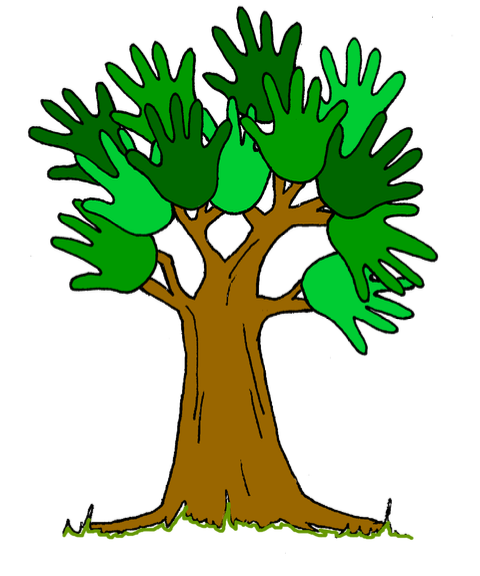
Using brown construction paper, build a tree trunk with branches and attach it to the wall in your classroom. On the trunk of the tree, write the words “I will be used.” The children will decorate the tree with hand print “leaves” during the activity time.
Background - Tax-collectors were often referred to in the Scripture as publicans. They were hated by the people because of their dishonesty and extortion (Luke 3:12-13). They were classed with the lowest of sinners (Matthew 9:10). Because their sin was so blatant, and they were hated by the people, they were sometimes ostracized and ridiculed by the religious leaders (Luke 18:10-13).
The middle-eastern sycamore is a tree with a short trunk with lateral branches that made it easy to climb. The tree has large leaves like a fig or mulberry tree. Zachaeus may have thought he could use the tree as a vantage point from which to see Jesus, while remaining hidden among the leaves.
How to Teach This Lesson
As a teacher, God has entrusted you with one of the most rewarding and important responsibilities – that of imparting the life-changing Word of God to the pliable minds of children. It is not enough that you give out the Word, the Word must be received and applied.
The approach and central character of this lesson is somewhat different than what is usually taught, but the truth that Jesus loves, and came to die for sinners remains the same. The tree was chosen as the central character in order to emphasize the fact that God can use anything or anyone to accomplish His goals – even young children!
The sycamore tree had no special gifts, didn’t have to perform any extraordinary acts or become anything other than what God created it to be. The only thing that was necessary for the sycamore tree to be used to help Zacchaeus see Jesus was that it be available. God needs people who will just say with Isaiah, “Here am I; send me” (Isaiah 6:8).
Sometimes the complexities of life crowd out or obscure people’s view of the Savior. The sycamore tree didn’t have to explain Jesus or move the people out of the way, it simply gave Zacchaeus a different perspective. It lifted him up and helped him to see beyond the circumstances. When we live our lives in obedience to God, we offer those around us a different perspective of Jesus. He becomes more than just a curse word – he becomes a life changer!
Encourage the children, as they draw their hand and place it on the tree, to be like the sycamore tree. God can use them to help others see Jesus, if they are available.
Review Questions
1. Why did Zacchaeus climb the sycamore tree?
2. What can you tell us about Zacchaeus?
3. Why didn’t the people in town like Zacchaeus?
4. What did Jesus do when He came to the sycamore tree?
5. What did Zacchaeus do after Jesus talked to him?
6. What can you do to help people see Jesus?
Teacher-Directed Activity
After you have placed the “tree” on your wall, give each child a half sheet of colored construction paper. Have the children trace around their hand (they may take turns tracing each other’s hands). Cut out the hand shapes and have each child write his or her name on their hand. Glue the hands on the branches of the tree, like leaves. If your class is small, you may have the children trace both of their hands. Explain that by glueing their hands on the tree, they are saying that they are willing to let God use them to help someone see Jesus.
REACH Activity
Special Materials Needed:
Heavy card stock, transparency film
Activities:
1. Trees are a part of God’s beautiful creation. Use an encyclopedia to find out more about the sycamore tree. Where does it grow? How big does it get? Do all sycamore trees look alike? Write at least five facts about the sycamore tree in your Bible notebook. Share with family and friends.
2. Where is Jericho? Use your Bible, concordance, and Bible map to find Jericho. Draw a map and label (with a tree) Jericho, then label other cities and bodies of water. Put the map in your Bible notebook.
3. Use your Bible and concordance to find at least two more Scriptures about Jericho. Write them in your Bible notebook. Share with family and friends.
4. Imagine that you are part of the crowd that saw Zacchaeus in the tree. Then you saw Jesus and heard Him tell Zacchaeus that He was going to Zacchaeus’ house. Write a newspaper article explaining what you saw and heard that day. Give the article a headline. Draw a picture to go with the article. Share with family and friends.
5. Choose at least ten words from the YEA lesson and create a crossword puzzle. Give to family and friends to solve.
6. Jesus wants you to be like Zacchaeus and admit that you have done some things that are wrong. You have sinned. He wants to forgive you. In your Bible notebook write a prayer telling Jesus that you want forgiveness for doing the wrong thing. You do not need to share the prayer.
7. Make a tree out of clay. Then make a little man to sit in the tree. Retell the story of Zacchaeus to your parents using the clay tree and little clay man.
8. Write your memory verse in the shape of a tree. You might need to write it more than one time. Color the tree but not the words. Practice the memory verse until it is memorized.
9. Sing: A. “Zacchaeus” on page 29 of Kids Classics Collection. B. “Let Others See Jesus in You” on page 178 of the CEM Hymnal. C. “This Little Light of Mine” on page 49 of Kids Classics Collection. D. “Here I Am, Lord” on page 134 of the CEM Hymnal. How do these songs relate to the YEA lesson?
10. Do a sword drill with this week’s Daily Devotionals.
More Information: Use the Daily Devotional Scriptures to have a sword drill. Read the Scripture reference to the child. Then start the timer. When the child has found the verse, stop the timer. Read the verse and talk about how it relates to the lesson. Challenge the child to see how quickly he/she can find each of the verses in the Bible.
11. Zacchaeus needed a different way of thinking to see Jesus. People around you may need to think in a different way to see Jesus too. How do the songs in activity nine encourage you to help others see Jesus? In your Bible notebook make a list of at least five ways that others can see Jesus in you. Share with family and friends.
12. Add “look for Jesus” as this week’s hidden treasure to your treasure chest. Make a key out of heavy card stock. Color it gold. Write Jesus across the key and hang it from the treasure chest. Jesus is the key to all the treasures in this life and for eternity.
13. Think about YEA lessons five (Believing is Seeing) and six (Up a Tree!). What do both lessons have that are alike? How are they different? Make a Venn diagram to display the similarities and differences in these two lessons. You can put this in your Bible notebook.
More Information: A Venn diagram is two circles which intersect, or overlap, each other. The part that overlaps is used to show how two objects or persons are alike; the parts of the circles that don’t overlap are the places to write where the objects or people are different.
14. Draw a picture of Zacchaeus sitting in the sycamore tree. Write your memory verse across the bottom of your picture.
15. Make two identical magnifying glass frames out of heavy card stock. Put a piece of write-on transparency film between the two frames. Make sure the transparency film is smaller than the frames so that you can glue the frames together. Write the memory verse on the transparency film.
Song
“Zacchaeus” is on page 29 of the Kids Classics Collection.
Closing Prayer
Ask one of the children to lead in a prayer asking that God uses them to help other people see Jesus. Also, ask God to give them the courage to invite their friends to church.
Printable Pages