YEA Lesson Library
Growing Greedy
About This Lesson
Using the Parable of the Rich Fool, this lesson emphasizes the importance of showing our love and gratitude towards God by sharing what we have with others.
Scriptures
Psalm 49:6-8
Proverbs 11:3-4
Proverbs 11:27-28
Matthew 6:19-21
Matthew 19:23-24
Mark 8:36
Luke 12:13-21
Luke 12:15
1 Timothy 6:6-12
1 Timothy 6:17-19
Words to Know
INTERRUPT - to speak when someone else is speaking
HARVEST - gathering in of a crop
The Lesson
What does it mean to be greedy? A greedy person doesn’t like to share. He wants to keep everything for himself. He always wants more stuff.
Chris was a greedy little boy. One day he and his mom went shopping. They were looking for a birthday present for Billy. Mom and Chris looked at the toy store. Mom found lots of toys Billy might like. But, Chris begged her to buy him one just like it. Chris already had a Super Soaker. He had lots of cars and trucks. Chris didn’t have room in his toy box for anything else. But Chris still wanted more.
Mom told Chris to clean out his toy box. She said they could give some toys to children who didn’t have any. But Chris shouted, “No, these are mine! I want all of them.” Chris even asked for a bigger toy box. He needed a lesson in sharing.
Jesus was teaching one day. A man interrupted Jesus. The man wanted his brother to share what he had with him. Jesus said, “Why do you want me to be a judge?” Jesus was very busy. He was teaching people about God and how they should live. But, He took time to tell this story. It teaches us not to be greedy.
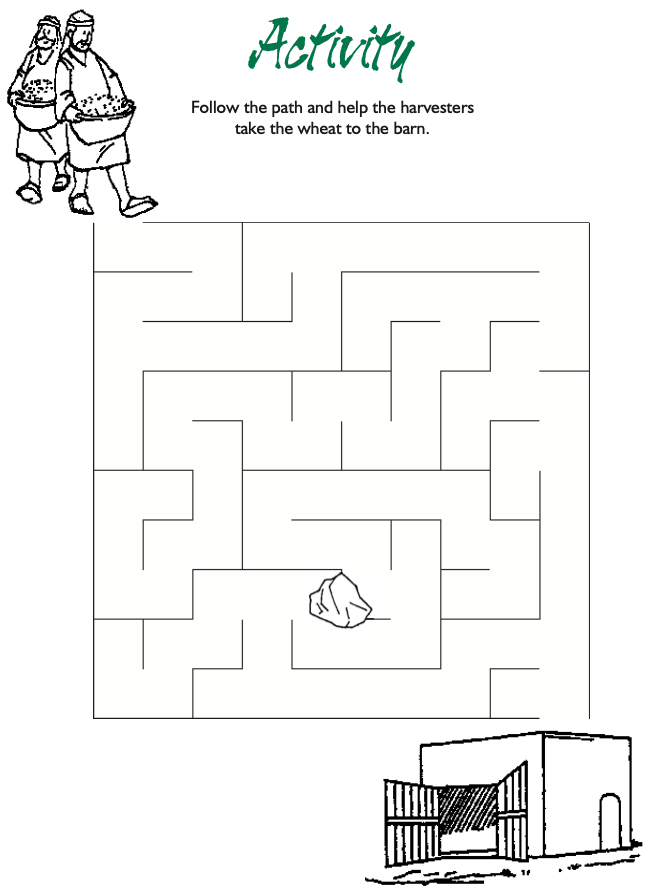
Once there was a very rich farmer. He had lots of land and many barns. His garden grew the best grain. His grape vines grew the biggest grapes. He had many workers helping him harvest his garden. Everything was finally picked. But the farmer didn’t have room to store it all.
What would the rich man do? He said, “I’ll tear down my old barns and build bigger, new ones.” Then he would have a place to store his har- vest. He had enough to last for years. He didn’t even think of sharing with his poor neighbor. He didn’t think about giving an offering to God. He wanted it all for himself. He said, “I will eat, drink, and have a good time!”
But, God had different plans. He said, “You won’t live to see your new barns built. You are going to die.” Things were important to the rich man. But, he wouldn’t need all his things when he died. They would all belong to someone else. God said, “Life is not made up of how much a person has.” What you are is more important than what you have.
God wants us to learn to give to Him and others. He wants us share. What could the rich man do with his harvest? Remember Chris who wanted more toys? How could he show he is thankful for what he has? What can you do to share with others?
Sometimes God has to teach us how to share with others. He may take away things we like very much. He wants us to learn what is really important. Pleasing God and helping others is better than being greedy.
Student Prayer
Dear Father, Thank you that Jesus taught the rich man why he should not be greedy. Help me learn to show I love you by giving and sharing with others. In Jesus’ name I pray. Amen.
Daily Devotions
Sunday - Proverbs 11:3-4
Monday - Proverbs 11:27-28
Tuesday - Mark 8:36
Wednesday - Matthew 6:19-21
Thursday - Matthew 19:23-24
Friday - Psalm 49:6-8
Saturday - 1 Timothy 6:17-19
Objectives
At the end of this lesson, students will be able to:
1. Define what it means to be greedy.
2. State the reason the rich man thought he needed bigger barns.
3. Give God’s reply to the rich man’s greediness.
4. Recite their memory verse.
Topics & Themes
Coveting
Gratitude
Greed
Jesus, His Ministry
Loving God
Obedience
Parable of Rich Fool
Sharing
Ten Commandments
Materials Needed
Bible, YEA students and teacher’s books, crayons, glue, scissors, butcher paper, magazine pictures, box with candy treats, gift wrap paper, songbook, CD/cassette tape, music player, attendance and memory verse charts, stars
Preparation
Preparation is a key factor in the behavior of your class. The less prepared you are, the more problems you will have. If the children in your class sense that they are not important enough to you for you to be prepared, they will attempt to gain your attention any way they can. This may include misbehavior. The answer isn’t discipline, it is discipleship. Ask pertinent questions as the children arrive, such as: How was your week at school? Do you have anything exciting planned for tomorrow? Tommy, I hear that you have a birthday coming
up. Are you going to have a party? How is that bruise on your knee, Billy? I hope it is better. Have you ever visited a farm? Have any of you ever lived on a farm? These last questions will lead into your opening activity. Letting the children know that you are interested in them personally will win their attention.
Before you come to class, tear pages from magazines that illustrate different aspects of farm life. These should include farm animals, vegetables and fruit, fruit trees, house, barn, fence, tractor, etc. Attach a sheet of butcher paper to the wall. The children will use these to create a farm mural.
For your activity you will need a box with enough candy treats for each child in your class to have one. Wrap the box in colorful gift wrapping paper.
How to Teach This Lesson
As an introduction to today’s lesson, have the children create a farm mural. They may cut out pictures from the magazine pages and glue them to the butcher paper. Some of the children may want to draw items to complete the mural, such as a pond for the ducks, a fence around the animals, a path to the house and barn or a scarecrow in the garden. Let them be creative. As they are busy, discuss what is necessary to have a successful farm. They must have rain, seeds have to be planted, weeds must be pulled, animals must be fed, etc. Encourage the children to think of as many things as they can.
Explain that the rich farmer in today’s lesson had many barns. He evidently had been successfully farming for a number of years. He knew the right things to do to ensure a plentiful harvest.
He was very proud that he was rich. He not only wanted to keep all of his money and things for himself, but he took all of the credit for having them. He did not thank God’s for giving him a successful harvest. His decision to tear down his old barns, and build bigger barns, showed his pride. He worked hard, was clever and thought no one could conquer or beat him. To reward himself, he told himself to “eat, drink and be merry” (Luke 12:19).
God looked down on this selfish, greedy man and saw something different. He saw the man as being rude, unthankful, not caring how others felt. God showed that He didn’t like it by telling the man he was about to lose it all. Everything that he had worked for, took pride in and gloried over was about to be taken from him. Then what would he have?
Explain that God is more interested in our obeying Him than in our money, more concerned with our person than the things we have.
Review Questions
1. Can you tell what it means to be greedy?
2. Why did the rich farmer think he needed to build bigger barns?
3. When the man told himself to eat, drink and be merry, what did God say?
4. Why do you think God told the man he would lose everything?
5. What is more important, what you have or what kind of person you are?
Teacher-Directed Activity
This activity will emphasize sharing and discourage greediness. Have all of the children sit in a circle. Give one of the children the package you have wrapped. Tell them that you are going to ask the child with the package a question. As long as he can truthfully answer “yes” to the questions, he can keep the package. As soon as he answers “no,” he must pass the package to the child next to him. The last child with the package before you run out of questions gets the prize.
You’ll need about three questions per child. Ask questions such as: Do you have brown eyes? Do you wear nail polish? Have you ever been to the fair? Can you wiggle your ears? Do you read your Bible everyday? Is today your birthday? Do you play baseball? Etc.
After a child answers one or two “yes” questions, ask him a definite “no” question so the package will be passed along. The last child holding the package gets to open it and share the treats with the class.
REACH Activity
Special Materials Needed:
Aluminum foil, old socks, yarn, newspaper, magazine
Activities:
1. Use a dictionary to find the meaning of the word “share.” Write the meaning in your Bible notebook. Use share, shared, and sharing in three different sentences. Write them in your Bible notebook. Share with family and friends.
2. Think of someone you know who has a hard time sharing. What will you say or do the next time they won’t share with you or others? Write it down in your Bible notebook. Share with family and friends.
3. Sometimes it is really hard to share what we have with others. Have you ever felt “greedy” about sharing your toys or other things? Why did you want to keep them all to yourself? What happened? How did you feel? Write your answers in your Bible notebook.
4. Think about sharing something with your little brother or sister. How does that make you feel? Do you want to share? Why or why not? Now think about God sharing His Son with us. And the way God shared Jesus was to send Him to die for us so that we could live with God in His Kingdom. God has given us everything. Is there anything so precious we shouldn’t be willing to share.
5. Make two lists in your Bible notebook of things that you own. One list is for things that you will share without a problem. The other list is for things that you would have a hard time sharing. Which list is the longest? Why? Write your answers in your Bible notebook. Share with family and friends.
6. Do you really need everything you have on both lists? How would you feel if you had to give them to a boy or girl who didn’t have anything? Talk it over with your family.
7. Go through your toys and clothes. If you have toys you don’t play with anymore, clean them up and give them to another child or to a Goodwill store. Pass along the clothes you’ve outgrown too.
8. Jesus said that life is not made up of what we have. Choose a possession that you really like; perhaps something on your list from activity five. Ask someone to put it away for one week. During the week the person should not give it back to you. Each day write how you feel about not having that “possession.” Do you agree with Jesus? Was your life very different without that possession? Share with family and friends how you felt. Challenge them to try this experiment.
9. What if the rich man had not been greedy? Draw a picture of the rich man sharing his harvest. Write the memory verse on your picture. Share with family and friends.
10. Talk with your family to find out if there is someone you could help. Helping others is a different way to share and not be greedy. Helping is sharing your time with someone instead of doing something you want to do, like watching television or playing video games. After you have helped someone, write about it in your Bible notebook.
11. Search a magazine or newspaper for the words in the memory verse. Cut them out and glue them on a large index card (any color). Put the memory verse card in a place where it can be seen each day. Practice until memorized.
12. Sing: A. “Give of Your Best to the Master” on page 147 of the CEM Hymnal. B. “This is My Commandment” on page 4 of Kids Classics Collection.
13. After reading all of this week’s Daily Devotionals, make a matching quiz for your parents. Put the verse on one side and the Scripture reference on the other side. See how many of them your parents can match correctly without using a Bible.
14. Make sock puppets to retell the story of the rich farmer.
More Information: Measure an old sock from the heel to the toe and make a large oval out of black construction paper to fit the area. Make a slightly smaller oval out of red construction paper for the inside of the mouth. Glue the two ovals together then glue them onto the sock. Sew yarn to the sock for hair. Use construction paper to make eyes. Use a permanent marker to make a nose.
15. Add sharing as this week’s hidden treasure to your treasure chest. Glue aluminum foil circles to the poster board.
16. Read Matthew 13:22 again. You read it last week when thinking about Mary and Martha. Read it this week and think about the rich farmer.
17. Sing: “Take My Life and Let It Be” on page 129 of the CEM Hymnal. Find out a little about the lady who wrote this song. Was she poor or rich? Share what you learn with your parents and friends.
Song
“Jesus Wants Me For a Sunbeam” is on page 21 of the Kids Classics Collection.
Closing Prayer
The teacher may lead in prayer, or ask one of the children to pray, thanking God for the story about the greedy farmer. Ask God to help you not be selfish, but to share what you have with others.
Printable Pages