YEA Lesson Library
The Golden Rule
About This Lesson
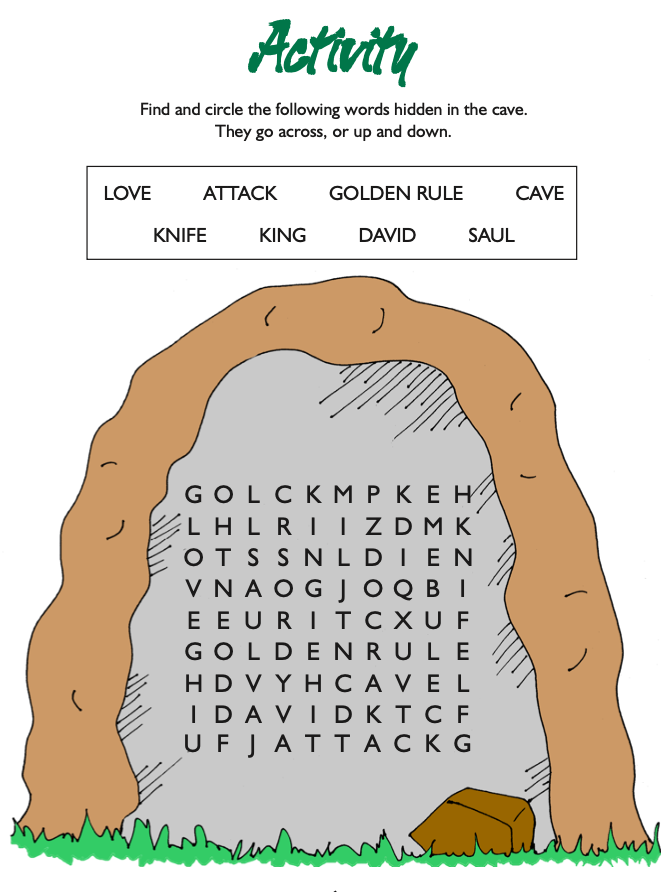
Using the episode when Saul was chasing David and David (and his men) were in the cave, this lesson teaches the Golden Rule.
Scriptures
Leviticus 19:17-18
1 Samuel 24:1-22
Proverbs 3:27
Proverbs 11:27
Matthew 7:12
Matthew 11:29
Luke 6:27-31
Luke 6:31
Acts 10:38
Galatians 6:2-3
Words to Know
SLING - a weapon with a pouch, from which rocks are thrown
ATTACK - to harm or hurt someone
The Lesson
Kathy didn’t like going to school. Some of the boys made fun of her. Kathy had bright red hair and freckles. The boys called her “carrots.” They said she looked like she had mud splattered on her face. This had been going on for days. It was very mean.
Kathy thought about ways she could “get even” with the boys. She thought of names she could call them. She might get her girlfriends to join her. They could gang up on the boys during recess. Maybe she would tell the teacher what the boys were doing. Today Kathy had to face them again. What should Kathy do? What does our memory verse say?
Our Bible story today is about David. He had a problem like Kathy’s. David had killed the giant, Goliath, with a stone and sling. But, now he was all grown up. David was in King Saul’s army. Saul was jealous because everyone liked David. Saul even tried to kill David.
Now what do you think David did? Did he try to get even with King Saul? Do you think he fought back? No! David did what the Bible says to do. He treated Saul the way he knew would be pleasing to God.
One night David and his men were in the back of a dark cave. They were hiding from King Saul. They knew Saul was very angry with David.
Saul and his army were hunting for David. They came to a cave. Saul went inside. He didn’t know David was hiding in that same cave! David’s men whispered, “Now is your chance. Go, get him!” But, David said no. Instead, he quietly crept up and cut off a piece of Saul’s robe with his knife.
Later David felt sorry for what he did. He knew God didn’t want him to hurt the king in any way. So, when Saul left the cave, David called out to him. Saul turned around and saw David. David bowed down to the king. David said, “Why do you listen when people say I want to hurt you?” David showed Saul the piece of his robe. David said, “I would never do anything to hurt you.” Why do you think David did that? He was being kind to Saul because David wanted to please God.
The Bible says not to try to get even when people are mean to you. God will punish people who treat us badly. David did the right thing. Our Friend, Jesus, wants us to love our enemies. He said we should do good to those who hate us. We should always treat others the way we want to be treated.
What should Kathy do? Will you do the right thing when people are mean to you?
Student Prayer
Dear Father, Thank you for giving me the ‘Golden Rule’ to live by. Help me to learn to treat other people the way I want them to treat me, and not to try to get even. I want to obey your commandment to love others. In Jesus’ name I pray. Amen.
Daily Devotions
Sunday - Matthew 11:29
Monday - Acts 10:38
Tuesday - Matthew 7:12
Wednesday - Proverbs 3:27
Thursday - Proverbs 11:27
Friday - Galatians 6:2-3
Saturday - Leviticus 19:17-18
Objectives
At the end of this lesson, students will be able to:
1. Tell why David was hiding in the cave.
2. Tell what David did to show Saul that he didn’t want to hurt him.
3. Explain why we should be kind to people who treat us badly.
4. Recite their memory verse.
Topics & Themes
David
Golden Rule
Loving God
Loving Others
Obedience
Saul
Materials Needed
Bible, YEA students and teacher’s books, memory verse and attendance charts, stars or stickers, pencils, marker pen, crayons or stickers, colored construction paper, metal brad-type paper fasteners, newsprint or blackboard and chalk, songbook, CD/cassette tape, music player
Preparation
This is the first lesson in this new book. You will need to have a chart to keep track of each child’s attendance and memory verse recitation. These can either be made or purchased at your local Christian bookstore or teacher’s supply store. Be sure to place the charts low enough for the children to reach. Each week they attend class and successfully recite their verse, allow them to place a star or sticker on their chart. When you complete this book, a small award can be given to those students with perfect attendance and who have recited all ten memory verses.
Because children learn in diverse ways, the lessons in this book are filled with variety to appeal to kids’ many learning styles. When you, as a teacher, are full of excitement and understanding of the lesson, your students will be eager to learn. Begin by reading the lesson over in both the student’s and teacher’s books early in the week. Meditate on scriptures, and ask God to direct you to creative ways to reinforce the objectives.
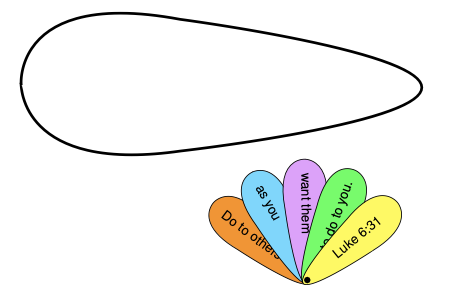
Before you come to class, enlarge the elliptical pattern to about seven inches in length. Make enough copies of the shape on colored construction paper so that each child will have five shapes. On a sheet of newsprint, or a blackboard, write out today’s memory verse. Divide the verse as follows: Luke 6: 31 – “Do to others – as you – want them – to do to you.”
How to Teach This Lesson
Introduce this lesson by asking the children to think of some places where there are rules. Stimulate them to think of rules they must follow at school, like: no running in the halls, no talking without raising your hand, walk in single file, etc. Next, ask them to discuss the rules of driving: you must stop at a stop sign, drive on the right side of the road, don’t speed, etc. Ask the children if they have any special rules in their home, like not sitting too close to the TV, not opening the door for strangers, always wash your hands before you eat, etc.
Explain to the children that rules are made for our protection or for our good. If we disobey the rules, we may be in danger or may get hurt. Examples: Failing to stop at a stop sign may cause an accident. If you run in the halls of your school, you may knock someone down and hurt them. You should not talk to strangers or let them into your house, because you don’t know what they may do to you. Washing your hands before you eat helps to get rid of germs.
Next, explain why we call this lesson and verse the “Golden Rule.” Things made of gold are usually very valuable. If your mother has a gold ring, she takes care of it. Because it is important to her, she probably keeps it in a jewelry box. Luke 6:31 is such an important and valuable verse that it is called “golden.” This rule is also for your protection and good. If everyone obeyed it, there would be no fighting, no wars, no stealing, no murders, no one would lie about his neighbor, etc. Likewise, when this rule is disobeyed, we put ourselves, and others, in danger.
Emphasize the fact that David had an opportunity to get even with King Saul for the way Saul was treating him. But, David chose to respond the way he knew God would want him to. Treating others the way that you want to be treated is for your good and protection – plus it pays dividends. David could have been badly hurt or even killed if he tried to take vengeance on Saul. But instead, he was loved and respected by the people because of his character. And, he was rewarded by God when he was crowned King of Judah and later King of Israel.
Review Questions
1. When someone is treated badly, what do most people want to do?
2. Why was Saul trying to kill David?
3. How did David respond when he found Saul in the cave?
4. Why do you think David did not try to get even with Saul?
5. Why do we call Luke 6:31 the “Golden Rule?”
6. What can happen if we don’t obey rules?
Teacher-Directed Activity
To make this memory verse fan, have each child cut out five of the elliptical shapes from colored construction paper. Next, have them copy the words of their memory verse on the shapes, dividing the verse as directed (You may have to help the younger children). Now place the shapes in order to form the memory verse, with the reference on top. Fasten the elliptical shapes together with a metal brad-type paper fastener at the narrow end of the ellipse. The children may want to add a decorative design to their fan with crayons, markers or stickers.
REACH Activity
Special Materials Needed: Poster board, gold glitter, yardstick, gold spray paint, paint pen
Activities:
1. On a poster board draw an open treasure chest. Inside the chest, draw all sorts of treasures (precious jewels, gold coins, strings of pearls, etc.). Paint with tempera paint. Once it is dry, use a permanent marker to write what hidden treasure is found in YEA lesson one: The Golden Rule. Each week you will add a treasure from each lesson to this poster until the YEA book is finished. Hang the poster somewhere easily assessable for the next ten weeks.
2. Role play the story of Saul and David found in 1 Samuel 24:1-22. Assign parts and gather props. (Substitute plastic scissors for the knife.) Find music to play in the background. Invite family and friends.
3. Write in your Bible notebook how Saul must have felt when he found out how easily David could have killed him.
4. Role play what David might say to his brothers the next day about King Saul and what happened in and out of the cave.
5. Make a list of people who have done unkind things to you. What should you do for each of these people? Why? How can you treat them nicely even though they’ve treated you badly?
6. Sing: A.“Jesus Bids Us Shine”on page 37 of Kids Classics Collection. B. “This is My Commandment” on page 4 of Kids Classics Collection. C. “Love, Love” on page 91 of Kids Classics Collection.
7. Sing: “Let Others See Jesus in You”is on page 178 of the CEM Hymnal. After you sing, talk about how this song relates to the YEA lesson.
8. Read 1 John 3:18. Write in your Bible notebook how this Scripture relates to the YEA lesson.
9. Write your memory verse in glue on a piece of 11x17 paper. Then sprinkle gold glitter over the glue. Hang it on the refrigerator when it dries. Or use the following materials for the memory verse: yard- stick, gold paint or spray paint, paint pen (any color that will show up on the gold). Paint the yardstick with gold paint. Let it dry. Write the memory verse on one side with the paint pen. Let it dry. On the other side write “The Golden Rule.” Let it dry. Display it at home or church. Practice reciting the verse until it is memorized.
10. Do a sword drill with this week’s Daily Devotionals.
More Information: Use the Daily Devotional Scriptures to have a sword drill. Read the Scripture reference to the child. Then start the timer. When the child has found the verse, stop the timer. Read the verse and talk about how it relates to the lesson. Challenge the child to see how quickly he/she can find each of the verses in the Bible.
11. Find the meaning of the word “jealous.” Write the meaning in your Bible notebook. Could you ever be jealous of someone? Why or why not? Write your answer in your Bible notebook.
12. Make a list in your Bible notebook of at least five ways you can love your enemies, or anyone you don’t especially like. Say a prayer for your enemies and ask God to help you love them more.
13. Use a Bible, concordance, and encyclopedia to find out more about David. Write at least five interesting facts about David in your Bible notebook. Share this with family and friends.
Song
“This is My Commandment” is on page 4 of Kids Classics Collection.
Closing Prayer
Ask one of the students if they would like to lead in prayer, asking God to help them remember to keep the Golden Rule instead of getting even.
Printable Pages